


Adenandra fragrans
Introduction
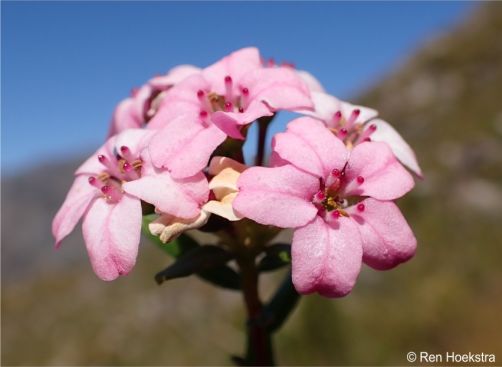
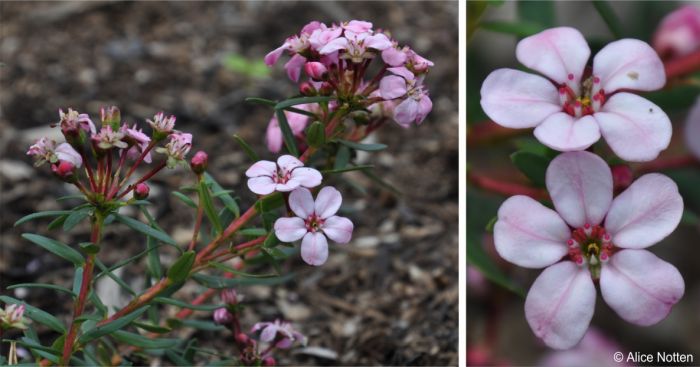
Adenandra fragrans is an aromatic shrublet with pink to white flowers in spring. This species is known to have a very strong but pleasant smell and it is a lovely addition to any garden.
Description
Description
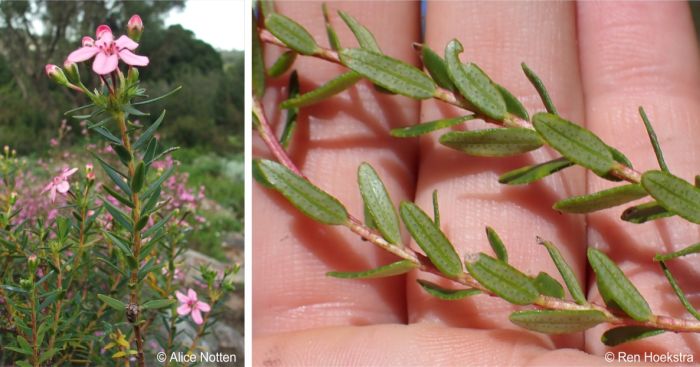
An erect somewhat branched shrublet, that can reach about 1 m high. Young branches are glabrous and pale-brown, and as they get older they lose their leaves and as the branches mature, they are left with leaf scars that form a regular pattern and become dark ash-grey. Leaves are made up of the petiole and the blade, the petiole is yellowish and appressed, blade is oblong to narrowly oblong, margins slightly revolute, entire to glandular-crenulate, upper surface dull green and smooth, lower surface pale green and with either conspicuous or inconspicuous glandular dots.
Inflorescence a 4-18 flowered umbel. Bracts lanceolate, different from the upper leaves. Bracteoles attached at or below the middle of the pedicel. Calyx brownish-green, glabrous. Petals white inside and pinkish outside with conspicuous veins, often glandular-punctate in central part, hairless. Mature capsule about as long as the calyx, slightly transversely rugose and usually papillate in the upper part, greenish brown. Seeds narrowly ovoid. Flowering period is mainly in spring to early summer, between September and November.
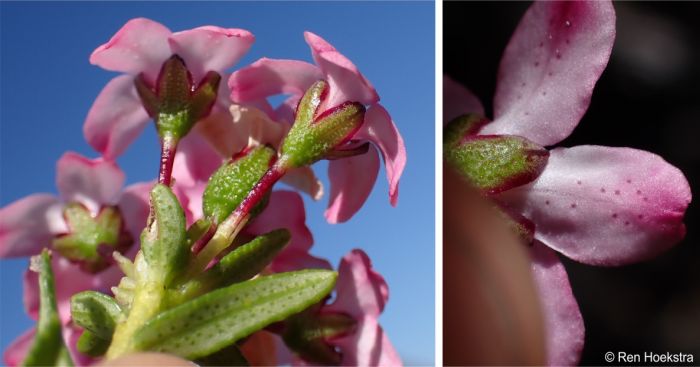
Adenandra fragrans is a distinct species but is most closely related to A. mundiifolia. It differs in that A. mundiifolia has smaller, sparser leaves that are dark green (dull green in A. fragrans), spreading (erecto-patent in A. fragrans), glands are almost absent or only present on the upper surface (present throughout leaves in A. fragrans), and few-flowered umbels (2-6 in A. mundiifolia, 4-18 in A. fragrans).
Conservation Status
Status
Adenandra fragrans is assessed as Least Concern (LC) by the Red List of South African Plants.
Distribution and habitat
Distribution description
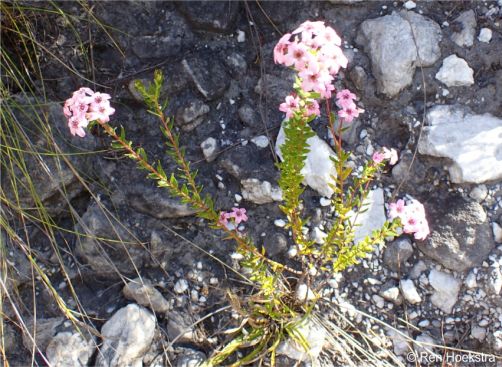
Adenandra fragrans is only found on the Langeberg mountain range in the Western Cape, where it grows on sandstone slopes, in fynbos.
Derivation of name and historical aspects
History
The genus Adenandra consists of 18 species that are endemic to the Western Cape. The name is derived from two Greek words, aden meaning ‘gland’ and andros meaning ‘male’ and here referring to a stamen, so Adenandra is referring to the stamens that have stipitate glands on the tips. The epithet fragrans is a Latin word meaning ‘sweet smelling’ which could be referring to the scent of the oils in the leaves.
Ecology
Ecology
As are other Adenandra species, Adenandra fragrans is pollinated by insects and protandrous, meaning the male reproductive traits are ripe before the female reproductive traits. This strategy prevents self-fertilisation and promotes cross-fertilisation.
Uses
Use
Adenandra fragrans has in the past been used medicinally as tea and in brandy infusions, but this is not practiced anymore and it is currently only used as a garden plant.
Growing Adenandra fragrans
Grow
Similar to that of other species in the Rutaceae family, Adenandra fragrans can be propagated by seed or by cuttings. For propagation by seed, first prepare a well-drained soil made of a mixture of sand, loam and compost in equal proportions. Place the mixture in deep trays with enough holes for drainage. Level the soil and water. Sow the seeds in autumn, sow in the trays and cover with about 3 mm of soil. A smoke treatment can be used to improve germination. Place the trays in an area with good air circulation and light. Make sure the trays remain damp. Seeds will take up to two months to germinate.
For propagation by cuttings, make sure the cutting is at least 50 mm long and taken from the current year’s growth. The best time to take a cutting is between six to nine weeks after the plant has flowered. When cutting the plant, make sure to make a clean cut below a node and remove most of the leaves on the bottom half of the cutting. The cutting can then be dipped in a rooting hormone. The cutting must then be placed in trays in a mixture of bark and polystyrene in equal proportions. The trays must then be placed in a misting unit or enclosed in transparent plastic to create a terrarium to increase humidity. Make sure the plastic does not touch the leaves and make sure that the mixture is always damp. Rooting will occur in up to 11 weeks. Rooted cuttings can then be placed in bags with a potting mixture of well-drained humus-rich fynbos soil. After three weeks the plants can be placed in the sun. Plants can be planted in the garden after seven to eight months.
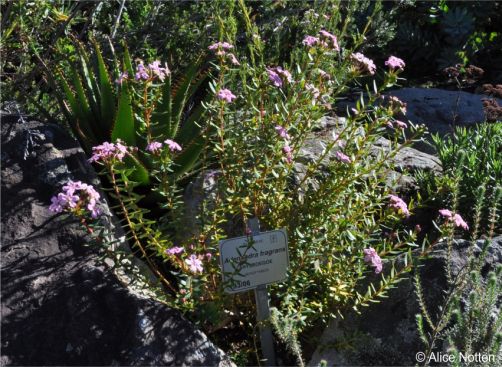
Adenandra fragrans is best suited to fynbos gardens and can be planted in beds and rock garden pockets, in slightly acidic, well-drained soil enriched with compost, in full sun. For best effect they should be planted in groups of three or five with spacing of at least 200 mm between each plant. Planting them in groups also helps retain soil moisture. Mulching should take place one a year to help to suppress weeds, reduce water loss and keep the temperature of the soil low. They should be watered moderately. Light pruning of the branches can be done after flowering to maintain a compact growth and prevent the plant from becoming too woody.
Adenandra fragrans possibly has similar pests and diseases as other species in the Rutaceae family such as the citrus caterpillar, that can be controlled with pesticides. The fungus Phytophthora cinnamomii can be controlled by treating young plants with acylalanine and reducing the temperature of the soil by using mulch.
References
- Brown, N.A.C. & Duncan, G.D. 2006. Grow fynbos plants. Kirstenbosch Gardening Series. South African National Biodiversity Institute, Cape Town.
- Hoekstra, R. 2023-Sep. Observation of Adenandra fragrans, Garcia’s Pass, WC. iNnaturalist. Online. https://www.inaturalist.org/observations/184890553.
- Manning, J. & Goldblatt, P. 2012. Plants of the Greater Cape Floristic Region 1: the Core Cape Flora. Strelitzia 29. South African National Biodiversity Institute, Pretoria.
- Raimondo, D., Von Staden, L., Foden, W., Victor, J.E., Helme, N.A., Turner, R.C., Kamundi, D.A. & Manyama, P.A. (eds) 2009. Red list of South African plants. Strelitzia 25. South African National Biodiversity Institute, Pretoria.
- Smith, C.A. 1966. Common names of South African plants. Memoirs of the Botanical Survey of South Africa No. 35. Government Printer, Pretoria.
- Strid, A. 1972. Revision of the genus Adenandra (Rutaceae). Opera Botanica 32:1-112.
Credits
Aarifah Jakoet
Compton Herbarium
August 2026
Acknowledgements: the author thanks Ren Hoekstra for allowing the use of his images of Adenandra fragrans in habitat, and Alice Notten for images of it growing in Kirstenbosch National Botanical Garden.
Plant Attributes:
Plant Type: Shrub
SA Distribution: Western Cape
Soil type: Sandy, Loam
Flowering season: Spring, Early Summer
PH: Acid
Flower colour: White, Pink
Aspect: Full Sun
Gardening skill: Challenging
Special Features:
 Fragrant
 Medical plant
Horticultural zones



Rate this article
Article well written and informative
Rate this plant
Is this an interesting plant?
Login to add your Comment
Back to topNot registered yet? Click here to register.