


Agapanthus pondoensis
Introduction
Agapanthus pondoensis is a recently described species in the genus Agapanthus, found in the beautiful landscapes of Gwexintaba village near Magwa Falls in Lusikisiki.
Description
Description
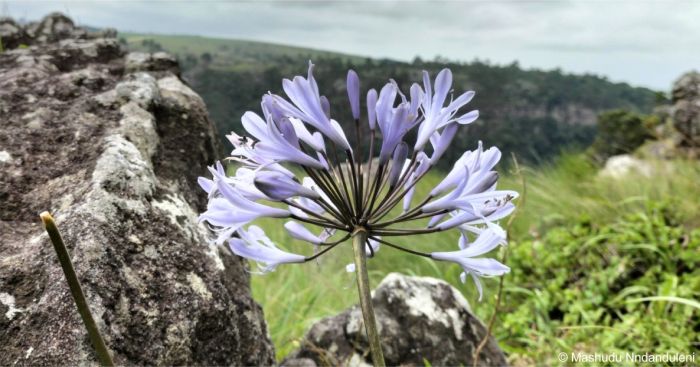
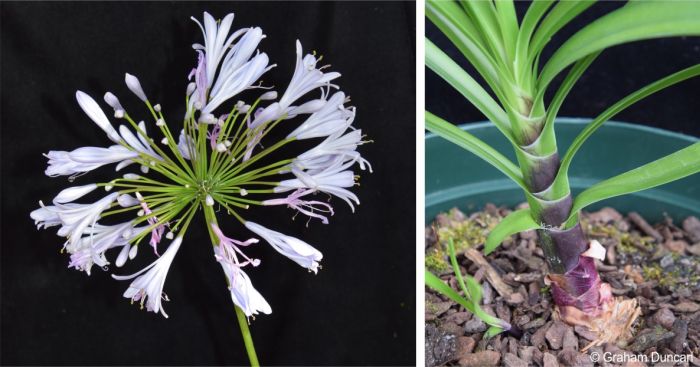
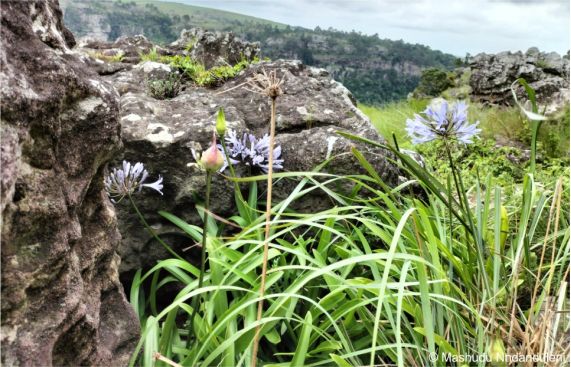
Agapanthus pondoensis, like all Agapanthus species, is a summer flowering perennial. A. pondoensis is deciduous, with a flowering period starting from early December to mid-January, sometimes extending to February, peaking in mid-summer. It has a dormant period, from late autumn up until mid-winter (late May to mid-July). Plants are clump-forming, 600–850 mm tall in flower. The leaves are broadly linear, bright green, with acute or subacute apices and 8–12 per shoot, produced in arching to almost erect fans. It has narrowly funnel-shaped flowers, light blue tepals with deeper blue margins, which are borne on purple or green pedicels in a nearly globose flower head, 160–200 mm in diameter, of 15 to 30 flowers.
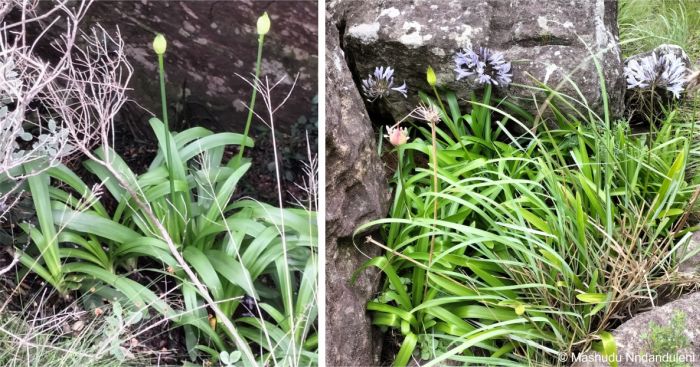
The flower heads are held by a green or purple stalk that develops from a pseudostem and underground rhizome. The pseudostem of A. pondoensis is 700–110 mm x 15–20 mm, flushed with deep purple and bulbous at the base, and has 2–3 basal sheathing leaves. This basal pseudostem and its purple colouration clearly distinguishes A. pondoensis from A. praecox.
Conservation Status
Status
Agapanthus pondoensis has not yet been listed or assessed by the Red List of South African Plants or the IUCN Red List of Threatened Species. It is restricted to three localities in Pondoland, making it a species of conservation concern. Duncan considers it to be rare but not threatened.
Distribution and habitat
Distribution description
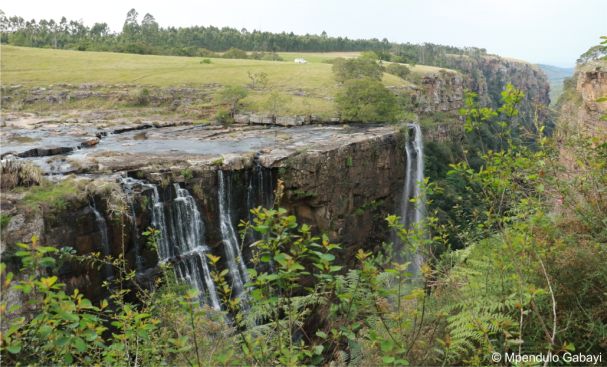
Agapanthus pondoensis is endemic to the Eastern Cape in South Africa. It occurs from the northern Eastern Cape in Pondoland, in Lusikisiki, on the rocky cliffs of Magwa Falls, Angel Falls and Fraser Falls, to the south-east of Lusikisiki in the Pondoland-Ugu Sandstone Coastal Sourveld, in the Pondoland Centre of Endemism. In Lusikisiki, A. pondoensis grows among sandstone boulders and in rocky river gorges. At Fraser Falls, it grows among grass tussocks, low scrub and small shrubs. At Angel Falls, it grows on the southeast side of the sheer, shaded, west-facing rock face behind the waterfall. Leaves die back in late autumn (May) and new shoots emerge in mid-winter (early to mid-July), grow until early summer and flowering occurs in mid-summer.
Derivation of name and historical aspects
History
The genus Agapanthus was first described in 1789 by Charles Louis L’Héritier de Brutelle, who initially placed it in the family Liliaceae. This early classification followed the broad concept of lilies that was common at the time. During the late 20th century, advances in comparative morphology and later in molecular systematics, showed that Agapanthus differs significantly from true lilies. Taxonomists highlighted key characteristics, such as the presence of an inferior ovary, umbel-like inflorescences and thick rhizomatous roots. Based on these findings, Agapanthus was removed from Liliaceae and temporarily placed in Alliaceae. Subsequent phylogenetic studies using DNA evidence demonstrated that Agapanthus forms a distinct evolutionary lineage within the order Asparagales. As a result, the genus was placed in its own family, Agapanthaceae, a classification that is now widely accepted.
In 1953, botanist Frances M. Leighton explored the wild areas of Pondoland in the Eastern Cape, where she discovered and collected Agapanthus pondoensis. At the time, she believed it was a form of Agapanthus praecox and therefore nothing new. This assumption was likely made because the plant appeared very similar at first glance, with blue flowers and a comparable overall shape. Subtle differences in flower form or growth habit were easy to overlook. It was only decades later, through careful observation and comparison in the wild, that horticulturists realised this Pondoland agapanthus was in fact a distinct species. Almost fifty years later, in 2002, Liesl van der Walt, a horticulturist at Kirstenbosch at the time, collected the same plant near Magwa Falls but its identity was still unresolved. The plant’s true status was finally clarified when Mpendulo Gabayi and Mashudu Nndanduleni, horticulturists from Kirstenbosch, encountered the agapanthus in full flower while exploring Magwa Gorge near Lusikisiki in 2017. They brought the plant to Dr. Graham Duncan, a bulb specialist at Kirstenbosch, for identification. After visiting the site the following year and collecting additional specimens himself, he confirmed that the plant was a completely new species, distinct from Agapanthus praecox, as Frances Leighton had originally suggested. He formally named the species Agapanthus pondoensis F.M.Leight. ex G.D.Duncan, honouring Frances Leighton, who had first discovered it more than 60 years earlier.
Ecology
Ecology
There are no recorded ecological interactions or known pollinators for Agapanthus pondoensis. However, it is likely to behave in a similar way to other Agapanthus species. Its flowers may attract insects such as bees and butterflies because of their bright colour and nectar. After pollination, the flowers form dry capsules with light, winged seeds that can be easily carried by wind and water. Like other species in the genus, it may also provide food and shelter for insects and small birds. These possible roles are based on what is known from related species and have not yet been studied or confirmed for A. pondoensis.
Uses
Use
There are no recorded medicinal or traditional uses for A. pondoensis by people. Other Agapanthus species in the Eastern Cape have been used traditionally to treat coughs, chest ailments and during pregnancy, usually with roots or leaves. Some species are also used in cultural rituals for protection, fertility or good luck. These uses have not been documented specifically for A. pondoensis.
Agapanthus plants are also valued for their ornamental qualities. Their large, showy flowers and strong leaves make them popular in gardens, parks and pots, where they are planted as ground cover or in groups. They are easy to grow, tolerate dry conditions and attract pollinators such as bees and butterflies. While these horticultural uses are known for other species in the genus, they are yet to be tested for A. pondoensis.
Growing Agapanthus pondoensis
Grow
Like many of its relatives, Agapanthus pondoensis is a tough, adaptable plant shaped by its natural habitat. In the wild, it clings to cliffs and rocky outcrops along the Pondoland gorges, thriving in exposed, sun-drenched conditions where many other plants would struggle. This resilience, combined with its striking flowers, makes it an exciting prospect for gardeners seeking bold seasonal colour.
Although the Pondoland agapanthus is still new to cultivation and not yet widely available in gardens, its vigorous growth habit suggests it will perform beautifully in medium to large landscapes. Plant it in full sun to partial shade in well-drained, compost-enriched loam soil. When spacing plants, allow between 50 cm and 1 m apart to give each clump room to develop. Once established, it should prove both hardy and rewarding.
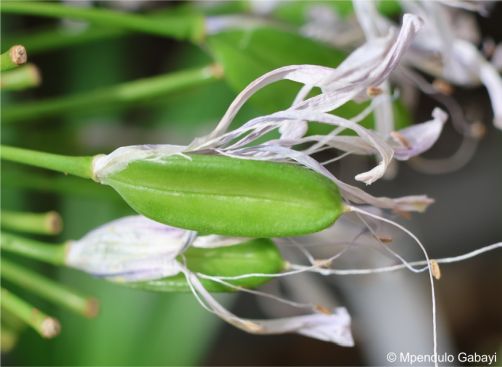
Agapanthus pondoensis produces dry capsule fruits filled with black, flattened seeds. As the genus hybridises easily with other Agapanthus in gardens, seedlings may not always be identical to the parent plant, but seed propagation is still a simple satisfying way to groe these new plants. The seeds need to be collected in mid to late summer once the capsules have dried, placing them in a brown paper bag to allow the seeds to be released. For best results, the seeds should be sown immediately after harvesting, as their viability declines quickly. A well-drained, porous growing medium should be used, such as a mix of buffered coir, peat moss, and perlite (2:1:1). A seed tray should be filled with the mixture, the surface levelled without compacting it and gently moistened with a fine spray before sowing. The seeds should be separated from the dry husks by shaking the bag and sifting them clean, then scattered evenly over the surface and lightly covered with a thin layer of the mix. The tray should be kept at 18–21°C in a well-ventilated area, where germination should occur within three to eight weeks.
Once the seedlings have sprouted, carefully prick them out using a dibber or a thin hand trowel. Transfer each seedling into a small pot or a potting bag filled with a well-draining soil mix made of sifted fine bark, sand, and compost in a 3:1:1 ratio. To encourage strong root development, apply an organic fertilizer around the base of the root crown. To minimize transplant shock, consider using a seedling-friendly liquid fertilizer, such as a seaweed extract, and keep the seedlings in a cool, humid environment. Water them consistently, starting with once every day or every other day and gradually reduce to once a week as the plants become established. This careful balance of nutrients, moisture and environment will help your seedlings grow healthy and strong.
Among the many pests that can affect Agapanthus species, such as scale insects, spider mites, thrips, mealybugs, and snails, the most destructive is the Agapanthus Borer (Neuranethes spodopterodes). This moth’s larvae are highly specialised feeders, they tunnel down the flower stalk into the rhizome, disrupting the plant’s vascular system and often leading to crown rot. If left untreated, even a single infestation can severely weaken or kill the plant. Early detection is critical. Regularly inspect your plants and remove larvae by hand while they are still near the flower buds or upper stalk. The optimal window for intervention is late spring to early summer, when flower buds are forming and larvae have not yet burrowed deep into the rhizomes. For more extensive infestations, contact insecticides containing pyrethroids can be effective against young larvae. Additionally, isolating heavily infested plants helps prevent the pest from spreading to nearby healthy specimens. By combining careful observation with timely action, gardeners can protect their agapanthus and ensure robust, healthy blooms year after year.
References
- Brickell, C. 2019. RHS A–Z Encyclopedia of Garden Plants. 4th edn. Dorling Kindersley, London.
- Dahlgren, R.M.T., Clifford, H.T. & Yeo, P.F. 1985. The families of the monocotyledons: structure, evolution and taxonomy. Springer-Verlag, Berlin.
- Duncan, G. 2021. The Genus Agapanthus. Royal Botanic Gardens, Kew, Richmond.
- George, E.F., Hall, M.A. & De Klerk, G.J. 2008. Plant propagation by tissue culture. 3rd edn. Springer, Dordrecht.
- Goldblatt, P. 1990. Phylogeny and classification of the Iridaceae and related families. Annals of the Missouri Botanical Garden 77(3):607–627.
- Hutchings, A., Scott, A.H., Lewis, G. & Cunningham, A.B. 1996. Zulu medicinal plants: an inventory. University of Natal Press, Pietermaritzburg.
- Manning, J., Goldblatt, P. & Snijman, D. 2002. The color encyclopedia of Cape bulbs. Timber Press, Cambridge.
- Snijman, D.A. 2012. Agapanthus. In J. Manning & P. Goldblatt, Plants of the greater Cape Floristic Region 1: The Core Cape Flora. Strelitzia 29. South African National Biodiversity Institute, Pretoria.
- Snoeijer, W. 2004. Agapanthus: a revision of the genus. Timber Press, in association with the Royal Boskoop Horticultural Society, Portland and Cambridge.
- Van Wilgen, B.W. 2022. A new revision of Agapanthus. South African Journal of Science 118.
Credits
Athi Sigcau, Mpendulo Gabayi & Sibulele Jokazi
Kirstenbosch National Botanical Garden
March 2026
Acknowledgements: images by Graham Duncan, Mashudu Nndanduleni and Mpendulo Gabayi.
Plant Attributes:
Plant Type: Bulb
SA Distribution: Eastern Cape
Soil type: Sandy, Loam
Flowering season: Early Summer, Late Summer
PH: Acid, Neutral
Flower colour: Blue
Aspect: Full Sun
Gardening skill: Average
Special Features:
 Good potplant
 Medical plant
 Feeds honeybees
Horticultural zones


Rate this article
Article well written and informative
Rate this plant
Is this an interesting plant?
Login to add your Comment
Back to topNot registered yet? Click here to register.