


Albuca setosa
Introduction
Albuca setosa commonly known as thick slime-lily, is a member of the Asparagus family, and endemic to southern Africa. It is a deciduous perennial geophyte with strap-like leaves during active growth, and white, yellow and green flowers in spring and early summer.
Description
Description
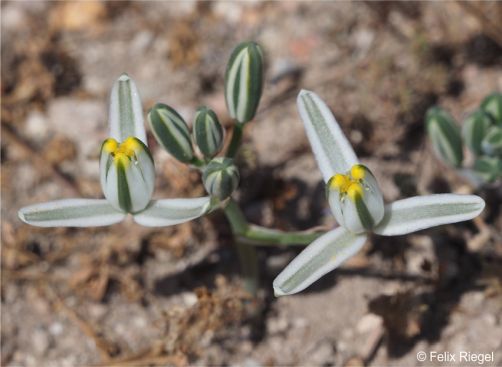
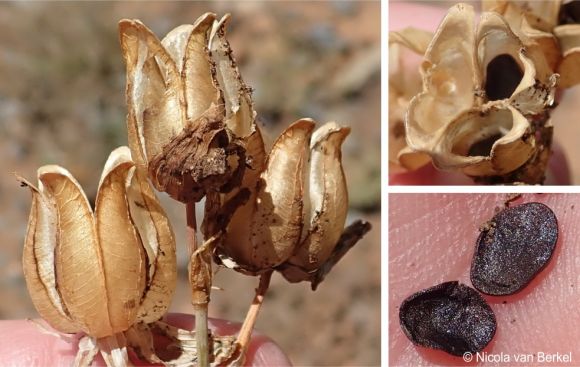
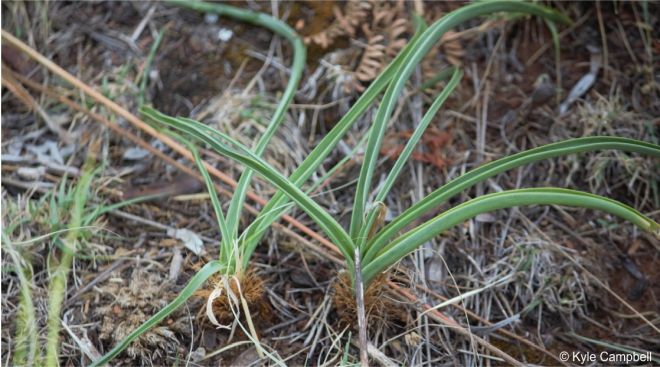
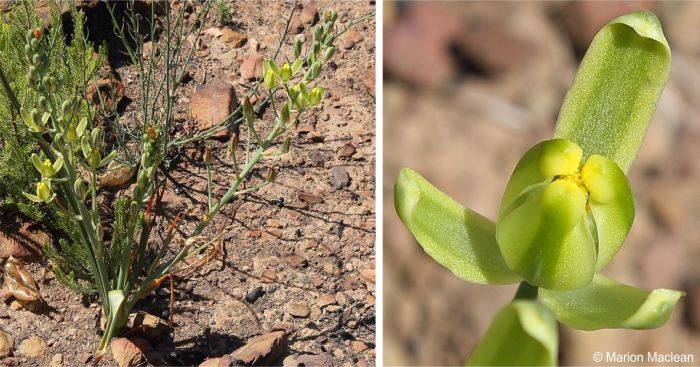
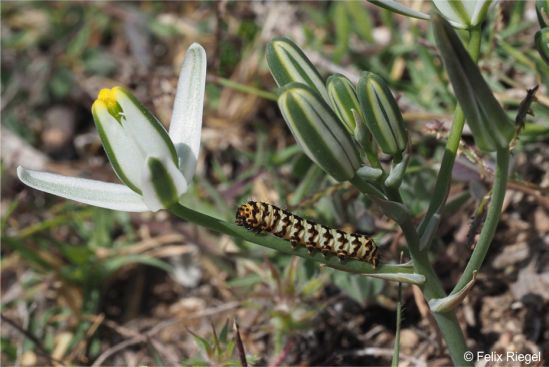
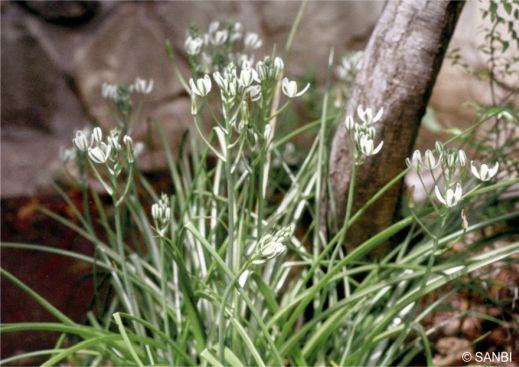
A deciduous perennial geophyte that grows 150-600 mm tall. The bulb is large, globose, with coarse brown hair-like fibres at the top of the bulb. The leaves are dark green, strap-shaped, broader at the base, slightly fleshy, drying up in dry weather and often produced after the flowering period. Flowering occurs in spring to early summer (August to January in the southern hemisphere). The flowers are erect, in a flat-topped cluster on a long peduncle. They are white or yellow, with a thick green to brownish stripe in the middle of the tepals. The tips of inner tepals are usually yellow and meet and stay tightly together to form a tube while the outer tepals open widely. The flowers produce nectar that attracts bees. After flowering, the plant produces fruits in the form of capsules that open to release small black seeds when dry and mature.
Conservation Status
Status
This species is assessed by the Red List of South African plants as Least Concern (LC), because it is widespread and common, occurring in all provinces of South Africa. It has been recorded to be sold in traditional medicine markets in Gauteng, KwaZulu-Natal and Eastern Cape, which may cause a decline in the wild population in the near future, if the number of plants being harvested increases.
Distribution and habitat
Distribution description
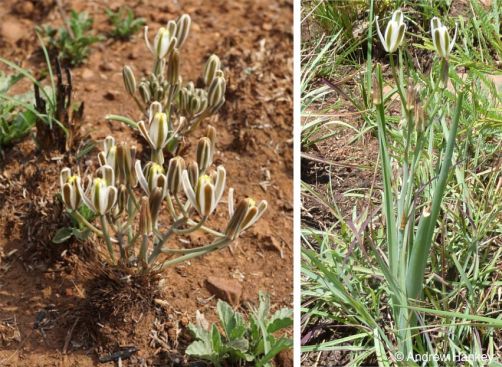
Albuca setosa is native and endemic to southern Africa, and can be found in Lesotho, Botswana, Mozambique, Zimbabwe, Namibia and South Africa. In South Africa it occurs in all provinces, mainly in the summer-rainfall region, from the semi-arid zones of Namaqualand and the Mediterranean climate region of the Northern and Western Cape, through the Karoo to the Eastern Cape, Free State, KwaZulu-Natal, Mpumalanga and Limpopo. This bulbous plant can adapt to variety of habitats, including dry shrubland, open woodland and grassland, and it grows on mountain slopes, flats, in sandy, well drained, nutrient-poor, shallow and rocky soils. Albuca setosa can tolerate drought and is often found in an open exposed position.
Derivation of name and historical aspects
History
The genus Albuca currently has 167 accepted species, native to Africa, Madagascar and the Arabian Peninsula, and is from the large diverse family of Asparagaceae, but was previously placed in the Hyacinthaceae family. The genus name Albuca was derived from the Latin word albus, meaning ‘white’, which describes the pale white flowers in most of Albuca species. The species name setosa is also from Latin, the word setosus meaning ‘hairy or bristly’, which describes the characteristic brown fibres around the base of the plant. This species was first described by Nikolaus Joseph von Jacquin (Jacq.) in 1795. Synonyms for Albuca setosa are Albuca pachychlamys Baker and Ornithogalum setosum (Jacq.) J.C.Manning & Goldblatt. The name pachychlamys means ‘thick cloak’, referring to the fibrous covering of the bulbs.
Ecology
Ecology
The flowers of Albuca setosa attract certain bees such as leafcutter and solitary bees during the flowering season for pollination. The flowers exhibit an unusual pollination mechanism, where the inner tepals have become a secondary stigma. The bees push their way between the tightly closed inner tepals to reach the nectar at the base of the flower, brushing against the tips of the inner tepals and the anthers as they do so, and pollen is deposited on their backs. When they visit another flower, the pollen deposited by the first flower is scraped off by the tip of the inner tepal of the second flower as they push their way in. The pollen germinates on the tip of the inner tepal and the pollen tubes grow into the style when the flower wilts.
It is a deciduous plant that is adapted to a summer-rainfall climate with a dry winter season, whereby the leaves wither in autumn or when the rains cease, to reduce water loss, and they store their resources in the bulb while they lie dormant during dry season. The bulb also allows the plants to survive fires and frost.
The seeds are dispersed by wind and gravity, where seeds are shaken out of the dry capsules and fall close to the mother plant.
Uses
Use
Albuca setosa is used in traditional medicine and sold in muthi markets in southern Africa. The bulb is used in traditional remedies to treat wounds, inflammatory conditions, digestive problems, venereal diseases and to manage diabetes. It is also used culturally for ritual cleansing and as a protective charm against lightning. Pharmacological studies report that extracts of A. setosa show anti-inflammatory, antioxidant and anti-ulcerogenic activity, however it has not been clinically tested for safe use. The plant is cultivated as an ornamental bulb in rocky gardens.
Growing Albuca setosa
Grow
The plant is easily propagated through seeds and by division of bulbs to remove offsets from the mother plant. Sow fresh seeds in spring or early summer, in a well-drained soil, and in warm, bright conditions to encourage germination. Bulbs can be lifted and divided during dormancy and re planted in a free draining, sandy soil mixture, and placed in full sun or semi-shade with morning sun. This bulbous plant is tolerant of drought and frost. Bulbs can be lightly watered during active growing, and take care to avoid overwatering and waterlogging which will cause the bulbs to rot. Reduce watering towards the end of the growing season and keep the bulbs cool and dry during the dormant season as fungal rot is a common problem. Caterpillars and lily borers are the most observed pests attacking the leaves, during the growing season.
References
- Campbell, K. 2023-Nov. Observation of Albuca setosa, Carletonville. iNaturalist. Online. https://www.inaturalist.org/observations/190696852.
- Dictionary of botanical epithets. http://www.winternet.com/~chuckg/dictionary.html
- Hankey, A.2025. Observations of Albuca setosa. iNaturalist. Online. www.inaturalist.org/observations?taxon_id=119911&user_id=andrew_hankey.
- Hyde, M.A., Wursten, B.T., Ballings, P. & Coates Palgrave, M. 2025. Albuca setosa Jacq. Flora of Mozambique. Online. https://www.mozambiqueflora.com/speciesdata/species.php?species_id=114220 Accessed 7/11/2025.
- International Plant Names Index (IPNI). Albuca setosa Jacq. https://www.ipni.org/n/527457-1. Accessed 7/11/2025.
- Johnson, S.D., Jurgens, A. & Kuhlmann, M. 2012. Pollination function transferred: modified tepals of Albuca (Hyacinthaceae) serve as secondary stigmas. Annals of Botany 110(3):565-572.
- Maclean, M. 2018. Observation of Albuca setosa, The Keisie, Western Cape. iNaturalist. Online. https://www.inaturalist.org/observations/36702257.
- Musara, C. Mudyiwa, S.M. & Maroyi, A. 2019. Pharmacological potential, botany, biological and chemical properties of Albuca setosa (Asparagaceae) endemic to southern Africa. Journal of Pharmacy & Nutrition Sciences 9(3):195-199.
- Ndebia, E.J. Umapathy, E., Nkeh-Chungag, B.N. Iputo, & J. E. 2011. Anti-inflammatory properties of Albuca setosa and its possible mechanism of action. Journal of Medicinal Research 5(18):4658-4664.
- Pacific Bulb Society. Albuca setosa. https://www.pacificbulbsociety.org/pbswiki/index.php/Albuca_setosa. Accessed 7/11/2025.
- Plants of the World Online. Albuca setosa Jacq. https://powo.science.kew.org/taxon/urn:lsid:ipni.org:names:527457-1. Accessed 7/11/2025.
- Pooley, E. 1998. A field guide to wild flowers of Kwazulu-Natal and the eastern region. Natal Flora Publications Trust, Durban.
- Riegel, F. 2018. Observation of Albuca setosa, De hoop Nature Reserve, Western Cape. iNaturalist. Online. https://www.inaturalist.org/observations/19595423.
- Sagbo, I.J. & Hussein, A.A. 2022. Antidiabetic medicinal plants used in the Eastern Cape province of South Africa: An updated review. Processes 10(9):1817.
- Van Berkel, N. 2017-Dec. Observation of Albuca setosa, Graaff Reinet. iNaturalist. Online. https://www.inaturalist.org/observations/9272385.
- Wentzel, J. n.d. Albuca setosa. Indigenous plant database, Wildflower Nursery. Online. https://wildflowernursery.co.za/indigenous-plant-database/albuca-setosa-2/. Accessed 29/11/2025.
- Williams, V.L., Raimondo, D., Crouch, N.R., Cunningham, A.B., Scott-Shaw, C.R., Lötter, M. & Ngwenya, A.M. 2008.2008. Albuca setosa Jacq. National Assessment: Red List of South African Plants. https://redlist.sanbi.org/species.php?species=3795-71.
Credits
Sharlotte Kwenaite
Free State National Botanical Garden
January 2026
Acknowledgements: The author thanks Felix Riegel, Nicola van Berkel, Andrew Hankey, Kyle Campbell and Marion Maclean for making their images available on iNaturalist and granting permission to utilise them.
Plant Attributes:
Plant Type: Bulb
SA Distribution: Eastern Cape, Free State, Gauteng, KwaZulu-Natal, Limpopo, Mpumalanga, North West, Northern Cape, Western Cape
Soil type: Sandy, Loam
Flowering season: Spring, Early Summer
PH: Acid, Neutral
Flower colour: Green, White, Yellow
Aspect: Full Sun
Gardening skill: Average
Special Features:
 Drought resistant
 Medical plant
Horticultural zones





Rate this article
Article well written and informative
Rate this plant
Is this an interesting plant?
Login to add your Comment
Back to topNot registered yet? Click here to register.