


Albuca suaveolens
Introduction
Albuca suaveolens is one of the most eye-catching and underestimated Albuca species, with sweetly fragrant yellow and green spring flowers, it stands out in its large genus consisting of over 100 species.
Description
Description
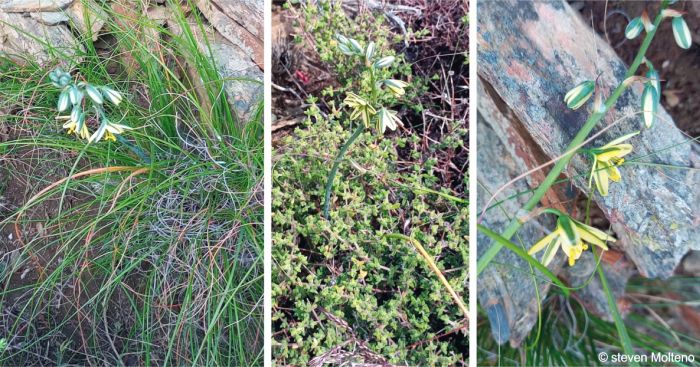
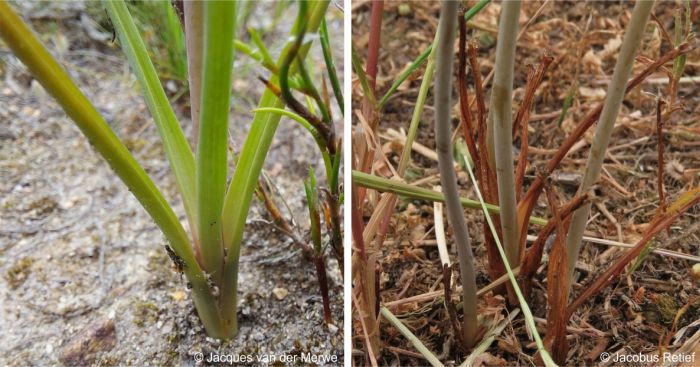
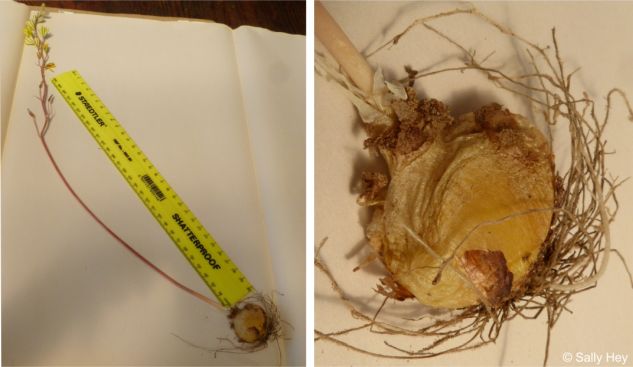
Albuca suaveolens is a bulbous deciduous perennial, which grows 100-500 mm high. Leaves are linear to lanceolate, channeled, the bases clasping. The leaves are narrow and tend to curve back near their tips, 2-6 are produced per year and sometimes flowering occurs after the leaves have withered and dried.
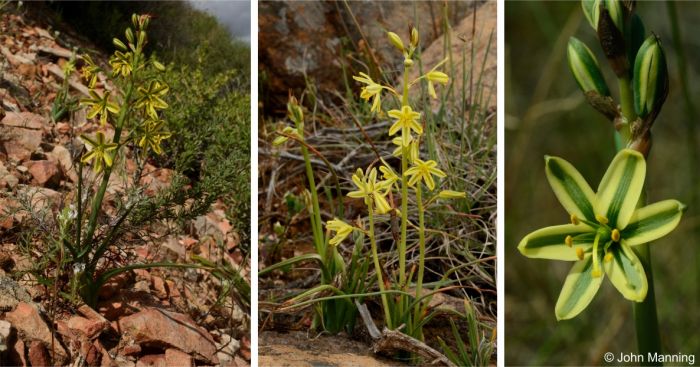
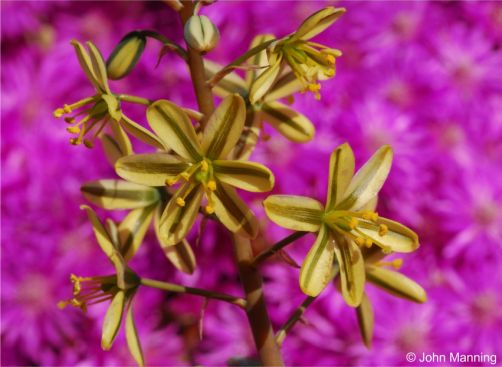
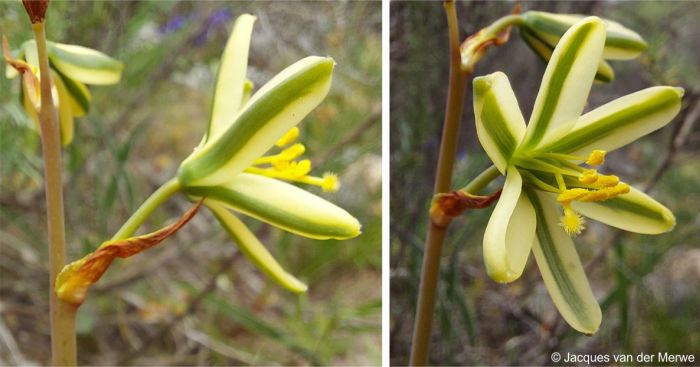
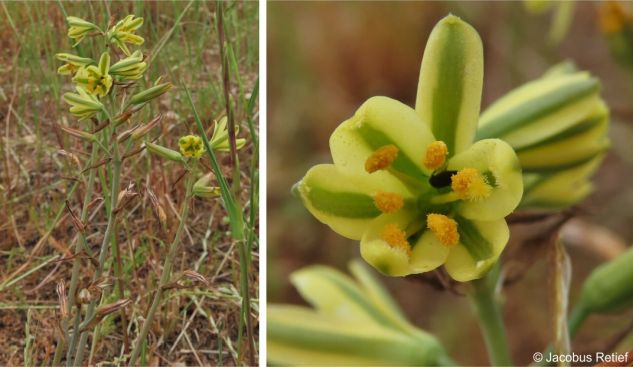
Flowers are spreading or nodding, yellow with broad green stripes along the keels, borne in a stiff, upright raceme, in spring (Sept. to Nov.). Many of the flowers open simultaneously. The flowers are sweetly scented, the fragrance fades away as the flowers age. The flowers are on petioles that are 20 mm long and hold the flowers in an outward-facing to nodding position, a feature that differentes this species from similar albucas. There is a tapering papery bract on each flower stalk. The tepals are oblong, ± 15 x 5 mm, 6 tepals in a flower and they open widely to about 20 mm in diameter. The filaments are slender and taper to a point (subulate), ± 8 mm long. The fruits are capsules which contain thin, flattened, black seeds.
Conservation Status
Status
Albuca suaveolens is assessed as Least Concern (LC) by the Red List of South African Plants, it is widespread and common and not in danger of extinction.
Distribution and habitat
Distribution description
Albuca suaveolens occurs on dry slopes and flats in rocky sandstone habitats, it is found growing in the northwestern, southwestern and southern parts of Namibia, and in South Africa, in the Northern Cape, Western Cape and the Eastern Cape as far east as Humansdorp. The species is endemic to southern Africa.
Derivation of name and historical aspects
History
The specific name suaveolens (Latin) means ‘sweet smelling’ or ‘fragrant’, referring to the flowers.
Ecology
Ecology
Albuca suaveolens is adapted to a winter-rainfall climate, with a mild wet winter and a hot dry summer. Plants sprout leaves in autumn, grow during winter and flower towards the end of their growing season in spring to early summer and then die back and lie dormant underground during summer.
Albuca species with tightly closed flowers, such as Albuca setosa, are pollinated by leafcutter bees that squeeze through the tepals to feed on the nectar inside and deposit the pollen on the tips of the tepals where it is absorbed and fertilizes the ovules, in the first recorded case of flower petals serving the function of the stigma in the pollination process. However, the pollination of albucas with open flowers has not yet been studied. Monkey beetles have been observed visiting the flowers of Albuca suaveolens near Darling but the observations uploaded on iNaturalist capture very little insect activity on the flowers.
Uses
Use
Albuca suaveolens can be used as an ornamental plant; planted in rockeries and on sandy slopes, or grown in containers, for its attractive flowers. No medicinal purposes are recorded.
Growing Albuca suaveolens
Grow
Propagation of Albuca suaveolens is done by means of seed and division. Sow seeds in autumn in well-drained soil, germination takes place after 1-2 weeks. Seedlings normally flower in their third year. Divide offsets from the mother bulb and transplant into well drained soil in late summer. Transplant the seedlings and offsets in early autumn or late summer.
Grow Albuca suaveolens in full sun in an open, well-ventilated, well-drained acidic to neutral soil. Moderate to little watering is required and it can survive periods of drought when established since it stores water in the bulb. It can tolerate cold conditions to -5°C to high temperature of 41°C, in extremely cold areas it is best grown in containers in controlled conditions. Fertilizer is optional, organic fertilizer or compost can be applied every 12 months.
Albuca suaveolens is best suited for rock gardens (rockeries), beds and areas on slopes in temperate winter-rainfall climates and for container planting. Overwatering and poor drainage results in the damage causing disease of bulb rot and other fungal problems, thus avoid too much watering, place it in a well-ventilated location in well-drained (sandy) soil and do not grow it in extremely moist or wet positions.
The common pests which the species may be susceptible to are sap sucking insects, such as aphids, mealy bugs and mites. Apply organic insecticidal soaps to control the infestation.
References
- Duncan, G. 2010. Grow bulbs. A guide to the cultivation of bulbs of South Africa and neighboring countries. Kirstenbosch Gardening Series. South African National Biodiversity Institute, Cape Town.
- Hey, S. 2022. Observation of Albuca suaveolens, Hawerland Farm, West Coast District Municipality. iNaturalist. Online. https://www.inaturalist.org/observations/141698960.
- Johnson, S.D., Jurgens, A. & Kuhlmann, M. 2012. Pollination function transferred: modified tepals of Albuca (Hyacinthaceae) serve as secondary stigmas. Annals of Botany 110(3):565-572.
- Manning, J. & Goldblatt, P. 2012. Plants of the Greater Cape Floristic Region 1: the Core Cape Flora. Strelitzia 29. South African National Biodiversity Institute, Pretoria.
- Molteno, S. 2024. Observation of Albuca suaveolens, Overberg District Municipality. iNaturalist. Online. https://www.inaturalist.org/observations/243315092.
- Operation Wildlfower. Albuca suaveolens. https://operationwildflower.net/index.php/latest/6260-albuca-suaveolens-judd-2-6260. Accessed on 2026/02/05.
- Pacific Bulb Society. Albuca. https://www.pacificbulbsociety.org/pbswiki/index.php/Albuca. Accessed on 2026/02/05.
- Picker, M.D. & Midgley, J.J. 1996. Pollination by monkey beetles (Coleoptera: Scarabaeidae: Hopliini): flower and colour preferences. African Entomology 4(1): 7–14.
- Plants of the World Online. Albuca suaveolens (Jacq.) J.C.Manning & Goldblatt. https://powo.science.kew.org/taxon/urn:lsid:ipni.org:names:77097772-1. Accessed on 2026/02/05.
- Raimondo, D., Von Staden, L., Foden, W., Victor, J.E., Helme, N.A., Turner, R.C., Kamundi, D.A. & Manyama, P.A. (eds) 2009. Red list of South African plants. Strelitzia 25. South African National Biodiversity Institute, Pretoria.
- Retief, J. 2024. Observation of Albuca suaveolens, West Coast District Municipality. iNaturalist. Online. https://www.inaturalist.org/observations/244667297.
- Snijman, D.A. (ed.). 2013. Plants of the Greater Cape Floristic Region 2: The Extra Cape Flora. Strelitzia 30. South African National Biodiversity Institute, Pretoria.
- Van der Merwe, J. 2020. Observation of Albuca suaveolens, Joostenbergkloof, Paarl. iNaturalist. Online. https://www.inaturalist.org/observations/61805104#
Credits
Ofentse Naanyane
Free State National Botanical Garden
March 2026
Acknowledgements: the author thanks John Manning for providing his photographs and also the iNaturalist photographers Sally Hey, Koos Retief, Steven Molteno and Jacques van der Merwe for allowing permission to use their photographs.
Plant Attributes:
Plant Type: Bulb
SA Distribution: Eastern Cape, Northern Cape, Western Cape
Soil type: Sandy, Loam
Flowering season: Spring, Early Summer
PH: Acid, Neutral
Flower colour: Green, Yellow
Aspect: Full Sun
Gardening skill: Average
Special Features:
 Drought resistant
 Fragrant
 Good potplant
Horticultural zones



Rate this article
Article well written and informative
Rate this plant
Is this an interesting plant?
Login to add your Comment
Back to topNot registered yet? Click here to register.