


Alepidea setifera
Introduction
Alepidea setifera is a little-known indigenous herb with bristly-edged leaves and finely hairy flowering stems, producing delicate white to cream flower clusters that attract insects and birds. Part of the medicinally important genus Alepidea in the carrot family (Apiaceae), this hardy, low-maintenance plant thrives in grasslands, rocky slopes, and along streams, offering both beauty and intrigue to gardens.
Description
Description
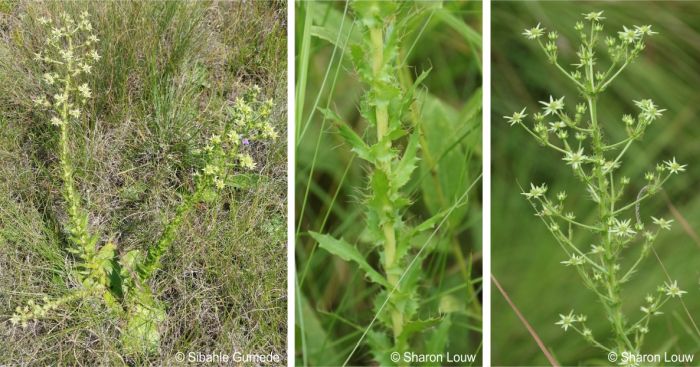
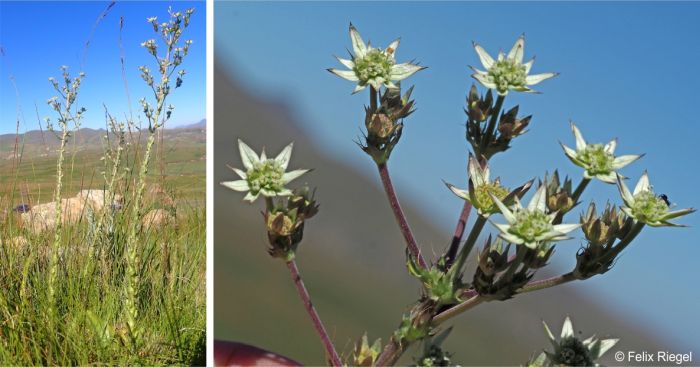
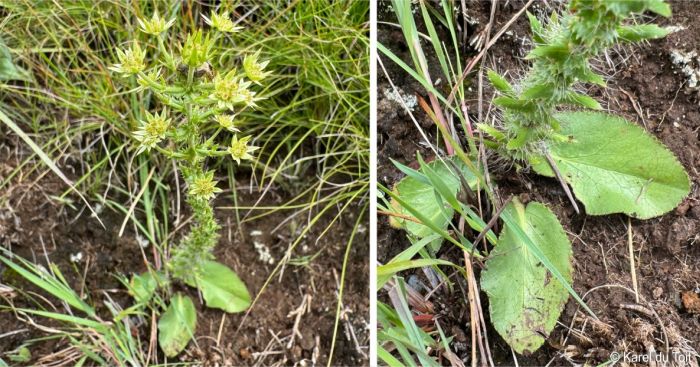
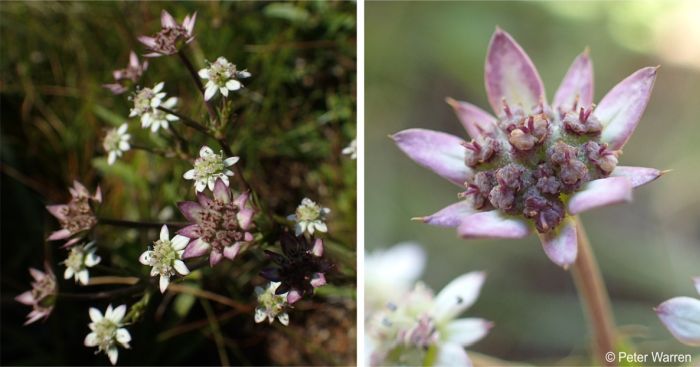
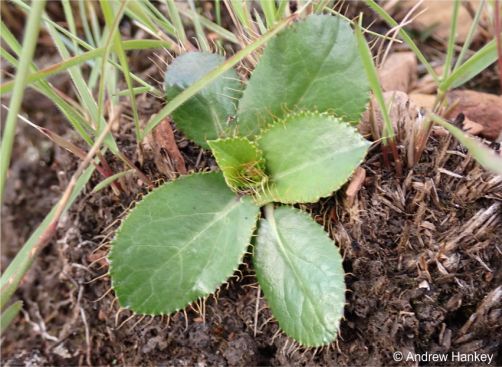
Alepidea setifera is a small, evergreen, herbaceous perennial growing 300–600 mm tall. It is low-growing, aromatic, and usually occurs alone or in small clumps. The plant arises from a small underground rhizome, 5–10 mm wide, with thin, fibrous roots that are not swollen. The basal leaves form a loose rosette, usually 3–6 per plant, and vary in shape from round or oval to spoon-shaped or lance-shaped, up to 100 mm long and 50 mm in diameter. Leaves are smooth, with rounded or pointed tips, and the veins lie flat on the upper surface. The margins are toothed, with each tooth ending in a fine hair and usually no hairs between the teeth. Leaf bases are mostly heart-shaped or rounded, and the petioles are 10–105 mm long, flattened, ribbed, and smooth to slightly rough. The inflorescence is an upright, hollow, ribbed, and finely hairy stalk, often with one or two main stems and multiple lateral branches. Narrow, leaf-like bracts densely cover the inflorescence. It bears numerous small, round umbels, usually 5–70 per plant, with the main umbels 9–22 mm in diameter and containing 10–14 flowers. Some flowers are fully functional, while others are male only, particularly in the smaller upper umbels. The flowers are white to cream, often flushed with pink or purple after pollination, and appear in late summer, from January to March. The fruit is a small, rounded to egg-shaped schizocarp, splitting into two mericarps at maturity, with one mericarp usually remaining attached to the central stalk, a characteristic feature of the genus Alepidea within the Apiaceae family.
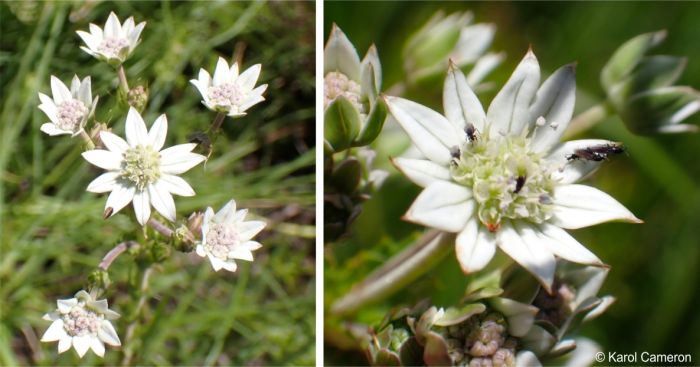
Alepidea setifera resembles Alepidea inflexa in having a hairy inflorescence but differs in having fewer basal leaves with heart-shaped bases, flat upper leaf veins, and fine hairs only at the tips of the leaf teeth, with no hairs between them; it is also similar to Alepidea jenkinsii in leaf shape but differs in having a hairy inflorescence.
Conservation Status
Status
Alepidea setifera is assessed as Least Concern (LC) on the Red List of South African Plants. It occurs across a broad range of approximately 120 000 km² and is represented by numerous populations. While some habitats are affected by human activity or environmental changes, these impacts are currently insufficient to threaten the species. In the northern parts of its range, however, populations may be vulnerable to invasive alien plants, which could cause localized declines over time.
Distribution and habitat
Distribution description
Alepidea setifera has a wide distribution, ranging from northern and eastern Lesotho across South Africa’s eastern Free State, western KwaZulu–Natal, Mpumalanga, and southern Limpopo, and extending into Eswatini. It is highly adaptable, occurring in semi-shaded proteoid grasslands, open rocky slopes and plateaus, and along floodplain edges.
Derivation of name and historical aspects
History
The genus name Alepidea comes from the Greek a- meaning ‘without’ and lepis meaning ‘a scale’, referring to the absence of scale-like structures on the fruit or at the base of the petals. The species name setifera is derived from the Latin seta meaning ‘bristle’ and fera meaning ‘bearing’, highlighting the fine bristle-like hairs present on the flowering stems and leaf margins. These bristles are not only a key identifying feature within the genus but may also help protect the plant from herbivores and reduce water loss in its sun-exposed habitats, making it both a diagnostic and ecologically meaningful trait.
The genus Alepidea was first formally described in 1808 by the French botanist François-Étienne de La Roche. It belongs to the carrot family, Apiaceae, a globally significant group of aromatic plants with hollow or pith-filled stems and flat-topped flower clusters called umbels. The family includes familiar food and herb plants such as carrot, celery, parsley, coriander, and cumin, and comprises roughly 446 genera and 3 540 species worldwide.
Alepidea is an African genus with about 28 species, most of which occur in southern Africa. Only two species extend as far north as the highlands of Kenya and Ethiopia. The genus is concentrated in summer-rainfall regions, particularly in eastern South Africa, Lesotho, Eswatini, Mozambique, and Zimbabwe. Within South Africa, over 80% of species are found in the Eastern Cape, KwaZulu-Natal, Free State, and Mpumalanga, with a few extending into Limpopo, Gauteng, and the Northwest Province, while two species are confined to the Cape winter-rainfall region. These plants typically grow in grasslands, along forest edges, near streams, or on rocky slopes, from lowlands to high mountain areas.
Despite their importance in traditional medicine, species of Alepidea remain taxonomically challenging. In 1949, the Swedish botanist Carl Weimarck classified the genus into six sections based mainly on leaf and flower traits. Later studies revealed that these characters were limited or unreliable, leading to uncertain species boundaries. This has practical consequences: several medicinal species with thick underground stems, such as Alepidea amatymbica, A. cordifolia, and A. macowanii, are commonly sold under the same local name, ikhathazo. This has caused confusion in medicinal literature and makes monitoring of harvesting and trade difficult, posing a significant concern for conservation and sustainable use.
The species A. setifera was likely named to draw attention to its bristly stems and leaf margins, a distinctive feature that separates it from close relatives like A. inflexa and A. jenkinsii. Beyond identification, the bristles may also reflect subtle ecological adaptations, helping the plant survive in its often rocky, semi-shaded grassland, and streamside habitats.
Ecology
Ecology
Alepidea setifera quietly supports the grassland ecosystem. Its creamy-white flower clusters rise above the surrounding grass on finely hairy stems, attracting bees, butterflies, flies, and beetles. Each visit transfers pollen from one flower to another, ensuring seed production and maintaining genetic diversity. The plant dies back during winter or after fire but resprouts from its underground rhizome with the return of summer rains, flowering again to continue its life cycle. The fruit is a small schizocarp that splits into two mericarps at maturity, with one often remaining attached to the central stalk a characteristic feature of the genus Alepidea. Seeds are likely dispersed by wind, water, and incidental contact with animals, allowing the plant to colonize open grasslands, rocky slopes, and floodplain edges.
Alepidea setifera is well adapted to fire-prone environments. The underground rhizome remains protected during fire or dry periods, while hairs on leaves and stems may deter herbivores. Stored energy and water in the rhizome enable rapid recovery after disturbance. Together, these traits allow A. setifera to persist in variable and often harsh habitats, contributing to grassland biodiversity and ecological resilience.
Uses
Use
The genus Alepidea is highly valued in traditional medicine across southern Africa, although historical confusion over species names has made it difficult to distinguish them. While A. amatymbica is often cited in literature, closely related species such as A. cordifolia are more widely distributed; from northwestern KwaZulu–Natal to Lesotho, Eswatini, Zimbabwe and Mozambique; and are likely the most used. Several species, including A. cordifolia, A. amatymbica and A. macowanii, are known locally as ikhathazo (Zulu) or inkatazo (Xhosa) and are often used interchangeably. Their underground stems, or rhizomes, are large, aromatic, and resinous, and form the basis of traditional remedies. Rhizomes are used to treat respiratory problems such as coughs, colds, influenza, and asthma, as well as digestive disorders, rheumatism, wounds, sore throats, and malaria. Remedies are prepared as decoctions, infusions, chewing, or inhaling powdered roots, with dosages adapted for children. These rhizomes are widely traded in informal herbal markets across South Africa and Lesotho, reflecting both cultural importance and ongoing demand. Scientific studies have identified kaurene-type diterpenes in Alepidea rhizomes, which have antibacterial, anti-inflammatory, muscle-relaxing, and mild diuretic effects. These compounds likely underpin the traditional uses of the plant and point to potential pharmacological applications. Alepidea species are also used in ethnoveterinary medicine for livestock ailments, and historically for tonics, insect repellents, and other purposes. High demand, combined with destructive harvesting of rhizomes and habitat loss from agriculture and forestry, has caused severe declines in wild populations of related species, with reductions of 50% or more over the past 60 years and local extinctions reported in KwaZulu-Natal, Zimbabwe, and parts of Lesotho. While specific data on Alepidea setifera is limited, it shares many physical and chemical traits with its relatives, suggesting similar uses. Cultivating A. setifera and other Alepidea species could reduce pressure on wild populations, provide a sustainable source of rhizomes, support biodiversity, and create economic opportunities for local communities, helping to preserve both cultural heritage and South Africa’s indigenous plants. High demand for rhizomes, coupled with destructive harvesting, habitat loss, and overcollection, has caused wild populations of related species to decline dramatically. At the same time, informal trade in urban and rural markets highlights an unmet economic potential. Formalizing this trade; through cultivation, sustainable harvesting and quality control, could provide livelihoods, preserve cultural practices, and protect biodiversity. Developing commercial plant-based products is complex, expensive, and regulated, but a dual approach that respects indigenous knowledge while ensuring safety and efficacy through scientific methods offers a realistic path forward.
Growing Alepidea setifera
Grow
Alepidea setifera is a small, evergreen, herbaceous perennial geophyte that grows 300–600 mm tall. It occurs naturally in semi-shaded grasslands, rocky slopes, and floodplain margins. In cultivation, it adapts well to indigenous gardens, wetland edges, understory plantings, and containers, especially when grown among rocks. It performs best in summer rainfall regions, with active growth in spring and summer and a drier rest period in winter.
Based on my experience as a horticulturist working in a botanical garden, propagation is most reliable from fresh seed or by division. Seeds are aromatic, resinous, and antiseptic, often staining the hands orange. Clean seeds before sowing and sow in early spring or late summer. Sow on a firmly tamped surface and cover lightly with 0.5–1 mm of medium, deeper sowing delays germination. Use a well-drained seedling medium of milled pine bark (medium to coarse), peat or sphagnum moss, and perlite or coarse sand in a 1:3:1 ratio. Place trays in bright, indirect light and keep the medium evenly moist, watering when the surface begins to dry. Germination usually occurs within 14–28 days at 25–28°C, with success rates around 90%. Seedlings are prone to damping-off during the first 2–3 weeks, so avoid overwatering and ensure good air circulation. Once seedlings have 2–3 true leaves, pot them individually and grow them on until the rhizome develops, usually within 4–6 months, after which they can be planted out at the start of the growing season. Propagation by division is also effective. Remove basal suckers in spring or summer, ensuring each division includes roots and at least one growth point. Grow divisions under the same conditions as seedlings until established. The species tolerates light frost (to about –2°C), though young plants benefit from protection. Growth is moderate, and flowering usually begins 2–3 years after germination. Fertilizer is not essential, but an annual application of compost or a low-dose organic feed supports healthy growth. Maintenance is minimal and involves removing old leaves and spent flower stalks.
References
- Cameron, K. 2025-Dec. Observation of Alepidea setifera, Dullstroom, Mpumalanga. iNaturalist. Online. https://www.inaturalist.org/observations/332587820.
- De Castro A. & Van Wyk. B.-E. 1994. Diagnostic characters and geographic distribution of Alepidea species used in traditional medicine. South African Journal of Botany 60(6): 345-350.
- Du Toit, K. 2025-Feb. Observation of Alepidea setifera, Qwa-Qwa, FS. iNaturalist. Online. https://www.inaturalist.org/observations/263283300.
- Gumede, S.P. 2024-Feb. Observation of Alepidea setifera, Bergville, Free State. iNaturalist. Online. https://www.inaturalist.org/observations/200500781.
- Hankey, A. 2023-Nov. Observation of Alepidea setifera, Thaba Chweu, MP. iNaturalist. Online.https://www.inaturalist.org/observations/193783395.
- Hutchings, A., Scott, A.H., Lewis, G. & Cunningham, A.B. 1996. Zulu medicinal plants: an inventory. University of Natal Press, Pietermaritzburg.
- Hutchinson, S.-L., Tilney, P.M., Van Wyk, B.-E., & Magee, A.R. 2015. Towards a working taxonomic revision of the medicinally important genus Alepidea (Apiaceae). South African Journal of Botany 98:180. doi: 10.1016/j.sajb.2015.03.050.
- Louw, S. 2025-Jan. Observation of Alepidea setifera, uThukela District, KZN. iNaturalist. Online. https://www.inaturalist.org/observations/260304310.
- Maroyi, A. 2021. A review of medicinal uses, phytochemistry and pharmacological activities of Alepidea species. International Journal of Scientific & Technology Research 10(5): 382–391.
- Mhlongo, N.N. 2023. Alepidea setifera N.E.Br. National Assessment: Red List of South African Plants version 2024.1. Accessed on 2026/01/26.
- Mulaudzi, R.B. 2009. Seed germination and medicinal properties of Alepidea species. M.Sc. Dissertation, University of KwaZulu-Natal, Pietermaritzburg.
- Nichols, G. 2005. Growing rare plants: a practical handbook on propagating the threatened plants of southern Africa. Southern African Botanical Diversity Network Report No. 36.
- Riegel, F. 2022-Jan. Observation of Alepidea setifera, Golden Gate Highlands National Park, FS. iNaturalist. Online. https://www.inaturalist.org/observations/140042202.
- Van Wyk, B.-E., De Castro, A., Tilney, P.M., Winter, P.J.D. & Magee, A.R. 2008. A new species of Alepidea (Apiaceae, subfam. Saniculoideae). South African Journal of Botany 74: 740–745.
- Van Wyk, B.-E., Tilney, P.M. & Magee, A.R. 2013. African Apiaceae: a synopsis of the Apiaceae/Umbelliferae of sub-Saharan Africa and Madagascar. Briza Academic Books.
- Warren, P. 2017-Apr. Observation of Alepidea setifera, Thaba Chweu, MP. iNaturalist. Online. https://www.inaturalist.org/observations/14345252.
- Yembaturova, E.Yu., Van Wyk, B.-E., Tilney, P.M. & Winter, P.J.D. 2010. The taxonomic significance of fruit morphology and anatomy in the genus Alepidea Delaroche (Apiaceae, Saniculoideae). Plant Diversity and Evolution 128(3):369–385.
Credits
Lungisani Zondi & Sihle Mvunyiswa
KwaZulu-Natal National Botanical Garden
February 2026
Acknowledgements: images by Sibahle Gumede, Sharon Louw, Karol Cameron, Felix Riegel, Karel du Toit, Peter Warren and Andrew Hankey.
Plant Attributes:
Plant Type: Bulb, Perennial
SA Distribution: Free State, Gauteng, KwaZulu-Natal, Limpopo, Mpumalanga, North West
Soil type: Sandy, Loam
Flowering season: Late Summer
PH: Acid, Neutral
Flower colour: White, Pink, Cream
Aspect: Full Sun, Morning Sun (Semi Shade), Afternoon Sun (Semi Shade)
Gardening skill: Average
Special Features:
 Attracts birds
 Attracts butterflies
 Drought resistant
 Medical plant
 Feeds honeybees
Horticultural zones




Rate this article
Article well written and informative
Rate this plant
Is this an interesting plant?
Login to add your Comment
Back to topNot registered yet? Click here to register.