


Asclepias cooperi
Introduction
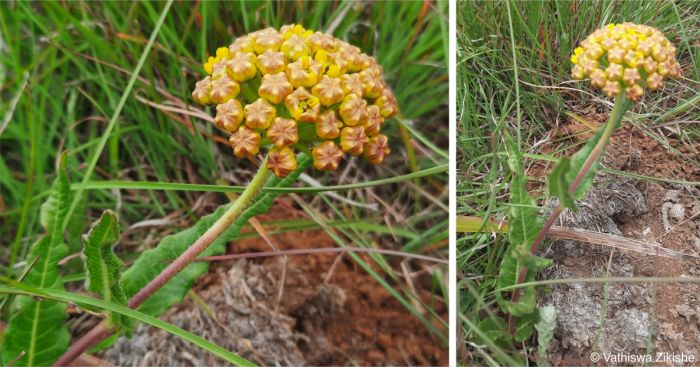
Asclepias cooperi is a rare endemic confined to the Amatole mountain range in the Eastern Cape, with stunning, golden-yellow flower-heads in midsummer.
Description
Description
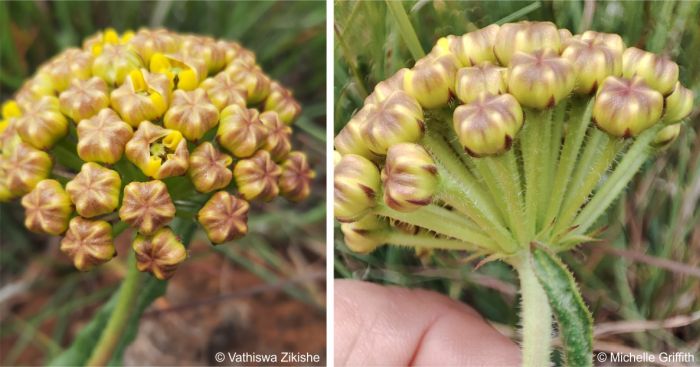
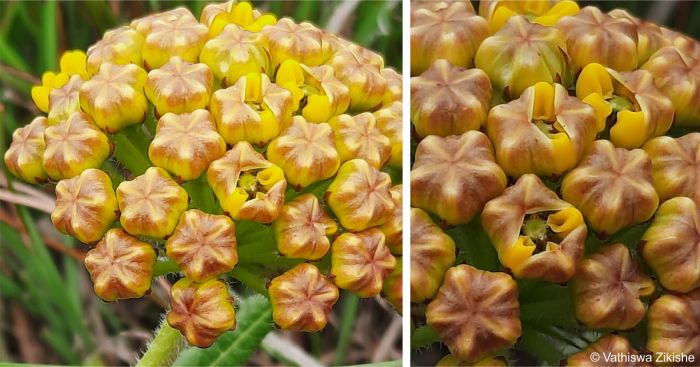
Asclepias cooperi is a perennial herb with an underground stem. It grows 150 to 300 mm tall and has one or two erect stems. The leaves grow upwards and are triangular. The leaf base is truncate (ending abruptly in a more or less straight line, as if cut off) or trullate (shaped like a bricklayer’s trowel). The margins are wavy, and the leaf tip gradually narrows (attenuate). The flower-heads (inflorescences) are solitary and borne at the top of the stem, forming a hemispherical cluster of 30–50 flowers. Flowers are greenish-yellow, with a crown-like structure, the corona, which is bright golden-yellow, fleshy, and claw-shaped when viewed from the side. It flowers in midsummer, from mid-December to January.
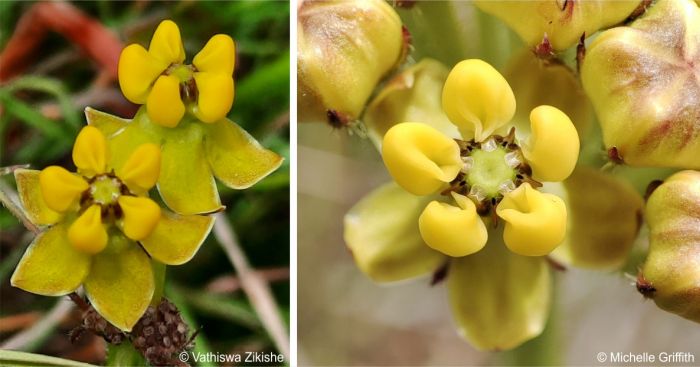
Asclepias cooperi may be mistaken for A. densiflora, but can be distinguished by its longer leaf stalks, leaves with a wedge-shaped base, and larger flowerheads of more numerous flowers.
Conservation Status
Status
Asclepias cooperi is currently listed as Rare in the Red List of South African Plants. The Rare category is not a global IUCN category; it is applied to species assessed using the regional assessment procedures. The IUCN Red List categories and criteria are designed to be applied to the entire (global) range of a species. Such assessments, which take into account the worldwide distribution range of a species, are known as global assessments and are included in the International Red List of Threatened Species.
In the case of Asclepias cooperi, however, a regional assessment criterion was applicable. When a species is not exposed to any direct or plausible threats and does not qualify for any of the five IUCN criteria, but meets at least one of the four South African criteria for rarity, it is considered Rare. Asclepias cooperi meets three of these criteria: it has a restricted range with an extent of occurrence of less than 500 km², it occurs in a very small population (typically fewer than 50 mature individuals), and it is sparsely distributed over its range, resulting in a small global population.
Distribution and habitat
Distribution description
This is an endemic species, restricted to the Eastern Cape, from Idutywa to Stutterheim. It occurs in a montane grassland vegetation type, at an altitude of between 650 and 1 400 m.
Derivation of name and historical aspects
History
The name Asclepias comes from the Greek doctor Aesculapius, who, according to old stories, became the god of medicine. The species name honours Thomas Cooper (1815–1913), an English botanist and explorer who collected plants in South Africa from 1859 to 1862. Interestingly, he was the father-in-law of Nicholas Edward Brown, who described this species.
Ecology
Ecology
Plants in the genus Asclepias are known to possesses a highly specific floral morphology, often compared to orchids. Pollination in this genus is generally unusual, as the male and female parts of the flowers are fused together to form a structure called a gynostegium, requiring suitably sized pollinators to transfer the pollen. Unlike most flowering plants, where pollen is released as individual grains to ease the transfer by pollinating insects. Asclepias pollen is grouped into complex structures known as pollinia. This requires pollinating insects to slip their leg or mouth parts into one of the five slits formed by adjacent anthers in each flower. The pollinia then attach automatically to the insect so that, when the pollinator flies off, a pair of pollen sacs can be pulled free, provided it is an appropriately sized pollinator to produce the necessary pulling force. Smaller or poorly matched insects may become trapped and die.
Uses
Use
Considering the fact that the genus Asclepias is named after an ancient Greek god of healing and medicine, it is fitting that several species in the genus have a documented history of traditional medicinal use. However, many milkweed species contain milky latex, rich in cardiac glycosides known as cardenolides, which can be toxic or poisonous when ingested. But, as with many plants, some insects have developed a mechanism which allows them to tolerate the latex while feeding on the plant and using it as a host for the development of larvae.
Asclepias cooperi is notable for its striking appearance and vibrantly coloured flowers, making it an excellent candidate for gardening and landscaping.
Growing Asclepias cooperi
Grow
Not many Asclepias species are cultivated or available from nurseries. The flowers and fruits of these plants are very attractive but relatively short-lived. To the author’s knowledge, indigenous species are not grown in gardens nor available from nurseries in South Africa. The species that are cultivated include Asclepias curassavica, which was introduced from Mexico to South Africa. If they are cultivated, it is usually by specialist growers and collectors of exotic plants rather than for use as ornamental garden plants. Plants can be grown from wild-collected seeds, which germinate relatively easily. However, it is difficult to maintain a plant in cultivation until it flowers. Fresh seed should be sown in a light, sandy-to-humic soil substrate and kept moist until germination, which usually takes about a week to sixteen days.
For more information on indigenous Asclepias, see this general account of the genus and how to cultivate the species, based on the experience of an expert working on the family Apocynaceae in growing the species in the genus Asclepias.
References
- Beentje, H.J. & Williamson, J. 2016. The Kew plant glossary: an illustrated dictionary of plant terms. Kew Publishing.
- Bester, S.P. 2017. Asclepias L. (Apocynaceae). PlantZAfrica. Online. https://pza.sanbi.org/asclepias-genus.
- Biodiversity Advisor. South African National Biodiversity Institute (SANBI). Asclepias cooperi N.E.Br. https://biodiversityadvisor.sanbi.org/search/detail/792bb5ce-4c9c-4ed7-8cf2-614bd34981dd. Accessed 03/05/2026.
- Brown, N.E. 1909. Asclepiadeae. In W.T. Thiselton-Dyer, Flora capensis IV Section I (Vacciniaceae to Gentianeae): 518–1036. Lovell Reeve, London.
- Griffith, M. 2024-Dec. Observation of Asclepias cooperi, Amathole District. iNaturalist. Online. https://www.inaturalist.org/observations/256993353.
- Manning, J. & Batten, A. & Bokelmann, H. 2001. Eastern Cape South African Wild Flower Guide 11. Botanical Society of South Africa, Cape Town
- Victor, J.E. 2006. Asclepias cooperi N.E.Br. National Assessment: Red List of South African Plants version 2024.1. https://redlist.sanbi.org/species.php?species=2681-14.
- World of Succulents. Dictionary of succulent plant names. https://worldofsucculents.com/epithets/cooperi/. Accessed on 04/05/2026.
Credits
Vathiswa Zikishe
Threatened Species Unit: Custodians of Rare and Endangered Wildflowers Programme (CREW)
May 2026
Acknowledgements: images by Michelle Griffith as credited
Plant Attributes:
Plant Type: Perennial
SA Distribution: Eastern Cape
Soil type: Sandy, Loam
Flowering season: Early Summer
PH: Acid, Neutral
Flower colour: Yellow
Aspect: Full Sun
Gardening skill: Challenging
Special Features:
 Attracts butterflies
 Poisonous
Horticultural zones


Rate this article
Article well written and informative
Rate this plant
Is this an interesting plant?
Login to add your Comment
Back to topNot registered yet? Click here to register.