


Babiana ringens
Introduction
The rat’s tail babiana is a small feature plant with striking red and yellow flowers which attract malachite sunbirds. It makes a unique pot plant and interesting border plant, best in winter-rainfall rock gardens.
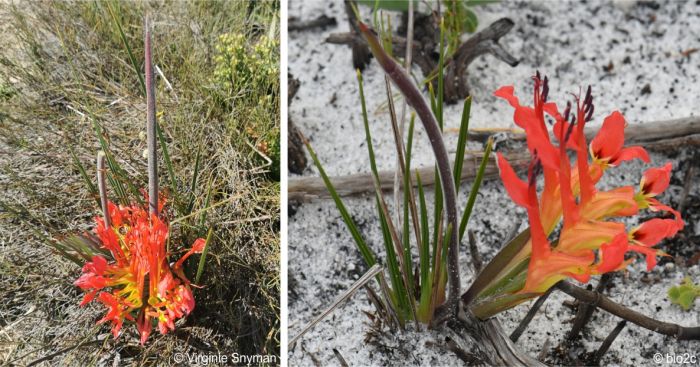
Fig. 1. Babiana ringens showing the distinctive velvety sterile stem (rat’s tail perch) and compact flower spike close to the ground.
Description
Description
Babiana ringens is a very distinctive plant that is unlikely to be confused with other species. This deciduous perennial grows from a corm and reaches 120–400 mm in height. Plants have a single, sterile, velvety stem with one or rarely two short horizontal branches borne close to the ground. The leaves are linear-lanceolate to almost terete, stiff, sharply pointed and deeply pleated. Plants flower in winter and spring (between late July and October), producing red flowers with a yellow throat borne in a compact spike close to the ground. Each plant has two to 10 flowers. The flowers are zygomorphic (bilaterally symmetrical), unscented and have a narrowly funnel-shaped perianth tube, 27–45 mm long, that is expanded in the upper half and curved upward. The upper tepals are 18–50 mm long and erect, with overlapping margins in the lower part which partly enclose the filaments and style, while the lower tepals are shorter, 22–25 mm long, and horizontal. The unequal position of the tepals give the flowers a gaping appearance. Green bracts, 20–50 mm long, with dry rust-coloured tips encase the base of the flowers. The stamens are unilateral with straight, erect filaments 24–60 mm long and purple anthers 4.0–7.5 mm long. The ovary is smooth and the style branches 2–5 mm long.
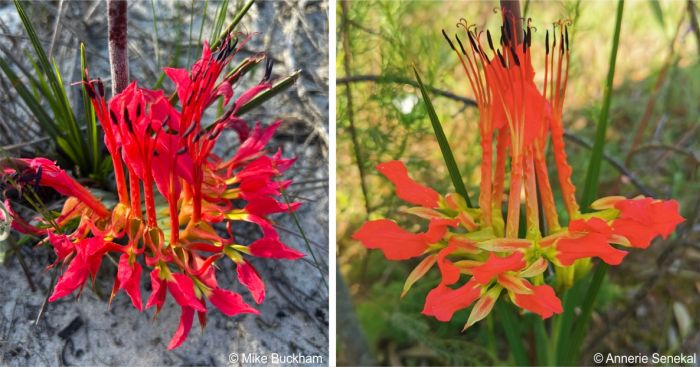
Fig. 2. The striking red and yellow flowers of Babiana ringens have a characteristic gaping appearance.
Two subspecies are currently recognized. Babiana ringens subsp. ringens is characterized by having larger flowers, the dorsal tepal is 25-50 mm long, and longer styles dividing in level with the middle of the anthers or beyond them. Babiana ringens subsp. australis has smaller flowers, the dorsal tepal 18-30 mm long, and shorter styles that divide at or below the base of the anthers. The subsp. australis also typically has fewer flowers, 2-4 per spike, whereas the subsp. ringens has 6-10 flowers per spike.
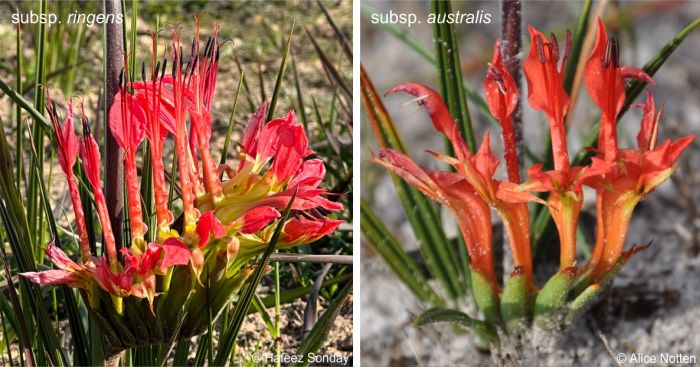
Fig. 3. Babiana ringens subsp. ringens left and subsp. australis right, showing the branching of the style in relation to the anthers.
Conservation Status
Status
Both subspecies of Babiana ringens are assessed as Least Concern (LC) in the Red List of South African Plants as they are widespread and very common. The species appears to be resistant to disturbances and alien plant invasions and the population is not considered to be declining.
Distribution and habitat
Distribution description
The rat’s tail babiana is a South African endemic occurring from Albertinia in the Western Cape, west to the Cape Peninsula and northwest to the Bokkeveld mountains in the Northern Cape. Babiana ringens subsp. ringens is widespread throughout this range but has not been recorded further east than Napier. Babiana ringens subsp. australis extends along the southern coast from Albertinia west to the Cape Peninsula. This species is found on deep coastal sandy flats and slopes in strandveld and fynbos vegetation at elevations up to 600 m.
Derivation of name and historical aspects
History
The genus Babiana is part of the large and diverse Iridaceae family which has approximately 1 800 species across about 65 genera worldwide. Iridaceae, named after the genus Iris, is an important agricultural and horticultural family with many species being cultivated and grown globally. For example, Crocus sativus is the source of the expensive spice saffron, Gladiolus and Freesia species are popular cut-flowers, and Iris species are used in commercially sold products such as perfumes and gins.
Babiana is one of the larger genera in Iridaceae. It consists of approximately 93 species that are mostly restricted to the winter-rainfall areas of southern Africa. Some species extend further north into Zimbabwe and Zambia. Babiana is named after the Cape Dutch word babiaan, meaning baboon, because baboons were observed digging up and eating the corms. The species name ringens is a Latin word meaning 'gaping', presumably referring to gaping appearance of the flowers.
The rat’s tail babiana was first described by Linnaeus in 1753 as Antholyza ringens, but was later transferred to Babiana by John Bellenden Ker Gawler in 1804. The common names rat's tail and rotstert refer to the distinctive velvety sterile main stem that functions as a specialized bird perch. The Afrikaans name hanekam meaning rooster's comb likely refers to the colour and arrangement of the flowers on the inflorescence.
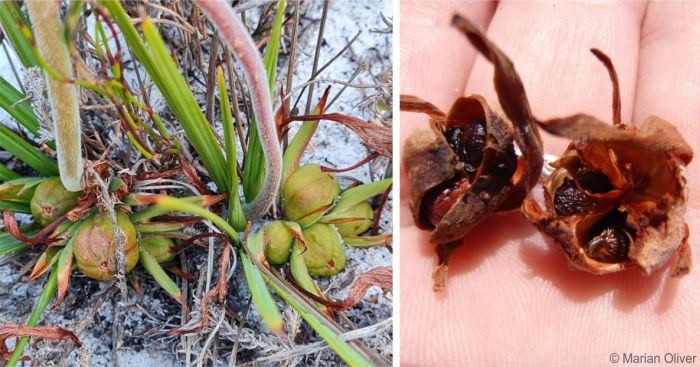
Fig. 4. Mature and developing seed capsules of Babiana ringens.
Ecology
Ecology
Babiana ringens is a typical fynbos species in that it thrives after fire, often appearing in large numbers following burns. It is one of only five Babiana species pollinated by sunbirds. The flowers are predominately pollinated by the malachite sunbird (Nectarinia famosa), but the southern double-collared sunbird has also been observed visiting flowers on occasion. The red and yellow unscented flowers with a long perianth tube that is wide in the upper half, and the copious amount of nectar attracts these birds. Sunbirds, unlike hummingbirds which can hover, need to perch while feeding. Babiana ringens has evolved a remarkable adaptation to facilitate sunbird pollination. The plants produce a sturdy sterile main stem that reaches above the flowers so that the sunbirds have a secure perch from where they can lean down to feed. The stem is velvety and resembles a rat’s tail, hence the popular common name rat’s tail babiana. As the bird feeds, with its beak inserted deep into the flower, pollen is deposited on its breast and is then transferred to other flowers visited. Interestingly, male malachite sunbirds are twice as likely to perch as females and spend on average four times longer foraging via the perch. The perch has been shown to play a significant role in the reproductive success of plants. Those without an intact perch produce 47% fewer seeds on average compared to plants with functional perches.
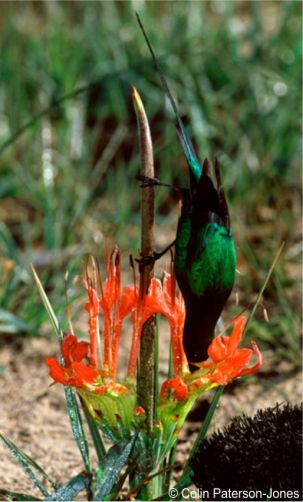
Fig. 5. A malachite sunbird perched on the specialized stem of Babiana ringens while feeding on the nectar in the flowers.
Uses
Use
Babiana is mostly of horticultural use as an ornamental plant and attracts various pollinators including birds and insects such as bees and moths. Species cultivated for their attractive flowers include fragrant varieties like B. ambigua and B. nana. The most popular garden plants are often hybrids derived mainly from B. nervosa (= B. stricta). The corms of numerous species including B. bainesii, B. hypogea and B. fragrans are eaten by animals and were historically a food source for indigenous people.
Growing Babiana ringens
Grow
Babiana ringens is a winter-growing species that is dormant during summer (December to February), actively growing during the cool, wet months (April to September) and entering dormancy during the hot, dry summer (November to December). This species makes an excellent addition to fynbos gardens and other rocky winter-rainfall gardens, and also fares well in containers. It prefers full sun and is able to survive temperatures down to about −5°C. The distinctive rat's tail perch and attractive red flowers of this feature plant create an unusual focal point. Plant in groups for best effect or combine them with other winter-growing corms that share similar cultural requirements.
Propagate Babiana ringens from seed or by dividing corms. Sow fresh seed in autumn (March to April) in a well-drained, sandy potting mix. Cover seeds lightly with soil and keep moist until germination occurs. Transplant seedlings once they are large enough to handle. Plants grown from seed typically take several years to reach flowering size. Plant corms in autumn at a depth of about 5–8 cm in nutrient-poor, sandy, gritty and very well-drained soil. Use neutral to acidic soil for optimal growth.
Water plants regularly from autumn through spring to keep the soil lightly moist. Water deeply at the root level and allow the soil to become almost dry between waterings. Fertilizer is generally not essential if the soil is well-prepared. If desired, apply a light application of all-purpose or high-potassium fertilizer in winter as growth begins. Leaves emerge in autumn (April), flowers are produced from late July to October, and seed capsules mature in late spring (October to November).
Do not cut the foliage after flowering. Allow the leaves to turn brown and die down naturally in late spring to early summer (October to November). This process stores energy in the corm for the next season's growth and flowering. Stop watering completely during the hot, dry summer dormancy (December to February) to prevent corm rot. In summer-rainfall areas or regions with hard frost (below −5°C), lift corms once the foliage has died back completely and store them in a cool, dry place. If desired, divide the corms and replant in autumn as the growing season begins.
Babiana ringens is generally pest-free when grown in well-drained conditions. However, like many cormous plants, it can be susceptible to several common pests. Thrips and red spider mites may attack the leaves, causing discoloration and stunting, particularly during dry conditions. Caterpillars can cause holes in leaves, while snails and slugs may feed on foliage and young growth. Mealybugs occasionally infest corms. Good horticultural practices, including proper watering and drainage, help prevent most problems. For severe infestations, use appropriate insecticidal soaps, horticultural oils, or targeted pesticides.
References
- Anderson, B., Cole, W.W. & Barrett, S.C.H. 2005. Specialized bird perch aids cross-pollination. Nature 435: 41–42.
- Bio2c. 2025-Aug. Observation of Babiana ringens, southern Peninsula, Western Cape. iNaturalist. Online. https://www.inaturalist.org/observations/305275036.
- Buckham, M. 2025-Aug. Observation of Babiana ringens, Malmesbury, Western Cape. iNaturalist. Online. https://www.inaturalist.org/observations/310411854.
- De Waal, C., Anderson, B. & Barrett, S.C.H. 2012. The natural history of pollination and mating in bird-pollinated Babiana (Iridaceae). Annals of Botany 109: 667–679.
- De Waal, C., Barrett, S.C.H. & Anderson, B. 2012. The effect of mammalian herbivory on inflorescence architecture in ornithophilous Babiana (Iridaceae): Implications for the evolution of a bird perch. American Journal of Botany 99: 1096–1103.
- Duncan, G. 2010. Grow bulbs. A guide to the cultivation of bulbs of South Africa and neighboring countries. Kirstenbosch Gardening Series. South African National Biodiversity Institute, Cape Town.
- Foden, W., Potter, L. & Patel, T. 2021. Babiana ringens (L.) Ker Gawl. subsp. ringens. National Assessment: Red List of South African Plants version 2024.1. https://redlist.sanbi.org/species.php?species=1534-56.
- Geerts, S. & Pauw, A. 2009. Hyper-specialization for long-billed bird pollination in a guild of South African plants: the Malachite Sunbird pollination syndrome. South African Journal of Botany 75: 699–706.
- Goldblatt, P. & Manning, J. 2007. A revision of the southern African genus Babiana, Iridaceae: Crocoidea. Strelitzia 18. South African National Biodiversity Institute, Pretoria.
- Goldblatt, P. & Manning, J.C. 2020. Iridaceae of southern Africa. Strelitzia 42. South African National Biodiversity Institute, Pretoria.
- Oliver, M. 2014-Nov. Observation of Babiana ringens, Baskloof, Scarborough, Western Cape. iNaturalist. Online. https://www.inaturalist.org/observations/26000059.
- Oliver, M. 2021-Oct. Observation of Babiana ringens, Baskloof, Scarborough, Western Cape. iNaturalist. Online. https://www.inaturalist.org/observations/97178035.
- Paterson-Jones, C. n.d. Image of Babiana ringens, north of Joostenberg, Western Cape. Biodiversity Explorer. Online. https://www.biodiversityexplorer.info/plants/iridaceae/babiana_ringens.htm.
- Powrie, F. 1998. Grow South African Plants. A gardener's companion to indigenous plants. National Botanical Institute, Cape Town.
- Senekal, A. 2022-Aug. Observation of Babiana ringens, Stellenbosch, Western Cape. iNaturalist. Online. https://www.inaturalist.org/observations/131776373.
- Snyman, V. 2025-Sep. Observation of Babiana ringens, Malmesbury, Western Cape. iNaturalist. Online. https://www.inaturalist.org/observations/316464447.
- Sonday, H. 2024-Aug. Observation of Babiana ringens, Joostenbergkloof, Western Cape. iNaturalist. Online. https://www.inaturalist.org/observations/257572818.
- Stearn, W.T. 2004. Botanical Latin. Timber Press, Oregon.
- Van der Spuy, U. 1971. Die groot veldblomboek vir die tuin. Tafelberg, Cape Town.
- Von Staden, L. & Patel, T. 2021. Babiana ringens (L.) Ker Gawl. subsp. australis Goldblatt & J.C.Manning. National Assessment: Red List of South African Plants version 2024.1. https://redlist.sanbi.org/species.php?species=1534-173.
Credits
Natasha Lombard
Pretoria National Herbarium
December 2025
Acknowledgements: Images by Virginie Snyman, bio2c, Annerie Senekal, Mike Buckham, Hafeez Sonday, Alice Notten, Marian Oliver and Colin Paterson-Jones.
Plant Attributes:
Plant Type: Bulb
SA Distribution: Northern Cape, Western Cape
Soil type: Sandy
Flowering season: Spring, Winter
PH: Acid, Neutral
Flower colour: Red, Yellow, Orange
Aspect: Full Sun
Gardening skill: Average
Special Features:
 Attracts birds
 Good potplant
Horticultural zones



Rate this article
Article well written and informative
Rate this plant
Is this an interesting plant?
Login to add your Comment
Back to topNot registered yet? Click here to register.