


Bergeranthus addoensis
Introduction
A mat-forming, drought resistant succulent with a distinctive ring-forming growth habit and bright yellow diurnal flowers in summer, only known from the red, lime-rich soils of the thicket vegetation of Eastern Cape’s Albany Centre of Floristic Endemism.
Description
Description
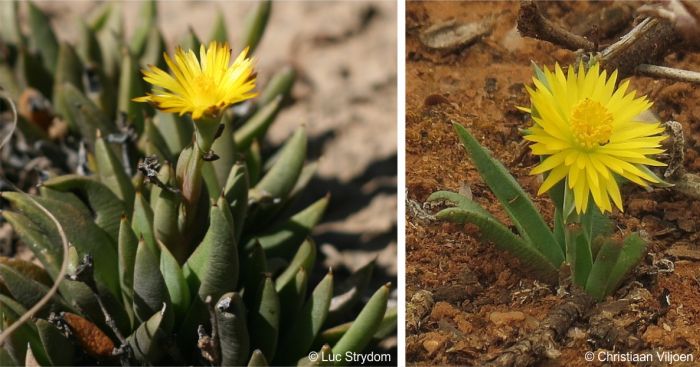
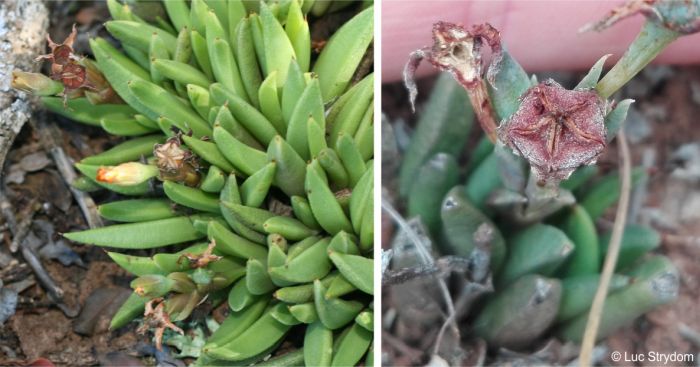
Bergeranthus addoensis is a dwarf, mat-forming perennial succulent groundcover growing up to 100 mm tall and 800 mm in diameter, with a thick rootstock. Leaves are smooth, lance-shaped, broad below and narrow at the tip. The leaves are covered with a pale grey, blue-green powder coating. Flowers are yellow, petals open in late afternoon and close during the night, flowering from spring to early autumn (September to April). The fruit is a capsule composed of chambers with 5 triangular cavities enclosing smooth seeds.
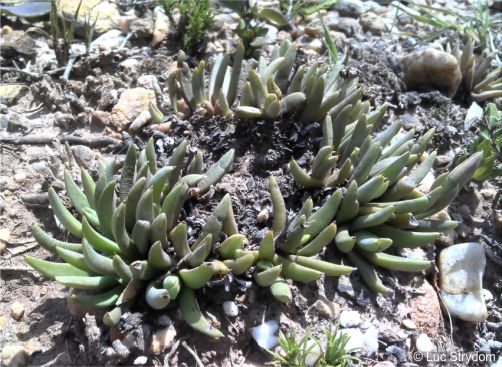
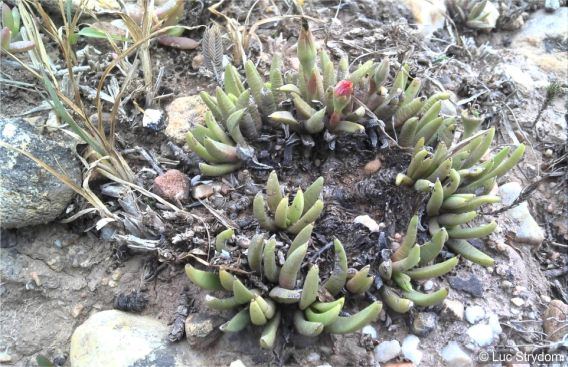
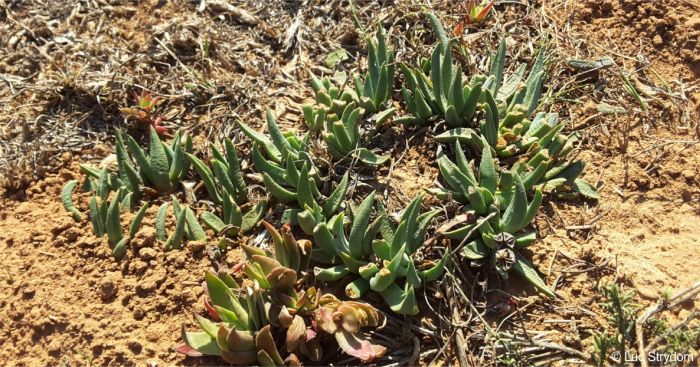
Bergeranthus addoensis can be distinguished from other species in the genus by its growth habit, the leaves grow from the centre outwards, forming rings, with dead inner older plants remaining in the centre, and it has smooth seed coats.
Conservation Status
Status
Bergeranthus addoensis was assessed as Near Threatened (NT) by the SANBI Red List of South African Plants in 2018 because rapid urbanization, industrialization, overgrazing and encroachment of alien invasive species is degrading and fragmenting its population and causing it to decline. Seeds have been collected by Millennium Seed Bank Partnership (MSBP) South Africa and banked in the Millennium Seed Bank UK as back up and for future restoration. Half of the collection will be withdrawn from the Millennium Seed Bank and banked in our own SANBI seed bank when it is operational.
Distribution and habitat
Distribution description
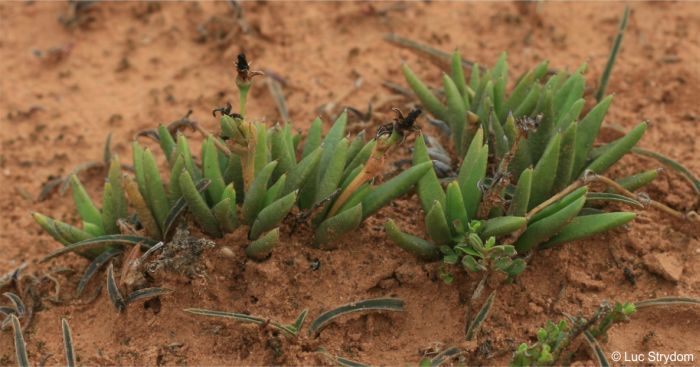
Bergeranthus addoensis is a South African endemic, confined to the low-lying areas between Addo and Gqeberha in the Eastern Cape, growing in clay-rich soils in open karroid thicket mosaic habitats where it experiences hot summers and mild winters with sporadic rainfall, although most rain falls in the summer months.
Derivation of name and historical aspects
History
The genus Bergeranthus is named after a German horticulturist and succulent researcher, Alwin Berger (1871–1931). Bergeranthus is a small genus composed of only 10 species which all occur in the Eastern Cape Province of South Africa, and 6 of them are listed as taxa of conservation concern. The species name addoensis means ‘from Addo’, a town in the Eastern Cape Province of South Africa, referring to the type locality or geographical place where the species was first discovered. B. addoensis was first described by Harriet Margaret Louisa Bolus (1877–1970), a South African Botanist, Mesembryanthemaceae family specialist and Bolus Herbarium Curator from 1903 until 1955.
The Aizoaceae family, commonly known as vygies in South Africa, consists of 135 genera and approximately 1 800 species. Numerous species of the Aizoaceae family inhabit the Greater Cape Floristic Region, one of the world’s biodiversity hotspots.
Ecology
Ecology
Addo vygie is adapted to the summer rainfall climate, tolerating little frost. The bright yellow flowers attract pollinators such as bees, butterflies and other insects. The flowers are diurnal, opening in late afternoon and closing before sunset in a phenomenon called nyctinasty, a survival mechanism in which petals close at night to protect the plant’s reproductive organs (stamens, pistils, ovaries) and pollen from nocturnal insects and dew as moisture lowers pollen fertility. The species has hygrochastic seeds which only open when wet, to release seeds. In the wild, seed dispersal occurs in the rainy season as the capsules only open when wet.
Uses
Use
No medicinal uses or cultural applications have been documented for this species, however, the roots of Bergeranthus species are used by the Xhosa people as fermenting and fortifying agents in iqhilika, a traditional honey beer. Bergeranthus addoensis is an excellent pot plant and can be grown as a groundcover to combat soil erosion.
Growing Bergeranthus addoensis
Grow
Bergeranthus addoensis thrives in gardens that experience hot summers and sporadic rainfall with mild winters. It can be planted in a waterwise rocky garden in full sun and is well suited to be grown as a container plant.
Bergeranthus addoensis can be easily propagated through division and seeds. Division is recommended as true to type forms of the plants are instantly guaranteed. As plants mature and clumps develop, separate the offsets ensuring roots remain attached. Plant in individual containers in a well-drained sandy mixture, preferably 2 parts river sand and 1 part potting soil mix. Water sparingly and keep the soil slightly moist to avoid root rot. Place containers in a sunny position. Divide the plants in late winter, just before the active growing season begins. To transplant mature and overgrown plants into the garden, carefully squeeze the container or pot to loosen the edges, shake off the roots to remove compacted soil, plant at the same depth as their previous container. Water sparingly to avoid excessive moisture. Remove dead leaves to encourage new growth.
Bergeranthus addoensis is prone to powdery mildew in humid areas. Treat with systemic fungicide.
Sow Bergeranthus addoensis seeds in spring (September-October) on a mix of 2 parts fine river sand and 1 part fine potting soil. Spread the seeds on top of the soil in seed trays and cover the seeds with a thin layer of the sandy mix. Place the trays in a warm area away from direct sunlight. Gently water with a fine nozzle spray every second day, keep the medium moist, not wet. Germination takes place within 3 weeks; however, seedlings are slow growing.
References
- Bredenkamp, C. 2019. A flora of the Eastern Cape Province. Strelitzia 41. Volume 1. South African National Biodiversity Institute, Pretoria.
- Chesselet, P. 2004. Mesembryanthemaceae (Aizoaceae) Class: Dicotyledonae (Angiosperms) Order: Caryophyllales. PlantZAfrica. Online. https://pza.sanbi.org/mesembryanthemaceae.
- Dold, A.P., Hammer, S.A. & Barker, N.P. 2005. Leaves of grass: A taxonomic revision of the genus Bergeranthus Schwantes (Aizoaceae). Haseltonia 11:78-97.
- Dold, A.P., Victor, J.E. & Von Staden, L. 2018. Bergeranthus addoensis L. Bolus. National Assessment: Red List of South African Plants version 2024. 1. https://redlist.sanbi.org/species.php?species=152-1.
- Glen, H.F. & Germishuizen, G. (compilers). 2010. Botanical exploration of southern Africa, edition 2. Strelitzia 26. South African National Biodiversity Institute, Pretoria.
- Metzing, D. 2017. The scientific heritage of the gardener, botanist, and succulent researcher Alwin Berger. Bolletino dei Musei e degli Istituti Biologici dell’Università di Genova. 79. 17-45.
- Nqentsu, S. 2020. Bergeranthus scapiger (Haw.) Schwantes. (Aizoaceae). PlantZAfrica. Online. https://pza.sanbi.org/bergeranthus-scapiger.
- Peter, C.I., Dold, A.P., Barker, N.P. & Ripley, B.S. 2004. Pollination biology of Bergeranthus multiceps (Aizoaceae) with preliminary observations of repeated flower opening and closure. South African Journal of Science 100:624-629.
- Strydom, L. 2026. Observations of Bergeranthus addoensis, Eastern Cape. iNaturalist. Online. https://www.inaturalist.org/observations?taxon_id=581034&user_id=lucstrydom.
- Viljoen, C. 2020. Observation of Bergeranthus addoensis, Eastern Cape. iNaturalist. Online. https://www.inaturalist.org/observations/62382135.
- World Flora Online: Bergeranthus addoensis L.Bolus. http://www.worldfloraonline.org/taxon/wfo-0000564271. Accessed on 29 Mar 2026.
Credits
Ntsakisi Masia
Kwelera National Botanical Garden
April 2026
Acknowledgements: Special thanks to Luc Strydom and Christiaan Viljoen for providing information and photos of Bergeranthus addoensis.
Plant Attributes:
Plant Type: Succulent
SA Distribution: Eastern Cape
Soil type: Sandy, Clay, Loam
Flowering season: Spring, Early Summer, Late Summer, Autumn
PH: Acid, Alkaline, Neutral
Flower colour: Yellow
Aspect: Full Sun
Gardening skill: Easy
Special Features:
 Drought resistant
 Good potplant
 Useful plant
 Feeds honeybees
Horticultural zones


Rate this article
Article well written and informative
Rate this plant
Is this an interesting plant?
Login to add your Comment
Back to topNot registered yet? Click here to register.