


Berkheya angusta
Introduction
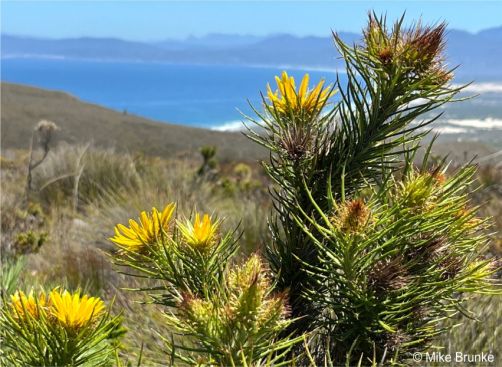
A woody shrub characterized by its spiny narrow leaves, and yellow flower heads typical of the Berkheya genus, that stands out for its striking appearance and tenacity.
Description
Description
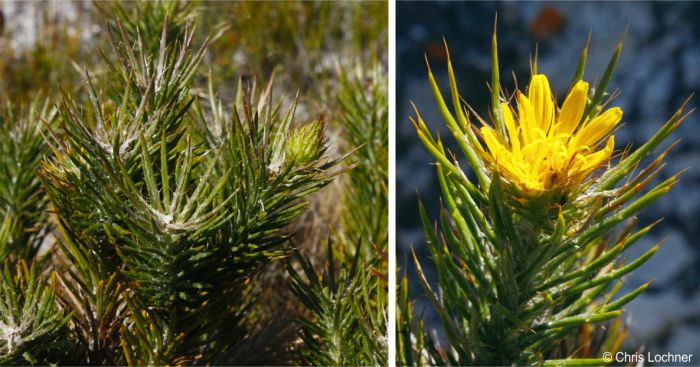
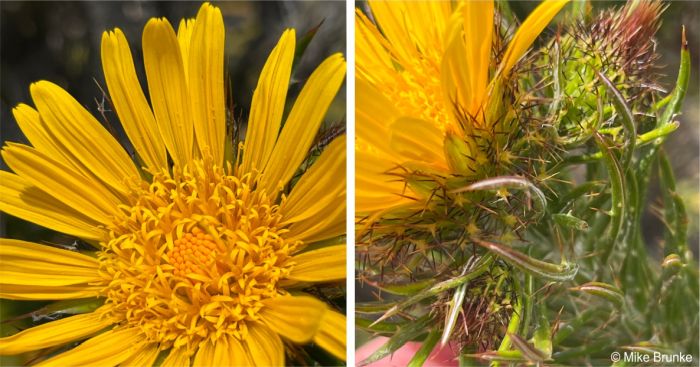
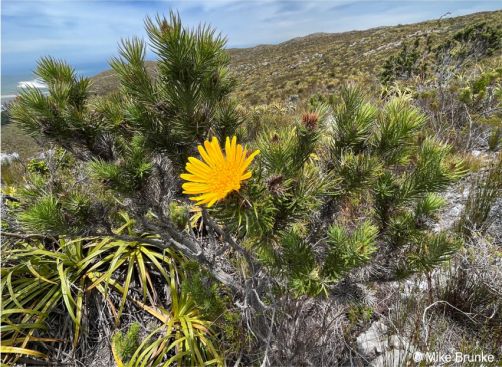
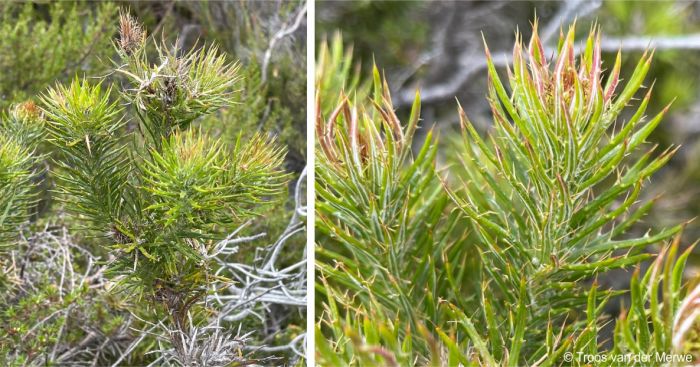
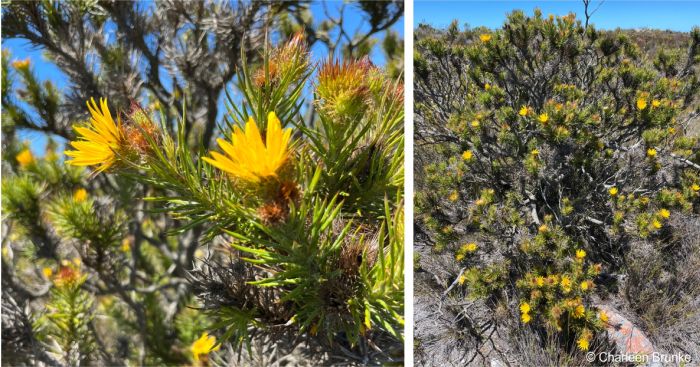
Berkheya angusta reaches a height of about 1 m. It is an erect, densely leafy, woody shrub with ascending, spiny, linear leaves with margins rolled under (revolute). Young growth is covered with white woolly hair, becoming hairless when mature. The leaves are green and are white felted underneath. Bright yellow daisy-like flower heads are produced among the upper leaves at the tips of branches, appearing mainly in spring and early summer.
Conservation Status
Status
Berkheya angusta is currently assessed as Vulnerable (VU) by the Red List of South African Plants. This species is threatened by habitat loss caused by the expansion of commercial farming. Urban development also poses a potential threat to the African thistles.
Distribution and habitat
Distribution description
This species is endemic to South Africa, and is only found in the Western Cape, where it grows on lower sandstone or clay slopes in fynbos ecosystems in the Breede River Valley east of Worcester and in the mountains between Bredasdorp and Gansbaai. Its major habitats are rich in biodiversity and include South Langeberg Sandstone Fynbos, Overberg Sandstone Fynbos, Montagu Shale Fynbos, Breede Shale Fynbos, Robertson Granite Fynbos and Elim Ferricrete Fynbos.
Derivation of name and historical aspects
History
The genus Berkheya was created by Jakob Friedrich Ehrhart in 1784, he named it in honour of Johannes le Francq van Berkhey, a Dutch botanist. The genus Berkheya is native to southern and tropical Africa and contains around 75 species with the majority being indigenous in southern Africa. The plants are often spiny with a thistle-like appearance and some species are considered weeds. The genus includes other notable members such as Berkheya purpurea, Berkheya radula and Berkheya angustifolia.
The specific name angusta is Latin, meaning narrow, which likely refers to the leaves. Berkheya angusta is poorly known and is often misidentified as the closely related and similar looking genus Cullumia.
The species belongs to the very large daisy family, Asteraceae. It is one of the largest families of flowering plants, with over 32 000 species, including well known garden plants like sunflowers, daisies and chrysanthemums, as well as edible artichokes and lettuce.
Ecology
Ecology
Berkheya angusta is typically pollinated by insects such as bees and beetles. The species serves as a vital component of the surrounding ecosystem, the flowers providing essential nectar and pollen for a variety of pollinators. Furthermore, as native flora, it helps stabilize the soil, preventing erosion and maintaining the health of the ecosystem.
Uses
Use
Berkheya angusta can be used in fynbos gardens, rockeries and as a barrier to keep unwanted animals and visitors out of an area because of its spiny leaves. There is no documented or published information on the traditional medicinal uses of Berkheya angusta, however other members of the same genus, Berkheya setifera and Berkheya heterophylla, are used to treat various illnesses such as stomach complaints, inflammation, chest pain and colic. The plant is not known to be edible, nor does it have any craft uses.
Growing Berkheya angusta
Grow
Cultivating Berkheya angusta requires well-drained, acidic soil and full sun exposure. Propagation is typically achieved through seeds sowing. Seeds should be sown in a well-drained medium, kept moist in warm environment. Germination usually occurs within 2-3 weeks. Once seedlings are established, they can be transplanted into plastic bags or 3 litre pots. After transplantation, they are left at the potting shed to harden off so that they can withstand the moving process and exposure to different environments.
This resilient plant thrives best in regions with a Mediterranean climate, characterized by cool, wet winters and hot, dry summers. It prefers well-drained acidic soil, often growing in sandy or rocky substrate, which indicates that it is well adapted to tolerate drought conditions effectively.
References
- Bean, A. & Johns, A. 2005. Stellenbosch to Hermanus. South African Wild Flower Guide 5. Botanical Society of South Africa, Cape Town.
- Brunke, C. 2023 Observation of Berkheya angusta. iNaturalist. Online. https://www.inaturalist.org/observations/146198048.
- Brunke, M. 2023. Observations of Berkheya angusta. iNaturalist. Online. https://www.inaturalist.org/observations/191383487 & https://www.inaturalist.org/observations/146124568
- Gumede, S. 2022. Berkheya multijuga (DC.) Roessler. (Asteraceae). PlantZAfrica. Online. https://pza.sanbi.org/berkheya-multijuga.
- Lochner, C. 2021. Observation of Berkheya angusta. iNaturalist. Online. https://www.inaturalist.org/observations/71353461.
- Manning, J. & Goldblatt, P. 2012. Plants of the Greater Cape Floristic Region 1: the Core Cape Flora. Strelitzia 29. South African National Biodiversity Institute, Pretoria.
- Manning, J. 2007. Field guide to Fynbos. Struik Publishers, Cape Town.
- Mckenzie, R.J., Karis, P.O. & Gwynne-Evans, D. 2025. Morphology and distribution of the enigmatic Berkheya angusta (Asteraceae, Arctotideae). Phytotaxa 736(2):135–150. https://phytotaxa.mapress.com/pt/article/view/phytotaxa.736.2.3.
- Raimondo, D., Turner, R.C. & von Staden, L. 2012. Berkheya angusta Schltr. National Assessment: Red List of South African Plants version 2024.1. https://redlist.sanbi.org/species.php?species=3077-5.
- Van der Merwe, T. 2021 Observation of Berkheya angusta. iNaturalist. Online. https://www.inaturalist.org/observations/99759098.
- Van Rooyen, G. & Steyn, H. 1999. Cederberg Clanwilliam & Biedouw Valley South African wildflower guide 10. Botanical Society of South Africa, Cape Town.
Credits
Mashudu Tshitereke
Walter Sisulu National Botanical Garden
February 2026
Acknowledgements: images by Mike Brunke, Charleen Brunke, Troos van der Merwe and Chris Lochner.
Plant Attributes:
Plant Type: Shrub
SA Distribution: Western Cape
Soil type: Sandy, Loam
Flowering season: Spring, Early Summer
PH: Acid
Flower colour: Yellow
Aspect: Full Sun
Gardening skill: Average
Special Features:
 Drought resistant
 Feeds honeybees
Horticultural zones



Rate this article
Article well written and informative
Rate this plant
Is this an interesting plant?
Login to add your Comment
Back to topNot registered yet? Click here to register.