


Caputia medley-woodii
Introduction
The KwaZulu-Natal caputia is a succulent leaved shrub with silvery leaves and bright yellow daisy-like flowers from summer to winter. Widespread from the Eastern Cape to KwaZulu-Natal, it is an attractive plant best grown in rockeries and containers.
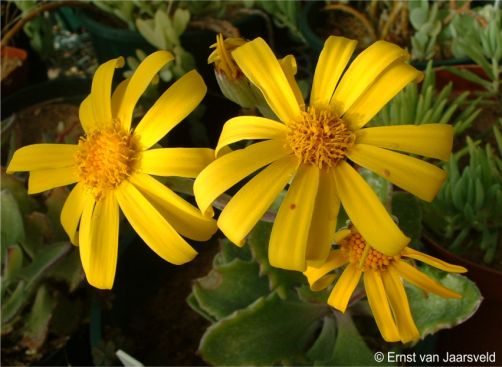
Fig. 1. Caputia medley-woodii flowering in the Kirstenbosch Succulent Nursery.
Description
Description
Caputia medley-woodii is a spreading, decumbent, semi-scandent, sometimes pendent, and sparsely branched shrub, 0.5–2 m tall and 0.6–1 m in diameter, covered with dense felt-like hairs, becoming glabrescent in part. Roots fibrous. Branches terete, thick, succulent, white-felted, greyish to maroon-purplish green, tapering, up to 400 mm long, at first soft, becoming firm and deciduous towards base. Leaves dorsiventrally flattened, ascending, shortly petiolate, firm, succulent, obovate to rhombic, 35–60 × 15–40 mm to almost triangular; surface whitish green owing to dense mat of white woolly hairs, becoming glabrescent with age, exposing the green surface; margin reddish, entire or bearing up to 5 shallow to larger triangular teeth; base wedge-shaped (cuneate), rarely arrowhead-shaped (sagittate); apex acute to sub-acute, ending in a sharp, short point (mucronate).
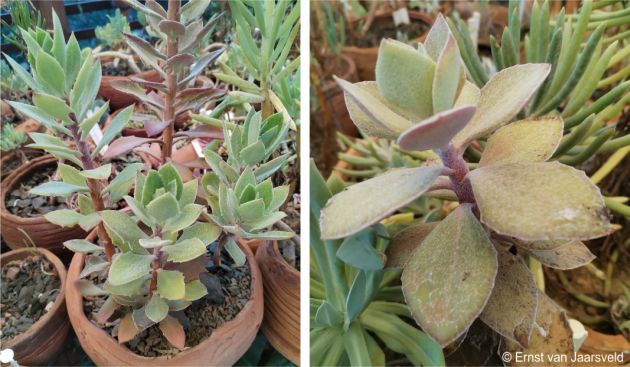
Fig. 2. Caputia medley-woodii in cultivation in the succulent collection at Babylonstoren Farm, LEFT ‘Mzimvubu’, note the spear-shaped leaves and RIGHT a plant originally from Oribi Gorge in southern KwaZulu-Natal.
Inflorescence with 1 to 4 capitula, a terminal loose corymb up to 190 mm long; peduncle 30–90 mm long with a few smaller leaf-like bracts. Capitulum large, 37–50 mm in diameter, honeycombed at base, with up to 15 phyllaries. Ray florets up to 13, bright yellow. Disc florets dirty yellow. cypsela fusiform, glabrous, 5-ribbed, about 6 mm long; pappus bristles white, persistent, 9–10 mm long. Flowering from late summer to winter.
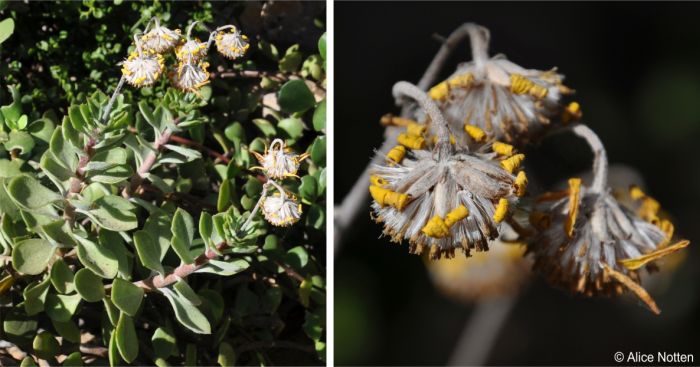
Fig. 3. Caputia medley-woodii fruiting in the Conservatory at Kirstenbosch.
Conservation Status
Status
Caputia medley-woodii has specialised habitat requirements in dry river valleys on cliffs, but it is widespread and well protected by its habitat and is not threatened. Consequently it is assessed as Least Concern (LC) by the Red List of South African Plants.
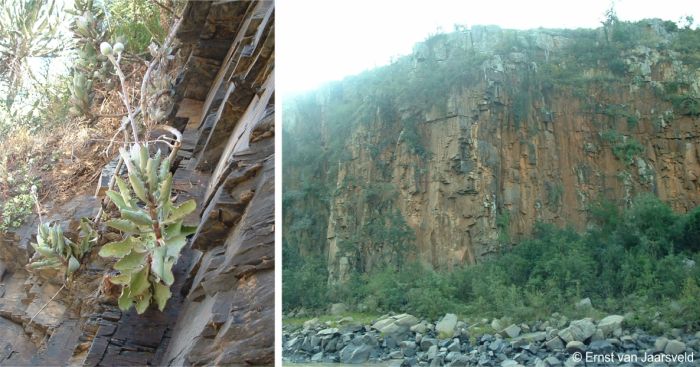
Fig. 4. LEFT Caputia medley-woodii in habitat on a north-facing shale cliff along the Mzimvubu River, Eastern Cape. RIGHT The cliffs of the Mzimvubu River, habitat of Caputia medley-woodii.
Distribution and habitat
Distribution description
Caputia medley-woodii is distributed from the Mzimvubu River (Port St Johns), Eastern Cape, in the south to northern KwaZulu-Natal and just reaching Mpumalanga where it grows on cliffs adjacent to the Pongola River at Klipwal Gold Mine. It also occurs in Eswatini. The habitat is dry river valleys, where it grows on steep rocky embankments and vertical quarzitic sandstone or shale cliffs (quarzitic sandstone of the Natal Group, (Cape Supergroup), also on Beaufort shale (Karoo Supergroup). Plants are rooted in crevices and on rock ledges and grow at altitude from 460–800 m (all aspects). Extreme temperatures as high as 40°C have been recorded. Winters are cooler but frost is a rarity or absent. The average daily maximum temperature is 24°C and the average daily minimum is 16°C. Rainfall mainly from spring to autumn but occasionally also in winter, ranging from 1000–1250 mm per annum. The associated vegetation consists of Eastern Valley Bushveld of the Savanna Biome.
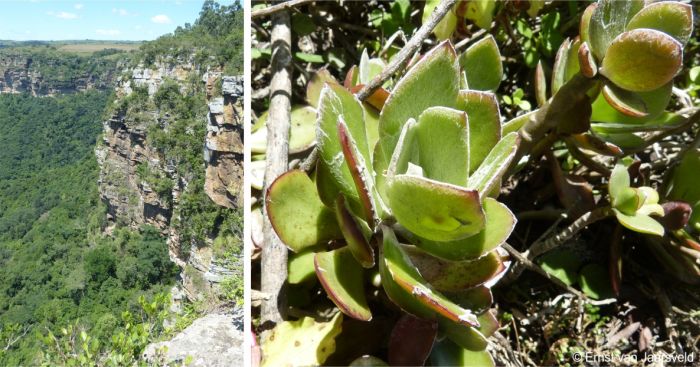
Fig. 5. LEFT The sheer cliff face at Oribi Gorge, southern KwaZulu-Natal, habitat of Caputia medley-woodii. RIGHT Caputia medley-woodii in habitat, growing on the cliffs at Oribi Gorge.
At Oribi Gorge plants were found growing on south-facing cliffs in association with Adromischus cristatus var. zeyheri, Aloe arborescens, Gasteria croucheri, Cotyledon orbiculata var. oblonga, Crassula perfoliata var. perfoliata, Crassula perforata, Crassula sarmentosa var. integrifolia, Delosperma lebomboense, Petopentia natalensis and Plectranthus ernstii.
At the Mzimvubu River Waterfall, plants of this distinctive form were observed on north-facing Beaufort Shale cliffs together with Crassula perforata, Adromischus cristatus var. mzimvubuensis, Crassula foveata, Portulacaria afra and Euphorbia triangularis. Plants are locally abundant.
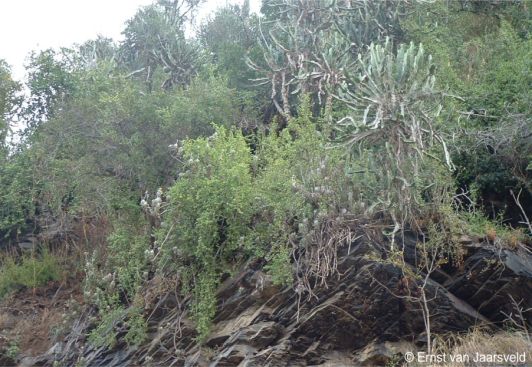
Fig. 6. A group of Caputia medley-woodii in habitat beside the Mzimvubu River, growing among Euphorbia triangularis and Portulacaria afra.
Derivation of name and historical aspects
History
The genus Caputia was established by the Swedish botanist, Bertil Nordenstam and the South African, Pieter Pelser in 2012 in the Compositae Newsletter. The generic name Caputia alludes to their geographical origin, the old geographical name Caput bonae spei was often applied not only to the Cape of Good Hope or the old Cape Province but to the whole of Southern Africa.
The botanist John Hutchinson (1884–1972), the author of this species, named it in 1923 in the Flowering Plants of Africa in honour of the botanist John Medley Wood (1827-1915), a prolific horticulturist, botanist and botanical writer, who became the Curator of the Natal Botanical Garden in 1882 and first Curator of the Natal Herbarium. Medley Wood is honoured for his contribution towards the KwaZulu-Natal collection of plants and building up the Natal Botanical Garden. He was responsible for collecting the type specimen for this species near Murchison in 1884, as well as at a few other sites sites. Living examples of Caputia medley-woodii can be seen in the Botanical Society Conservatory at Kirstenbosch, as well as the succulent collection of the Babylonstoren Farm near Simondium in the Western Cape.
The genus Caputia consists of 5 species: Caputia medley-woodii, C. oribiensis, C. pyramidata, C. scaposa and C. tomentosa all endemic to southern Africa and all featured on PlantZAfrica.
Caputia medley-woodii varies in leaf shape and marginal teeth size. Various forms were encountered along the rubber canoe expeditions exploring the rivers of the Eastern Cape undertaken by the author during the past 25 years. On our rubber canoe expedition down the Mzimvubu River, near the waterfall in April 2002 we found plants with distinctive large teeth, and plants introduced to cultivation is given the cultivar name ‘Mzimvubu’ This form was illustrated by botanical artist Jeanette Loedolff. It has been given the cultivar name Caputia medley-woodii ‘Mzimvubu’.
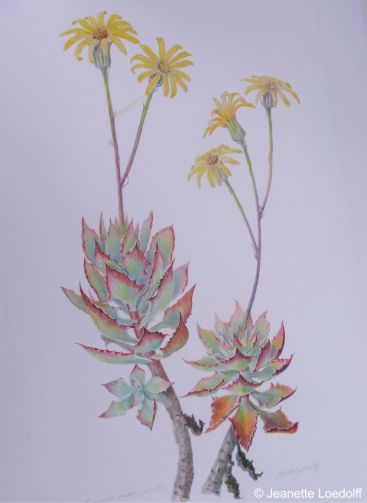
Fig. 7. Illustration of Caputia medley-woodii 'Mzimvubu', by Jeanette Loedolff, from plants collected on a rubber canoe expedition to the Mzimvubu River, Eastern Cape, in April 2002.
Ecology
Ecology
Caputia medley-woodii is well adapted to the dry river valleys. Plants are evergreen, bearing firm, long-lived leaves, older leaves withering from the base. The fleshy stems and leaves become turgid after rain, but are often in a semi-desiccated state during dry periods. The leaves often crowded at the stem tips grow ascending, often pointing towards the light source, the tips facing towards the sun, thus receiving the least amount of direct exposure, and the dense mat of wool protects the plants from excessive sunlight and heat. The younger and older stems are often maroon-purplish due to the anthocyanin pigment assisting during dry conditions.
The inflorescence consists of a loose, terminal 1–4-flowered corymb. The flowers are conspicuous and large in comparison to plant size (rich flowering). They are pollinated by insects. The fruits develop and once the capitulum ripens, are dispersed by gusts of wind or thermals, each seed with its own parachute becomes airborne, dispersing its offspring. The thermals carry the parachute with its seed which will germinate if it lands on a suitable crevice. The seeds ripen during summer and autumn.
The spreading to sub-pendent stems are flaccid, rooting where they find adjacent ledges or crevices below, forming new colonies. Detached plants landing in crevices or on ledges will root, an extensive vegetative backup strategy aiding long-term survival.
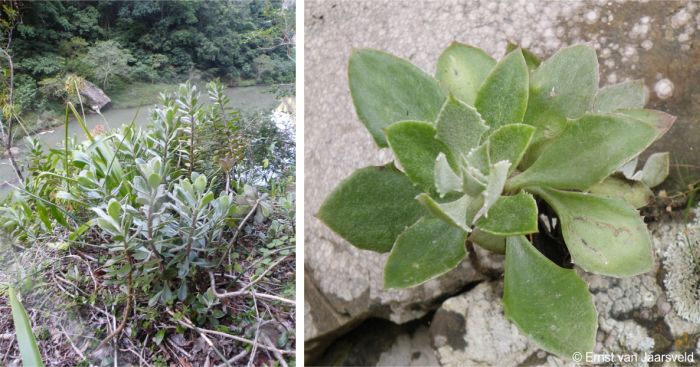
Fig. 8. Caputia medley-woodii growing beside the Msikaba River, Eastern Cape, LEFT on a cliff ledge near the Vulture Colony and RIGHT on a sandstone cliff.
Uses
Use
No medicinal or cultural uses are known, apart from its horticultural potential . It is best suited to the succulent garden or rock garden.
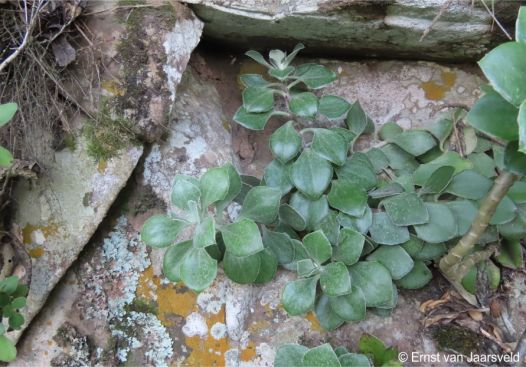
Fig. 9. Caputia medley-woodii in habitat growing on cliffs of the Umkhomazi River near Durban, KwaZulu-Natal.
Growing Caputia medley-woodii
Grow
Caputia medley-woodii is easily grown and best cultivated in dry bushveld, thicket and Mediterranean-climate gardens where frost is not a problem. It grows well in dappled shade and prefers exposed habitats. Plant on steep embankments and gabions. Plants can be established planting cuttings in situ. It makes a great pot plant, best kept in a sunny, exposed position such as a balcony or windowsill. The soil should be sandy and well-drained, such as 2 parts sand, 1 part compost and 1 part garden loam, as is found in its natural habitat. They react well to an organic fertiliser. Water sparingly summer and winter. When plants become untidy they can be pruned accordingly.
Sow seed in spring or summer in a sandy medium. First moisten the substrate with fine rose. Sow the seed and cover lightly with a thin layer of sand or gravel. Keep moist and place in a shady region. Germination is usually within 3 weeks and the young seedlings are slow growing. Transplant seedlings to individual containers when they are large enough to handle.
Plants are relatively disease free but snails can cause a problem.
References
- Dyer, R.A. 1931. Senecio scaposus. Flowering Plants of Africa 11: t. 434.
- Gunn, M. & Codd, L.E. 1980. Botanical exploration of southern Africa. Balkema, Cape town.
- Hutchinson, J. 1923. Senecio medley-woodii. The Flowering Plants of South Africa 3: t. 83.
- Mucina, L. & Rutherford, M.C. (eds) 2006. The vegetation of South Africa, Lesotho and Swaziland. Strelitzia 19. South African National Biodiversity Institute, Pretoria.
- Nordenstam, B.E. & Pelser P.B. 2012. Caputia, a new genus to accommodate four succulent South African Senecioneae (Compositae) species. Compositae Newsletter 50: 56-69.
- Raimondo, D., Von Staden, L., Foden, W., Victor, J.E., Helme, N.A., Turner, R.C., Kamundi, D.A. & Manyama, P.A. (eds) 2009. Red list of South African plants. Strelitzia 25. South African National Biodiversity Institute, Pretoria.
- Rowley, G.D. 1994. Succulent compositae. Strawberry Press, Mill Valley, California.
- Smith, C.A. 1966. Common names of South African plants. Memoirs of the Botanical Survey of South Africa No. 35. Government Printer, Pretoria.
- Van Jaarsveld, E.J. 2010. Waterwise gardening in South Africa and Namibia. Struik, Cape Town.
Credits
Ernst van Jaarsveld
Kirstenbosch National Botanical Garden (Retired)
Babylonstoren Farm (Current)
Extraordinary senior lecturer and researcher,
Department of Biodiversity and Conservation, University of the Western Cape
July 2026
Plant Attributes:
Plant Type: Shrub, Succulent
SA Distribution: Eastern Cape, KwaZulu-Natal, Mpumalanga
Soil type: Sandy, Loam
Flowering season: Late Summer, Autumn, Winter
PH: Acid, Neutral
Flower colour: Yellow
Aspect: Full Sun, Morning Sun (Semi Shade), Afternoon Sun (Semi Shade)
Gardening skill: Easy
Special Features:
 Drought resistant
 Good potplant
 Indoor plant
 Feeds honeybees
Horticultural zones


Rate this article
Article well written and informative
Rate this plant
Is this an interesting plant?
Login to add your Comment
Back to topNot registered yet? Click here to register.