


Carissa spinarum
Introduction
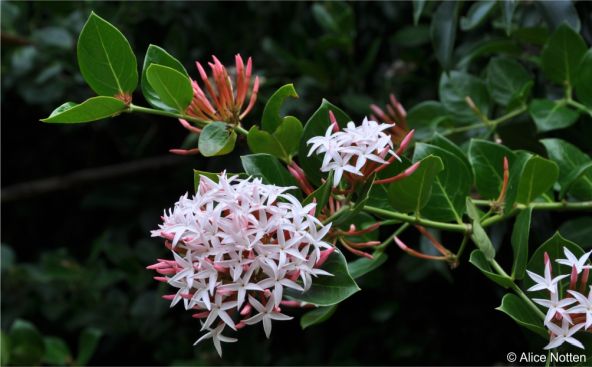
A fast-growing, spiny, scrambling shrub with glossy foliage, masses of fragrant white flowers in spring and small, oval, red, edible fruits in summer.
Description
Description
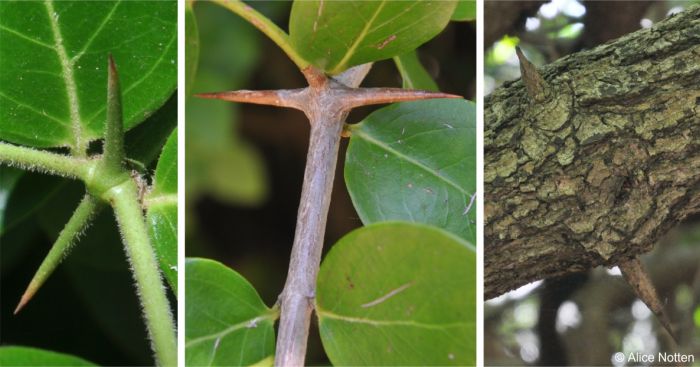
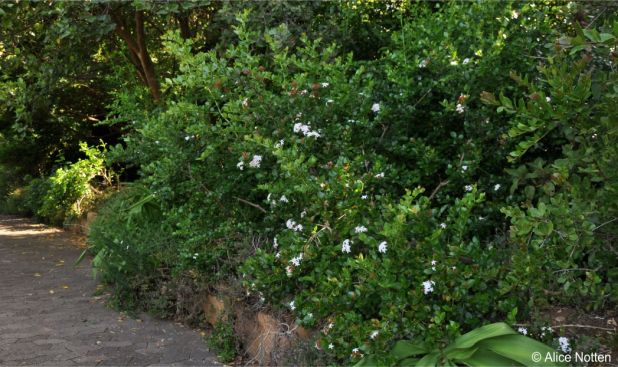
Carissa spinarum is a much-branched, spiny, evergreen shrub or small tree, usually multistemmed, often scrambling, up to 6 m tall and forming a dense canopy. All parts of the plant release white, non-toxic, milky latex. Young branches are green, smoothly covered with short hair, but older branches and stems become light brown and corky with deep cracks. The plant is armed with rigid spines up to 70 mm long, opposite, and nearly always simple, not forked as with other species of Carissa. Leaves are simple and opposite, leathery, dark green above and paler below, with or without hair. The leaf base is shallowly lobed, the margins are smooth and the leaf stalk up to 5 mm long.
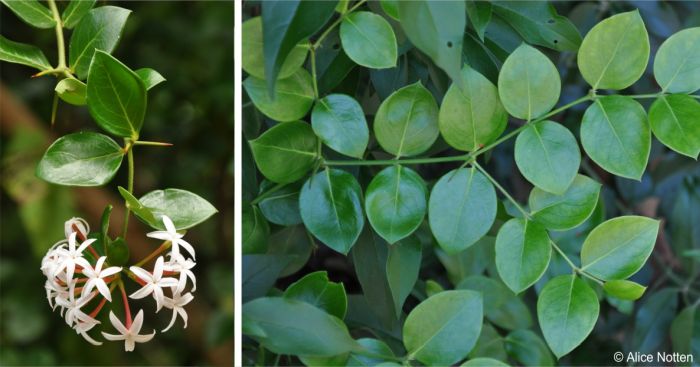
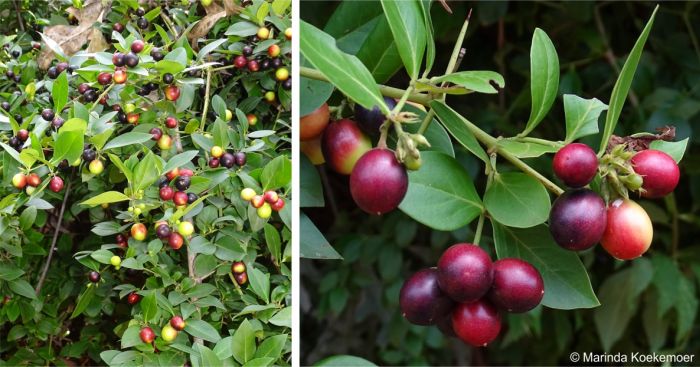
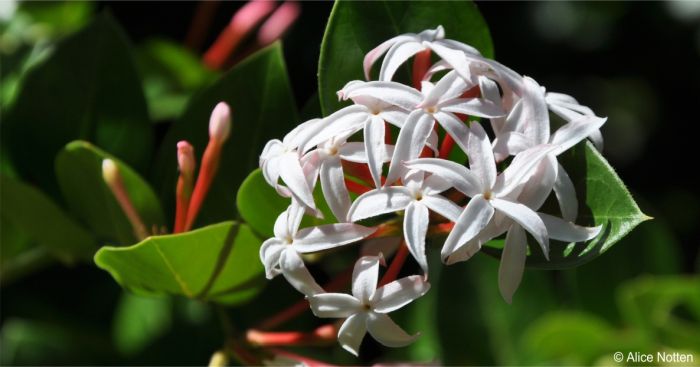
Flowers are in terminal heads up to 40 mm in diameter, white tinged pink to purple and up to 20 mm long. The corolla with lobes overlapping to the right. The flowers have a strong sweet jasmine-like scent. Flowering is in spring and early summer, from September to December. Fruits are fleshy berries, ovoid, 6-11 mm in diameter, 2- to 4-seeded. Unripe fruits are green with red to purplish marks. Ripe fruits are dark red to purplish-black.
Conservation Status
Status
Carissa spinarum is assessed as Least Concern (LC) by the Red List of South African Plants. It is widespread, does not qualify for any of the categories of threat and is not at risk of extinction.
Distribution and habitat
Distribution description
Carissa spinarum occurs in Africa south of the Sahara, from Senegal in the west to north-eastern South Africa in the south, to Socotra in the east, and in Seychelles, Madagascar, Arabian Peninsula, India, southern Asia and Oceania. In South Africa, it occurs in the provinces of Mpumalanga and Limpopo, in bushveld, dry woodland, often in riverine vegetation or on termite mounds, and is common in deciduous to evergreen woodland. It also occurs in wet or dry forest, thicket and savanna. It is often found in granite soil.
Derivation of name and historical aspects
History
Carissa spinarum has a very wide range and is a variable species that occurs in diverse habitats and, as a result, it has been named many times by many botanists over the years, and currently has 80 recognised synonyms according to Plants of the World Online. The 2001 revision by Leeuwenberg and van Dilst concluded that they are all the same species and the characters used to divide them are not consistent and variations occur within populations. In South Africa this species has been known as Carissa edulis for many years, but the name Carissa spinosa is now its valid and accepted name because it is the earliest published name. The taxonomy of Carissa can be described as messy, with much disagreement on the recognition of some species. The 2015 phylogenetic analysis by Stodart and Barker showed an African and an Asian/Australian clade but with low support, and concluded that more data from more populations is required for further study.
The genus name Carissa is derived from the Sanskrit name for an Indian plant of this genus. The species name spinarum means ‘thorns, spines or prickles’, referring to its large spines. The former species name edulis means ‘edible’, referring to the fruits.
Other southern African species of Carissa include C. macrocarpa (big num-num), C. bispinosa (forest num-num), C. tetramera (sand num-num) and C. sebrabergensis (Sebraberg num-num).
Ecology
Ecology
The habit of the plants varies depending on the habitat. It is a bushy shrub in open environments, and a climber or a tree in forests. It tends to have larger spines in arid climates, and climbing forms tend to have larger leaves.
Leaves are browsed by kudu, nyala, bushbuck, impala and grey duiker and the fruits are eaten by kudu, grey duiker, baboons, monkeys and bush pigs. Birds favour the tree for nest building, and fruit eating birds (francolins, louries, hornbills, barbets and bulbuls) love the fruits. Bushes are also an ideal refuge for small animals and reptiles like snakes.
Uses
Use
Traditionally decoctions of roots are used as pain killer and to treat malaria. Taken warm and in small quantity it is also used for indigestion and for abnormal pains during pregnancy. The fruits help in the treatment of dysentery. The powdered root is used as a remedy for chest complaints. An infusion made from the roots is drunk to ease stomach ache, as a cough remedy or is dropped into the eye for cataract problems. Root macerated in rum or gin has also been used as bitters. Extracts of Carissa spinarum show activity against Herpes simplex virus and cytotoxicity against breast and lung cancer cells.
Fruits are edible, the milky red pulp having a pleasant sweet taste and are much sought after. The fruit can be used to make jam, jellies, added to stews and meat dishes, fermented to make a refreshing pink wine or left longer to make vinegar. Boys eat the fruits when looking after livestock in the forest.
If planted close together it can be grown as an effective hedge to keep intruders out and can take heavy pruning quite well. When planted as a hedge along a fence after a period of eight years the hedge will be so thick that no stock or game will be able to penetrate it. A delightful addition to any garden, it does not have an invasive root system and can be planted close to buildings. It makes a successful background plant with its scrambling habit and masses of fragrant white flowers.
Growing Carissa spinarum
Grow
Carissa spinarum can be propagated from both seeds and cuttings. Fill a tray with river sand and place the seeds on the surface, press them into the sand until they are flush with the surface and cover with a layer of sand equal to the thickness of the seed.
Keep them in a warm spot; germination takes about 7-14 days. Seedlings can be transplanted into nursery bags filled with a mixture of soil and compost (2:1 ratio) when they reach the 2-leaf stage, or they can be planted into open ground. Seedlings and young plants are frost-tender and should be covered by grass or shade cloth for the first two winters if grown in an area affected by frost. The simple-spined num-num has a growth rate of 1-2 m per year; it is very drought resistant.
References
- Dharani, N. 2002. Field guide to common trees and shrubs of East Africa. Struik, Cape Town.
- Fox, F.W. & Norwood Young, E. 1982. Food from the veld: edible wild plants of southern Africa. Delta Books, Cape Town.
- Jackson, W.P.U. 1990. Origins and meanings of names of South African plant genera. University of Cape Town Printing Department, Cape Town.
- Leeuwenberg, A.J.M. & Van Dilst F.J.H. 2001. Series of revisions of Apocynaceae XLIX Carissa L. Backhuys Publishers, Leiden.
- Plants of the World Online. Carissa spinarum L. https://powo.science.kew.org/taxon/urn:lsid:ipni.org:names:77756-1. Accessed 19 March 2023.
- Raimondo, D. 2023. Carissa spinarum L. National Assessment: Red List of South African Plants version 2024.1. https://redlist.sanbi.org/species.php?species=984-9.
- Stodart, D.W. & Barker, N.P. 2015. The species level phylogenetic relationships of the genus Carissa L. (Apocynaceae). South African Journal of Botany 98:202.
- Van Wyk, A.E. & Van Wyk, P. 2007. How to identify to trees in southern Africa. Struik, Cape Town.
- Van Wyk, B. & Van Wyk, P. 1997. Field guide to trees of southern Africa. Struik, Cape Town.
- Venter, F. & Venter, J. 2007. Making the most of indigenous trees. Briza Publications, Pretoria.
- Wangteeraprasert, R., Lipipun, V., Gunaratnam, M., Neidle, S., Gibbons, S. & Lichitwitayawuid, K. 2012. Bioactive compounds from Carissa spinarum. Phytotherapy Research 26(10):1496-9.
Credits
Thompson Mutshinyalo and Refilwe Malatji
Walter Sisulu National Botanical Garden
June 2012
Updated by Alice Notten
Kirstenbosch National Botanical Garden
March 2026
Acknowledgements: images by Alice Notten and Marinda Koekemoer.
Plant Attributes:
Plant Type: Scrambler, Shrub, Tree
SA Distribution: Limpopo, Mpumalanga
Soil type: Loam
Flowering season: Spring, Early Summer, Late Summer
PH: Acid, Neutral
Flower colour: White, Pink
Aspect: Full Sun, Morning Sun (Semi Shade), Afternoon Sun (Semi Shade)
Gardening skill: Easy
Special Features:
 Attracts birds
 Drought resistant
 Fragrant
 Hedge/screen
 Edible plant
 Medical plant
Horticultural zones


Rate this article
Article well written and informative
Rate this plant
Is this an interesting plant?
Login to add your Comment
Back to topNot registered yet? Click here to register.