


Coleus gibbosus
Introduction
Few indigenous plants combine understated beauty and resilience as effectively as Coleus gibbosus. This attractive aromatic perennial belongs to the mint family (Lamiaceae) and is endemic to the KwaZulu-Natal Midlands in South Africa, where it grows along forest margins and in scrub vegetation. Formerly known as Plectranthus rehmannii, the species was transferred to the genus Coleus following recent molecular studies that improved our understanding of relationships within the group. Its attractive foliage, delicate white flowers and adaptability to shaded conditions make Coleus gibbosus an excellent choice for indigenous gardens, woodland plantings and container displays.
Description
Description
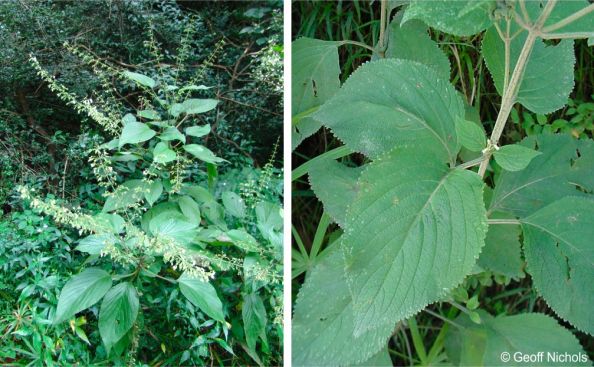
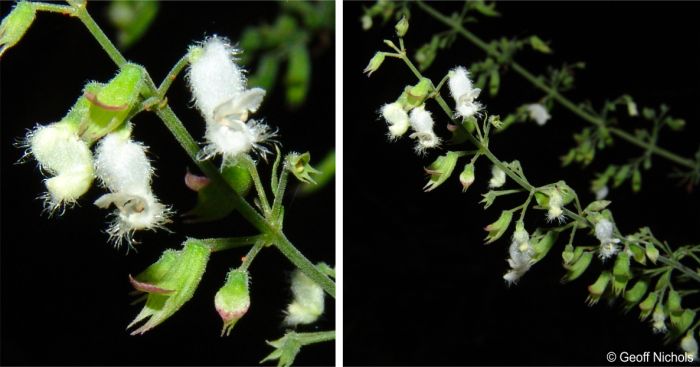
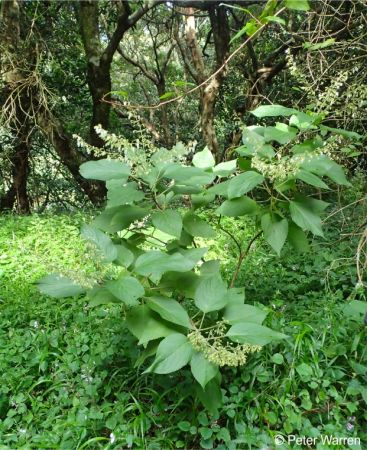
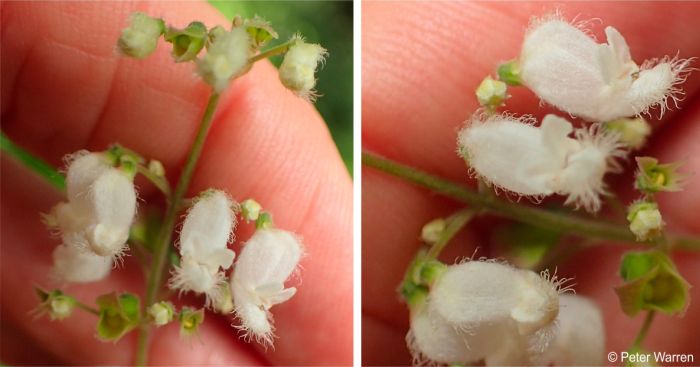
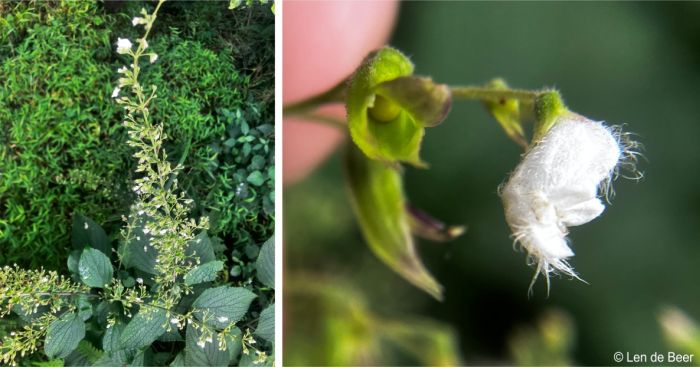
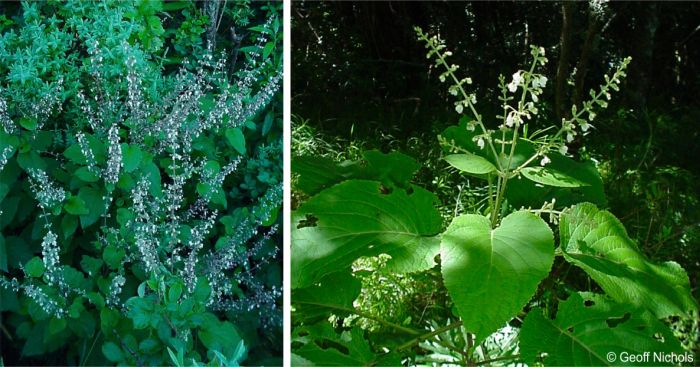
Coleus gibbosus is an erect, well-branched perennial herb or subshrub that typically grows between 0.6 and 1.2 m tall. Its ascending stems are covered with fine hairs, giving the plant a soft texture. The leaves are arranged in opposite pairs and are thick-textured, ovate to oblong-ovate, measuring 80–140 mm long and 50–80 mm wide. The leaf margins are finely toothed, and the undersides are dotted with distinctive orange-brown glands, a characteristic feature of the species. The flowers are borne in an upright, branched panicle, 250–350 mm long, carrying clusters of small white flowers. Each flower is about 7 mm long and densely covered with white hairs. The lower lip of the corolla is boat-shaped and curves upwards, while the upper lip is much shorter. As with other members of the genus, the flower tube is slightly sigmoid (S-shaped), an adaptation associated with specialised pollination. Flowering usually occurs from late summer into autumn, adding subtle seasonal interest to shaded gardens.
Conservation Status
Status
Coleus gibbosus is currently assessed as Least Concern (LC) according to the Red List of South African Plants. Populations are considered stable and the species faces no major threats. It was assessed under its former name, Plectranthus rehmannii, by Matlamela and Kamundi in 2006.
Distribution and habitat
Distribution description
Coleus gibbosus is endemic to South Africa and is restricted to the KwaZulu-Natal Midlands. It occurs naturally along forest margins, forest edges and in scrub vegetation, where it grows in semi-shaded to shaded conditions. The species prefers fertile, humus-rich, well-drained soils and is often found on moist slopes and amongst rocky outcrops within its forest-margin habitat. Historical collections have recorded the species from localities including Karkloof and Peak of Byrne. Its natural habitat experiences warm, wet summers and cool, dry winters, making the species well adapted to the climatic conditions of the KwaZulu-Natal Midlands. Like many indigenous forest-edge plants, C. gibbosus thrives under filtered light, where it contributes to the rich diversity of the forest understorey.
Derivation of name and historical aspects
History
For many years, this plant was known as Plectranthus rehmannii. However, advances in DNA-based phylogenetic studies demonstrated that many species formerly placed in Plectranthus belong in the reinstated genus, Coleus. In such cases, the genus name changes but the plant usually keeps its specific epithet, however in this case the name Coleus rehmannii had already been used to describe a different species. Consequently, a new name had to be given to this species and Plectranthus rehmannii is now recognised as Coleus gibbosus.
The genus name Coleus is derived from the Greek word koleos, meaning ‘sheath’ or ‘scabbard’, referring to the fused stamens that were once considered a defining characteristic of the genus. The specific epithet gibbosus is Latin for ‘humped’ or ‘swollen’, probably alluding to the swollen or sac-like base of the corolla tube. The former name honours Anton Rehmann (1840–1917), a botanist and geographer who collected the type specimen in Karkloof in 1875.
Ecology
Ecology
The small, white, two-lipped flowers of Coleus gibbosus with their slightly sigmoid (S-shaped) corolla tubes are adapted for insect pollination. The pollinator is a megachilinid bee, Chalicodoma sp. which Potgieter and Edwards observed visiting the flowers in Leopard’s Bush Nature Reserve during their study. Honey bees (Apis mellifera) and the bee Allodape pernix were also observed visiting the flowers but only to collect pollen. Although only bees were observed to visit the flowers, various flies and other nectar-feeding insects may also visit the flowers. The curved flower tube only allows certain insects to access the nectar and while feeding they are positioned where they will transfer pollen between the flowers and effect pollination.
Growing naturally along forest margins and in scrub vegetation, C. gibbosus is well adapted to partially shaded environments. Its dense foliage provides ground cover and contributes to the understorey vegetation, helping to protect the soil from erosion and retain moisture. Like many members of the mint family (Lamiaceae), the species is vigorous and readily regenerates after disturbance. Stems that come into contact with the soil may produce roots, allowing the plant to spread vegetatively and recover from grazing, trampling or other physical damage.
Uses
Use
There are currently no documented traditional medicinal or cultural uses specific to Coleus gibbosus. However, several other species in the genus Coleus are widely used in traditional medicine across Africa to treat ailments such as stomach disorders, skin conditions and respiratory complaints. Some species are also cultivated for their aromatic foliage or colourful leaves and have become popular ornamental plants worldwide.
Coleus gibbosus is valued primarily as an ornamental species. Its attractive foliage, delicate white flowers and ability to thrive in shade make it an excellent choice for indigenous woodland gardens, shaded borders, containers and naturalistic landscape plantings. It is particularly effective when planted in groups beneath trees or alongside other indigenous forest-margin species, where it provides texture and seasonal interest from late summer into autumn. Its ease of cultivation and low maintenance requirements also make it well suited to home gardens and botanical garden displays.
Growing Coleus gibbosus
Grow
Coleus gibbosus is an easy-to-grow indigenous perennial that performs best in semi-shaded to shaded positions with fertile, organically enriched, well-drained soil. Although it prefers consistently moist conditions, established plants are moderately drought tolerant owing to their somewhat succulent stems and leaves. Regular watering during prolonged dry periods promotes vigorous growth, but waterlogged conditions should be avoided. Applying compost annually and lightly pruning the plant at the end of winter encourages compact growth and prolific flowering in the following season.
Propagation is straightforward. Stem cuttings taken in spring or summer root readily in coarse river sand or a well-drained propagation medium, usually without the need for rooting hormone. The species can also be grown from seed, which should be collected from mature flower spikes and sown in spring in a light, well-drained seedling mix.
Its adaptability, ease of propagation and low maintenance requirements make Coleus gibbosus an excellent choice for beginner gardeners, indigenous woodland gardens, shaded borders and container plantings.
References
- Codd, L.E. 1985. Lamiaceae. Flora of southern Africa 28(4). Botanical Research Institute, Department of Agriculture and Water Supply, Pretoria.
- De Beer, L. 2025. Observation of Coleus gibbosus, Karkloof Conservancy, KwaZulu-Natal. iNaturalist. Online. https://www.inaturalist.org/observations/269081840.
- Matlamela, P.F. & Kamundi, D.A. 2006. Plectranthus rehmannii Gürke. National Assessment: Red List of South African Plants. South African National Biodiversity Institute, Pretoria.
- Paton, A.J., Mwanyambo, M., Govaerts, R.H.A., Smitha, K., Suddee, S., Phillipson, P.B., Wilson, T.C., Forster, P. I. & Culham, A. 2019. Coleus and Plectranthus (Lamiaceae): a tale of more than two genera. Phytokeys 129: 1–158.
- Plants of southern Africa online. Coleus gibbosus species search. South African National Biodiversity Institute. https://posa.sanbi.org. Accessed June 2026.
- Plants of the World Online. Coleus gibbosus A.J.Paton. Royal Botanic Gardens Kew. https://powo.science.kew.org/taxon/urn:lsid:ipni.org:names:77201079-1. Accessed June 2026.
- Potgieter, C., Edwards, T. & Van Staden, J. 2009. Pollination of Plectranthus spp. (Lamiaceae) with sigmoid flowers in southern Africa. South African Journal of Botany 75(4):646–659.
- Warren, P. 2018. Observation of Coleus gibbosus, Mbona Private Nature Reserve, KwaZulu-Natal. iNaturalist. Online. https://www.inaturalist.org/observations/54746114.
Credits
Thamsanqa Msweli
KwaZulu-Natal National Botanical Garden
July 2026
Acknowledgements: images by Peter Warren, Len De Beer and Geoff Nichols
Plant Attributes:
Plant Type: Perennial, Shrub
SA Distribution: KwaZulu-Natal
Soil type: Loam
Flowering season: Late Summer, Autumn
PH: Acid, Neutral
Flower colour: White
Aspect: Shade, Morning Sun (Semi Shade)
Gardening skill: Easy
Special Features:
 Good potplant
 Indoor plant
 Feeds honeybees
Horticultural zones


Rate this article
Article well written and informative
Rate this plant
Is this an interesting plant?
Login to add your Comment
Back to topNot registered yet? Click here to register.