


Coleus hereroensis
Introduction
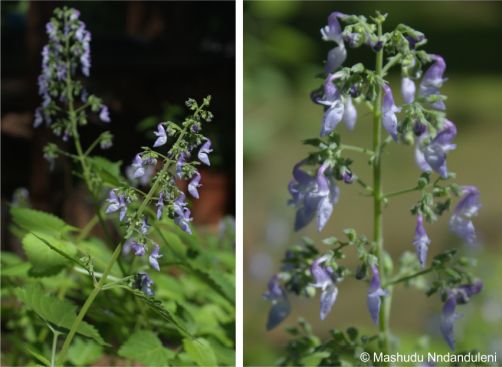
Unlike the Coleus varieties with bright and showy foliage often used in summer bedding schemes, Coleus hereroensis is recognised for its gentle texture and lasting beauty, especially in late summer and autumn when it produces its dark bluish-purple flowers. This species forms a soft, shrubby mound with green, softly hairy foliage that holds its fresh appearance, even under intense African sunlight.
Description
Description
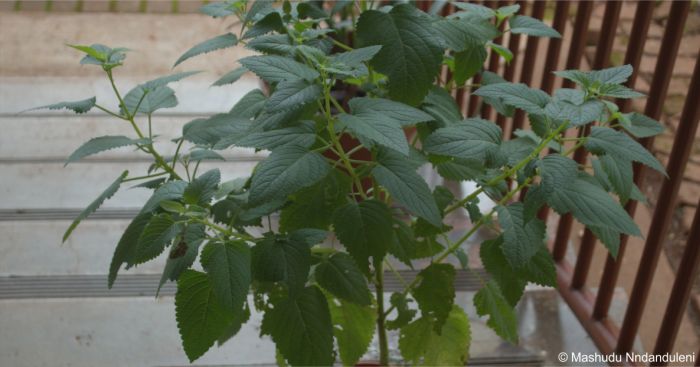
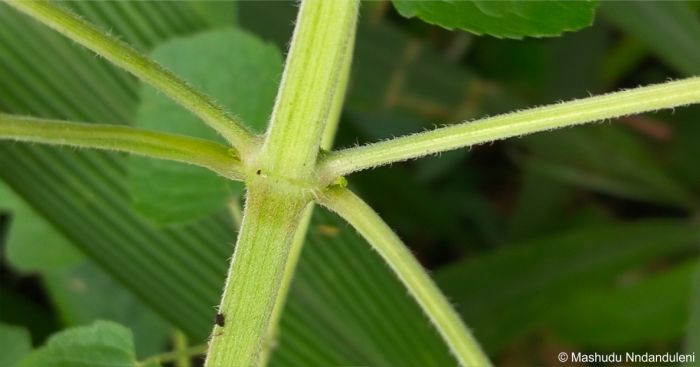
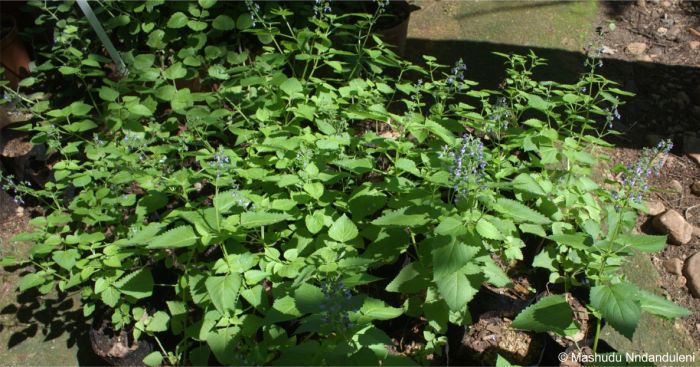
Coleus hereroensis is an evergreen aromatic herbaceous perennial with a rounded, bushy habit. This species is fast growing but relatively short lived, typically attaining a height and width of 300 to 600 mm, however, under favourable garden conditions, particularly when planted in well-prepared soil and left unpruned, it can grow up to 2 m high. The entire plant is covered in a dense layer of fine white hairs, giving it a uniformly soft, velvety texture. Its stems are square, a characteristic feature of the mint family (Lamiaceae). Leaves are ovate to ovate-triangular measuring 40-70 mm long and 35-70 mm wide, on stalks 20-70 mm long. They are thin-textured, wrinkled, and have a crenate to dentate margin.
Coleus hereroensis flowers in late summer and autumn, producing upright spikes toward the tips of the branches, 100-250 mm long, made up of pale to deep bluish-purple blooms that emerge from fuzzy, bell-like green calyces. The flowers are small, tubular, and two lipped, measuring about 8-12 mm long. After flowering, each bloom produces a tiny, smooth, oval nutlet.
Although it belongs to the large and diverse Coleus genus, Coleus hereroensis is easily distinguished from its more common relatives. Unlike the hybrid bedding coleus, known for its large, vividly patterned leaves, this species is defined by its textured, and finely hairy leaves and stems. This complete coating of white hairs on both leaves and stems, along with its overall muted colour palette and bushy, shrubby form, sets it apart as a plant of subtle texture rather than bold colour.
Conservation Status
Status
Coleus hereroensis is classified as Least Concern (LC) according to Red List of South African Plants. This status was assigned in 2005 after it was not flagged as a priority for detailed evaluation during initial screening processes. It is considered relatively stable in the wild and does not face immediate or major threats across its natural range.
Distribution and habitat
Distribution description
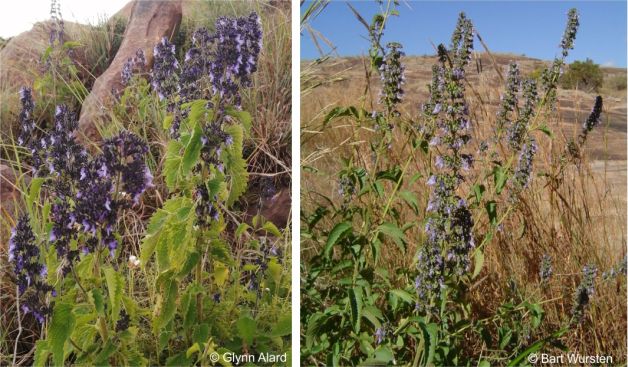
Coleus hereroensis is found across the northeastern regions of South Africa, including Gauteng, KwaZulu-Natal, Limpopo and North West Province. In addition to its distribution within South Africa, the species also occurs in southern tropical Africa, where it is found in parts of Namibia, Zimbabwe, Angola and Botswana. It is seen growing in shady rocky places and south-facing wooded hills in dry savanna.
As a terrestrial species, it thrives in areas with seasonal summer rainfall where frost is light or absent. Its occurrence in the inland provinces of Limpopo and North West, areas characterised by savanna and rocky outcrops, strongly suggests it is adapted to sandy, rocky, or shallow loam soils that provide excellent drainage. This natural distribution indicates its adaptation to a climate with moderate water availability during its growing season, tolerance for full sun to partial shade, and a likely resilience to cooler temperatures making it a suitable candidate for cultivation in similar bushveld, grassland or subtropical gardens.
Derivation of name and historical aspects
History
The genus name Coleus originates from the Greek word koleos, meaning ‘sheath’ or ‘scabbard’, likely referring to the distinctive way the fused stamens are enclosed within the flower. The species epithet, hereroensis, denotes its geographical connection, indicating where the plant was first documented, in the Hereroland region of Namibia, which is inhabited by the Herero people.
This species was initially described by Engler in 1888 as Plectranthus hereroensis. Following the taxonomic revision by Paton in 2019, which reinstated the genus Coleus based on molecular data, it was transferred to Coleus. This history of naming is the result of a many botanical studies and revisions. For decades, this plant was classified within the genus Plectranthus, this name derived from the Greek plektron, meaning ‘spur’, and anthos, ‘flower’. However, comprehensive DNA studies by Paton et al. in 2019 resolved longstanding confusion. They revealed that the old Plectranthus genus did not form a single evolutionary group. The core lineage containing the familiar coleus was distinct and more accurately aligned with the original genus Coleus. Consequently, the genus Coleus was reinstated, and Plectranthus was redefined as a separate, smaller genus. Furthermore, the study led to the merging of the genera Pycnostachys, Anisochilus and Leocus into Coleus, and the recognition of a new genus, Equilabium, from the remaining Plectranthus lineage.
Coleus hereroensis is a member of the mint family (Lamiaceae), one of the largest and most economically important plant families, known for aromatic herbs like basil, mint and lavender. Following the modern revision, the genus Coleus is now large and distinct, containing approximately 294 recognised species, primarily distributed across Africa, Madagascar, South and Southeast Asia and Oceania.
Ecology
Ecology
Coleus hereroensis is well adapted to a dry climate. The plant is densely covered in fine white hairs that help reflect strong sunlight and reduce water loss, helping the plant to survive during drought conditions. Its two-lipped, bluish-purple flowers are specially shaped to attract bees, butterflies and other insects. These insects collect nectar or pollen and pollinate the plant. After flowering, the plant uses passive seed dispersal. The small, smooth seeds drop to the ground or are shaken out by wind or carried away by rain, settle into the surrounding rocky or shallow loamy or sandy soil, they remain dormant until rainfall arrives. When sufficient moisture penetrates the soil, the seeds germinate and establish new seedlings.
The leaves are aromatic when crushed, releasing a strong scent.
Uses
Use
Coleus hereroensis is primarily valued in ornamental horticulture for its fast growth, drought tolerance, soft foliage and delicate bluish-purple flowers. These features make it an excellent mixed border or bedding plant and a striking container specimen. Although highly attractive and hardy, it is not yet a common plant in mainstream nurseries. It is ideally suited to bushveld and grassland gardens, and can be treated as an annual in cold climates.
Beyond its ornamental value, the plant is also used in traditional medicine to treat digestive disorders and liver complaints. Scientific studies have shown that oil extracted from the plant possesses both antibacterial and antiviral properties. It has demonstrated activity against Herpes simplex and certain antibiotic-resistant bacterial strains.
Growing Coleus hereroensis
Grow
Coleus hereroensis is an easy and reliable plant to propagate from both seeds and cuttings. Cuttings can be collected throughout the year, although spring and summer provide the best results. It is advisable to collect material early in the morning and prepare the cuttings under shade to prevent wilting. Softwood or semi-hardwood cuttings are most suitable. Each cutting should have at least two nodes, with the leaves removed from the lower node while retaining the top leaves. The cuttings should be inserted into clean river sand and kept consistently moist but not waterlogged. They must remain under shade or partial shade until rooting occurs, which usually begins around the third week. Once fully rooted, the young plants can be moved to a hardening-off area before transplanting. Although rooting hormone may be applied, it is not necessary and often not recommended for many Coleus species because it can cause stem rot.
Propagation can also be done from seed. Seeds should be sown in a well-drained soil mix and lightly covered with a fine-sieved medium. The trays should be placed in a warm, semi-shaded position away from direct sunlight. Germination generally begins within three weeks.
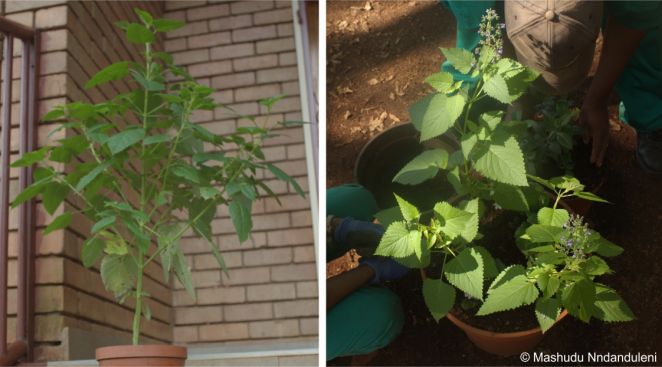
When planting in the garden, the soil should be well drained and enriched with plenty of compost. This is because the species has a shallow root system, organically rich soil supports healthy root development and growth. Mulch after planting as it helps to retain moisture and suppress weeds. Coleus hereroensis grows well in full sun and semi-shade, although flowering is more prolific in full sun. Despite its tolerance of sunny conditions, the plant does not store water in its stems, so regular watering is important during dry periods.
Pruning is essential to encourage bushy growth and the production of more flowering stems. This should be done at the end of winter before new growth begins in spring. The plant is tender to frost, but if frost damage occurs, it can be pruned back and will recover well. Flowering typically takes place in late summer and autumn, and pruning does not significantly affect blooming. After pruning, a layer of compost or organic mulch should be added to nourish the plant gradually and maintain soil moisture.
In landscaping, this species can be planted as a border or combined with other colourful plants. It pairs well with species such as Barleria albostellata or many other Barleria species, creating a striking colourful display in the garden.
References
- Alard, G. 2021. Observation of Coleus hereroensis, Marakele National Park, Limpopo. iNaturalist. Online. https://www.inaturalist.org/observations/74883290.
- Codd, L.E. 1985. Plectranthus (Lamiaceae). Flora of Southern Africa 28: 137-172.
- Fern, K. 2024-10-13. Plectranthus hereroensis. Tropical Plants Database. Online. https://tropical.theferns.info/viewtropical.php?id=Plectranthus+hereroensis.
- Hankey, A. 2001. Plectranthus (Lamiaceae). PlantZAfrica. Online. https://pza.sanbi.org/plectranthus.
- Hyde, M.A., Wursten, B.T., Ballings, P. & Coates Palgrave, M. 2026. Coleus hereroensis (Engl.) A.J.Paton. Flora of Zimbabwe. Online. https://www.zimbabweflora.co.zw/speciesdata/species.php?species_id=149870.
- Lukhoba, C.W., Simmonds, M.S.J. & Paton, A.J. 2006. Plectranthus: a review of ethnobotanical uses. Journal of Ethnopharmacology 103(1): 1–24.
- Paton, A.J., Mwanyambo, M., Govaerts, R.H.A., Smitha, K., Suddee, S., Phillipson, P.B., Wilson, T.C., Forster, P. I. & Culham, A. 2019. Coleus and Plectranthus (Lamiaceae): a tale of more than two genera. Phytokeys 129: 1–158.
- Plants of the World Online. Coleus hereroensis (Eng.) A.J.Paton. https://powo.science.kew.org/taxon/urn:lsid:ipni.org:names:77201108-1. Accessed 23 Apr 2026.
- Raimondo, D., Von Staden, L., Foden, W., Victor, J.E., Helme, N.A., Turner, R.C., Kamundi, D.A. & Manyama, P.A. (eds) 2009. Red list of South African plants. Strelitzia 25. South African National Biodiversity Institute, Pretoria.
- Random Harvest. Plectranthus hereroensis. https://www.randomharvest.co.za/South-African-Indigenous-Plants/Show-Plant/PlantId/475/Plant/Plectranthus-hereroensis. Accessed 15/02/2026.
- Rice, L.J., Brits, G.J., Potgieter, C.J. & Van Staden, J. 2011. Plectranthus: a plant for the future? South African Journal of Botany. 77(4): 947–959.
- Van Jaarsveld, E. 2006. The southern African Plectranthus and the art of turning shade to glade. Fernwood Press, Vlaeberg, Cape Town.
- Wursten, B. 2004. Observation of Coleus hereroensis, Domboshawa, Goromonzi, Zimbabwe. iNaturalist. Online. https://www.inaturalist.org/observations/307813701
Credits
Ndivhudzannyi Madamalala and Mashudu Nndanduleni
Thohoyandou National Botanical Garden
May 2026
Acknowledgements: Images of Coleus hereroensis in habitat by Bart Wursten and Glynn Alard.
Plant Attributes:
Plant Type: Perennial
SA Distribution: Gauteng, KwaZulu-Natal, Limpopo, North West
Soil type: Sandy, Loam
Flowering season: Late Summer, Autumn
PH: Acid, Neutral
Flower colour: Blue, Purple
Aspect: Full Sun, Morning Sun (Semi Shade), Afternoon Sun (Semi Shade)
Gardening skill: Easy
Special Features:
 Attracts butterflies
 Drought resistant
 Fragrant
 Good potplant
 Medical plant
 Feeds honeybees
Horticultural zones


Rate this article
Article well written and informative
Rate this plant
Is this an interesting plant?
Login to add your Comment
Back to topNot registered yet? Click here to register.