


Conophytum luckhoffii
Introduction
Conophytum luckhoffii is a dwarf, mat-forming to cushion-shaped, cliff-hugging summer-dormant succulent. The leaves are fused into a beautifully ornamented greyish-green to purplish body. It has large solitary flowers with pink magenta petals and a gold or white centre. Plants grow wild along the Cape Folded Mountains between Niewoudtville and Citrusdal. Best grown as a potted plant.
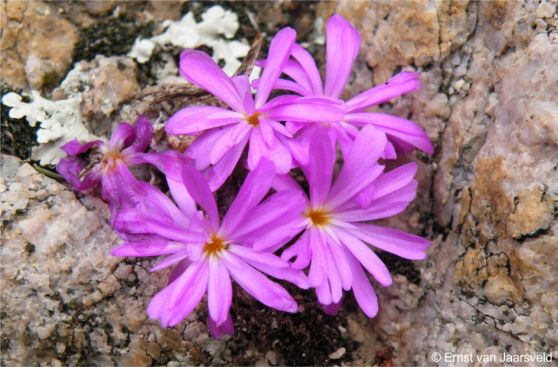
Fig. 1. Conophytum luckhoffii flowering in autumn on a south-facing cliff on the Olifantsrivierberge, Western Cape, the flowers completely covering the plants.
Description
Description
The plants are active in winter and rest during summer, forming small to larger, dense, dome-shaped clusters up to 150 mm in diameter. Roots fibrous. The leaves are fused into elongated-heart-shaped (cordiform) bodies with sharply keeled, ornamented lobes. The bodies 8–15 × 4–8 × 2–5 mm, of which the surface is smooth and greyish to bluish-green. The leaf margin and keels etched ornamentally with appealing purplish to reddish lines and dots. The flowers diurnal and without scent, about 35 mm in diameter, magenta to pink. The petals in 2–4 series, up to 15 × 2 mm and the staminodes filamentous, white to golden. The fruiting capsule hygrochastical, 4- or 5-locular, 2 × 4 mm, angular, fragile. The seed 0.9 × 0.5 × 0.4 mm, tuberculate-wrinkled. Flowering occurs in early autumn.
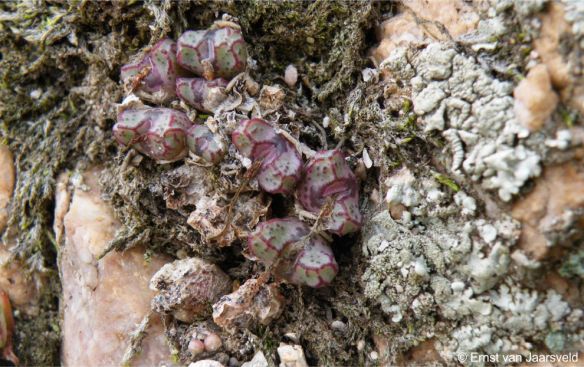
Fig. 2. Conophytum luckhoffii growing on a south-facing quarzitic sandstone cliff on the Olifantsrivierberge, the plants having just finished fowering with the beautifully ornamented leaves now showing and the plant sharing its habitat with mosses and lichens.
Conservation Status
Status
Classified as Vulnerable (VU) by the Red List of South African Plants. Conophytun luckhoffii was assessed as not threatened in 1996 and 2009, but due to a sharp increase in plant poaching since 2019 the wild population is estimated to have declined by nearly 40%. Climate change models predict a future loss of habitat, which increases its risk profile. This species is relatively widespread, and is well protected by its inaccessible cliff face habitat. Plants are well established in cultivation (ex situ conservation), and seed is available from various sources.
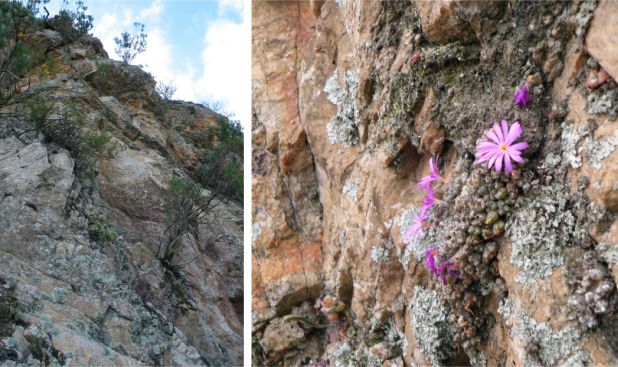
Fig. 3. The south-facing quarzitic sandstone cliff face along the Olifantsrivierberge, Western Cape, South Africa, habitat of many succulents including Conophytum luckhoffii. RIGHT Conophytum luckhoffii growing on the cliff in autumn.
Distribution and habitat
Distribution description
Highly localised cliff- and bedrock-dwelling plant, growing in crevices and shallow pockets in quarzitic sandstone crevices of the Olifants River Mountains between Piketberg and Citrusdal and northwards to the Bokkeveld Mountains in the Niewoudtville district at 100–980 m altitude. Confined to the Cape Fold Belt mountains where it grows mainly on south-facing cliffs, occasionally also on other aspects in accessible sandstone pockets. The plants are variable in size and ornamentation and with many local variants. The plant often shares its habitat with other small succulents. Summers are hot and dry and the plants are subject to occasionally fog from the Atlantic Ocean. The average daily maximum temperature about 23°C and average daily minimum is about 12°C, with frost absent. Rainfall mainly in winter (cyclonic cold fronts), late summer and autumn (thunder showers), 400–500 mm per annum. The plant grows in both the Fynbos and to a lesser extent the Succulent Karoo Biomes and has been recorded from several bioregions, but is mainly confined to the Sandstone Fynbos bioregion. It has also been recorded from Shale Renosterveld, Sand Fynbos, Western Strandveld and Trans-escarpment Succulent Karoo bioregions, which is an indication of resilience.
The associated vegetation near Citrudal consists of Piketberg Sandstone Fynbos of the Fynbos Biome. Associated plants in its habitat near Citrusdal include lichens, species of moss and the following succulents: Adromischus hemisphaericus, Crassula montana subsp. montana, Crassula atropurpurea var. watermeyeri, Crassula rupestris and Tylecodon paniculatus. The geology consists of quarzitic sandstone of the Graafwater Subgroup (Table Mountain Group, Cape Supergroup).
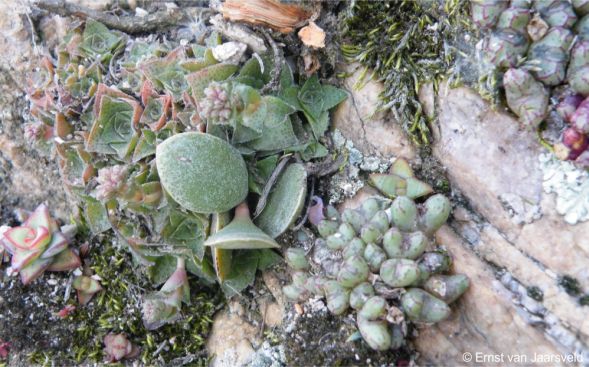
Fig. 4. Conophytum luckhoffii in winter, on the south aspect of a quarzitic sandstone cliff on the Olifantsrivierberge, sharing its habitat with Crassula montana subsp. montana, Adromischus hemisphaericus and Crassula rupestris.
Derivation of name and historical aspects
History
Conophytum luckhoffii was named by Mary Lavis (later O’Connor-Fenton) (1903-1992) in 1931, and honours the South African medical practitioner and succulent enthusiast James Luckhoff, the father of Carl Luckhoff (1914-1961), both collectors and interested in succulent plants. James collected his plants near Citrusdal in 1930. The name Conophytum is derived from the Latin conus, for cone, and the Greek phyton, for plant. The genus was created by N.E. Brown in 1922 for the many species of which the fused leaves form a cone-shaped body.
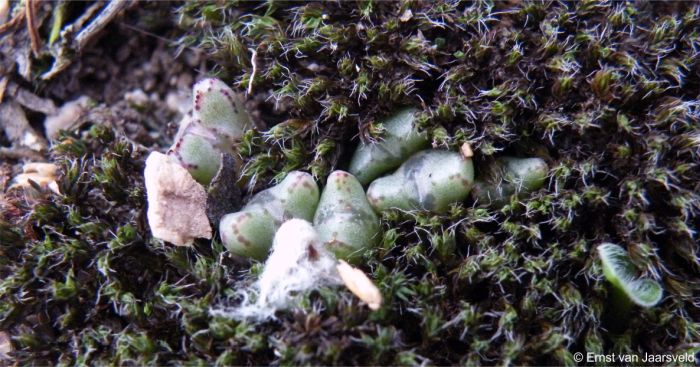
Fig. 5. Conophytum luckhoffii in autumn, growing among moss, on a south-facing cliff in the Olifantsrivierberge, Western Cape.
The genus Conophytum consists of about 100 species and is mainly confined to the semi-arid winter-rainfall parts of South Africa and south-western Namibia. It is divided into two subgenera: subgenus Derebergia for those with diurnal flowers (open during the day) and subgenus Conophytum, flowering during the night. Conophytum luckhoffii belongs to subgenus Derenbergia. The subgenus Derenbergia was divided into 9 sections of which C. luckhoffii belongs to section Minuscula which includes 11 species, all minuscule and with beautifully ornamented leaves.
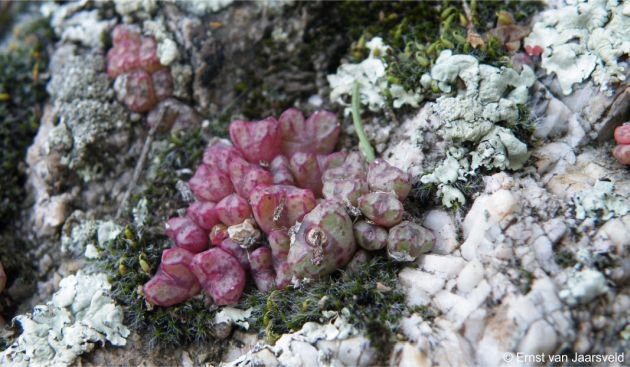
Fig. 6. Conophytum luckhoffii during the winter growing season, the reddish leaf colour a result of the betanin pigmets slowing the process of photosynthesis.
In 2002, Steven Hammer, Conophytum specialist, writes on the distinguishing feature of C. luckhoffii, “The outstanding feature of this southern Minuscula is its extended, keeled lobing, beautifully edged and crosshatched with red”.
Apart from the closely related Lithops, Conophytum represents one of the most popular groups within the Aizoaceae. Grown mainly for their ornamental leaves with flowering secondary, as a bonus.
Conophytum was revised by Steven Hammer in 1993 when his very popular book The Genus Conophytum, a Conograph’ appeared followed in 2002 by Dumpling and His Wife: New Views of the Genus Conophytum. A must for succulent plant lovers!
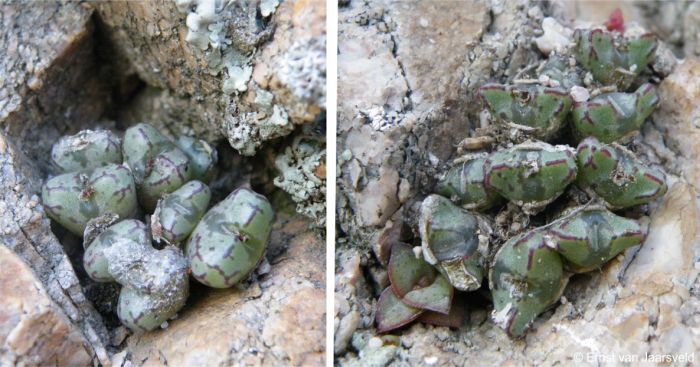
Fig. 7. Conophytum luckhoffii in habitat in winter, note the windows near the leaf centre allowing for light penetration, a feature often associated with cliff dwelling plants.
Ecology
Ecology
Conophytum luckhoffii is a fairly long-lived, winter-growing, summer-resting perennial, with a compact cushion-like growth habit that is retained in cultivation. The plants grow in crevices and rocky pockets on cliffs and its highly succulent leaves enables the plant to survive the long dry summers, when the plant goes into its resting phase. The darker leaf windows adjacent to the leaf centres allows light to penetrate the swollen succulent tissue, a characteristic also found on a few other cliff dwelling succulents. At the end of spring, the moisture from the old fused leaf pair is recycled into a new leaf pair, and the older withering remnants of the leaf pair becomes a covering, which protects the younger leaf pair from the sun, during the long dry summer months. In autumn, with cooler conditions, the new leaf pair and flower emerges, breaking through the protective covering of the greyish white remains of the old leaf. The simple, magenta to pink flower is large, 3-4 times the size of the plant body, and conspicuous, thus maximising visibility for successful pollination in the cliff environment, and an example of rich flowering ensuring visibility. Flowers are open during the day and scentless, suggesting a day-flying insect pollinator, such as bees. After successful pollination the capsule matures slowly and reaches maturity during the summer months. The capsule is hygrochastical and will only open with rain, where the expending keel forces open the cell lids. Capsules have broad rectangular valve wings, but the cavities are without covering membranes. Rain fills the saucer-like cavity of the capsule and the seeds are washed out and down the cliffs, succumbing to gravity until they become wedged in a crevice. The large, tuberculate seeds provide good anchorage for seedlings. Once the dry conditions set in, the expanding keels contract, again closing the lids and safely retaining the seed for the next rain event. At the end of the growing season the leaves turn reddish or purplish, due to the presence of the pigment betanin, which slows the process of phototsyntheses and aiding in water conservation.
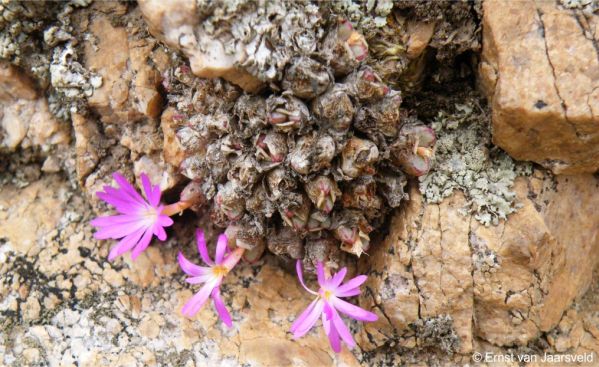
Fig. 8. Conophytum luckhoffii in autumn, the plant just coming out of its summer rest period with the new leaves breaking through the protective sheath formed by the remains of the old leaves. The dried out leaf of the previous season acts almost like a protective tent.
Uses
Use
It is not known whether the plants are used medicinally. This species is well established in cultivation and is grown as a container plant.
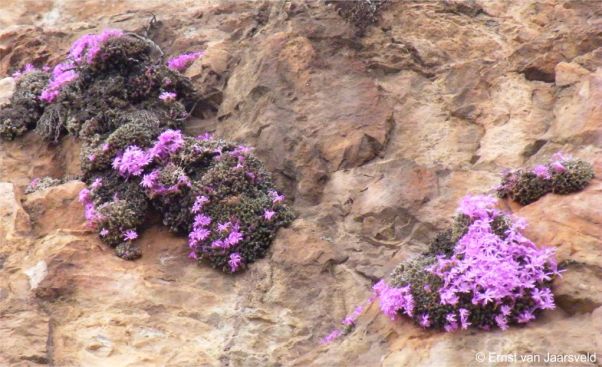
Fig. 9. Large clusters of Conophytum luckhoffii flowering in autumn on a south-facing cliff on the Olifantsrivierberge, Western Cape.
Growing Conophytum luckhoffii
Grow
Best for small containers grown in a protected environment where moisture and light can be controlled. Plants are summer-resting, and at its best during and just after flowering when the beautifully ornamented leaves appear. The soil should be sandy, mineral poor with a low organic component and slightly acidic. Easily cultivated and prefers dappled shade. Commence watering in autumn when the new leaf pair and flower emerges. Keep moist until spring, and reduce watering drastically and abstain from watering through the summer months until the autumn. Plants can be fed with a diluted organic fertiliser.
Propagate from cuttings or seed.
Cuttings are best made in autumn. The best medium is sand. Plant with the leaf tips emerging from the substrate and keep moist. Rooting is usually within a week or two. Once rooted it can be planted into individual containers.
The seed is fine and can be sown in a sandy mixture. Sow seed in autumn and cover with a very thin layer of gravel. Keep moist. Remove seedlings as soon they are large enough to handle.
References
- Christenhusz, M.J.M., Fay, M.F. & Chase, M.W. 2017. Plants of the World, an illustrated Encyclopedia of vascular plants. Kew Publishing, Royal Botanic Gardens, Kew.
- Clarke, H. & Charters, M. 2016. The illustrated dictionary of southern African plant names. Flora & Fauna Publications Trust, Jacana, Johannesburg.
- Hammer, S. 1993. The genus Conophytum. Succulent Plant Publications, Pretoria.
- Hammer, S. et al. C. 2002. Dumpling and his wife; new views of the genus Conophytum. EAE Creative Colour Limited.
- Hartmann, H.E.K. 1991. Mesembryanthema. In Systematics, Biology and Evolution of Some South African taxa. Contributions from the Bolus Herbarium 13. 75-157.
- Hartmann, H.E.K. 2001. Aizoaceae A-E. In Eggli, U. & Hartmann, H.E.K. (eds.) Handbook of Succulent Plants. Springer. Heidelberg, New York, etc.
- Herre, H. 1971. The genera of the Mesembryanthemaceae. Tafelberg, Cape Town.
- Lavis, M. 1931. In H.M.L. Bolus, Notes on Mesembryanthemum and allied genera 2: 291–292.
- Mucina, L. & Rutherford, M.C. (eds) 2006. The vegetation of South Africa, Lesotho and Swaziland. Strelitzia 19. South African National Biodiversity Institute, Pretoria.
- Van Jaarsveld, E.J. 2011. Cremnophilous succulents of southern Africa: diversity, structure and adaptations. Ph.D.Thesis, University of Pretoria.
- Young, A.J., Desmet, P.G., Ebrahim, I., Guo, D., Harrower, A., Jabar, L., Knoetze, L., Rodgerson, C., Van Wyk, P.C.V. & Mhlongo, N.N. 2021. Conophytum luckhoffii Lavis. National Assessment: Red List of South African Plants. Accessed 2026/06/08.
Credits
Ernst van Jaarsveld
Kirstenbosch National Botanical Garden (Retired)
Babylonstoren Farm (Current)
Extraordinary senior lecturer and researcher,
Department of Biodiversity and Conservation, University of the Western Cape
June 2026
Plant Attributes:
Plant Type: Succulent
SA Distribution: Western Cape
Soil type: Sandy
Flowering season: Autumn
PH: Acid
Flower colour: Pink, Mauve/Lilac
Aspect: Shade, Morning Sun (Semi Shade), Afternoon Sun (Semi Shade)
Gardening skill: Average
Special Features:
 Drought resistant
 Good potplant
Horticultural zones



Rate this article
Article well written and informative
Rate this plant
Is this an interesting plant?
Login to add your Comment
Back to topNot registered yet? Click here to register.