


Crassula cymbiformis
Introduction
Crassula cymbiformis is a dwarf, sparingly dividing succulent plant with boat-shaped leaves in 4-ranked rosettes, the leaves not mottled and becoming reddish during the dry season, and small white flowers in a flat-topped inflorescence in summer. It is a rare species, only known from cliffs of the Waterberg, in the Limpopo Province. Easily grown, it makes a beautiful small pot plant.
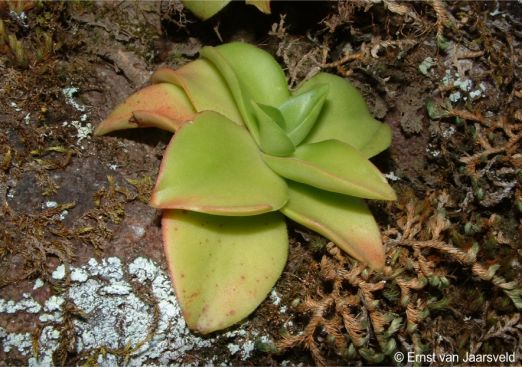
Fig. 1. Crassula cymbiformis in its south-facing quarzitic sandstone cliff face habitat in the Waterberg, Limpopo Province, South Africa, growing with a poikilohydric fern and numerous lichens.
Description
Description
Crassula cymbiformis is a sparsely branched, decumbent to erect, tufted, succulent, up to 120 mm high (in flower). The roots fibrous. Branches firm, decumbent occasionally drooping and to 150 mm long, the lower branches bare and becoming brownish. The leaves without stalks, (sessile), 4-ranked; the blade (lamina) 15–95 × 15–32 mm, green to reddish-green and the basal leaves egg-shaped, triangular to oblong-obovate, the upper leaves spear-shaped (lanceolate), dorsiventrally flattened, but keeled (cymbiform), the surface without hairs (glabrous) and the margin with a row of hairs (ciliate). The leaf tip is pointed (acute) the base wedge-shaped (cuneate). The inflorescence is a terminal, flat-topped thyrse bearing many dichasia, flower pedicels up to 6 mm long. The calyx lobes linear-triangular, up to 1 mm long. The individual flower (corolla) is tubular, up to 5 mm long and shortly fused at base. The floral lobes are up to 4 mm long, spear-shaped (lanceolate), spreading, becoming recurved. Anthers black. Flowering is from early summer to early autumn (December–March).
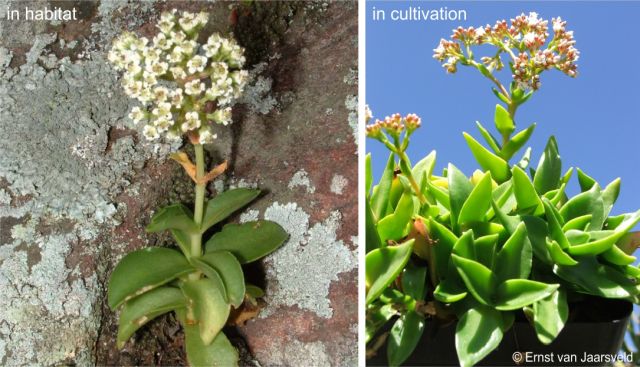
Fig. 2. LEFT Crassula cymbiformis in flower in its south-facing quarzitic sandstone cliff face habitat in the Waterberg. RIGHT A flowering plant of Crassula cymbiformis (ex Waterberg) growing in a container at Kirstenbosch National Botanical Garden during the moist autumn season.
Conservation Status
Status
Assessed as Critically Rare by the Red List of South African Plants, Crassula cymbiformis is well protected by the often inaccessible cliff habitat and its distribution falls within a National Park.
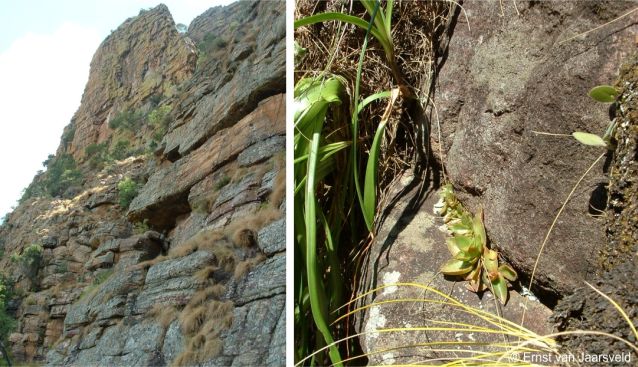
Fig. 3. Left The south-facing quarzitic sandstone cliffs of the Waterberg, Limpopo Province, South Africa, habitat of Crassula cymbiformis, in autumn. Right Crassula cymbiformis growing in a horizonal crevice on the cliff face in the Waterberg, growing with Agapanthus coddii and a species of grass.
Distribution and habitat
Distribution description
Crassula cymbiformis is only known from the Waterberg, east of Thabazimbi, Limpopo Province, confined to sheer south-facing cliffs and kloofs, at 1 000–1 750 m altitude, on the southern margin of the Waterberg. The geology consisits of quartzitic sandstone of the Matlabas Subgroup (Waterberg Group). Plants are rooted in crevices and on ledges. The winters are cool but frost is absent or light. Temperatures moderate, the average daily maximum about 27°C and the average daily minimum for the region about 15°C. Rainfall is mainly in summer, ranging from 700–800 mm per annum.
The associated vegetation consists of Waterberg-Magaliesberg Summit Sourveld of the Grassland Biome. At the Marakele National Park plants were observed on steep cliffs. The associated cliff dwelling plants in its habitat include Aeollanthus buchnerianus, Aeollanthus parvifolius, Agapanthus coddii, Aloe arborescens, Bulbine latifolia var. latifolia, Crassula sarcocaulis, Crassula setulosa, Crassula swaziensis, Delosperma waterbergense, Lobelia aquaemontis, Teedia pubescens and Tetradenia brevispicata.
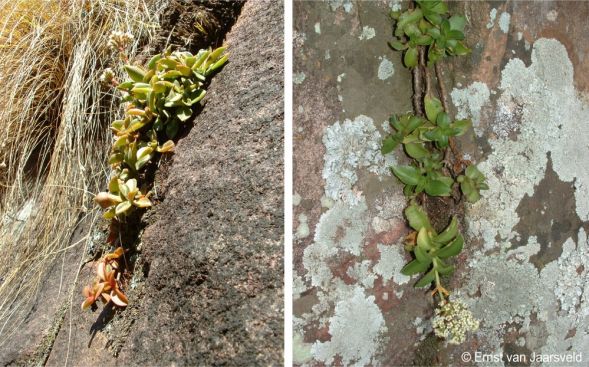
Fig. 4. Crassula cymbiformis growing on the south-facing quarzitic sandstone cliff face of the Waterberg, Limpopo Province, South Africa, LEFT in a vertical crevice, RIGHT a drooping plant in flower growing in a vertical crevice, note the brownish stems.
Derivation of name and historical aspects
History
Crassula cymbiformis was named by Helmut Toelken in the Flora of Southern Africa in 1985 from plants collected by Dave Hardy (1931–1998), succulent horticulturist at the Pretoria National Botanical Garden. Dave collected his plant on the Rankin’s Pass. The Latin epithet cymbiformis, means ‘boat-shaped’, and pertains to the leaves.
Several attempts by the author to locate Crassula cymbiformis on the Rankin’s Pass adjacent to the Kransberg failed. However, on an expedition on 18 March 2003 with SANBI colleagues Andrew Hankey, David Dlamini and Thompson Mushinyalo, the plants were located on the farm Houtboskloof of the Kransberg, which is part of the Marakele National Park. Crassula cymbiformis appears to be an obligatory cliff-dwelling species, and perhaps drifting seeds germinated on the Rankin’s pass where Dave Hardy collected his plants.
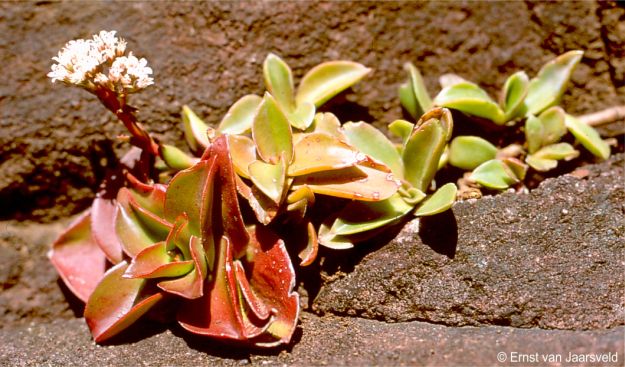
Fig. 5. A cluster of Crassula cymbiformis in flower in autumn, growing on a south-facing quarzitic sandstone cliff of the Waterberg, Limpopo Province, South Africa.
Crassula cymbiformis belongs to section Rosulares, which includes the plants that are characterised, as its name implies, by having leaves in tight basal rosettes. The leaves all have the firm bristle-like hairy margin and the elongate inflorescence with a distinct peduncle. Plants vary from the dwarf C. socialis to C. acinaciformis which can be more than 1 m tall when in flower.
Crassula cymbiformis is related to Crassula flanaganii, they both have loosely arranged leaves and thin irregular marginal cilia, but Crassula cymbiformis is a more robust, compact succulent and has thick stems to 10 mm in diameter, and cymbiform leaves.
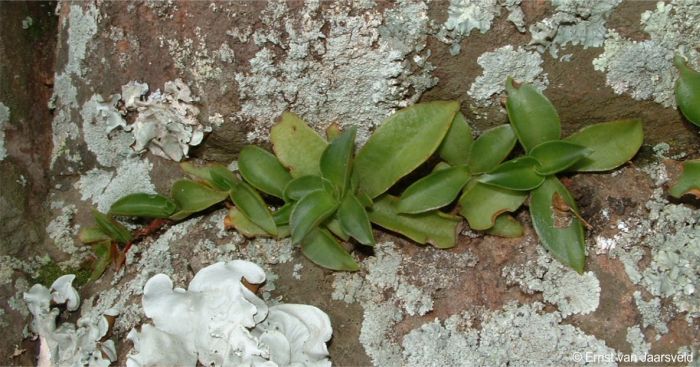
Fig. 6. Crassula cymbiformis growing in a horizonal crevice on a south-facing quarzitic sandstone cliff face in the Waterberg. Note the dense growth of numerous white lichens, which are an indication of seasonal humidity and fog.
Ecology
Ecology
The plants are long-lived perennials with a compact, cliff-hugging growth habit. It grows in sheltered crevices in slightly acidic rocky substrate, sometimes forming small mats. Plants grow where larger to smaller herbivores are absent. The leaves are in opposite pairs (decussate), becoming reddish during dry periods. The compact nature can be viewed as an adaptation to the dry conditions on the cliff face. The leaf surface is green, becoming reddish purple during dry periods, owing to anthocyanins which reduce penetration of excessive light. The plant flowers from early summer to early autumn. The small white flowers are pollinated by insects. The fruits (follicles) ripen during autumn and the minute seeds are released in summer which is during the rainy season, when the upper and middle slopes are often covered in fog, which benefits the plants and the numerous species of lichens.
Crassula cymbiformis is prolific from the base, forming dense vegetative clusters. As in most other Crassula taxa, these offshoots will root if they become detached as a result of heavy wind or other disturbances and fall into other crevices, a vegetative reproductive backup system ensuring long-term survival.
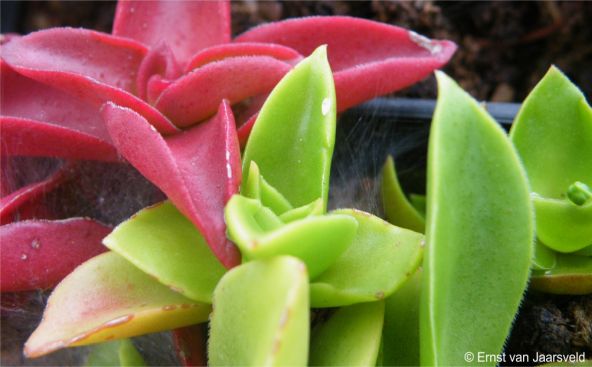
Fig. 7. A close-up of Crassula cymbiformis plants in containers at Kirstenbosch National Botanical Garden in autumn, the one plant remaining green and the other with its maroon coloured winter leaves. Note the row of fine hairs on the margin.
Uses
Use
It is not known whether the plants are used medicinally.
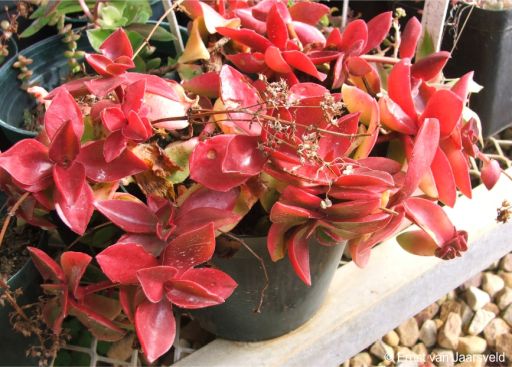
Fig. 8. Crassula cymbiformis (ex Waterberg) growing in a container at Kirstenbosch National Botanical Garden during the dry winter season, note the beautiful maroon colouring.
Growing Crassula cymbiformis
Grow
Easily cultivated, its vigour viewed as maximising survival. The substrate should be sandy, slightly acidic and well drained. Apply an organic liquid fertiliser when necessary. The plant does best in dappled shade. Avoid full sun. Keep dry during the winter months.
Best for bushveld gardens or grown in small containers, miniature succulent gardens and on windowsills. It can be grown with other succulent plants. Outside its habitat, it is best grown under controlled conditions in a greenhouse.
Propagate by division or seed.
Sow seed in a sandy gravely mixture and keep in a shady position. Germination is rapid and once the seedling is large enough to handle, prick out into a larger container.
Mealy bug can be a problem and occasionally white scale.
References
- Eggli, U. (ed.) 2003. Illustrated handbook of succulent plants: Crassulaceae. Springer, Berlin.
- Glen, H.F. & Germishuizen, G. (compilers). 2010. Botanical exploration of southern Africa, edition 2. Strelitzia 26. South African National Biodiversity Institute, Pretoria.
- Mucina, L. & Rutherford, M.C. (eds) 2006. The vegetation of South Africa, Lesotho and Swaziland. Strelitzia 19. South African National Biodiversity Institute, Pretoria.
- Rowley, G. 2003. Crassula: a growers guide. Cactus & Co. Vista, California.
- Toelken, H.R. 1985. Crassulaceae. Flora of Southern Africa 14: 1–244.
- Victor, J.E. 2006. Crassula cymbiformis Toelken. National Assessment: Red List of South African Plants version 2024.1. https://redlist.sanbi.org/species.php?species=3835-110.
Credits
Ernst van Jaarsveld
Kirstenbosch National Botanical Garden (Retired)
Babylonstoren Farm (Current)
Extraordinary senior lecturer and researcher,
Department of Biodiversity and Conservation, University of the Western Cape
April 2026
Plant Attributes:
Plant Type: Succulent
SA Distribution: Limpopo
Soil type: Sandy
Flowering season: Early Summer, Late Summer, Autumn
PH: Acid
Flower colour: White
Aspect: Shade, Morning Sun (Semi Shade)
Gardening skill: Easy
Special Features:
 Drought resistant
 Good potplant
 Indoor plant
Horticultural zones


Rate this article
Article well written and informative
Rate this plant
Is this an interesting plant?
Login to add your Comment
Back to topNot registered yet? Click here to register.