


Crassula pseudhemisphaerica
Introduction
Crassula pseudhemisphaerica is a dwarf, cluster-forming, cliff-hugging succulent to 200 mm high when in flower, with distinctly mottled leaves in a tight rosette, and yellowish tubular flowers in spring. It occurs only in Namaqualand in the Western and Northern Cape of South Africa and in southwestern Namibia. Best grown in containers in dappled shade under controlled conditions.
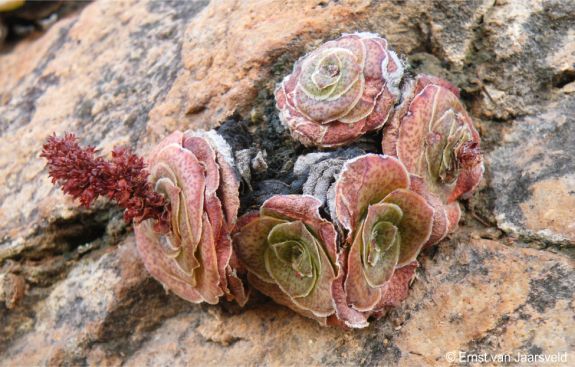
Fig. 1. Crassula pseudhemisphaerica in habitat at Spitskloof, Richtersveld, Northern Cape.
Description
Description
Starting off as a solitary rosette, but plants soon becoming branched and forming mats up to 300 mm in diameter and up to 200 mm high (when flowering). Roots fibrous. Leaves obovate to orbicular, 8–45 × 10–50 mm, dorsiventrally flattened, 4-ranked, tightly imbricate, forming neat, slightly dome-shaped (rarely flat or other) bodies, green to reddish green, mottled, hairless (glabrous) but the margin with a fringe of short hairs (ciliate). The leaf tips are rounded. The inflorescence is a terminal ascending, elongated thyrse, bearing many dichasia. The peduncle up to 250 mm high, hairless (glabrous). The calyx lobes oblong-triangular, up to 3 mm long. The flowers are small, the corolla yellowish, tubular, up to 5 mm long, shortly fused at base. The floral lobes oblong-oblanceolate, up to 4 mm long, spreading and becoming recurved. The anthers yellow. Flowering time is in spring (September to November).
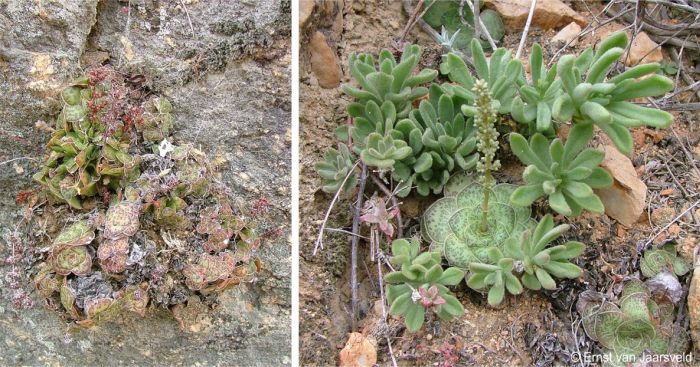
Fig. 2. Crassula pseudhemisphaerica in habitat on a cliff along the Buffelsrivier at Kleinzee, Namaqualand, Northern Cape. Right a close-up of a plant coming in to flower, surrounded by Tylecodon racemosus.
Conservation Status
Status
Classified as Least Concern (LC) by the Red List of South African Plants, Crassula pseudhemisphaerica is well protected by its often inaccessible cliff habitat.
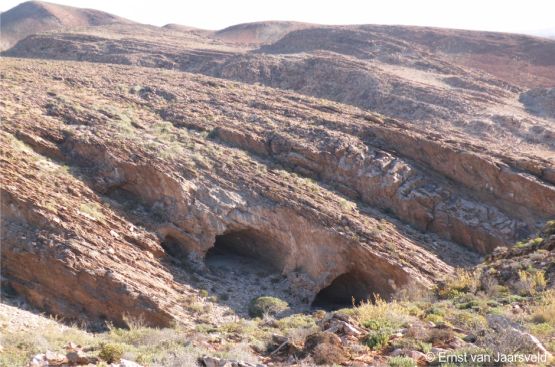
Fig. 3. The cliff-face at Spitskloof, Richtersveld, Northern Cape, habitat of Crassula pseudhemisphaerica.
Distribution and habitat
Distribution description
Crassula pseudhemisphaerica is confined to the winter-rainfall Namaqualand region, which includes the northwestern portion of the Western Cape, as well as the western coastal region of the Northern Cape, and northwards to southwestern Namibia. The habitat includes sheltered, mainly southern aspects on sandstone or shale cliffs in Succulent Karoo and Desert Biomes. Plants grow in shallow soil on shady rocky ledges at 50–900 m altitude. Temperatures are high in summer and mild in winter. The average daily maximum temperature is 25–27°C and the average daily minimum 10–12°C. Rainfall occurs mainly in winter (cyclonic) and occasionally in autumn (thunder showers) and ranges from 100–300 mm per annum. Crassula pseudhemisphaerica shares its cliff habitat with many other succulents. On the Kuamsibberg in southern Namibia plants grow in association with Aloe pavelkae and Tylecodon bruynsii, T. buchholzianus, T. racemosa and T. rubrovenosus.
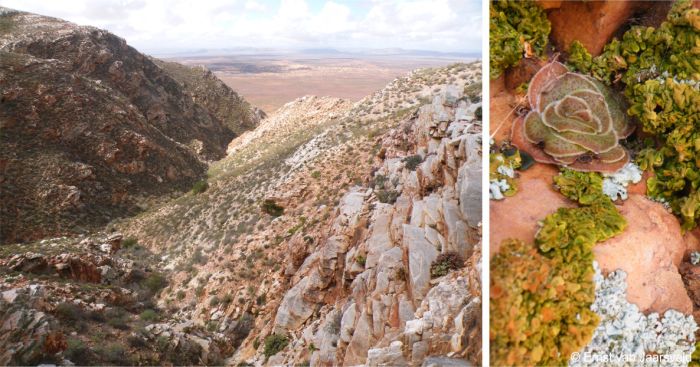
Fig. 4. Left. Fyftien-Myl-Se-Berg, Richtersveld, Northern Cape, habitat of Crassula pseudhemisphaerica. Right. A solitary plant of Crassula pseudhemisphaerica growing among lichens on a cliff at Fyftien-Myl-Se-Berg.
Derivation of name and historical aspects
History
Crassula pseudhemisphaerica was named by the German botanist Hans-Christian Friedrich (1925-1992) in the third volume of the botanical journal Mitteilungen Botanische Staatssammlungen in 1960, from plants collected by Kurt Dinter at Numais in Namibia. The name is derived from Greek, pseudo, meaning false, and hemisphaerica, half a sphere, and pertains to its likeness to Crassula hemisphaerica. It is also known as Crassula pseudohemisphaerica. Friedrich was an assistant at the Botanische Staatssammlung at Munchen University and he contributed (under the supervision of Hermann Merxmuller) towards the Prodromus einer flora von Süudwestafrika, at the time, a complete guide to the flora of Namibia. He was the scientific assistant at the botanical garden where he built up a collection of succulents of which his favourites include the Crassulaceae and Mesembryanthemaceae.
Crassula pseudhemisphaerica belongs to section Rosulares, that is characterised, as its name implies, by plants with leaves in tight basal rosettes. The leaves all have the firm bristle-like hairy margin and the elongate inflorescence with a distinct peduncle. Plants vary from the dwarf Crassula socialis to C. acinaciformis which can be more than 1 m tall when in flower. Of the 28 species in section Rosulares, 10 are confined to cliffs, all of which are dwarf cliff-huggers. These include: C. brachystachya, C. cremnophila, C. cymbiformis, C. exilis, C. luederitzii, C. montana, C. pseudhemisphaerica, C. sediflora, C. socialis and C. tabularis.
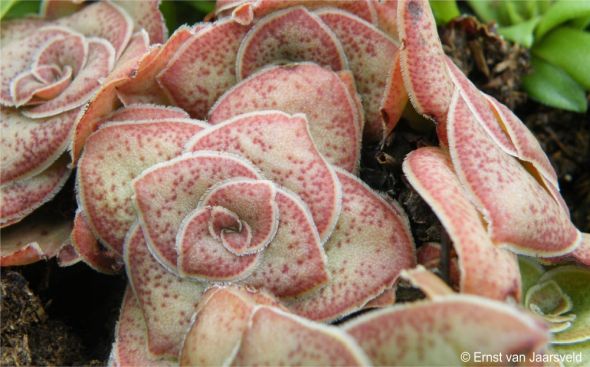
Fig. 5. Close-up of Crassula pseudhemisphaerica in cultivation (ex Rooiberg, Namaqualand) showing bristle-like hairy margin of the leaves.
Crassula pseudhemisphaerica is related to both C. hemisphaerica and C. montana subsp. quadrangularis, and is at once distinguished from them by its mottled sub-hemispherical rosettes and pale yellow flowers. Crassula hemisphaerica grows widespread on flats and hills, and is at once distinguished by its solitary growth. Crassula pseudhemisphaerica is also related to C. orbicularis, also growing on cliffs and mat-forming. It is distinguished from that species by its mottled green, 4-ranked leaves and pointed papillae on the ovary.
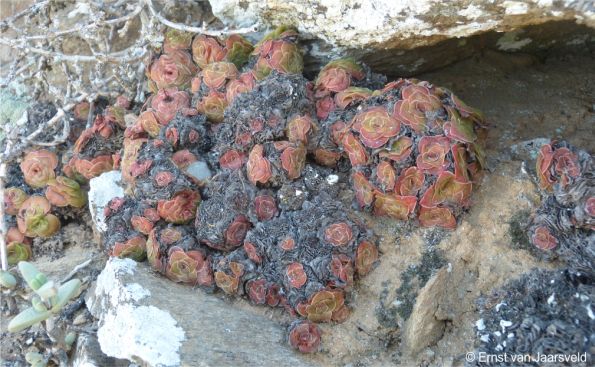
Fig. 6. Crassula pseudhemisphaerica in habitat on a cliff along the Holgat River, Richtersveld, Northern Cape.
Ecology
Ecology
The small dense clusters fill crevices on cliffs on south-facing shady aspects, in the absence of larger herbivores, this is an effective way of survival in a hostile terrain. Not only are the leaves succulent, but the dense compact arrangement ensures it long term survival. The compact 4-ranked often mottled leaves becoming purplish to reddish green during dry periods. The reddish colour that occurs with the onset of dry conditions is caused by the production of anthocyanins, and reduces penetration of light thus slowing the process of photosynthesis. Plants often occupy small crevices with shallow soil and take advantage of the regular fog and dew fall, so characteristic of the west coast of southern Africa.
The conspicuous diurnal yellowish flowers during spring suggest a day-flying insect. The fruits (follicles) are dehiscent, with seeds spontaneously released and dispersed by wind. The seeds are minute which is ideal for establishment in crevices and are released in late spring or summer.
Plants proliferate forming dense cushions, a vegetative backup strategy, enabling the plants to survive the harsh conditions on the cliff face. Crevices are soon occupied by the vegetative growth. Plants that become detached will soon root, forming new populations where they fall on suitable substrate.
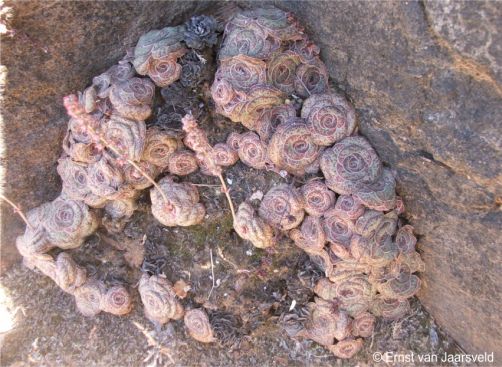
Fig. 7. Crassula pseudhemisphaerica growing on a south-facing cliff of the Hunsberg, southwestern Namibia.
Uses
Use
It is not known whether Crassula pseudhemisphaerica plants are used medicinally.
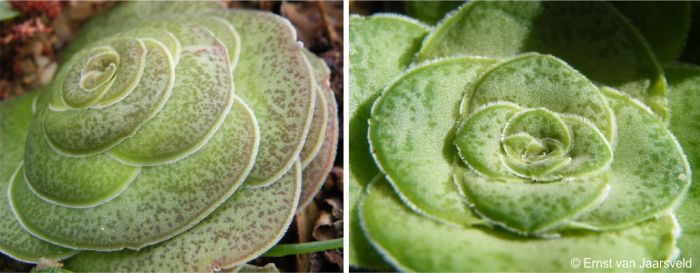
Fig. 8. Crassula pseudhemisphaerica plants in cultivation (ex Lekkersing, Namaqualand).
Growing Crassula pseudhemisphaerica
Grow
Crassula pseudhemisphaerica is sometimes grown for its ornamental mottled rosettes. It is fairly easily grown and makes a beautiful potplant. Best for miniature succulent gardens and containers grown under controlled conditions. Grow in a preferably in light or dappled shade environment. Soil should be sandy and slightly acidic and in a well-drained site. Add ample compost or a liquid organic fertiliser. Water well, especially during winter, but allow plants to dry out for some time before watering again. Keep dry during summer.
Best propagated by division or stolons. Plant offshoots in a sandy soil. Best time is in autumn to spring. Seed is fine. Sow in a sandy mixture in autumn, cover with a very thin layer of gravel. Keep moist. Remove seedlings as soon they are large enough to handle.
Roots are sometimes affected by mealybug, treat accordingly.
References
- Christenhusz, M.J.M., Fay, M.F. & Chase, M.W. 2017. Plants of the World, an illustrated Encyclopedia of vascular plants. Kew Publishing, Royal Botanic Gardens, Kew.
- Clarke, H. & Charters, M. 2016. The illustrated dictionary of southern African plant names. Flora & Fauna Publications Trust, Jacana, Johannesburg.
- Eggli, U. (ed.) 2003. Illustrated handbook of succulent plants: Crassulaceae. Springer, Berlin.
- Friedrich, H.C. 1960. Beiträge zur Kenntnis der Crassulaceae in Südwestafrika. Mitteilungen der Botanischen Staatssammlung München 3: 585-599.
- Glen, H.F. & Germishuizen, G. (compilers). 2010. Botanical exploration of southern Africa, edition 2. Strelitzia 26. South African National Biodiversity Institute, Pretoria.
- Linnaeus, C. 1753. Species plantarum. 1st edition. Salvius, Stockholm.
- Mucina, L. & Rutherford, M.C. (eds) 2006. The vegetation of South Africa, Lesotho and Swaziland. Strelitzia 19. South African National Biodiversity Institute, Pretoria.
- Raimondo, D., Von Staden, L., Foden, W., Victor, J.E., Helme, N.A., Turner, R.C., Kamundi, D.A. & Manyama, P.A. (eds) 2009. Red list of South African plants. Strelitzia 25. South African National Biodiversity Institute, Pretoria.
- Rowley, G. 2003. Crassula: a growers guide. Cactus & Co. Vista, California.
- Toelken, H.R. 1985. Crassulaceae. Flora of Southern Africa 14: 1–244.
- Van Jaarsveld, E.J. 2025. Crassula smithii Van Jaarsv., D.Styles & G.McDonald (Crassulaceae). PlantZAfrica. Online. https://pza.sanbi.org/crassula-smithii.
Credits
Ernst van Jaarsveld
Kirstenbosch National Botanical Garden (Retired)
Babylonstoren Farm (Current)
Extraordinary senior lecturer and researcher,
Department of Biodiversity and Conservation, University of the Western Cape
January 2026
Plant Attributes:
Plant Type: Succulent
SA Distribution: Northern Cape, Western Cape
Soil type: Sandy, Loam
Flowering season: Spring, Early Summer
PH: Acid, Neutral
Flower colour: Yellow
Aspect: Shade, Morning Sun (Semi Shade), Afternoon Sun (Semi Shade)
Gardening skill: Average
Special Features:
 Drought resistant
 Good potplant
 Indoor plant
Horticultural zones



Rate this article
Article well written and informative
Rate this plant
Is this an interesting plant?
Login to add your Comment
Back to topNot registered yet? Click here to register.