


Crassula rupestris subsp. marnierana
Introduction
Crassula rupestris subsp. marnierana is a cliff-hugging succulent shrublet, often becoming a hanger on ledges, bearing branches densely covered in rounded succulent leaves and forming a cylindrical body and an elongated to rounded inflorescence of white to pinkish flowers in the autumn. Very popular appealing ornamental succulent, easily propagated from stem cuttings, and best grown in containers.
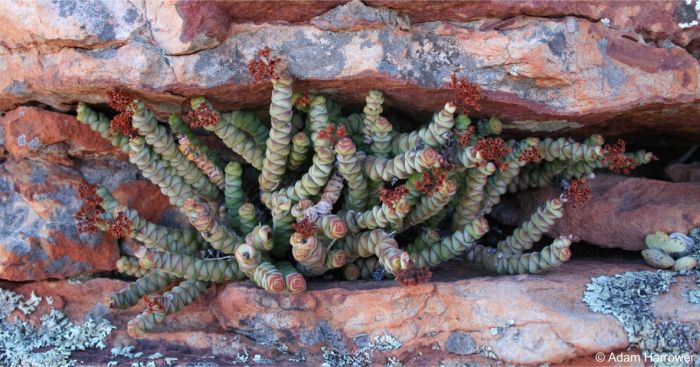
Fig. 1. A cluster of Crassula rupestris subsp. marnierana in fruit on a cliff ledge along the Seweweekspoort in the Klein Karoo, Western Cape. (Photo Adam Harrower).
Description
Description
Spreading to pendulous, branched shrublets up to 200 mm in diameter, or sometimes forming larger clusters, rooting where branches touch ground. Stems 1–2 mm in diameter, spreading and becoming pendulous, often curving upwards. Leaves crowded and internodes not visible, sessile, ovate, 3–6 × 4–6 mm, bases fused for over half leaf length forming a disc; surface smooth, glaucous; margin entire, often reddish; hydathodes concentrated along margins; apex rounded. Inflorescence a short, sessile, rounded thyrse up to 15 mm in diameter, with many flowers in dichasia. Flowers 5-merous, star-shaped, up to 4.5 mm in diameter, white; pedicels 2–5 mm long. Calyx lobes triangular, 1 mm long, apices acute. Corolla lobes oblong-elliptic, 3–4 mm long, recurved; apices obtuse. Stamens up to 3.5 mm long; anthers brown; pollen yellow. Squamae oblong to square, 0.4–0.9 × 0.3–0.6 mm, thick, fleshy, yellowish orange. Flowering time is in autumn (April–May).
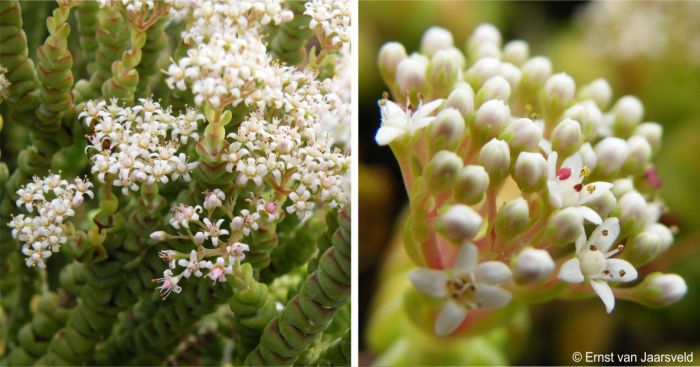
Fig. 2. Crassula rupestris subsp. marnierana in flower in the Kirstenbosch Succulent Collection, and a close-up of the inflorescence.
Conservation Status
Status
Crassula rupestris subsp. marnierana is assessed as Rare according to the Red List of South African Plants. It is not facing any known threats, the plants are safeguarded by their difficult to reach cliff habitat and its distribution falls within a greater conservation region.
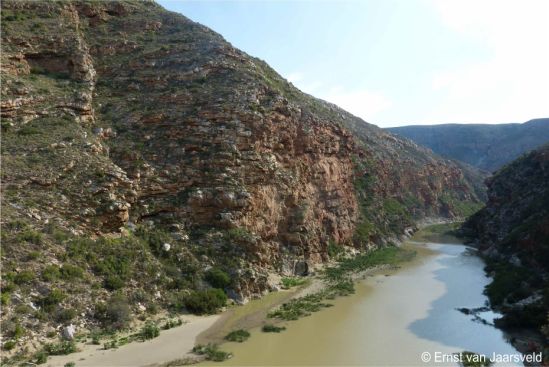
Fig. 3. The sheer cliffs along the Buffelspoort, Klein Karoo, in the Western Cape, the habitat of Crassula rupestris subsp. marnierana.
Distribution and habitat
Distribution description
Crassula rupestris subsp. maranierana is known from the northwestern Klein Karoo, Anysberg to Klein Swartberg and mountains along the Huis River Pass in the Western Cape. It is mainly found on south-facing mineral-poor quartzitic sandstone cliffs at 800–1 500 m (Peninsula Formation, Table Mountain Group, Cape Supergroup). It is locally abundant, firmly rooted in crevices. The summers are warm to hot and temperatures can reach 40°C. Winters are cooler but frost is absent. The average daily maximum temperature is about 25–26°C and the average daily minimum for the region 9–10°C. Rainfall occurs in winter (cyclonic) and summer (thunder showers), ranging from 250–350 mm per annum. The associated vegetation is known as Gamka Thicket (Albany Thicket Biome). Associated cliff dwelling plants in its habitat include Aloe comptonii, Crassula cotyledonis, Crassula muscosa, Crassula perforata and Haemanthus coccineus.
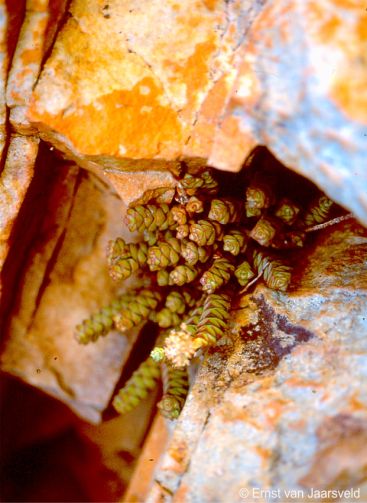
Fig. 4. A cluster of Crassula rupestris subsp. marnierana on a cliff ledge west of Ladismith in the Klein Karoo, Western Cape.
Derivation of name and historical aspects
History
Crassula rupestris subsp. marnierana was named by H.E. Huber and Hermann Jacobsen in 1952 in the Cactus Journal from plants collected on the Touwsberg by the botanist Elsie Esterhuysen from the University of Cape Town. Huber and Jacobsen named it for Marnier la Postolle, grower of succulent plants in France.
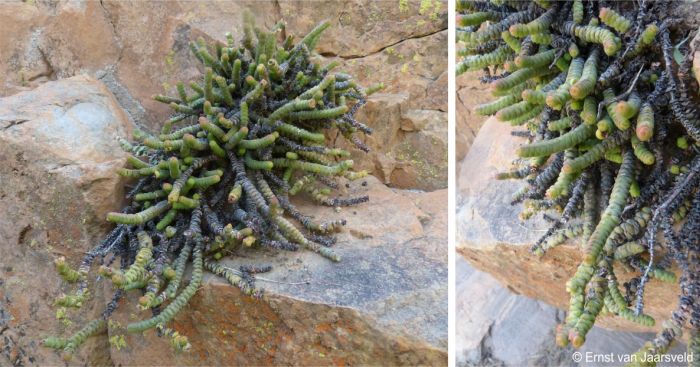
Fig. 5. Crassula rupestris subsp. marnierana in habitat on a on a quarzitic sandstone cliff at Buffelspoort, Klein Karoo, Western Cape.
Crassula rupestris subsp. marnierana belongs to section Perfilatae to which 7 species belong. These include: Crassula badspoortensis, C. fusca, C. macowaniana, C. perforata, C. sladenii, C. rupestris and C. brevifolia. Of these, Crassula badspoortensis, C. sladenii, C. rupestris subsp. marnierana and C. perforata subsp. kougaensis are mostly obligatory cliff dwellers. Adrian Haworth, British succulent botanist, created this section in 1828 to accommodate those species with woody stems, leaves with obvolute vernation, a stalked inflorescence and small tubular flowers. Species in section Perfilatae are popular among succulent enthusiasts due to the ornamental appeal of their leaves.
Crassula rupestris subsp. marnierana is immediately distinguished from subsp. rupestris by its smaller, spreading habit and readily rooting at the nodes, its tightly packed leaves and short internodes making them very close together so that the stems are not visible, the leaves are egg-shaped with rounded apices, the bases of the opposite pairs are fused into an orbicular disc, the fused portion at least half as long as each leaf. It can also be confused with Crassula perforata subsp. kougaensis, but the latter is a smaller plant from the Kouga River, further east, with an elongated inflorescence and smaller yellowish flowers.
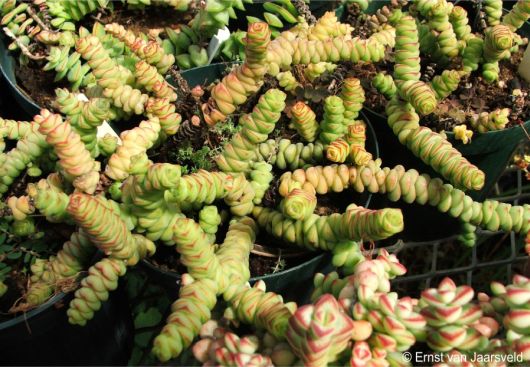
Fig. 6. Crassula rupestris subsp. marnierana growing in the Kirstenbosch Succulent Collection, note the rounded leaves tightly packed along the stem.
Ecology
Ecology
The plants have spreading branches, often drooping from the cliff face. The stems are flaccid, shorter and pendulous or sub-pendulous. The softer, less woody and pendulous nature of the stems (compared to the woody stems of subsp. rupestris in non-cliff habitats) can be viewed as an adaptation to the cliff environment. The leaves are spreading, closely packed, forming a cylindrical body. Leaf pairs are fused by half or more their length forming a disc, and the crowded leaf arrangement is an adaptation to the xeric conditions of the cliff face. The leaf surface is glaucous, an adaptation resulting from the extreme run-off in the sheer habitat. Plants are long-lived perennials. The leaves are also persistent and long-lived, suggesting adaptation to the xeric cliff conditions. The soft-leafed plant bodies are without conspicuous armament nor camouflage.
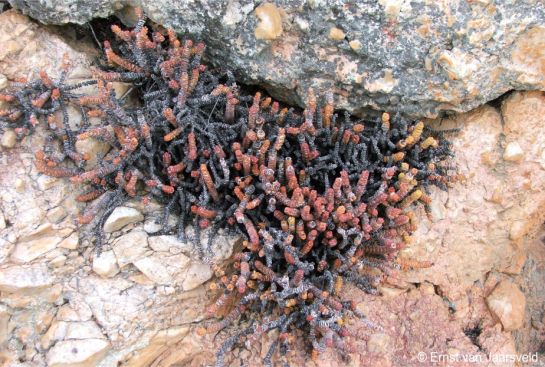
Fig. 7. Crassula rupestris subsp. marnierana growing on a quarzitic sandstone cliff ledge on the upper quarzitic sandstone cliffs along the Huisrivier pass, Klein Karoo, Western Cape, the plants have become reddish due to drought stress.
The inflorescence is a large round-topped thyrse, conspicuous, in autumn and winter (April–June) bearing pinkish white flowers. The fruits (follicles) are dehiscent, the seed spontaneously released and dispersed by wind, in time for autumn rains, maximising establishment.
Plants are slow growing, and long-lived perennials. This slow conservative growth can also be viewed as an adaptation to the mineral-poor quarzitic sandstone soil. The succulent nature of leafy branches stores sufficient moisture enabling the plant so survive periods of drought. The closely packed nature forming an oblong, rectangular body (minimising moisture loss), becoming distinctly purplish reddish during dry periods. This columnar feature is typical of many cliff-dwelling succulents and can be viewed as an adaptation to the extreme xeric conditions of the cliff face.
The leafy stems are often encountered with aerial roots, and stems will root when coming in close contact with crevices, an efficient vegetative backup strategy for surviving the harsh conditions on the cliff face. A detached branch will also root when landing on a crevice.
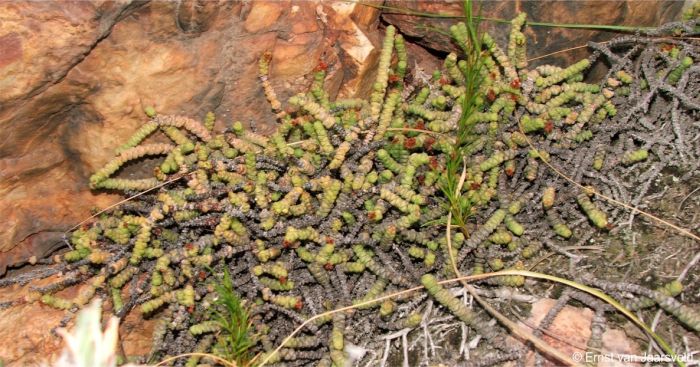
Fig. 8. A densely branched cluster of Crassula rupestris subsp. marnierana growing on a quarzitic sandstone cliff ledge on the upper quarzitic sandstone cliffs along the Huisrivier pass, Klein Karoo, Western Cape.
Growing Crassula rupestris subsp. marnierana
Grow
Grown for its ornamental value, appealing with its compact shape. In fact a very popular succulent widely grown. Crassula rupestris subsp. marnierana is best grown in succulent karoo and thicket gardens, on rockeries, among rocks and free from competition from non-succulent plants or in a container.
In regions outside of its habitat ceramic containers are the solution. It also grows well with other succulents in miniature succulent gardens where conditions can be controlled. Grow in a gravely or sandy soil which drains well. Keep in full sun or dappled shade. Plants are easily propagated by stem cuttings and are not difficult to root. The stems can simply be placed on the substrate and aerial roots will soon penetrate the soil. Avoid over watering. Water should be provided throughout the year, but sparingly.
Sow seed in autumn or spring in a shallow tray in a sandy mixture and keep moist. Germination is within 3 weeks and once large enough to handle, transfer to individual containers. Place container in a sunny or dappled shady position but with full light. The sunny, north side (southern Hemisphere) of a building is ideal.
Plants are relatively disease free, except for stem and root rot with too much watering. Aphids, vine weevils, slugs and snails can sometimes be a problem.
References
- Christenhusz, M.J.M., Fay, M.F. & Chase, M.W. 2017. Plants of the World, an illustrated Encyclopedia of vascular plants. Kew Publishing, Royal Botanic Gardens, Kew.
- Clarke, H. & Charters, M. 2016. The illustrated dictionary of southern African plant names. Flora & Fauna Publications Trust, Jacana, Johannesburg.
- Eggli, U. (ed.) 2003. Illustrated handbook of succulent plants: Crassulaceae. Springer, Berlin.
- Glen, H.F. & Germishuizen, G. (compilers). 2010. Botanical exploration of southern Africa, edition 2. Strelitzia 26. South African National Biodiversity Institute, Pretoria.
- Mucina, L. & Rutherford, M.C. (eds) 2006. The vegetation of South Africa, Lesotho and Swaziland. Strelitzia 19. South African National Biodiversity Institute, Pretoria.
- Raimondo, D., Von Staden, L., Foden, W., Victor, J.E., Helme, N.A., Turner, R.C., Kamundi, D.A. & Manyama, P.A. (eds) 2009. Red list of South African plants. Strelitzia 25. South African National Biodiversity Institute, Pretoria.
- Rowley, G. 2003. Crassula: a growers guide. Cactus & Co. Vista, California.
- Toelken, H.R. 1975. New taxa and new combinations in the genus Crassula. Journal of South African Botany 41(2): 93–124.
- Toelken, H.R. 1985. Crassulaceae. Flora of Southern Africa 14: 1–244.
- Van Jaarsveld, E.J. & Van Wyk, A.E. 2009. Crassula perforata subsp. kougaensis, a new cliff-dwelling taxon from South Africa. Aloe 46(1): 22–23.
- Van Jaarsveld, E.J. 2010. Waterwise gardening in South Africa and Namibia. Struik, Cape Town.
Credits
Ernst van Jaarsveld
Kirstenbosch National Botanical Garden (Retired)
Babylonstoren Farm (Current)
Extraordinary senior lecturer and researcher,
Department of Biodiversity and Conservation, University of the Western Cape
April 2026
Plant Attributes:
Plant Type: Succulent
SA Distribution: Western Cape
Soil type: Sandy
Flowering season: Autumn
PH: Acid, Neutral
Flower colour: White
Aspect: Full Sun, Morning Sun (Semi Shade), Afternoon Sun (Semi Shade)
Gardening skill: Easy
Special Features:
 Drought resistant
 Good potplant
Horticultural zones




Rate this article
Article well written and informative
Rate this plant
Is this an interesting plant?
Login to add your Comment
Back to topNot registered yet? Click here to register.