


Crassula swaziensis
Introduction
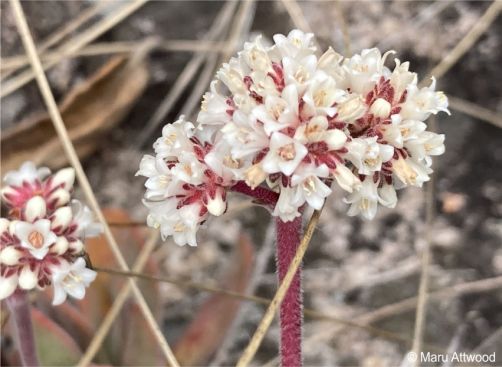
Crassula swaziensis is a slow growing, mat-forming, perennial succulent with rounded, succulent leaves and white flowers in flat-topped clusters that attract butterflies to the garden. It typically grows in rocky environments and can withstand heat and moderate frost.
Description
Description
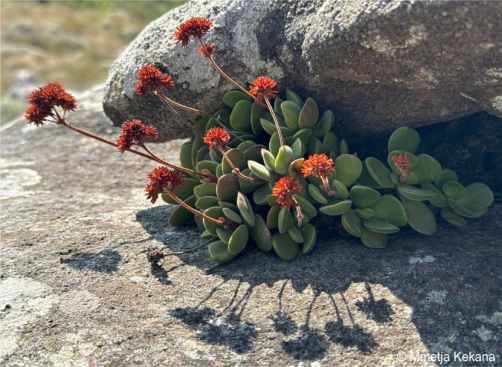
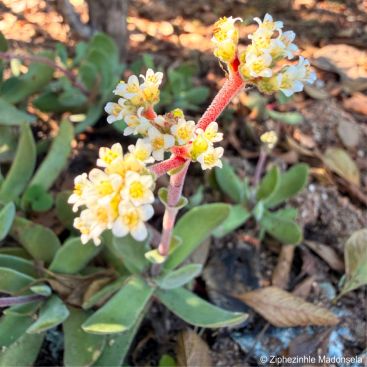
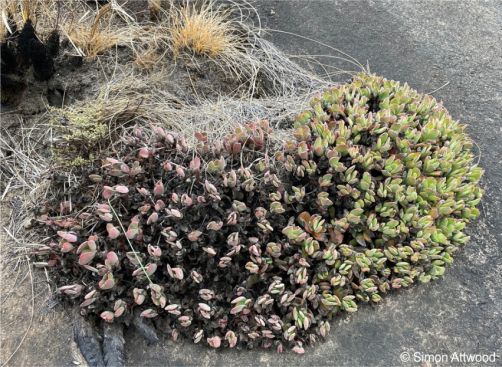
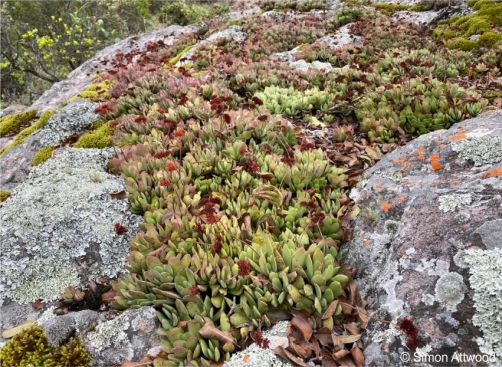
Crassula swaziensis is a branched, mat-forming succulent about 60 mm tall, up to 200 mm tall when in flower. Roots are fibrous and shallow helping the plant to grow in thin layers of soil and rocky places. Branches are short and thick, reddish-brown and brittle, and appear old even when new. They grow straight upwards, or start off growing sideways but end up becoming curved upwards from the base. Leaves are in rosettes at the tips of branches or in opposite pairs, thick and fleshy, green to greyish-green. They have an obovate to elliptic shape and are slightly convex on both surfaces. They are usually covered with hairs, sometimes hairless, and have tiny hairs along the edges, that become shorter towards the base of the leaf. They become reddish to purple when they are exposed to too much heat and drought.
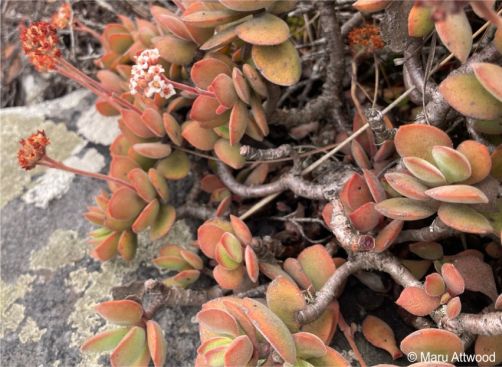
Inflorescence is multi-branched and is made up of many small flowers that are clustered at the tip of the flowering stem, which is slender, maroon-red, covered in white fine hairs and grows about 100 mm above the leaves of the plant. Flowers are white to cream-white and are tinged pink in bud, in flattened clusters. They appear in late summer, autumn and winter (January-April to August). The flowers are star-shaped and have 5 petals that are white to light pink or flushed with red. After flowering the inflorescence dries up and transforms to a vibrant reddish orange instead of brown, which remains beautiful against the colour of the leaves. The fruits of this species are small, when they are matured they split open and release a number of tiny, almost like dust-like seeds that get dispersed by wind.
Conservation Status
Status
Crassula swaziensis is assessed as Least Concern (LC) according to Red List of South African Plants, as the population of this plant is considered as stable in the wild and there are no known risks that will cause the plant to become extinct.
Distribution and habitat
Distribution description
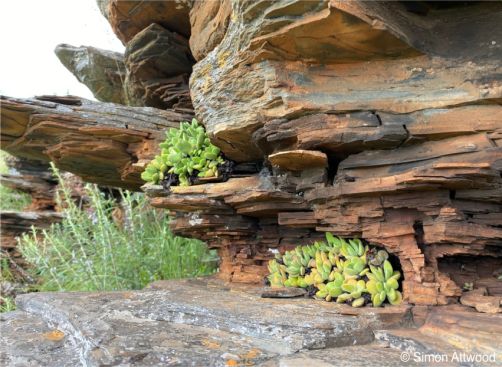
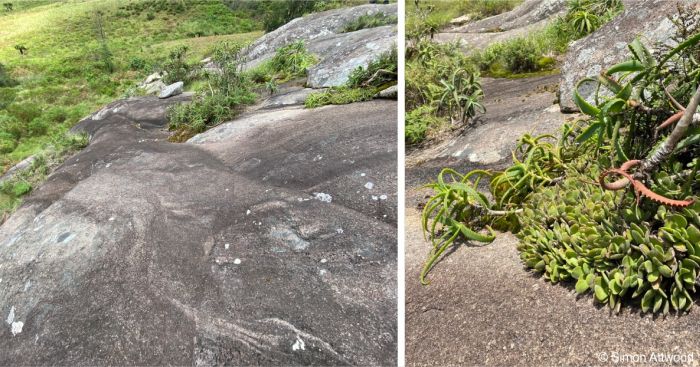
Crassula swaziensis has a wide distribution as it grows naturally in eastern southern Africa in the countries South Africa, Eswatini, Malawi, Mozambique and Zimbabwe. In South Africa it grows naturally in Free State, Gauteng, KwaZulu-Natal, Limpopo, Mpumalanga and North West Provinces. It grows predominantly in subtropical regions, on rocky outcrops in grassland and bushveld. Like most crassulas, it is well adapted to harsh environments, it is able to thrive in hot and dry areas that might have water shortages, and it can also do well in cooler, mountainous places. It is also able so grow in places where there is very little soil, and it can also be found growing on rocks and in rock crevices.
Derivation of name and historical aspects
History
This plant species is a member of Crassulaceae family also known as stonecrops or plakkies, which is predominately a group of succulents, with thick and fleshy leaves that the plant uses to store water and food. The genus name Crassula is derived from the Latin adjective crassus meaning ‘thick’ or ‘fat’, referring to the thick succulent leaves typical of the plant species under this genus.
Crassula swaziensis was first described in 1897 from a type specimen that was collected in 1895 by a German-South African botanist named Selmar Schönland. He named it swaziensis meaning ‘of Swaziland’ because it was found in what is now Eswatini (formerly Swaziland). In 1902 it was reclassified as Crassula argyrophylla. In 1929, Schönland himself reclassified this plant species suggesting it was not a separate species to Crassula argyrophylla but a variant and it became Crassula argyrophylla var. swaziensis.
Because it is a variable species, numerous forms and varieties were named between 1929 and 1975, such as Crassula swaziensis subsp. swaziensis var. gurnensis, Crassula swaziensis subsp. swaziensis var. gurnensis. forma brevipilosa, Crassula swaziensis subsp. swaziensis var. gurnensis. forma gurnensis, Crassula swaziensis subsp. swaziensis var. swaziensis, Crassula swaziensis subsp. swaziensis var. swaziensis forma argyrophylla , and Crassula swaziensis subsp. swaziensis var. swaziensis forma swaziensis. More studies in nature and of herbarium specimens were conducted and the conclusion reached was that the other varieties and forms linked to Crassula swaziensis were not valid, and they were then grouped together to form a single species. Because Crassula swaziensis was the first official name given in 1897, that name remained. Today, Crassula swaziensis is the accepted name, and the other names such as Crassula argyrophylla, Crassula argyrophylla var. swaziensis and Crassula swaziensis var. swaziensis are all considered as synonyms.
Ecology
Ecology
Crassula swaziensis is well adapted and thrives in dry and hot conditions, cold and rocky places and places with very little soil. In warm provinces it is also found at higher altitudes. It also has an ability to withstand fires. The plant being a Crassula, it survives drought using a special method called Crassulacean Acid Metabolism, known as CAM, where plants can make their food during the day while their stomata are closed and open them at night to absorb carbon dioxide when it is cooler, in this way the plant saves water. The plant is able to completely close it stomata throughout drought periods and use the carbon dioxide that is already in the plant cells, to avoid losing water, which keeps the plant healthy and avoids dying.
Its flat-topped flowerheads attract butterflies to the garden.
Uses
Use
Crassula swaziensis is an ideal plant for bedding, rock-gardens and waterwise gardens. It is an excellent plant to bring in autumn and winter colour to gardens, especially in the summer rainfall regions. It is also suitable for containers.
A pharmaceutical study on plants that was conducted in India concluded that the aerial parts of this plant have properties to treat Herpes simplex virus and HPV.
Growing Crassula swaziensis
Grow
Crassula swaziensis is a resilient plant that can withstand a range of harsh conditions, from moderate frost to extreme hot and dry conditions, making it a versatile plant. Its compact nature makes it an appealing ornamental plant for succulent and rockery gardens where it can be paired with other succulent plants. This plant grows best in well-drained soil, too much water and poor drainage causes the plant to rot and rust-like appearance on the leaves. It also thrives in positions in full shade and dappled shade in the garden.
Crassula swaziensis can be propagated sexually (seeds) and asexually (cuttings), but it is most easily propagated by stem cuttings and division, it roots easily with or without plant growth hormones. Stem cuttings should be placed in a cool place before they are propagated. Cuttings should be planted in river sand and they will root within 3 weeks. Watering should be administered adequately. Overwatering should be avoided on cuttings and on mature plants as this causes rotting.
This species can also be grown from seeds, even though seeds take longer to germinate.
References
- Attwood, M. 2023. Observation of Crassula swaziensis, Thaba Chweu, Mpumalanga. iNaturalist. Online. https://www.inaturalist.org/observations/176970333.
- Attwood, M. 2024. Observation of Crassula swaziensis, Mapulaneng, Mpumalanga. iNaturalist. Online. https://www.inaturalist.org/observations/243542538.
- Attwood, S. 2022. Observation of Crassula swaziensis, Thaba Chweu, Mpumalanga. iNaturalist. Online. https://www.inaturalist.org/observations/124543629.
- Attwood, S. 2023. Observations of Crassula swaziensis. iNaturalist. Online. https://www.inaturalist.org/observations/182950008 & https://www.inaturalist.org/observations/182919575.
- Attwood, S. 2025. Observation of Crassula swaziensis, Thaba Chweu, Mpumalanga. iNaturalist. Online. https://www.inaturalist.org/observations/262804421.
- Attwood, S. 2026. Observation of Crassula swaziensis, Thaba Chweu, Mpumalanga. iNaturalist. Online. https://www.inaturalist.org/observations/337948168.
- Eggli, U. (ed.) 2003. Illustrated handbook of succulent plants: Crassulaceae. Springer, Berlin.
- Kekana, M. 2024. Observation of Crassula swaziensis, Pelgrimsrus, Mpumalanga. iNaturalist. Online. https://www.inaturalist.org/observations/243983184.
- Mashego, K.S. 2021-11. Crassula fusca Herre (Crassulacee). PlantZAfrica. Online. https://pza.sanbi.org/crassula-fusca.
- Pal, D. (ed) 2023. Anti-viral metabolites from medicinal plants. Springer International Publishing, Germany.
- Plants of the World Online. Crassula swaziensis Schönland.https://powo.science.kew.org/taxon/urn:lsid:ipni.org:names:273530-1. Accessed 2026/02/27.
- Pooley, E., Nichols, G. & Hankey, A. 2025. South African indigenous garden plants, the gardener’s guide. Struik Nature, Cape Town.
- Raimondo, D., Von Staden, L., Foden, W., Victor, J.E., Helme, N.A., Turner, R.C., Kamundi, D.A. & Manyama, P.A. (eds) 2009. Red list of South African plants. Strelitzia 25. South African National Biodiversity Institute, Pretoria.
- Smith, G.F. & Crouch, N.R. 2009. Guide to succulents of southern Africa. Struik Nature, Cape Town.
- Smith, G.F., Crouch, N.R. & Figueiredo, E. 2017. Field guide to succulents in southern Africa. Struik Nature, Cape Town.
- Toelken, H.R. 1985. Crassulaceae. Flora of Southern Africa 14: 1–229.
- Van Jaarsveld, E.J. 2013. Waterwise gardening in South Africa and Namibia. Penguin Random House, South Africa.
Credits
Ziphezinhle Madonsela
Lowveld National Botanical Garden
August 2026
Acknowledgements: The author thanks Mmetja Kekana and Simon and Maru Attwood for providing images for this article.
Plant Attributes:
Plant Type: Ground Cover, Succulent
SA Distribution: Free State, Gauteng, KwaZulu-Natal, Limpopo, Mpumalanga, North West
Soil type: Sandy, Loam
Flowering season: Late Summer, Autumn, Winter
PH:
Flower colour: White
Aspect: Full Sun
Gardening skill: Easy
Special Features:
 Attracts butterflies
 Drought resistant
 Good potplant
 Medical plant
 Feeds honeybees
Horticultural zones




Rate this article
Article well written and informative
Rate this plant
Is this an interesting plant?
Login to add your Comment
Back to topNot registered yet? Click here to register.