


Cyathula uncinulata
Introduction
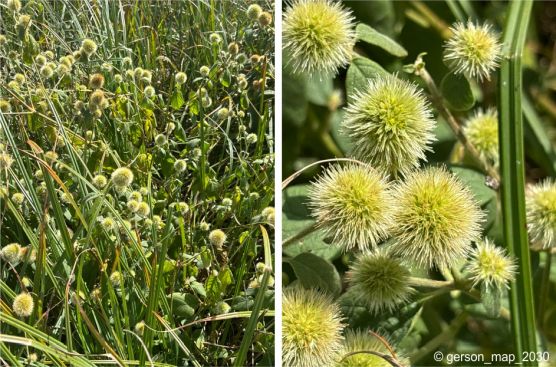
If there is a plant that has mastered the art of dominance and hook-ups, its definitely the globe cyathula. A perennial plant capable of creating impenetrable thickets, reaching a height of up to 6 m, with rounded whitish flowerheads of small flowers, turning into fruits full of hooks upon maturity. The plant ensures that no furry animal will pass its way without tagging itself along to ensure seed dispersal. The basal leaves are heart-shaped, a true indicator to justify its usage in love potions.
Description
Description
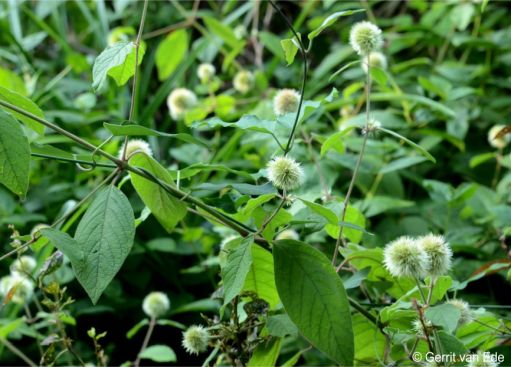
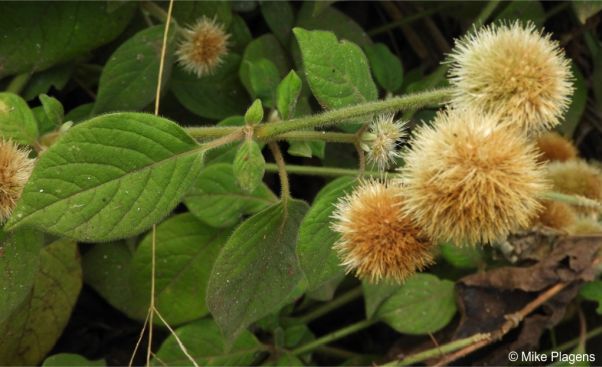
Cyathula uncinulata is a scrambling, straggling perennial shrub. It can grow erect and bushy in some conditions, but more often it climbs over other vegetation or sprawls along the ground. It is evergreen, keeping its leaves year-round, and grows fairly quickly, reaching lengths of anywhere from 300 mm to a substantial 6 m over time. The younger stems are noticeably hairy, with a soft, felt-like covering that ranges from whitish to yellowish. As the stems age, this hairiness thins out. One of the plant's most distinctive features is its swollen, knobby joints (nodes), where the leaves attach—a good clue for identifying it. The leaves are broad and oval to oblong in shape, typically 35 to 120 mm long and 25 to 80 mm wide. They have a short, wedge-shaped or slightly heart-shaped base and taper to a short, pointed tip. The upper surface of the leaf is moderately hairy, while the underside is much more densely covered in soft hairs, especially along the veins. Each leaf is carried on a short stalk (petiole), about 10 to 22.5 mm long.
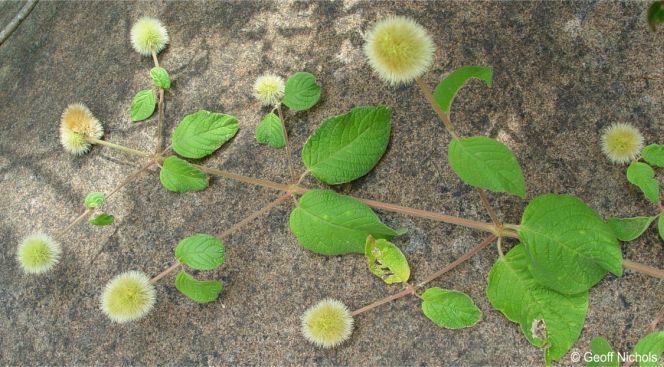
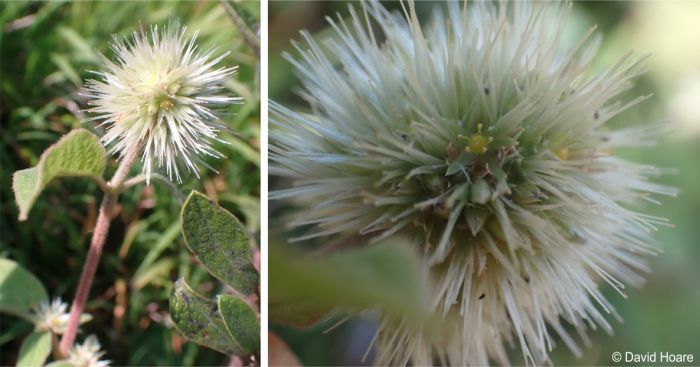
The flowers are small and grouped into dense, rounded heads that look like little pompons. These heads are about 18 to 25 mm across when in bloom, although some may be looser and slightly oblong, enlarging to about 40 mm in diameter in fruit. They are carried on individual stalks ranging from less than 10 mm to about 40 mm long, occasionally reaching 100 mm. Each flower head is made up of compact, branching clusters, with a central fertile flower flanked by two groups of three—one fertile and two sterile, modified flowers (although this arrangement can vary). The flowers are noticeable for their straw-like bracts and bracteoles and tepals with hooked tips, which become more prominent as they mature.
The individual flower parts, called tepals (similar to petals), are hairless, sharply pointed, and narrow. The two outer tepals are longer, about 5 to 6.5 mm, with a single vein that often ends in a tiny, fish-hook-like tip. The inner tepals are shorter, 2.5 to 5 mm, with two or three veins, and end in a small, abrupt point. The sterile, modified flowers have two bracteole-like structures with hooked tips, and two shorter hooked spines—all of which give the flower head a slightly prickly feel.
The male reproductive part (filaments) are delicate and slender, about 2 to 2.5 mm long. The female reproductive part (style), is slender and about 2 mm long. The fruit is a small, ovoid capsule, roughly 2.2 mm long, with a thin, papery wall but a firm, flattish tip, containing an ovoid, brown seed about 2 mm long.
Conservation Status
Status
According to the Red List of South African plants, Cyathula uncinulata is assessed as Least Concern (LC).
Distribution and habitat
Distribution description
Cyathula uncinulata has a wide distribution in Africa, from Cameroon and Sudan to South Africa, and also in Madagascar. In South Africa the plant occurs in all the provinces except the Northern Cape. This plant thrives in plantations and along the edges where forests meet grasslands. It also colonises roadsides and stream banks. There, it scrambles aggressively over neighbouring plants and forms dense, impenetrable thickets that can quickly take over the surrounding area.
Derivation of name and historical aspects
History
Cyathula is a genus consisting of 42 plant species, in the Amaranthaceae. Amaranthaceae, commonly known as the pig weed family, belongs to the order Caryophyllales and is native to tropical America and Africa. Its members grow across tropical and subtropical regions, and some even reach more temperate areas. According to Basu et al., scientists believe the family may have originated in the southwestern United States, Latin America, or Africa. Most species are herbs, but the family also includes vines, shrubs, and trees. In total, it contains about 800 species spread across more than 60 genera, and it is broadly divided into two subfamilies: Amaranthoideae and Gomphrenoideae. The genus name Cyathula is derived from the Greek word meaning ‘cup’ due to the fusion of the stamens at the bottom, creating a cup-shaped structure. The epithet uncinulata means ‘small hooks’ in reference to the hooks that are found on the matured flowers. This plant species has two synonyms: Cyathula globulifera Moq. and Desmochaeta uncinulata Hiern. Other noteworthy species within the genus are Cyathula prostrata, C. natalensis and C. cylindrica, which have medicinal properties.
Ecology
Ecology
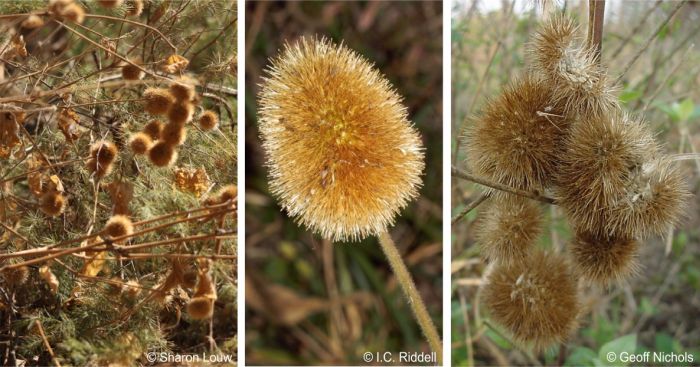
The developing fruits cluster together into a dense, oval-shaped bunch, and stink bugs feed on them. Each tiny capsule contains just one seed, which sits surrounded by a group of spiny, hooked bracts. These hooks catch easily in animal fur or passersby's clothing, helping the plant spread its seeds to new areas. It should be noted that the burrs can get stuck in the coats and tails of sheep, cattle and dogs, and are difficult to get out.
Uses
Use
The earliest record of Cyathula uncinulata in South African ethnobotany was recorded by Watt and Breyer-Brandwijk in 1932, where the authors noted that the plant was used in witchcraft by the Bapedi people. In Lesotho a decoction prepared from the plant leaves is used as an emetic. The plant has extensive use far beyond our boundaries. In Democratic Republic of Congo, the plant is used for the treatment of Malaria. In the eastern part of Democratic Republic of Congo, men use the plant to prepare love potions, whilst it is also a nutritive value feed for livestock in Ethiopia. In Rwanda the plant is considered to be anti-syphilitic. Extracts from Cyathula uncinulata have demonstrated antimicrobial activity against Escherichia coli, a very common pathogen known to cause diarrhoea.
Growing Cyathula uncinulata
Grow
Cyathula uncinulata is easily propagated from seed or soft-tip cuttings. Soak seeds for a day, then sow them in a warm, sunny spot like a heated bed or cold frame—they germinate within days. For cuttings, place them in a mist-unit with bottom heat, and they root in 10 to 14 days. No rooting hormone is necessary, though it may help. Propagate during the warmer months (spring or summer) for best results.
Plant it in well-drained soil and give it full sun, though it tolerates light shade. Water moderately during active growth, but once established, it handles drought well. It survives light frost and grows very fast. Apply a light dose of general fertiliser or compost in spring, and add mulch to retain moisture and suppress weeds. Avoid over-fertilising, which causes weak, leggy growth.
Prune in late winter or early spring to remove dead stems and encourage bushier growth. Regular trimming keeps its scrambling habit in check and prevents it from overwhelming neighbours. Cut back wayward shoots throughout the growing season to maintain shape. Water young plants regularly during their first year to help them establish strong roots.
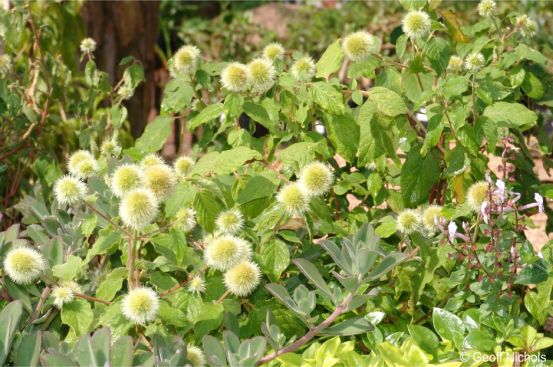
For garden use, use the plant to cover banks, tumble over retaining walls, or scramble through mixed borders and trellises. It also works well as fast-growing ground cover or in large containers where it spills over edges. Pair it with silver-leaved plants like Artemisia afra or bold foliage like Leonotis leonurus for striking contrast with the flowers. Avoid planting near delicate, slow-growing species, as it may outcompete them. It stays relatively pest-free, though you can treat occasional aphids with insecticidal soap or a strong spray of water.
References
- Basu, S., Zandi, P., Sengupta, R. & Cetzal-Ix, W. 2014. Amaranthaceae: The pigweed family. Encyclopedia of Earth.
- Bingham, M.G., Willemen, A., Wightman, N., Wursten, B.T., Ballings, P. & Hyde, M.A. 2026. Cyathula uncinulata. Flora of Zambia. Online. https://www.zambiaflora.com/speciesdata/species.php?species_id=122360.
- Bisi-Johnson, M.A., Obi, C.L., Hattori, T., Oshima, Y., Samuel, B.B. & Eloff, J.N. 2015. Antimicrobial activity of the bioactive fractions of Cyathula uncinulata (Amaranthaceae). European Journal of Medicinal Plants 10(1): 1-9.
- gerson_map_2030. 2025. Observation of Cyathula uncinulata, Sisonke, KwaZulu-Natal. iNaturalist. Online. https://www.inaturalist.org/observations/209068474
- Hoare, D. 2023. Observation of Cyathula uncinulata, Ermelo, Mpumalanga. iNaturalist. Online. https://www.inaturalist.org/observations/151857184
- Louw, S. 2024. Observation of Cyathula uncinulata, Rietvallei, Gauteng. iNaturalist. Online. https://www.inaturalist.org/observations/238141616
- Moteetee, A. & Van Wyk, B. 2011. The medicinal ethnobotany of Lesotho: a review. Bothalia 41(1): 209–228.
- Plagens, M. 2023. Observation of Cyathula uncinulata, Kitale, Kenya. iNaturalist. Online. https://www.inaturalist.org/observations/149154164.
- Raimondo, D., Von Staden, L., Foden, W., Victor, J.E., Helme, N.A., Turner, R.C., Kamundi, D.A. & Manyama, P.A. (eds) 2009. Red list of South African plants. Strelitzia 25. South African National Biodiversity Institute, Pretoria.
- Riddell, I.C. 2025. Observation of Cyathula uncinulata, Mutasa, Zimbabwe. iNaturalist. Online. https://www.inaturalist.org/observations/316467796.
- Townsend, C.C. 1985. Flora of Tropical East Africa. Amaranthaceae.
- Van Ede, G. 2025. Observation of Cyathula uncinulata, Bashewa, Gauteng Province. iNaturalist. Online. https://www.inaturalist.org/observations/278523885.
- Watt, J.M. & Breyer-Brandwijk, M.G. 1932. The medicinal and poisonous plants of southern Africa, edn 1. E. & S. Livingstone, London.
Credits
Lesiba Papo
National Herbarium, Pretoria
July 2026
Acknowledgements: the author thanks I.C. Riddell, Gerrit van Ede, gerson_map_2030, Mike Plagens, David Hoare, Geoff Nichols and Sharon Louw for images.
Plant Attributes:
Plant Type: Scrambler, Shrub
SA Distribution: Eastern Cape, Free State, Gauteng, KwaZulu-Natal, Limpopo, Mpumalanga, North West, Western Cape
Soil type: Sandy, Loam
Flowering season: Spring
PH:
Flower colour: White, Cream
Aspect: Full Sun, Morning Sun (Semi Shade), Afternoon Sun (Semi Shade)
Gardening skill: Easy
Special Features:
 Medical plant
 Pioneer plant
Horticultural zones




Rate this article
Article well written and informative
Rate this plant
Is this an interesting plant?
Login to add your Comment
Back to topNot registered yet? Click here to register.