


Diclis reptans
Introduction
A small, creeping, mat-forming herb from the family Scrophulariaceae that is valued for its ecological role in wetlands and grassland ecosystems.
Description
Description
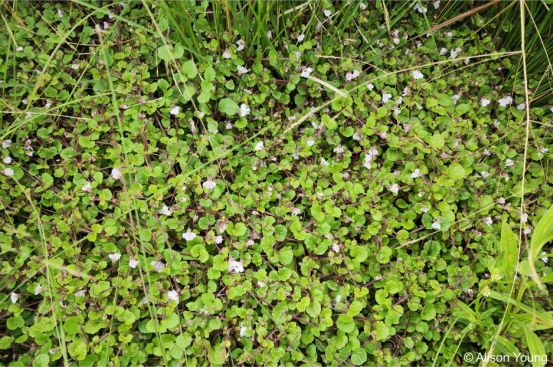
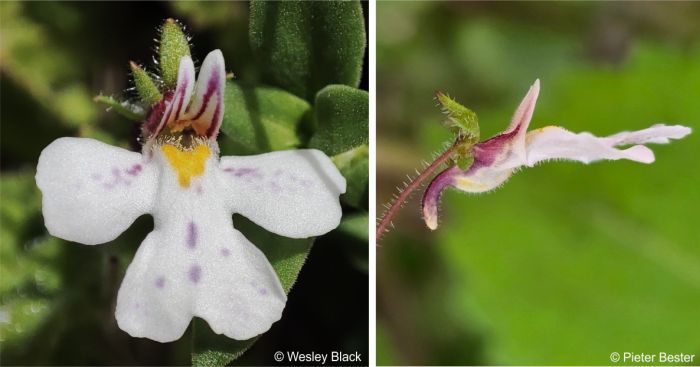
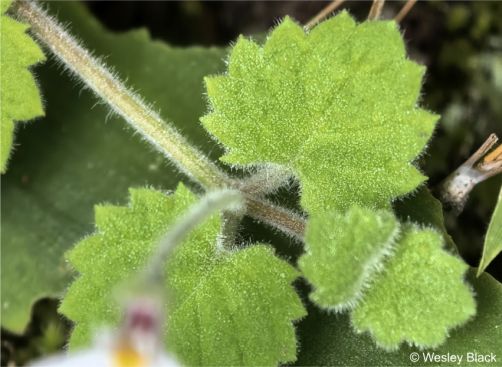
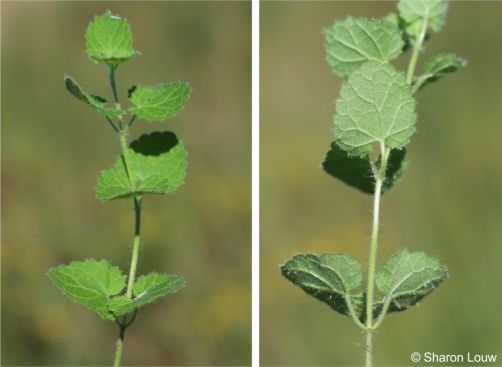
A perennial herb that grows up to 200 mm in height and forms a sprawling mat. The stems are reddish and hairy, with upright tips. The leaves are roughly 30 x 35 mm in size with stalks about 25 mm long, the blade broadly ovate, fleshy, the margins deeply and sharply toothed. It blooms in spring and summer (between September and May), producing solitary flowers, about 10 mm in size, white to pale mauve, spotted, with a pale yellow centre, two narrow lobes on the upper lip and three broad lobes on the lower lip, a straight thin spur 2.5–3 mm long, pointed calyx lobes, on slender stems about 30 mm long. Fruit is rounded, dry, with a notch at the tip.
Conservation Status
Status
This taxon was not flagged in any of the four screening procedures for identifying possible taxa of conservation concern for in-depth evaluation and therefore was automatically categorized as Least Concern (LC) by the Red List of South African Plants.
Distribution and habitat
Distribution description
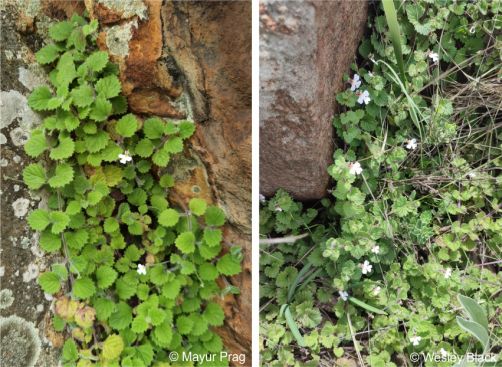
Diclis reptans is found in southern Africa, occurring in South Africa, Lesotho and Eswatini. In South Africa it is found in the Eastern Cape, Free State, KwaZulu-Natal, Limpopo, Mpumalanga and Western Cape provinces, from the coast to 2 000 m. It usually grows in rocky, wet and shaded or south-facing areas, or in open dry shrubland or grassland, but it prefers damp environments.
Derivation of name and historical aspects
History
Diclis is a genus of annual or perennial herbaceous flowering plants belonging to the Scrophulariaceae family, that includes herbs, shrubs and a few trees. Family members are often recognised by their two-lipped flowers, four stamens and capsule fruits. The genus name Diclis is derived from the Greek term diklis meaning ‘double folded’ or ‘two folded’ referring to some feature of the flower or fruit structure. The Latin species name reptans means ‘creeping’ or ‘spreading along the ground’ and describes the prostrate growth habitat of the plant. The species was described in 1836, as botanical knowledge of Africa grew. Early taxonomists recognized its unique creeping habit and snapdragon-like flowers which set it apart from other herbaceous wetland plants.
Ecology
Ecology
Its creeping growth habit enables it to spread across the soil surface and take advantage of favourable moisture conditions. The flowers are pollinated by small insects, such as bees and other nectar-feeding insects, drawn by their colourful, two-lipped corollas. The plant produces tiny capsules with many tiny seeds after pollination. These seeds spread by water movement, surface runoff and soil disturbance, allowing the species to settle in newly available moist areas. Diclis reptans increases plant diversity, supplies pollinators with nectar and helps to stabilise soil in damp environments.
Uses
Use
In traditional medicine it is used to treat distemper in dogs. It is an edible plant that is mostly grazed by cattle, goats and sheep due to its soft leaves but because it is a low and small plant, it regrows fast, and grazers do not kill it.
In the garden, it can be used as a ground cover, planted under trees to shade soil, retain moisture and prevent weeds. Can also be used in naturalistic landscaping and restoration projects as it is mat-forming.
Growing Diclis reptans
Grow
Propagating Diclis reptans is incredibly simple and successful due to its natural mat-forming, trailing growth habit and its stems naturally root when they come into contact with moist soil. There are three main ways to quickly multiply this plant: division, cuttings and layering.
Division is the most reliable method to obtain established plants right away. The best time to divide a plant is in spring or early autumn when the weather is warm but not hot. Use a hand trowel to carefully dig up a portion of a well established clump, while keeping the root system intact. Gently pull or cut the mat into smaller sections. Make sure there are roots and a healthy cluster of leaves on each piece. Plant the divisions at the same depth as before in loose, organic-rich soil. Quickly soak the fresh divisions and keep the soil continuously damp for the first two weeks.
Cuttings taken from the stem of Diclis reptans root very quickly due to the plant’s soft, creeping stems. Cut a healthy non-flowering stem that is 5 to 10 cm long. Make sure there are at least two or three nodes (the joints where leaves develop) in the cutting. Remove the leaves from the lower half of the stem to reveal the nodes where the roots will emerge, insert the stem into a very small container that has been filled with a wet, well drained medium such as a 50:50 mixture of perlite and potting soil. Put the container in a warm, humid area with plenty of indirect light, avoid direct sunlight to prevent wilting. Usually roots appear in two to three weeks.
Layering is the simplest approach. You do not need to remove any stems at first but can let the mother plant take care of it. Find a long healthy runner that extends from from the main plant. Put a very small pot filled with moist, well drained soil directly underneath a leaf node and press it firmly against the surface of the soil. Secure it down with a small wire hoop. Make sure the soil is wet and keep it wet. Once the node has a strong independent root system, cut off the stem that connects it to the parent plant and transplant it.
Diclis reptans thrives in containers or pots in a shaded area and makes a beautiful specimen for a raised bed or mixed border.
References
- Bester, S.P. 2026. Observation of Diclis reptans, Mopani District Municipality, Limpopo. iNaturalist. Online. https://www.inaturalist.org/observations/366347284.
- Black, W. 2025. Observation of Diclis reptans, Wakkerstroom. Mpumalanga. iNaturalist. Online. https://www.inaturalist.org/observations/337989881.
- Black, W. 2026. Observation of Diclis reptans, Wakkerstroom. Mpumalanga. iNaturalist. Online. https://www.inaturalist.org/observations/352612018.
- Louw, S. 2022. Observation of Diclis reptans, Umgungundlovu District Municipality. KwaZulu-Natal. iNaturalist. Online. https://www.inaturalist.org/observations/358219154.
- Moffett, R. 2018. A field guide to the Clarens Village Conservancy. African Sun Media.
- Plants of the World online. Royal Botanic Gardens. Diclis reptans Benth. https://powo.science.kew.org/taxon/urn:lsid:ipni.org:names:801961-1. Accessed 1/6/2026.
- Pooley, E. 1998. A field guide to wild flowers of KwaZulu-Natal and the eastern region. Natal Flora Publications Trust, Durban.
- Pooley, E. 2003. Mountain flowers, a field guide to the flora of the Drakensberg and Lesotho. Natal Flora Publications Trust, Durban.
- Pooley, E., Nichols, G. & Hankey, A. 2025. South African indigenous garden plants, the gardener’s guide. Struik Nature, Cape Town.
- Prag, M. 2026. Observation of Diclis reptans, Maloti-Drakensberg, KwaZulu-Natal. iNaturalist. Online. https://www.inaturalist.org/observations/350334477.
- Raimondo, D., Von Staden, L., Foden, W., Victor, J.E., Helme, N.A., Turner, R.C., Kamundi, D.A. & Manyama, P.A. (eds) 2009. Red list of South African plants. Strelitzia 25. South African National Biodiversity Institute, Pretoria.
- The World Flora Online. Diclis reptans Benth. http://www.worldfloraonline.org/taxon/wfo-0000646102. Accessed 1/6/2026.
- Young, A. 2025. Observation of Diclis reptans, Karkloof Conservancy. KwaZulu-Natal. iNaturalist. Online. https://www.inaturalist.org/observations/329986031.
Credits
Gorven Mokgaditsi
Lowveld National Botanical Garden
June 2026
Acknowledgements: the author thanks Wesley Black, Mayur Prag, Pieter Bester, Alison Young and Sharon Louw for making their pictures available on iNaturalist.
Plant Attributes:
Plant Type: Bi/Annual, Ground Cover, Perennial
SA Distribution: Eastern Cape, Free State, KwaZulu-Natal, Limpopo, Mpumalanga, Western Cape
Soil type: Loam
Flowering season: Spring, Early Summer, Late Summer
PH: Acid, Neutral
Flower colour: White, Yellow, Mauve/Lilac
Aspect: Shade, Morning Sun (Semi Shade), Afternoon Sun (Semi Shade)
Gardening skill: Easy
Special Features:
 Good potplant
 Edible plant
 Useful plant
 Feeds honeybees
 Wet sites
Horticultural zones


Rate this article
Article well written and informative
Rate this plant
Is this an interesting plant?
Login to add your Comment
Back to topNot registered yet? Click here to register.