


Dierama nixonianum
Introduction
Dierama nixonianum is an elegant and distinctive member of the Dierama genus, with pale mauve drooping flowers in early spring; it is a rare and threatened species from the mistbelt grasslands of northern and south-central KwaZulu-Natal.
Description
Description
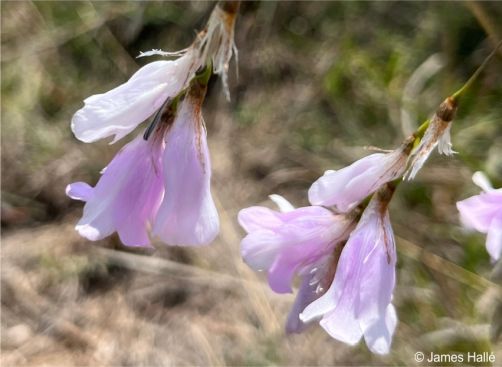
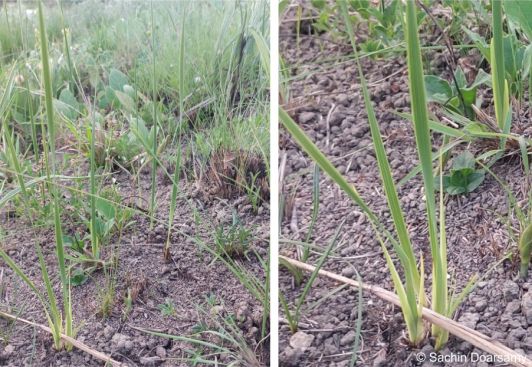
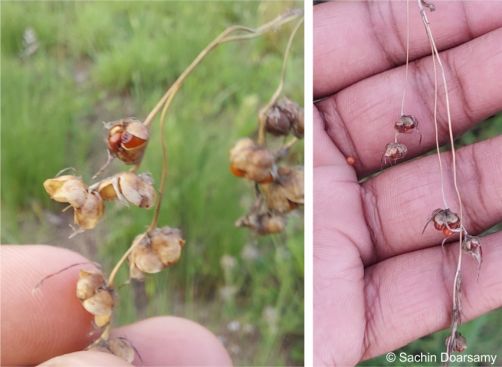
Dierama nixonianum is a herbaceous perennial geophyte, that grows from an underground corm, a solid, swollen storage organ similar in function to a bulb. The corm is 10–17 mm in diameter. The leaves and flowering stem are borne on separate shoots from the same corm and the leaves are often not fully developed when the flowers are present. The plant is deciduous, with its leaves dying back in winter and re-emerging in spring. Growth is moderate rather than rapid, but once established the plant is long-lived and can persist for many years in the same position. Plants are solitary or form neat, upright clumps of up to about 15 stems, that typically reach 100–750 mm in height, with flowering stems extending higher than the leaves. Over time, the clumps expand slowly but remain well behaved and non-invasive. The leaves are long, narrow, and grass-like, 150–330 × 0.75–2.40 mm, about 3 or 4 leaves emerging from the base of the plant. They are arching to upright, medium green, and give the plant a fine, fountain-like appearance even when it is not in flower. There are no woody stems or bark, all growth is soft and herbaceous. The flowering stems are slender, wiry, and upright, rising cleanly above the foliage before gently arching under the weight of the flowers. The flowers are the most striking feature of the plant. They are relatively large, 17–20 mm long, bell-shaped, and drooping, hanging gracefully from the tips of the arching stems. Flowers are pale mauve, often with a subtle sheen when viewed in good light. Flowering occurs in early spring (late August to September). When in full bloom, the flowers sway delicately in the breeze, giving rise to the common name “fairy fishing rods.” After flowering, the plant produces small, dry seed capsules that develop where the flowers were borne. As these mature, they release hard, rounded seeds that can germinate readily under suitable conditions, although plants grown from seed typically take several years to reach flowering size.
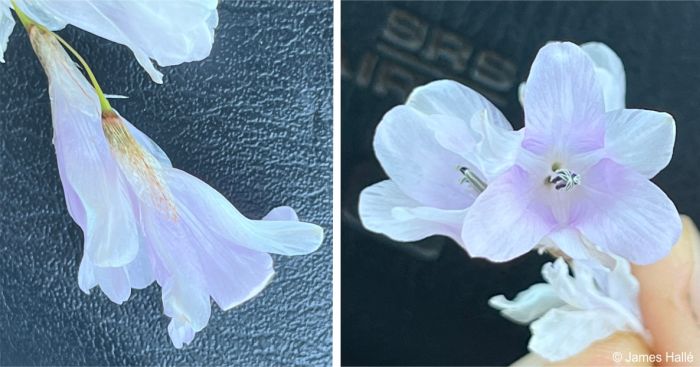
Dierama nixonianum can be distinguished from other species in the genus by its flowering stem and leaves being on separate shoots. It may be confused with Dierama trichorhizum which also flowers in early spring and has the same growth form, however its flowers are larger, funnel-shaped, tepals flaring more widely, and mauve or pink or purple. Overall, this species is a refined yet striking plant, combining elegant foliage with graceful spring flowers, and would be especially effective when planted where its arching stems and dangling blooms can be viewed against light or open space.
Conservation Status
Status
Dierama nixonianum is currently assessed as Vulnerable (VU) on the Red List of South African Plants and by the IUCN Red List of Threatened Species, reflecting its restricted distribution, limited number of known locations, and the ongoing decline in habitat quality and extent, primarily due to frequent fires and illegal dumping of waste by local residents.The species occurs in highly threatened mistbelt grassland, much of which has been transformed by agriculture (including sugarcane cultivation), commercial forestry, overgrazing (especially goats), and urban or rural development, leading to fragmentation and the loss of some historical subpopulations.
Distribution and habitat
Distribution description
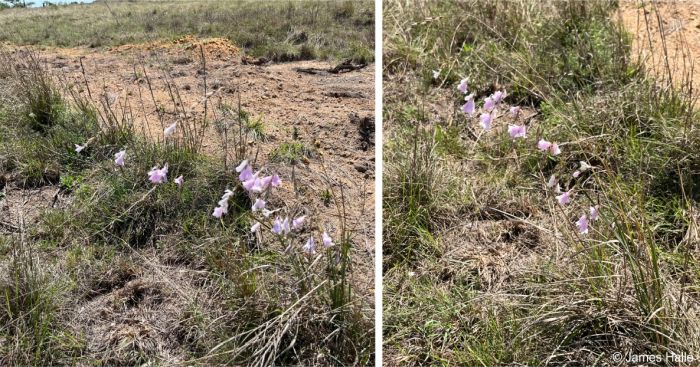
Dierama nixonianum is endemic to KwaZulu-Natal, with a restricted distribution extending from the KwaZulu-Natal Midlands to Wakkerstroom, occupying an area of less than 1 000 km². The species occurs within the summer-rainfall region, where it grows in open grassland habitats. It is known to occur at 5 to 7 locations and is regarded as rare, with a limited natural range, and for this reason its exact localities are not specified. In the wild, it is typically found on open slopes and well-drained grasslands, often where competition from taller vegetation is limited and where it can receive full sun for most of the day. Soils in its natural habitat are usually light, well-drained, and often slightly acidic, conditions that prevent waterlogging around the corms. While summer moisture is important for growth and flowering, the plant experiences relatively dry conditions in winter, which is critical for its long-term survival. Like other members of the genus, D. nixonianum is intolerant of poorly drained or waterlogged soils, especially during dormancy. Climatically, Dierama nixonianum is adapted to mild to warm summer temperatures and cool winters, and it can tolerate light frost when dormant, provided the soil remains dry. It is therefore best suited to regions with a distinct seasonal rainfall pattern, moderate summer rainfall, and dry winters that are cool but not severely cold. These conditions make it well adapted to cultivation in gardens that mimic its natural grassland environment, particularly those with summer watering, full sun, and good air circulation.
Derivation of name and historical aspects
History
The genus name Dierama is derived from the Greek diērama, meaning ‘a funnel’, referring to the shape of the flowers, while the species epithet nixonianum honours Miss K. Nixon, who first drew this plant to the attention of Hilliard and Burtt. Like many South African geophytes, Dierama nixonianum was described from relatively few collections, reflecting both its restricted natural range and the often remote, grassland habitats in which it occurs. As a result, it has long been regarded as a plant of botanical interest rather than a widely known ornamental, despite its exceptional beauty.
Ecology
Ecology
Dierama nixonianum is adapted to life in open grassland environments with seasonal rainfall. Its underground corm allows it to survive dry winters and occasional fires, resprouting vigorously when favourable conditions return. Fire plays an important indirect role in its life cycle by removing competing grasses and woody plants, opening up the habitat and increasing light availability, which promotes flowering in the seasons following a burn. This fire-resilience strategy is common among South African grassland geophytes and is key to their long-term persistence.
The flowers of Dierama nixonianum are adapted for insect pollination, particularly by bees and other robust, nectar-seeking insects that can navigate the pendulous blooms. The nodding flowers protect pollen and nectar from rain while remaining accessible to pollinators. Once pollinated, the plant produces dry capsules containing relatively lightweight seeds, which are released close to the parent plant and may be dispersed short distances by gravity, surface water runoff, or disturbance from animals moving through the grassland.
Although Dierama nixonianum does not rely on a single specialist animal interaction, it forms part of a broader grassland ecosystem where insects, small mammals, and fire all influence its survival and reproduction. These interactions make it a good example of how plants are shaped by their environment over long periods of time. For school learners, Dierama nixonianum is a useful species to illustrate key ecological ideas such as adaptation to fire, seasonal growth, plant–pollinator relationships, and the importance of conserving natural grassland habitats that support a wide diversity of plant and animal life.
Uses
Use
There are no documented medicinal or cultural uses for Dierama nixonianum. In Zulu culture, corms of local Dierama species are placed in seed gourds as fertility charms to ensure a good harvest.
Use Dierama nixonianum as a feature plant in mixed borders, grassland-style plantings, or on slopes where drainage is naturally good and flowering stems can arch freely. Combine it with ornamental grasses and other summer-growing perennials that share similar water requirements. Avoid planting near paving or foundations, as self-sown Dierama seedlings readily establish in narrow cracks and can be difficult to remove.
Growing Dierama nixonianum
Grow
Dierama species performs best when receiving regular moisture during spring and summer, and when kept relatively dry during winter. Good drainage is essential, as the corms are highly intolerant of winter waterlogging and perform poorly in heavy or clay soils. Plant Dierama nixonianum in well-drained soil, it grows best in neutral to slightly acidic soils. Rich soils are not necessary, and while light feeding or compost may be applied during the growing season, maintaining healthy, uncongested clumps through regular division is far more important than fertilisation.
Plant Dierama corms at a depth of approximately 5 to 10 cm, depending on their size, and space them at least 5 cm apart to allow sufficient room for clump development. Grow Dierama nixonianum in full sun to encourage strong flowering, although semi-shade is tolerated. The plants can also be grown successfully in containers, provided deep pots are used. Dierama species naturally pull themselves deeper into the soil through the formation of contractile roots, which develop annually, shrink as they die back, and gradually draw the corm downward. New corms form beside or above older ones, and if clumps become overcrowded, the new corms reduce in size and flowering declines.
As plants mature, the older foliage starts to wither, and dried leaves accumulate within the clump. Remove old leaves by cutting them off at ground level rather than pulling them by hand, as the leaves are extremely tough and can damage the growth point or cause injury. Regular cleaning and periodic division are essential to prevent congestion and maintain vigour. If a clump becomes congested and collapses or appears dead, lift it, remove all dead material, split the corms, and replant to restore growth and flowering.
Expect complete foliage die-back after transplanting or dividing any Dierama species, despite most hairbells being evergreen. This response is normal and temporary, and regrowth only begins once soil temperatures rise, usually in late spring. Mark planting positions clearly and avoid disturbing the corms again, as repeated lifting delays recovery. Although Dierama corms can be transplanted at any time of year, moving them just after flowering in summer results in the fastest regrowth because soil temperatures remain warm.
Dierama species are easily propagated from seed or by division of corms. When sowing in the seeding tray, sow fresh seed in late summer to early autumn or in spring, using a well-drained medium of coarse sand mixed with loam or compost. Space seeds well, as germination rates are usually high, and grow seedlings in deep pots to accommodate early contractile root development. Transplant seedlings before they reach flowering size, as young plants tolerate disturbance well and do not usually die back. Flowering from seed generally occurs after two to four years, depending on species size. Self-sown seedlings often grow faster and more vigorously than cultivated ones and may establish in gravel, paving cracks, or dense plantings.
Dierama nixonianum is generally pest-free, with the most common cause of failure being winter waterlogging leading to corm rot. Prevent problems by ensuring excellent drainage, reducing winter watering, and maintaining healthy, uncongested clumps through regular division.
References
- Doarsamy, S. 2024. Observation of Dierama nixonianum. iNaturalist. Online. https://www.inaturalist.org/observations/247484289.
- Dunlop, G. 2011. Dierama cultivation and propagation. Cornucopia. HPS Hardy Plant Society. Online. https://hardy-plant.org.uk/publication/dierama-cultivation-and-propagation.
- Goldblatt, P. & Manning, J.C. 2020. Iridaceae of southern Africa. Strelitzia 42. South African National Biodiversity Institute, Pretoria.
- Hallé, J. 2024. Observation of Dierama nixonianum. iNaturalist. Online. https://www.inaturalist.org/observations/248411209.
- Hilliard, O.M. & Burtt, B.L. 1991. Dierama, the hairbells of Africa. Acorn Books, Johannesburg & London.
- Hutchings, A., Scott, A.H., Lewis, G. & Cunningham, A.B. 1996. Zulu medicinal plants: an inventory. University of Natal Press, Pietermaritzburg.
- Plants of the World Online. Dierama nixonianum Hilliard. https://powo.science.kew.org/taxon/urn:lsid:ipni.org:names:959132-1. Accessed 12 March 2026.
- Scott-Shaw, C.R., von Staden, L. & Johnson, I.M. 2014. Dierama nixonianum Hilliard. National Assessment: Red List of South African Plants version 2024.1. http://redlist.sanbi.org/species.php?species=1544-29.
- Von Staden, L., Scott-Shaw, C.R. & Johnson, I.M. 2017. Dierama nixonianum. The IUCN Red List of Threatened Species 2017: e.T63729445A63729448.
Credits
Thamsanqa Msweli & Shane Koorbanally
KwaZulu-Natal National Botanical Garden
March 2026
Acknowledgements: the authors thank Sachin Doarsamy and James Hallé for allowing the use of their images via iNaturalist.
Plant Attributes:
Plant Type: Bulb
SA Distribution: KwaZulu-Natal
Soil type: Sandy, Loam
Flowering season: Spring
PH: Acid, Neutral
Flower colour: Mauve/Lilac
Aspect: Full Sun
Gardening skill: Average
Special Features:
 Drought resistant
 Good potplant
 Feeds honeybees
Horticultural zones


Rate this article
Article well written and informative
Rate this plant
Is this an interesting plant?
Login to add your Comment
Back to topNot registered yet? Click here to register.