


Diheteropogon amplectens
Introduction
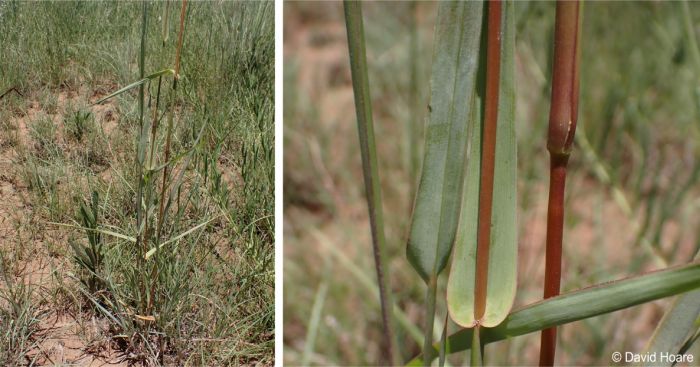
Broad-leaved blue-stem grass is an attractive grass that can be identified without its inflorescence. The shape of the leaf blade is distinctive because it is widened and rounded at the base and wrapped round the culm.
Description
Description
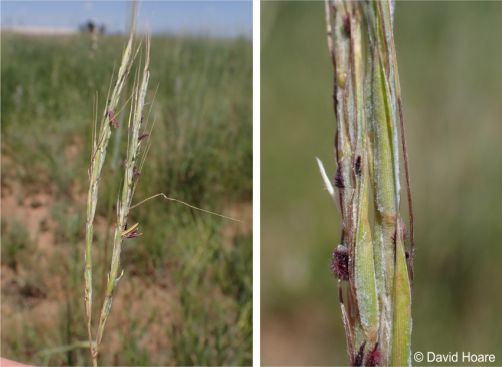
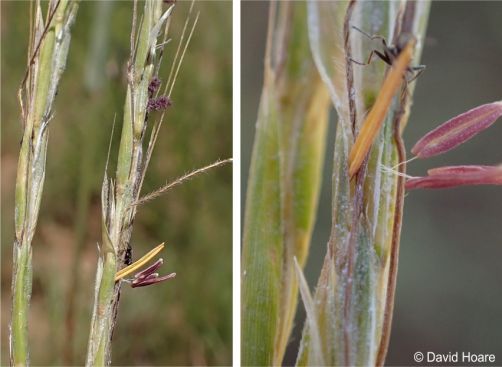
Diheteropogon amplectens is a perennial grass, 0.3–2 m high, usually glaucous; rhizomatous; basal sheath glabrous, inner often shiny. Leaf blade is 150–300 × to 20 mm, expanded, usually more than 3 mm wide, rarely densely hairy; bases, at least of upper leaves, narrowly to broadly rounded or cordate, clasping stem; young growth waxy. Inflorescence of 2 racemes, racemes 50–100 mm long; internodes and pedicels hairy; internode hollow at apex. Sessile spikelet is 7–9 mm long; lower glume rounded on either side of deep central groove, apex lobed; upper glume acute, mucronate; lemma awn 20–70 mm long, hairy; callus 1–5 mm long, hairy only towards the point; anthers 4–6 mm long. pedicellate spikelet is 9–13 mm; lower glume with or without awn up to 11.5 mm long (variable on same inflorescence), keeled, keels rounded, not winged; upper glume acuminate, awnless. Diheteropogon amplectens flowers during summer, from November to April.
Conservation Status
Status
The current status of Diheteropogon amplectens, according to the South African National Biodiversity Institute (SANBI) Red List of South African plants, is assessed as Least Concern (LC). Broad-leaved blue stem grass is widespread in eastern and northern South Africa andnorthwards to East Africa.
Distribution and habitat
Distribution description
Diheteropogon amplectens is widespread in Africa, especially in East Africa, DRC and Senegal and it occurs in South Africa, Botswana and Eswatini (formerly Swaziland), but not in Namibia or Lesotho. In South Africa Diheteropogon amplectens occurs in Limpopo, North West, Gauteng, Mpumalanga, Free State, KwaZulu-Natal, Eastern Cape and the Northern Cape Provinces but not in the Western Cape. Diheteropogon amplectens mainly grows in the tropics, especially in woodland, and occurs on a wide variety of ordinary dryland soils and rocky places. Further south it often grows in open grassland, sometimes in eroded and rocky places, where it can be small and puny.
Derivation of name and historical aspects
History
The genus name Diheteropogon is derived from the Greek words di, meaning two, hetero, meaning different and pogon meaning beard; the reason for the name is unknown. The species name amplectens is a Latin word for embracing; descriptive of the clasping bases of the leaf blades.
The genus Diheteropogon has 5 species, which are mainly found in tropical and southern Africa. Only two species occur in southern Africa: Diheteropogon amplectens and Diheteropogon filifolius.
Ecology
Ecology
Diheteropogon amplectens occurs in sour open grassveld (grasslands), often on shallow soils on stony hill slopes, and on poor sandy soils in savanna and deciduous bushland in areas receiving 900–1 200 mm annual rainfall in western Africa, and 500–1500 mm/year in southern Africa. The altitudinal range is between 300 m in western Africa and 1 800 m in eastern and southern Africa.
Uses
Use
Diheteropogon amplectens is an important forage species which has a high to average grazing value, but low in leaf production. Grazed when still young; it is appreciated by all stock, and makes an acceptable hay. Flowering plants are less willingly browsed because of the long, pungent awns. The culms are used for thatching and coarse matting. It is also used as an ornamental.
Growing Diheteropogon amplectens
Grow
Diheteropogon amplectens can be propagated primarily via seeds or tussock division. Plant seeds in well-draining soil mix during the warmer months. Lightly cover and keep moist until germination. To divide Diheteropogon amplectens, dig up mature, established tussocks during active growth. Carefully tease or cut the underground scaly rhizomes or shoots apart and replant the divisions immediately.
Cultivate this grass with full sun exposure. Diheteropogon amplectens tolerates poor, shallow, sandy, or clay soils, performing exceptionally well in nutrient-deficient and stony hill slopes. Highly water-wise, it adapts to mean annual rainfall ranges between 500 mm and 1 500 mm. Avoid waterlogged conditions.
References
- Chippindall, L.K.A. & Crook, A.O. 1976. Grasses of southern Africa. Collins, Harare.
- Fish, L., Mashau, A.C., Moeaha, M.J. & Nembudani, M.T. 2015. Identification guide to southern African grasses. Strelitzia 36: 271–276. South African National Biodiversity Institute, Pretoria.
- Hoare, D. 2025. Observation of Diheteropogon amplectens, Dr Kenneth Kaunda, North West, South Africa. iNaturalist. Online. https://www.inaturalist.org/observations/259866372.
- Leistner, O.A. (ed.). 2000. Seed plants of southern Africa: families and genera. Strelitzia 10. National Botanical Institute, Pretoria.
- Raimondo, D., Von Staden, L., Foden, W., Victor, J.E., Helme, N.A., Turner, R.C., Kamundi, D.A. & Manyama, P.A. (eds) 2009. Red list of South African plants. Strelitzia 25. South African National Biodiversity Institute, Pretoria.
- Van der Zon, A.P.M. 2002. Diheteropogon amplectens (Nees) Clayton. PROTA4U. Online. PROTA, Netherlands. https://prota.prota4u.org/protav8.asp?h=M4&t=Diheteropogon,amplectens&p=Diheteropogon+amplectens#Synonyms.
- Van Oudtshoorn, F. 1999. Guide to the grasses of southern Africa. Briza Publications, Pretoria.
Credits
Dr. Aluoneswi Caroline Mashau
National Herbarium, Pretoria
September 2026
Acknowledgements: images by David Hoare from their observation uploaded on iNaturalist.
Plant Attributes:
Plant Type: Grass
SA Distribution: Eastern Cape, Free State, Gauteng, KwaZulu-Natal, Limpopo, Mpumalanga, North West, Northern Cape
Soil type: Sandy, Loam
Flowering season: Early Summer, Late Summer, Autumn
PH:
Flower colour: Green
Aspect: Full Sun
Gardening skill: Easy
Special Features:
 Attracts birds
 Attracts butterflies
 Drought resistant
 Useful plant
 Pioneer plant
Horticultural zones




Rate this article
Article well written and informative
Rate this plant
Is this an interesting plant?
Login to add your Comment
Back to topNot registered yet? Click here to register.