


Dracaena angolensis
Introduction
Dracaena angolensis, formerly Sansevieria cylindrica, is a decorative succulent plant that is often grown indoors, its cylindrical shape makes it different from other plants in the family.

Description
Description
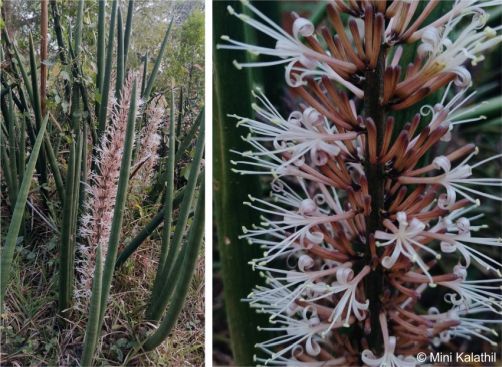
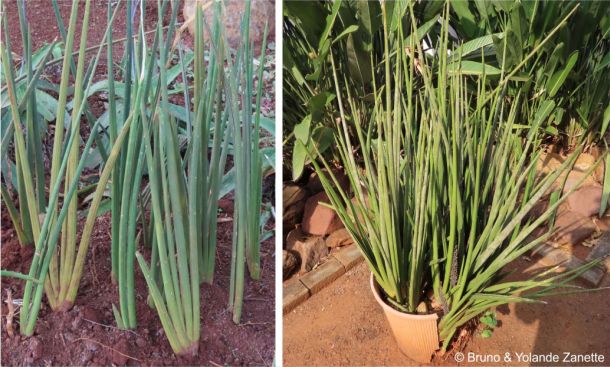
Dracaena angolensis is a sturdy, evergreen perennial plant that grows upright, up to 2 m. It is a rhizomatous geophyte with fibrous roots and underground creeping rhizomes that are bright orange outside and whitish inside. It has short, unbranched stems. Leaves are in basal rosettes, becoming distichous. Leaves are cylindrical, up to 2 m long and 30 mm thick, stiff, smooth, greenish-grey, with grooves running up the leaf and horizontal bands of slightly darker green. It grows slowly, forming dense clumps up to 1 m wide, and each plant is made up of 3-5 leaves presented in a fan-like shape, supported by the underground rhizome. In spring or summer, a plant produces clusters of greenish-white to pink, tubular flowers, 25-40 mm long, near the top of a 300-750 mm long stalk, blooming once a year. The flowers are followed by small, rounded, fleshy fruits that turn from green to bright orange when ripe, containing two pale brown seeds.
Conservation Status
Status
Unknown, to date, Dracaena angolensis has not been assessed by the IUCN Red List of Threatened Species.
Distribution and habitat
Distribution description
Dracaena angolensis originates in southern Africa, occurring in Angola, Zambia and Zimbabwe. It is now also widely distributed in America, Asia, Australia, and the Pacific Islands, cultivated as an ornamental and fibre plant, and it is naturalized in some countries including India and Indonesia. Dracaena angolensis thrives in many habitats, including roadsides, neglected gardens, coastal environments and forest edges, in tropical and subtropical climates. It grows in various light conditions, from full sun to shade, and has high salt tolerance and low nutrient needs.
Derivation of name and historical aspects
History
The genus Dracaena gets its name from the Greek word drakaina, meaning 'female dragon', referring to the dragon trees with their red ‘dragon’s blood’ sap, that were the first named species of the genus. The species name angolensis, refers to Angola, the country in southern Africa where the plant was first discovered. This species was previously called Sansevieria cylindrica, the genus named after Raimondo de Sangro (1710–1771), Italian scholar and Prince of San Severo, and the species named for its distinctive cylindrical leaves. This species was first described by Wenceslas Bojer in 1859.
The common name snake plant, for plants formerly known as Sansevieria, likely comes from their long, snake-like leaves. It is popular as an ornamental plant due to its ease of care and striking shape. In Brazil, it is known as lança de São Jorge (St. George's spear) and is used in the Afro-Brazilian religion Umbanda to represent the orisha Ogum.
Dracaena angolensis belongs to the Asparagaceae, a large and diverse family of 126 currently accepted genera of flowering plants, with approximately 3 170 species. The genus Dracaena is now considered to include Sansevieria after molecular studies showed that Sansevieria is nested within this genus. This species is not called Dracaena cylindrica because there is already a species with this name, which is now a synonym for D. bicolor. Our species thus takes the name angolensis as its second earliest described name. Dracaena is a big genus currently with 214 accepted species native to Africa, Madagascar, the Arabian Peninsula, the Indian subcontinent, Indonesia and Central America. Dracaena is known for its low-maintenance houseplants, and some species have unique shapes and abilities to purify the air.

Ecology
Ecology
Dracaena angolensis has adaptations suited to its environment and may interact with animals and insects in its natural habitat. The flowers are likely pollinated by insects, potentially attracting pollinators like bees, butterflies, moths or hoverflies. The plant produces berries, suggesting animal-mediated seed dispersal, thus seeds may be dispersered by birds or small mammals.
Like other sansevierias and Dracaena species, it is well adapted to dry habitats and is resistant to drought. Its underground rhizomes and thick succulent leaves store water and nutrients that allow it to survive in extreme weather conditions. The leaves use crassulacean acid metabolism (CAM) photosynthesis which reduces water loss, making it arid-adapted and drought tolerant. Its stiff, upright leaves also help protect it from herbivores.

Uses
Use
Dracaena angolensis, is a versatile plant with a range of traditional uses. Native to subtropical Africa, it is cultivated in many countries, including Myanmar, as an ornamental plant and used in traditional medicine to treat various ailments including cuts, sprains, broken bones, snakebites, fever, itching, respiratory infections, coughs, hemorrhoids, influenza, diabetes, and cancer. The plant's leaves and roots are used to make remedies, and it is valued as a hair tonic, natural antibiotic, and pain reliever. It is also used externally for bruises, sprains, wounds, and boils. Dracaena angolensis contains bioactive compounds like alkaloids, saponins, and polyphenols, showing potential as an antioxidant, anticancer, antibacterial, and antitoxic agent.
This plant is also grown for the fibre in its leaves, which is used to make rope and string.
As a decorative plant, it is prized for its unique shape, and its ability to eliminate unpleasant odours, and absorb air pollutants. It is widely cultivated and sold in nurseries, used as a houseplant, and has opportunities for development as a natural medicine. With high salt tolerance and low nutrient needs, this plant is low maintenance, tolerating drought and heat well, and thriving in sun or shade.
Growing Dracaena angolensis
Grow
Dracaena angolensis is mainly grown for its foliage, and flowering is rare in cultivation.
Dracaena angolensis is can be propagated from seed sown in spring or summer, or by lifting and dividing clumps and replanting rhizomes. It can also be propagated through leaf cuttings, which is a moderate method requiring controlled conditions. Cut the leaves into 1 cm pieces, sterilize them and place them on a growth medium to promote root growth and plant development. Keep at standard conditions for 4-5 weeks to induce roots, then increase daytime temperature to 37°C to trigger shoot growth. Multiple shoots form at higher rooting hormone concentrations. After 5 weeks, separate the plantlets, harden them in soil for 2 weeks, and then transfer them to pots. This method works best any time with controlled conditions. It is best to use a rooting hormone to improve shoot formation. Once potted up, the plantlets are ready to be gradually acclimated to outdoor conditions.
In cultivation Dracaena angolensis prefers well-draining soil, needs little water and can thrive in sun, semi-shade or light shade, making it a low-maintenance garden plant and houseplant. It is also grown for its air-purifying properties and unique shape.
Dracaena angolensis is a versatile, low-maintenance plant perfect for adding drama to your garden. Use it as a feature plant or focal point in succulent beds, modern gardens, or xeriscape designs, it is also great in containers on patios or indoors, where it thrives in bright, indirect light. As ground cover or mass planting in sunny, dry areas, it forms dense colonies over time. You can even braid its leaves for a unique, sculptural display. Consider pairing it with succulents like Aloe, Echeveria, or Crassula, or drought-tolerant plants like Agave or Yucca, which share similar watering and sun requirements. Its stiff leaves make it less suitable for clipped hedges or topiary, but it is perfect for edging, bedding, or mixed beds in modern or minimalist designs.
Dracaena angolensis, is susceptible to pests like mealybug and scale insects. It can also be affected by diseases such as leaf spot, which are often caused by fungal infections. To keep your Dracaena angolensis healthy, maintain moderate temperatures, moisture, and light conditions. Avoid overwatering, as this can lead to root rot. Regularly inspect your plant for signs of pests or diseases and treat promptly if necessary.
References
- Cal, L. 2002. Sanseviera cylindrica. Plant of the Week. University of Oklahoma Department of Biology and Microbiology.
- Dewatisari, W.F. & To’bungan, N. 2023. Biological activity and phytochemistry of Dracaena angolensis Welw. ex Carrière. Plant Science Today 10(4): 206-214.
- Fernandes, T. 2022 Observation of Sansevieria cylindrica. iNaturalist. Online. https://www.inaturalist.org/observations/142135935.
- Jackson, W.P.U. 1990. Origins and meanings of names of South African plant genera. University of Cape Town Printing Department, Cape Town.
- Kalathil, M. 2026 Observation of Sansevieria cylindrica. iNaturalist. Online. https://www.inaturalist.org/observations/340314764.
- Kaur, J. & Mudgal, G. 2021. An efficient and quick protocol for in vitro multiplication of snake plant, Sansevieria trifasciata var. laurentii. Plant Cell, Tissue and Organ Culture (PCTOC) 147(2): 405-411.
- Plants of the World Online. Asparagaceae Juss. https://powo.science.kew.org/taxon/urn:lsid:ipni.org:names:30275682-2. Accessed 10 Mar 26.
- Plants of the World Online. Dracaena angolensis (Welw. ex Carrière) Byng & Christenh. https://powo.science.kew.org/taxon/urn:lsid:ipni.org:names:77182375-1. Accessed 10 Mar 26.
- Plants of the World Online. Dracaena Vand. ex L. https://powo.science.kew.org/taxon/urn:lsid:ipni.org:names:30010732-2. Accessed 10 Mar 26.
- San Marcos Growers. Sansevieria cylindrica. https://www.smgrowers.com/products/plants/plantdisplay.asp?plant_id=3249. Accessed 10 Mar 26.
- Shewale, S., Undale, V., Shelar, M., Pimple, B., Kuchekar, M. & Bhalchim, V. 2022. Macroscopic and microscopic evaluation of Sansevieria cylindrica plant. Pharmacognosy Research 14(4): 412-6.
- Takawira-Nyenya, R., Mucina, L., Cardinal-Mcteague, W.M. & Thiele, K.R. 2018. Sansevieria (Asparagaceae, Nolinoideae) is a herbaceous clade within Dracaena: inference from non-coding plastid and nuclear DNA sequence data. Phytotaxa 376(6):254–276.
- Thongthiraj, R. Get inspired with sansevierias: the perfect solution for your home garden. California Cactus Center. Archived from the original on 2017-07-02.
- Useful Tropical Plants. Sansevieria cylindrica. https://tropical.theferns.info/viewtropical.php?id=Sansevieria+cylindrica. Accessed 10 Mar 26.
- Zanette, B. & Y. 2025. Observations of Sansevieria cylindrica. iNaturalist. Online. https://www.inaturalist.org/observations?taxon_id=168422&user_id=bruno_yolande_zanette.
Credits
Sisanda Mbambo
Kirstenbosch National Botanical Garden
March 2026
Acknowledgements: the author thanks Bruno and Yolande Zanette, Mini Kalathil and Thaíza Fernandes for making their images available via iNaturalist.
Plant Attributes:
Plant Type: Succulent
SA Distribution:
Soil type: Sandy, Loam
Flowering season: Spring, Early Summer
PH:
Flower colour: White, Pink, Cream
Aspect: Full Sun, Morning Sun (Semi Shade), Afternoon Sun (Semi Shade)
Gardening skill: Easy
Special Features:
 Commercially grown
 Drought resistant
 Feature plant
 Good potplant
 Indoor plant
 Medical plant
 Useful plant
 Pioneer plant
Horticultural zones




Rate this article
Article well written and informative
Rate this plant
Is this an interesting plant?
Login to add your Comment
Back to topNot registered yet? Click here to register.