


Drimia delagoensis
Introduction
This is not a showy plant in ornamental horticulture, however, for enthusiasts of succulents and dry-garden plants, it adds valuable textural interest to arid landscapes. All parts of the plant are toxic, and despite this, the species plays an important role in conservation due to its significant medicinal value.
Description
Description
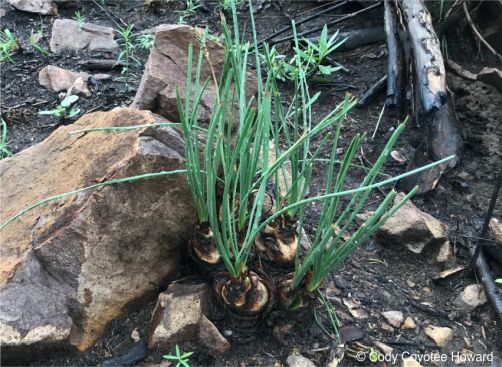
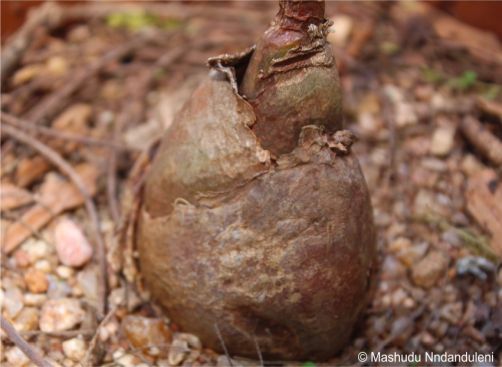
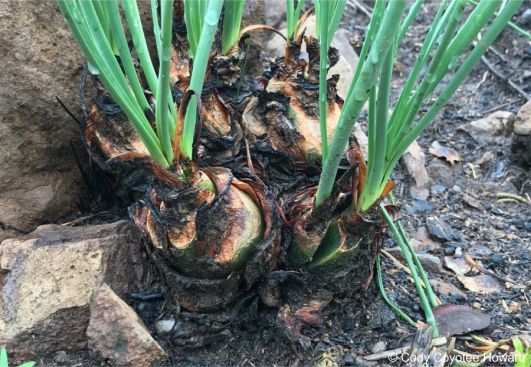
Drimia delagoensis is an evergreen bulbous geophyte that grows approximately 600 mm tall. The bulbs are fleshy, subglobose to ovoid, 25–150 mm in diameter, occurring either singly or in clumps. They may be epigeal (exposed above the surface of the soil) or underground and are covered with bulb scales; the outer scales are triangular, becoming dry and leathery with age, and are pink to red in colour. In partly epigeal bulbs, the exposed portion is green. The leaves are synanthous (present at the same time as the flowers), green or glaucous, and measure about 130–300 mm in length and 2–12 mm in width. They are erect to sub-erect, spreading, subterete to linear in shape, and are shed when dry.
The inflorescence is an elongate raceme, approximately 200–600 mm tall. It is moderately dense in bud and becomes more open as the flowers mature. Each inflorescence bears 10–50 flowers, which are usually not clustered and are spaced 5–20 mm apart. The flowers are slightly nodding, campanulate (bell-shaped), and range in colour from white, yellowish, or green to pale pink, often with a darker dorsal stripe. Drimia delagoensis flowers in winter and spring, from July to September. The flowers open in the morning and fade by evening. The fruit is a capsule, narrowly ellipsoid to ellipsoid and 7-10 mm long, containing black, narrowly lanceolate, winged seeds.
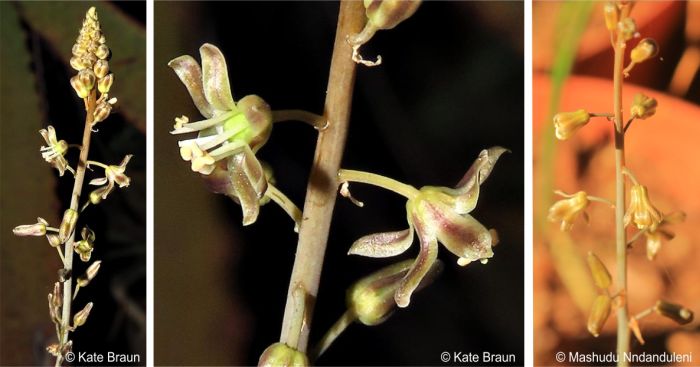
The flowers and capsules of Drimia delagoensis and D. edwardsii are morphologically similar. However, D. edwardsii can be distinguished by its loose, pale-grey, stalked bulb scales, the production of a solitary terete leaf, and a scape that is pubescent at the base.
Conservation Status
Status
Drimia delagoensis is assessed as Near Threatened (NT) on the Red List of South African Plants. The species is currently estimated to occur in approximately 30 subpopulations; however, subpopulations in Limpopo Province have not yet been fully assessed or counted. The observed decline in the species is largely attributed to harvesting for medicinal purposes, although the full impact of this harvesting remains poorly understood.
There is a clear need for a comprehensive assessment of the species’ distribution within South Africa. The species has been observed in traditional medicine (muthi) markets, indicating increasing utilization. In 2004, bulbs were recorded at the Faraday Market in Johannesburg by V.L. Williams. Further records were made in 2008, when plants were purchased at the Faraday Market in Johannesburg and the Warwick Market in Durban by V.J. Brueton for MSc research purposes. Brueton reported that approximately 5% of plants were harvested overall, with up to 10% harvested during the flowering stage. The increasing presence of D. delagoensis in muthi markets suggests growing popularity, which may contribute to further population decline if harvesting remains unmanaged. In contrast, an increasing number of observational records have recently been recorded on iNaturalist, providing valuable data that may assist in improving knowledge of the species’ distribution and conservation status.
Distribution and habitat
Distribution description
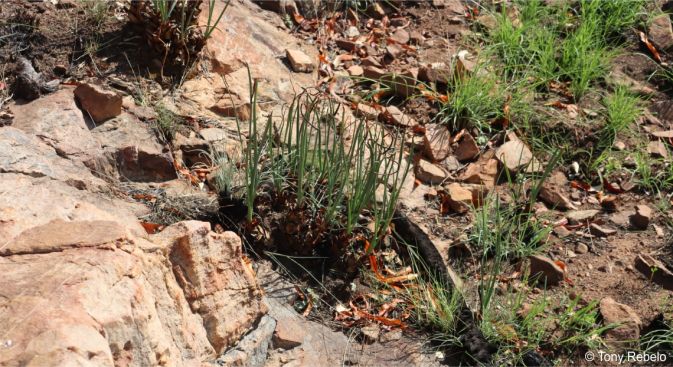
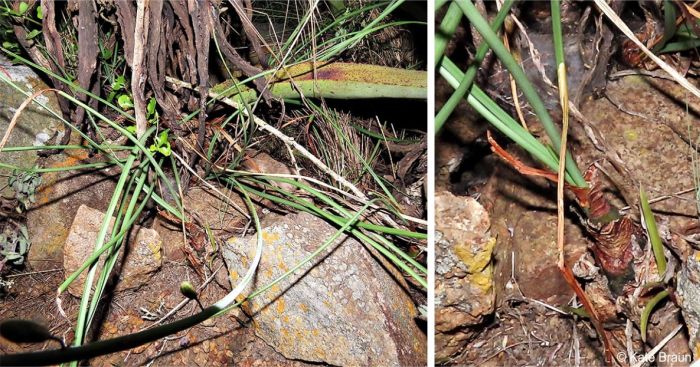
Drimia delagoensis is widely distributed in the Limpopo, Mpumalanga, and northern KwaZulu-Natal provinces of South Africa. The species also occurs in neighbouring countries, southern Mozambique and Eswatini. Its distribution extends from the Lebombo Mountains into Eswatini and inland through Mpumalanga to the Mbombela area. In Limpopo, the species appears to be under-recorded in herbaria, however, populations have been observed in Mphaphuli Nature Reserve, around Burgersfort, and near the Soutpansberg Mountains in the Makhado area. The species occurs on shallow pans over rock sheets and rock ledges, typically on clay or loamy soils with loose organic matter.
Derivation of name and historical aspects
History
According to the most recent revision of the genus Drimia by Manning and Goldblatt in 2018, approximately 70 species are recognised in southern Africa. Species of Drimia are also widely distributed beyond the region, occurring in Madagascar, the Mediterranean region, southeast Asia, India, Spain, Sardinia, Corsica and Egypt. The genus has long been associated with medicinal use, with the earliest recorded use dating back to approximately 1500 BCE.
The generic name Drimia is derived from the Greek word drimys, meaning ‘acrid’ or ‘pungent’, referring to the caustic nature of the bulbs. The specific epithet delagoensis refers to Delagoa, the historical name for southern Mozambique where this species was first recorded. Species in the genus Drimia are typically deciduous, short-lived flowering plants with perennial bulbs, and very few are evergreen. They are generally poisonous and are characterised by black, winged seeds.
Drimia delagoensis was regarded as distinct from Urginea lydenburgensis by Crouch and Martínez-Azorín in 2015, based on vegetative differences. U. lydenburgensis was described as having exposed pinkish bulb scales and linear leaves measuring 8–15 mm in width. In contrast, the leaves of D. delagoensis are slightly flattened on the upper surface when compared to those of U. lydenburgensis. Additionally, the two taxa were reported to differ chemically, suggesting potential taxonomic significance and indicating a need for further investigation. However, in the 2018 revision of Drimia, Manning and Goldblatt concluded that these two taxa should be treated as conspecific, recognising Urginea lydenburgensis as a synonym of Drimia delagoensis.
Ecology
Ecology
The species of Drimia are pollinated by insects, while their seeds are dispersed by wind. When the seeds are ripe, the capsules split open and release small, lightweight, dark-coloured seeds. The bulbs are resprouters and survive fire by being protected by their outer scales. Observations from the Lubombo Mountains on iNaturalist have shown that the plants survive even after high-intensity fires.
Drimia delagoensis is an interesting species in the genus, as it is one of the few evergreen species. Its leaves persist for two growing seasons, and flowering occurs while the leaves are still present. The bulbs are partially exposed above ground and occur in summer-rainfall regions that are generally free of frost. This ecological adaptation helps ensure the survival of the plants in their natural habitat.
Uses
Use
Drimia delagoensis is used by traditional health practitioners in the treatment of bone fractures and as a protective charm. The entire bulb is poisonous and caustic, meaning it contains substances with strong acidic or alkaline properties that can damage living tissue. The juice is traditionally used to preserve hides, including animal and human skin.
Studies have revealed that D. delagoensis contains natural antioxidant compounds that may help protect against certain diseases, including both curable and incurable conditions. However, due to its toxicity, caution is required in its traditional and medicinal use and it should not be eaten. Also, the sap from the bulbs irritates the skin and causes severe itchiness.
Drimia is considered to be one of the six most common poisonous plants in southern Africa that are toxic to humans and livestock.
Growing Drimia delagoensis
Grow
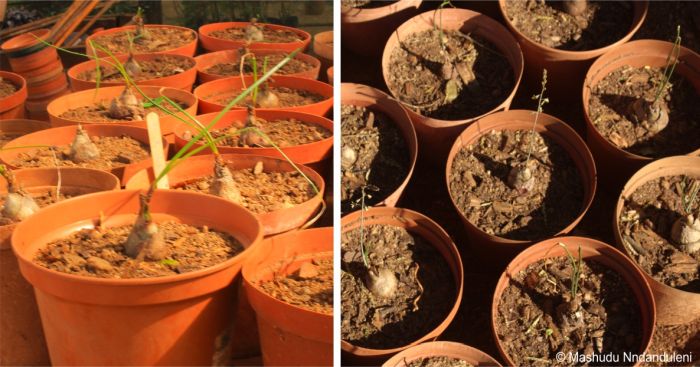
Drimia delagoensis is easily propagated by division and by seed. Clumps can be divided into single bulbs and potted into a well-drained growing medium. The growth medium for mature plants can consist of coarse milled bark mixed with sand or gravel. Newly potted bulbs should be watered once every two weeks until the plants are well established. Plants propagated by division establish successfully when watered appropriately and when the soil medium provides good drainage.
Seeds should be collected when the capsules begin to turn brown and split open. As this is a bulbous species from a summer-rainfall region, seed sowing should be done in spring to early summer. Sow the seeds in a medium consisting of fine sand mixed with fine compost or loam soil. Lightly cover the seeds with a fine layer of the medium and water the seed trays twice a week until germination occurs. Germination usually takes place within two to three weeks.
Plant the bulbs in semi-shade or full sun. During winter, plants should be kept almost dry, as overwatering can result in bulb rot and eventual plant death. No pests were observed during cultivation.
References
- Braun, K. 2024. Observation of Drimia delagoensis, Lubombo Mountains, Eswatini. iNaturalist. Online. https://www.inaturalist.org/observations/200164239.
- Dibakwane, D. 2025. Drimia sanguinea (Schinz) Jessop (Hycacinthaceae). https://pza.sanbi.org/drimia-sanguinea.
- Eswatini’s Flora Database. Drimia delagoensis (Baker) Jessop (Hyacinthaceae). http://eswatinibiodiversity.com/flora/speciesinfo.asp?spid=1942. Accessed on 06/09/2025.
- Howard, C.C. 2017. Observation of Drimia delagoensis, Lubombo Mountains, Eswatini. iNaturalist. Online. https://www.inaturalist.org/observations/9956305
- Hutchings, A., Scott, A.H., Lewis, G. & Cunningham, A.B. 1996. Zulu medicinal plants: an inventory. University of Natal Press, Pietermaritzburg.
- Hyde, M.A., Wursten, B.T., Ballings, P. & Coates Palgrave, M. 2026. Drimia delagoensis (Baker) Jessop (Hyacinthaceae). Flora of Mozambique. Online. https://www.mozambiqueflora.com/speciesdata/species.php?species_id=210270.
- Lifestyle Seeds. Drimia delagoensis (Asparagaceae). https://lifestyleseeds.co.za/product/drimia-delagoensis/. Accessed 08/02/2026.
- Manganyi, M.C., Tlatsana, G.S., Mokoroane, G.T., Senna, K.P., Mohaswa, J.F., Ntsayagae, K., Fri, J. & Ateba, C.N. 2021. Bulbous plants Drimia: A thin line between poisonous and healing compounds with biological activities. Pharmaceutics 13(9):1385.
- Manning, J.C. & Goldblatt, P. 2018. Systematics of Drimia Jacq. (Hyacinthaceae: Urgineoideae) in southern Africa. Strelitzia 40. South African National Biodiversity Institute, Pretoria.
- Mtshali, H., et al. 2022. Drimia delagoensis (Baker) Jessop. National Assessment: Red List of South African Plants version 2024.1. Accessed 2026/02/17.
- Ndaba, N., Fotsing, M.C.D. & Govender, P.P. 2024. Assessment of Drimia delagoensis (Jessop) Baker total phenol, flavonoids content and antioxidant activity of both bulb and leaves. Chemistry & Biodiversity 21(1):e202301402.
- Rebelo, T. 2023. Observation of Drimia delagoensis, Bivane Dam Nature Reserve, KwaZulu-Natal. iNaturalist. Online. https://www.inaturalist.org/observations/189993793.
- Smith, C.A. 1966. Common names of South African plants. Memoirs of the Botanical Survey of South Africa No. 35. Government Printer, Pretoria.
- Stellenbosch University Garden Explorer. Drimia delagoensis (Baker) Jessop. https://sun.gardenexplorer.org/taxon-3804.aspx. Accessed on 04/02/2026.
Credits
Mashudu Nndanduleni
Thohoyandou National Botanical Garden
February 2026
Acknowledgements: additional images of habitat, flowers and burned plants by Tony Rebelo, Cody Coyotee Howard and Kate Braun.
Plant Attributes:
Plant Type: Bulb, Succulent
SA Distribution: KwaZulu-Natal, Limpopo, Mpumalanga
Soil type: Loam
Flowering season: Spring, Winter
PH: Acid, Neutral
Flower colour: Green, White, Pink, Yellow
Aspect: Full Sun, Morning Sun (Semi Shade), Afternoon Sun (Semi Shade)
Gardening skill: Easy
Special Features:
 Drought resistant
 Poisonous
 Medical plant
Horticultural zones


Rate this article
Article well written and informative
Rate this plant
Is this an interesting plant?
Login to add your Comment
Back to topNot registered yet? Click here to register.