


Erepsia heteropetala
Introduction
Erepsia heteropetala is a cushion-shaped or pendent cliff-hugging shrublet with sickle-shaped succulent leaves and mauve-pink flowers in spring and summer. Plants grow wild in the central Cape Folded Mountains near Paarl and Franschhoek. Easily grown as a potted plant.
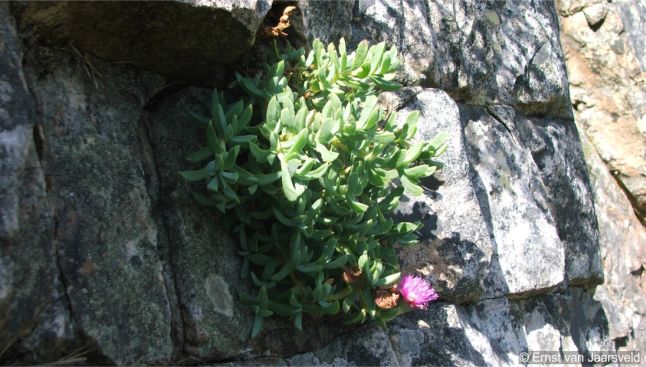
Fig. 1. A mature plant of Erepsia heteropetala, with a single flower, growing in a crevice on the Witteberg, Du Toitskloof, Western Cape.
Description
Description
The plants are much-branched, cushion-shaped cliff-hugging or pendent shrublets up to 200 mm tall and 300 mm in diameter. Roots fibrous. Stems reddish brown, up to 4.5 mm in diameter, soft at first becoming woody; nodes 5–30 mm apart. Leaves ascending, fleshy, pale green, margins and leaf tips sometimes reddish, three-angled (triquetrous), slightly flat (laterally compressed), 8 mm wide, sickle-shaped (falcate) to subfalcate, 35(–50) × 7 mm; margin serrate-denticulate; surface smooth, adaxial surface somewhat flat to slightly channelled; apex mucronate, reddish at tips. Flowers solitary or up to 3 in apical cymes, up to 40 mm in diameter, the pedicels 6 mm long when in fruit. The petals purplish pink or rarely white, linear, merging with staminodes. The capsule top-shaped, 15 mm deep, 15 mm in diameter at top; closing body absent, covering membranes present, valves light brown, valve wings narrow. Seed 1.5 × 1.2 mm in diameter, somewhat laterally compressed (0.5 mm) tuberculate, pale brown. Flowering ocurs mainly in spring and summer (October to February).
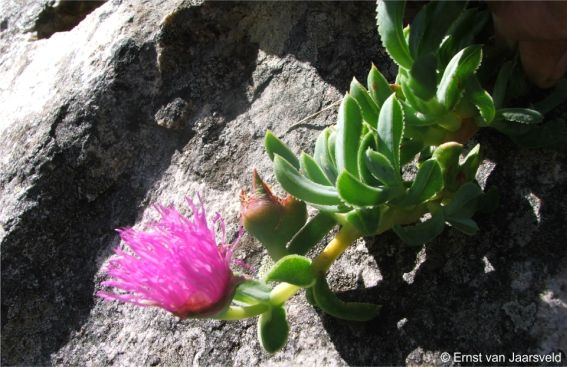
Fig. 2. A close-up of the flower and young fruit of Erepsia heteropetala, growing on the Witteberg, Du Toitskloof. Note the serrated leaf margin and keel.
Conservation Status
Status
Classified as Least Concern (LC) by the Red List of South African Plants. Although Erepsia heteropetala is not locally common, it is well protected by its inaccessible cliff habitat.
Distribution and habitat
Distribution description
Erepsia heteropetala is an obligatory cliff dweller and a quartzitic sandstone endemic, confined to the south- and east-facing cliffs in the Du Toitskloof, Drakenstein, Jonkershoek and adjacent regions in the Western Cape. The plants grow mainly on south- and east-facing cliffs of the central Cape Fold Belt mountains at an altitude of 400–1 300 m. The geology consists of mineral-poor, quarzitic sandstone of the Table Mountain Group (Cape Supergroup). Plants are rooted in crevices and on ledges, hugging the cliff, sometimes drooping over the rock faces. Temperatures are relatively low, with occasional snow in winter. The average daily maximum temperature is about 20°C and the average daily minimum for the region about 10°C. Rainfall occurs mainly in winter and is estimated to be above 1000–1500 mm per annum. The associated vegetation consists of Hawekwas Sandstone Fynbos of the Fynbos Biome. Erepsia heteropetala shares its habitat with other plants such as Crassula pellucida, Crassula atropurpurea var. anomala, Crassula nudicaulis, Lampranthus stokoei (= Esterhuysenia stokoei), Oscularia caulescens and Oscularia deltoides.
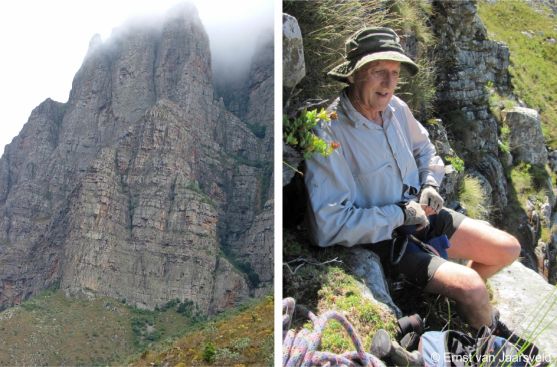
Fig. 3. The inaccessible sheer south-facing cliffs of the Witteberg, Du Toitskloof, Western Cape, habitat of Erepsia heteropetala. RIGHT Eric Harley, safely equipped with his mountaineering harness, sitting with an Erepsia heteropetala on the cliffs of the Witteberg. He helped the author to visit and document this species, an obligatory cliff dweller that is well equipped for permanent life on a cliff.
Derivation of name and historical aspects
History
Erepsia heteropetala was first named by the great British Succulent student Adrian Haworth (1767–1833) in 1803 as Mesembryanthemum heteropetalum in the Miscellanea Naturalia. Martin Heinrich Gustav (Georg) Schwantes (1881–1960), the great German mesemb student, transferred it to Erepsia in Gartenflora in 1928. It is not known whom was the first to introduce the plant to Europe. The German botanist and botanical explorer Rudolph Schlechter (1872–1925) also named the same species in 1899 as Mesembryanthemum montanum in the Beitrage zur Flora von Africa, but it is a synonym of Haworth’s name. Adrian Haworth gave the species epithet, heteropetala, it refers to the variable length of the petals. The genus Erepsia was created by N.E. Brown in 1925 and the name is derived from erepso, meaning ‘to cover or to hide’, pertaining to the stamens which are covered by the staminodes. In Afrikaans it is named altydvygie, which means ‘always mesemb’, as many species of Erepsia have flowers that remain open day and night.
Sigrid Liede, German botanist, revised Erepsia in 1990 in the Beitrage zur Biologie der Pflanzen recognising 29 species. She created 4 sections based on their flowers. Erepsia heteropetala belongs to section Crassifoliae which consists of 8 species. E. lacera, E. pillansii, E. dunensis, E. steytlerae, E. heteropetala, E. forficata, E. babiloniae and E. aristata. The section name Crassifoliae, is derived from crassus, meaning ‘fat’, and folius, leaves and pertains to the very swollen leaves, so distinctive of the species in this section.
Erepsia heteropetala is related to Erepsia lacera in shape, colour and size of the leaves, but the latter is an erect shrublet to 800 mm tall from Paarlberg and adjacent region. Two smaller species, E. forficata (Table Mountain) and E. inclaudens (Kogelberg), also occur frequently on cliff faces in the Western Cape.
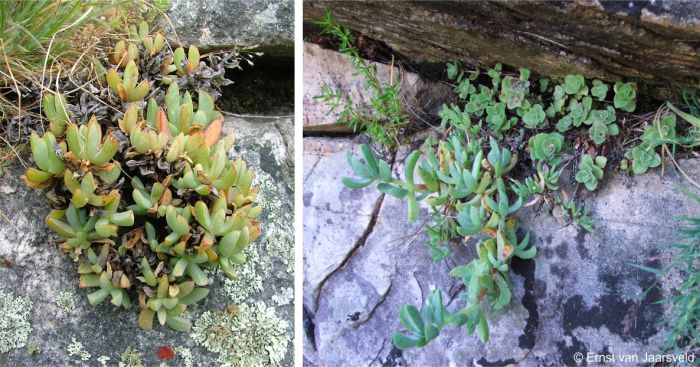
Fig. 4. LEFT A mature plant of Erepsia heteropetala drooping over a south-facing cliff-face on the Witteberg, Du Toitskloof, Western Cape. RIGHT Erepsia heteropetala growing in a crevice below an overhang on a south-facing cliff of the Witteberg, sharing its habitat with Crassula pellucida and a species of Lampranthus.
Ecology
Ecology
It is a fairly long-lived perennial, and the plants have a compact cushion-like or pendent growth habit that is retained in cultivation. The plants grow in crevices and the succulent leaves enable them to survive the long dry summers. The stems are softer, flaccid and more fragile than its relative, E. lacera, which does not grow on cliffs. The flowers are simple or in cymes of 3, produced at the branch tips, or in the axils, and are conspicuous, thus maximising visibility for successful pollination in the vertical cliff environment. It is pollinated by insects such as the honey-bee. Flowering time is in late spring and summer and flowers are regularly produced, ensuring a long and continual seed supply. After pollination, the capsule develops. It is hygrochastical and will only open with rain. Once the dry conditions set in, the expanding keels contract, again closing the lids and safely retaining the seed for the next rain event. The seeds in comparison with most other mesembs are fairly large, 1.5 mm in diameter, with a tuberculate surface that is ideal for establishment in crevices.
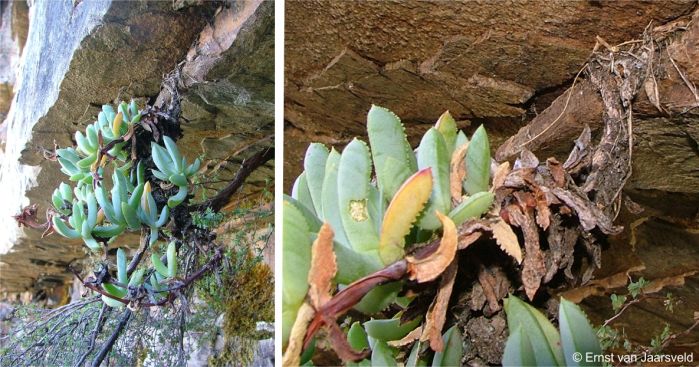
Fig. 5. Erepsia heteropetala hanging from the cliff, rooted in a narrow crevice below an overhang on the Witteberg, Du Toitskloof, Western Cape.
Uses
Use
It is not known whether the plants are used medicinally. It is easily cultivated and can be propagated from seed or cuttings. Best for dry fynbos gardens, grown in rockeries or small containers.
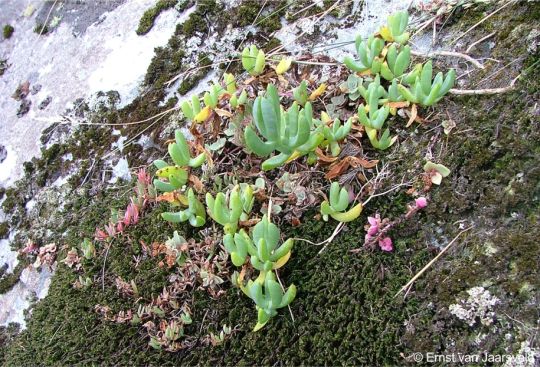
Fig. 6. Erepsia heteropetala seedlings growing on moss covered bedrock together with Crassula pellucida and a species of Lampranthus, on the Witteberg, Du Toitskloof, Western Cape.
Growing Erepsia heteropetala
Grow
Best for Mediterranean-climate gardens with a dry summer, grown in rockeries or embankments, in shallow soil in the absence of competition from other plants, particularly aggressively growing perennials. Outside its native habitat, it is best grown under controlled conditions in a greenhouse. Easily cultivated, it prefers dappled shade.
Propagate from cuttings or seed. Cuttings are best made in autumn. The soil should be sandy, mineral-poor and slightly acidic. Leaves near the base can be cut off and allowed to callus on a shady windowsill. Leaves should root and sprout.
The seed is fine and can be sown in a sandy mixture in autumn. Cover with a very thin layer of gravel. Keep moist. Remove seedlings as soon they are large enough to handle.
References
- Christenhusz, M.J.M., Fay, M.F. & Chase, M.W. 2017. Plants of the World, an illustrated Encyclopedia of vascular plants. Kew Publishing, Royal Botanic Gardens, Kew.
- Clarke, H. & Charters, M. 2016. The illustrated dictionary of southern African plant names. Flora & Fauna Publications Trust, Jacana, Johannesburg.
- Hartmann, H.E.K. 1991. Mesembryanthema. In Systematics, Biology and Evolution of Some South African taxa. Contributions from the Bolus Herbarium 13. 75-157.
- Hartmann, H.E.K. 2001. Aizoaceae A-E. In Eggli, U. & Hartmann, H.E.K. (eds.) Handbook of Succulent Plants. Springer. Heidelberg, New York, etc.
- Herre, H. 1971. The genera of the Mesembryanthemaceae. Tafelberg, Cape Town.
- Jackson, W.P.U. 1990. Origins and meanings of names of South African plant genera. University of Cape Town Printing Department, Cape Town.
- Mucina, L. & Rutherford, M.C. (eds) 2006. The vegetation of South Africa, Lesotho and Swaziland. Strelitzia 19. South African National Biodiversity Institute, Pretoria.
- Raimondo, D., Von Staden, L., Foden, W., Victor, J.E., Helme, N.A., Turner, R.C., Kamundi, D.A. & Manyama, P.A. (eds) 2009. Red list of South African plants. Strelitzia 25. South African National Biodiversity Institute, Pretoria.
- Van Jaarsveld, E.J. & Van Wyk, A.E. 2003. Adaptations without barriers: succulent plants shaped by cliffs. Aloe 40: 98–103.
- Van Jaarsveld, E.J. 2011. Cremnophilous succulents of southern Africa: diversity, structure and adaptations. Ph.D.Thesis, University of Pretoria.
- Van Jaarsveld, E.J. 2010. Waterwise gardening in South Africa and Namibia. Struik, Cape Town.
- Van Jaarsveld, E.J. 2018. Drosanthemum decumbens (Aizoaceae), a new status for an obligatory cremnophyte from the Western Cape, South Africa. Haseltonia 24: 2–6.
Credits
Ernst van Jaarsveld
Kirstenbosch National Botanical Garden (Retired)
Babylonstoren Farm (Current)
Extraordinary senior lecturer and researcher,
Department of Biodiversity and Conservation, University of the Western Cape
June 2026
Plant Attributes:
Plant Type: Shrub, Succulent
SA Distribution: Western Cape
Soil type: Sandy
Flowering season: Early Summer
PH: Acid, Neutral
Flower colour: White, Pink, Mauve/Lilac
Aspect: Full Sun, Shade, Morning Sun (Semi Shade), Afternoon Sun (Semi Shade)
Gardening skill: Average
Special Features:
 Drought resistant
 Good potplant
 Feeds honeybees
Horticultural zones



Rate this article
Article well written and informative
Rate this plant
Is this an interesting plant?
Login to add your Comment
Back to topNot registered yet? Click here to register.