


Euphorbia clava
Introduction
Euphorbia clava, commonly referred to as club spurge, is a succulent perennial herb that is native to South Africa. It belongs to the family Euphorbiaceae and is well adapted to arid and semi-arid environments. The species typically grows and thrives in dry, rocky habitats where water availability is limited. Its succulent characteristics enable it to store water, allowing it to survive under harsh environmental conditions. As a result, Euphorbia clava demonstrates notable resilience and adaptation to nutrient-poor soils and intense sunlight commonly found in semi-arid ecosystems.
Description
Description
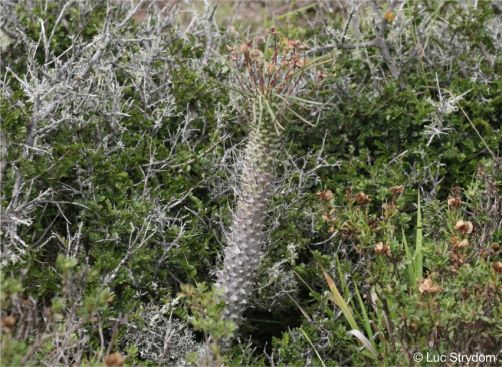
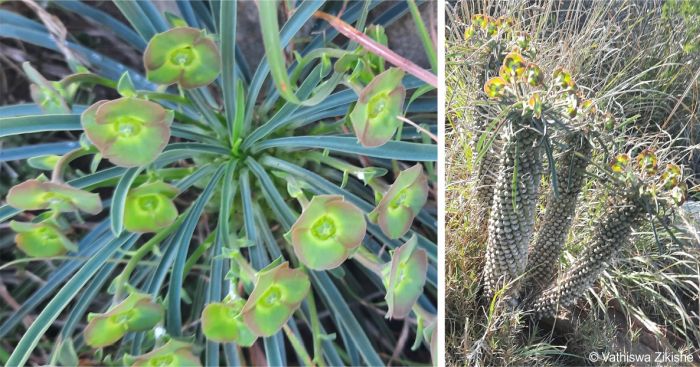
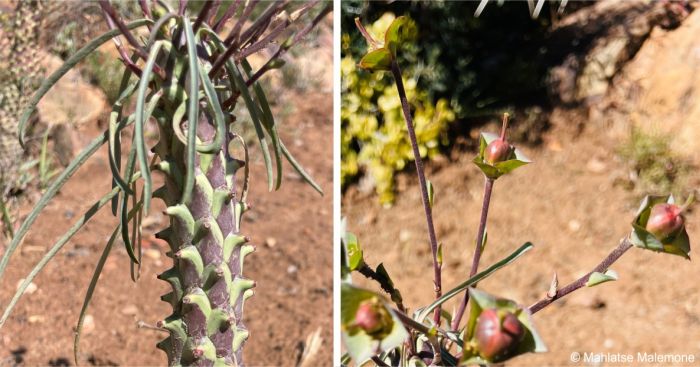
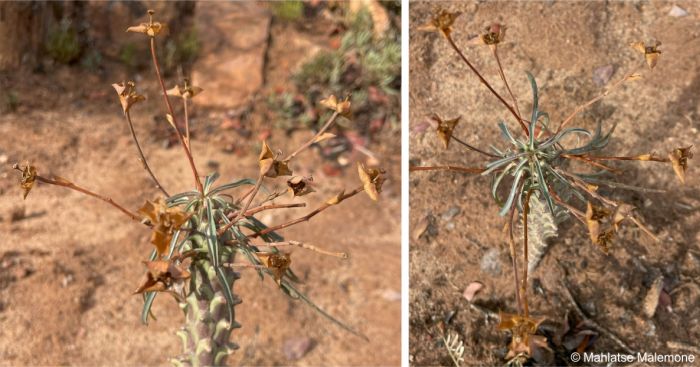
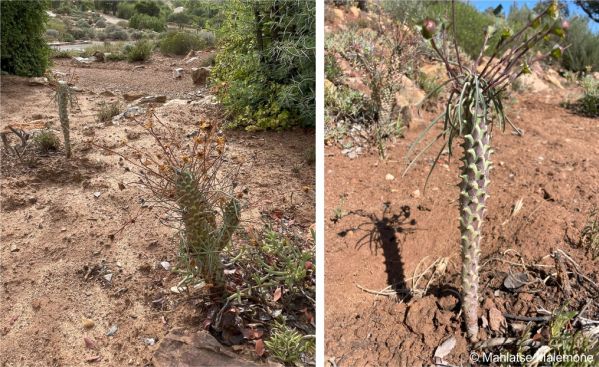
Euphorbia clava is a succulent plant that grows up to 1 m tall, usually with a solitary stem but occasionally with branches. The stem is club-shaped, pale green to bluish-green especially when young. The stem appears warty or rough and lacks spines. As the plant ages, its branches taper to their confluence with the main stem. The plant carries its noticeable, bright to bluish-green foliage on the upper part of the stem, for a considerable amount of time. The leaves are long and narrow (linear), slightly folded, about 130 mm long and are spreading or drooping. For a season or two, the long greenish to purplish stalks (peduncles) that carry the inflorescences (cyathia) stay affixed to the stems. Large, light-green bracts that occasionally have a purplish tint form a cup that surrounds the cyathia. A single green cyathium is carried at the tip of each 70-170 mm long peduncle, and they dry and remain on the plant for few years. The involucral glands, which produce the nectar and are located on the cyathia, are entire. Flowering occurs in summer, from November to April.
Conservation Status
Status
According to the Red List of South African Plants, Euphorbia clava is currently classified as Least Concern (LC). This classification indicates that the species is not presently considered to be at risk of extinction in its natural habitat.
Distribution and habitat
Distribution description
Euphorbia clava is an endemic succulent species found in the Eastern Cape and Western Cape Provinces of South Africa. Its distribution extends from Qonce (King William’s Town) to Knysna. The species typically occurs in dry, rocky slopes in Albany Thicket and Fynbos and is well adapted to arid conditions characteristic of this region.
Derivation of name and historical aspects
History
The genus Euphorbia was named after Euphorbus, a doctor to King Juba ll of Mauretania in ancient North Africa. Euphorbus is said to have extracted an excellent laxative from the euphorbias, prompting King Juba to name the group of plants after his doctor. In 1753, Carl Linnaeus named the entire genus Euphorbia. Nonetheless, the name also means ‘well fed’ from the Greek words eu, which means ‘well’ and phorbo, which means ‘feed, nourish or fat’. The species name clava, given by Jacquin in 1784, means ‘club’ and describes the ‘club-like form’ of a young plant. Many euphorbias are known by the common name spurge, which originates from middle English, and means ‘to purge’ due to the laxative properties of the sap of most species.
The Euphorbiaceae is a family of about 300 genera and 8 000 species. It is regarded as one of the largest dicot families found in the tropical zones. One of the distinguishing features of the Euphorbiaceae is its milky latex. If the latex comes in contact with the eye, it can cause allergic reactions, blistering and even blindness, and it has a strong acrid smell. Therefore, if latex comes in contact with the eyes, use plenty of water to rinse it out and seek medical attention if necessary. The latex of some euphorbias emits a scentless, volatile chemical that can cause a severe discomfort even when not in direct contact or touch. Euphorbias have different habits, some are thorny, fleshy bushes, while others are enormous trees with candelabriform branching, and some have tufts of delicate, pencil- thick stems.
Ecology
Ecology
The diversity of blooms and inflorescences of members of the Euphorbiaceae family means that they have a wide range of pollinating systems and pollinating agents. The most common visitors observed on the cyathia of Euphorbia clava are ants, tiny hairy sugar ants, tachinid flies, tumbling flower beetles, tube-tailed thrips, wasps and weevils. Ants are more likely to visit and pollinate plants with flowers that have an accessible nectaries in arid regions since they are typically placed near the ground.
Uses
Use
All succulent euphorbias, including Euphorbia clava, are great houseplants. They are renowned for being easy to maintain and resistant to drought. In arid climates, these euphorbias are also perfect for outdoor cultivation. They do well in desert rock gardens and flourish in similar conditions as cacti.
Numerous Euphorbia species are widely known for their medical uses. In modest dosages, the latex of various euphorbias is used as a laxative; in greater doses, it is used as an emetic. Antibacterial, antihelmintic, antiasthmatic, sedative, antispasmodic, antifertility, antifungal and antimalarial qualities have been found in Euphorbia hirta latex. Similar to this, the latex of Euphorbia tirucalli is used to treat rheumatism, warts, coughing, asthma, toothaches, earaches, and neuralgia. It also acts as a rubefacient and blistering agent. Rubber is made from the latex of species including Euphorbia ingens, Euphorbia turicalli and Euphorbia triangularis.
The euphorbias that generate latex, which includes Euphorbia clava, should be considered toxic. Although there are no records of Euphorbia clava being used in traditional medicine or having therapeutic qualities, it is possible that local people, both past and present, utilise its latex in the same manner that they use other euphorbias in the area, but that other species may be preferred because their latex is easier to obtain or because they grow more quickly and generate more latex.
Growing Euphorbia clava
Grow
Euphorbia species are generally considered relatively easy to cultivate and maintain when grown under conditions that resemble their natural habitats. These plants thrive in high temperatures and perform best in well-drained, loamy soil. Such soil conditions help maintain adequate moisture levels while preventing root desiccation during extended dry periods.
Watering requirements for Euphorbia species depend largely on the environmental conditions of their native habitats. Species originating from moist regions typically require more regular watering, particularly during the summer growing season. In contrast, species that naturally occur in dry or arid environments require less frequent watering and can often survive with irrigation once a week or even less frequently. Euphorbia clava, for example, should be kept dry during the winter months, as excessive moisture during this period may lead to root rot or other physiological stress.
Propagation of Euphorbia clava can be achieved through both seeds and vegetative cuttings, although these methods vary in their efficiency and application. Propagation by cuttings is commonly performed from late spring to early summer, when growth conditions are optimal. To propagate using cuttings, a healthy segment should be taken from a vigorous mother plant. The cutting should then be allowed to dry and callus for one to two weeks. Once the wound has sufficiently dried, the cutting can be placed in a suitable growing medium, ideally consisting of dry, loose, and highly well-drained soil to encourage successful root development.
References
- Court, D. 1981. Succulent flora of southern Africa. Balkema, Cape Town.
- Jackson, W.P.U. 1990. Origins and meanings of names of South African plant genera. University of Cape Town Printing Department, Cape Town.
- Manning, J. & Goldblatt, P. 2012. Plants of the Greater Cape Floristic Region 1: the Core Cape Flora. Strelitzia 29. South African National Biodiversity Institute, Pretoria.
- Mhlongo, N. 2022. Euphorbia umfoloziensis Peckover (Euphorbiaceae). PlantZAfrica. Online. https://pza.sanbi.org/euphorbia-umfoloziensis.
- Möller, A. & Becker, R.W. 2019. Field guide to the succulent euphorbias of southern Africa. Briza.
- Powrie, F. (ed) 1998. Grow South African Plants. A gardener's companion to indigenous plants. National Botanical Institute, Cape Town.
- Smith, G.F., Crouch, N.R. & Figueiredo, E. 2017. Field guide to succulents in southern Africa. Struik Nature, Cape Town.
- Strydom, L. 2022 Observation of Euphorbia clava, Gqeberha, EC. iNaturalist. Online. https://www.inaturalist.org/observations/140257239
- Von Staden, L. 2014. Euphorbia clava Jacq. National Assessment. Red List of South African Plants Version 2024.1. https://redlist.sanbi.org/species.php?species=574-57.
- Zikishe, V. 2026. Observations of Euphorbia clava. iNaturalist. Online. https://www.inaturalist.org/observations?taxon_id=577656&user_id=vats.
Credits
Mahlatse Michelle Malemone and Sicelo Sithole
Karoo Desert National Botanical Garden
April 2026
Acknowledgments: images of Euphorbia clava in habitat by Vathiswa Zikishe and Luc Strydom.
Plant Attributes:
Plant Type: Succulent
SA Distribution: Eastern Cape, Western Cape
Soil type: Sandy, Loam
Flowering season: Early Summer, Late Summer
PH: Acid, Neutral
Flower colour: Green, Purple
Aspect: Full Sun
Gardening skill: Average
Special Features:
 Drought resistant
 Feature plant
 Good potplant
 Poisonous
Horticultural zones




Rate this article
Article well written and informative
Rate this plant
Is this an interesting plant?
Login to add your Comment
Back to topNot registered yet? Click here to register.