


Euphorbia meloformis
Introduction
Euphorbia meloformis is a distinctive globose succulent plant endemic to the arid regions of the Eastern Cape, South Africa, recognized for its ribbed, melon-shaped stem, drought tolerance, and adaptation to harsh dry environments of the Succulent Karoo Biome.
Description
Description
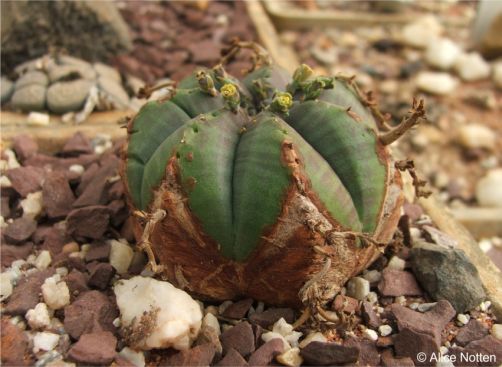
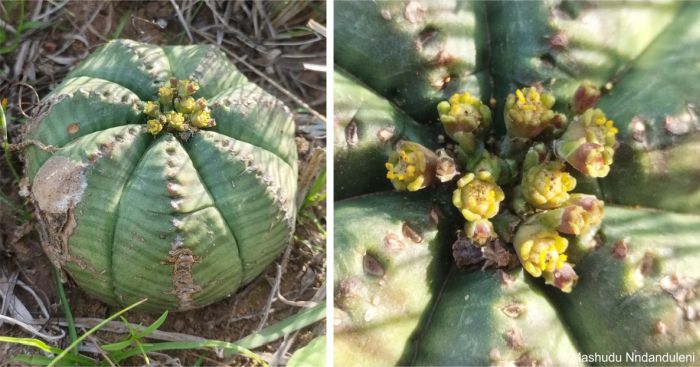
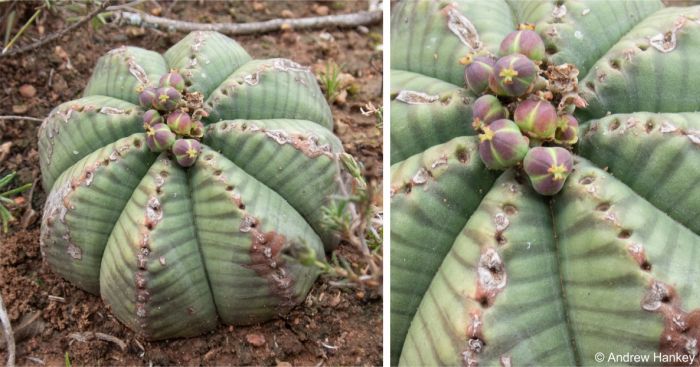
Euphorbia meloformis is a small, spineless succulent species that rarely grows taller than 100 mm and is distinguished by its compact, dome-shaped growth form. The plant develops a long, slightly thickened taproot and typically produces a solitary, sub-globose stem, although occasional lateral branching may occur. Mature plants often form clumps over time, creating clusters that resemble miniature onion domes. The stem is generally 50–100 mm thick, flattened at the apex, and marked by eight distinct angles with light green to purplish-brown striping and reddish cross-bands along the ribs. Its tiny, linear leaves are rudimentary, deciduous, and measure approximately 1–3 mm in length. From early summer to autumn (November to March), the plant produces small yellowish-green pseudo-flowers, with male and female flowers borne on separate plants. The flowers are produced in cyathia arranged in groups of 2–12, in compressed or erect cymes that emerge from the stem apex, while the short inflorescence stalks leave small depressions after being shed. The peduncles are up to 60 mm long, simple or branched, and generally fork once or twice.
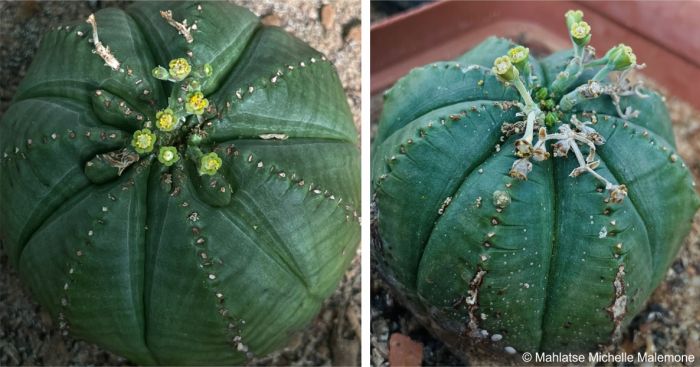
Although similar in appearance to the related species Euphorbia obesa subsp. obesa and Euphorbia obesa subsp. symmetrica, E. meloformis can be identified by the longer peduncles that persist on the plant for extended periods, the ovaries that are puberulous rather than glabrous, and by the wider spacing between its tubercles and flowering eyes.
Conservation Status
Status
According to the Red List of South African Plants, Euphorbia melorformis is currently classified as Near Threatened (NT) because of its restricted distribution, habitat degradation and illegal collection from the wild for the international succulent trade.
Distribution and habitat
Distribution description
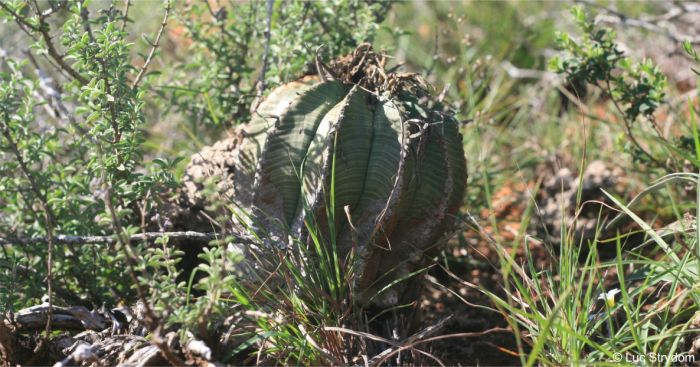
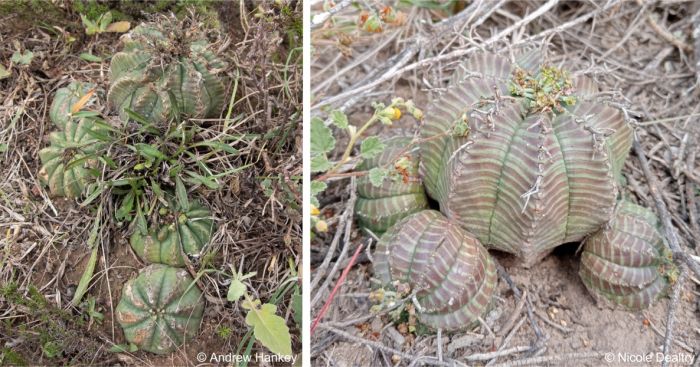
Euphorbia meloformis typically occurs in flat landscapes, including coastal plains and elevated plateaus, where it grows among brown surface limestone or calcrete substrates. The species is commonly associated with short, open grassland and gaps within succulent thicket vegetation. In South Africa, the species is distributed within the Eastern Cape province, in the areas surrounding Kariega (Uitenage), Gqeberha (Port Elizabeth), Makhanda (Grahamstown) and Peddie.
Derivation of name and historical aspects
History
Euphorbia meloformis derives its name from both historical and descriptive origins. The genus name Euphorbia commemorates Euphorbus, a doctor to King Juba II of Mauretania, who was associated with the medicinal use of plants from this group. The name is also interpreted as meaning ‘well fed’, derived from the Greek words eu meaning ‘well’ and phorbo meaning ‘to nourish, feed, or make fat’. Many species of Euphorbia are commonly referred to as ‘spurge’, a term originating from Middle English that relates to the purgative or laxative properties of the milky sap found in many members of the genus. The species epithet meloformis originates from the Latin words melo, meaning ‘melon’ or ‘apple-shaped’ and formis, meaning ‘shape’ or ‘form’, describing the plant’s rounded, melon-like stem. This name accurately reflects the species’ distinctive globular growth habit.
Historically, Euphorbia meloformis has long been recognised as one of the characteristic succulent species of South Africa’s Eastern Cape region, where it naturally occurs in dry grassland and succulent thicket vegetation. The species became popular among succulent collectors because of its compact shape and ornamental appeal.
The family Euphorbiaceae comprises more than 300 genera and approximately 8 000 species, making it one of the largest families of dicotyledonous plants distributed predominantly throughout tropical regions. A characteristic diagnostic feature of the family is the presence of milky latex, which typically possesses a strong acrid odour and may cause allergic reactions, skin blistering, or even temporary blindness upon contact with the eyes. In cases of ocular exposure, immediate rinsing with large quantities of water is recommended, followed by medical attention if necessary. In certain Euphorbia species, the latex emits odourless volatile compounds capable of causing severe irritation even without direct physical contact. Members of the genus Euphorbia exhibit considerable morphological diversity, ranging from thorny succulent shrubs and large candelabra-shaped trees to species with slender, pencil-like stems that grow in dense clusters.
Ecology
Ecology
The wide variety of flower forms and inflorescence structures within the Euphorbiaceae results in diverse pollination mechanisms and involves a broad spectrum of pollinating agents. Euphobia meloformis is pollinated mainly by small insects, such as flies, bees, ants, and wasps, that are attracted to nectar produced in the cyathia, the specialized flower structures of Euphorbia. Seeds are dispersed through explosive dehiscence, where the dry fruit bursts open and scatters seeds away from the parent plant. Ants may also help move seeds to protected places for germination.
Uses
Use
All succulent plants of the genus Euphorbia, including Euphorbia meloformis, are commonly valued as ornamental plants and are well suited to cultivation as houseplants due to their low maintenance requirements and strong drought tolerance. In regions with arid climates, these species are also frequently used in outdoor landscaping, particularly in rock gardens, where they perform well under conditions similar to those preferred by cacti. The species Euphorbia meloformis has limited direct traditional or large-scale economic use, but it is widely cultivated as an ornamental succulent due to its distinctive globose, ribbed stem and compact growth form, making it a popular plant in rock gardens and succulent collections. Its drought tolerance and low maintenance requirements also make it suitable for xeriscaping, particularly where the availability of water is limited. From an ecological and scientific perspective, the species is valuable for studying adaptations to arid environments. Like other members of the genus Euphorbia, it contains a toxic milky latex rich in secondary metabolites, which has been investigated in related species for potential pharmacological and defensive chemical properties, although E. meloformis itself is not used medicinally due to its irritant toxicity.
A number of Euphorbia species are also recognized for their ethnomedicinal applications. When administered in small quantities, the latex of certain species has traditionally been used as a laxative, whereas higher doses have been associated with emetic effects. Pharmacological studies on species such as Euphorbia hirta have reported a range of bioactive properties, including antibacterial, antifungal, antimalarial, antispasmodic, sedative, anti-asthmatic, anti-helmintic, and antifertility activities. Similarly, the latex of Euphorbia tirucalli has been traditionally employed in the treatment of various conditions, including rheumatism, warts, coughs, asthma, toothaches, earaches, and neuralgia, and has also been used as a rubefacient and vesicant. It should be noted that all latex-bearing euphorbias, including Euphorbia meloformis, are regarded as toxic due to their irritant and bioactive chemical compounds.
Growing Euphorbia meloformis
Grow
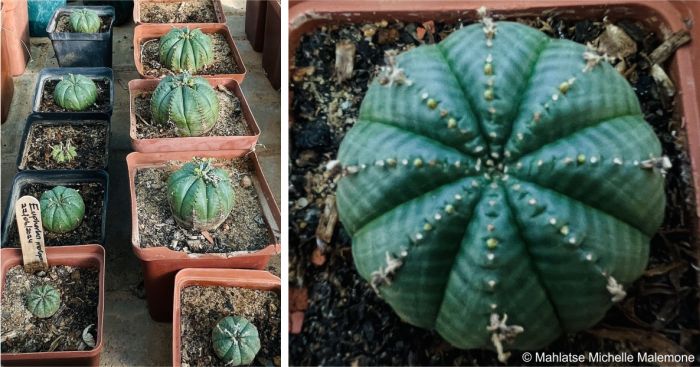
Euphorbia species are generally easy to grow and care for when cultivated in conditions similar to their natural environments. They prefer warm temperatures and grow best in well-drained, loamy soil, which helps retain sufficient moisture while protecting the roots from drying out during prolonged dry spells. The watering needs of Euphorbia species vary according to the climate of their native habitats. Species from wetter regions usually need more consistent watering, especially during the active summer growing period. On the other hand, species adapted to arid or dry environments require much less water and can often thrive with irrigation only once a week or even less often.
Euphorbia meloformis is commonly propagated through seeds and, less frequently, through offsets. Seeds are usually planted in a sandy, well-drained growing medium and kept under warm conditions to encourage germination. Light watering and temperatures between 20–25 °C or a normal room temperature help improve seedling emergence. When offsets are present, they should be carefully removed, left to dry and form a callus, and then planted in a porous soil mix to reduce the risk of rot. As with most succulent euphorbias, overwatering should be avoided during propagation.
References
- Barkhuizen, B.P. 1978. Succulents of southern Africa. Purnell and Sons Publishers, Cape Town.
- Bredenkamp, C.L. 2019. A flora of the Eastern Cape Province, Volume 2. Strelitzia 41. South African National Biodiversity Institute, Pretoria.
- Bruyns, P.V. 2012. Nomenclature and typification of southern African species of Euphorbia. Bothalia 42(2): 217–245.
- Carter Holmes, S. & Eggli, U. 2003. The CITES checklist of succulent Euphorbia taxa (Euphorbiaceae). Royal Botanic Gardens, Kew.
- Dealtry, N. 2022. Observation of Euphorbia meloformis. iNaturalist. Online. https://www.inaturalist.org/observations/139960907.
- Fajinmi, O.O, Olarewaju, O.O. & Van Staden, J. 2023. Propagation of medicinal plants for sustainable livelihoods and biodiversity conservation in South Africa. Plants 12(5): 1174.
- Hankey, A. 2024. Observations of Euphorbia meloformis. iNaturalist. Online. https://www.inaturalist.org/observations/219070716 & https://www.inaturalist.org/observations/219070692.
- Horn, J.W., Van Ee, B.W., Morawetz, J.J., Riina, R., Steinmann, V.W., Berry, P.E. & Wurdack, K.J. 2012. Phylogenetics and the evolution of major structural characters in the giant genus Euphorbia L. Molecular Phylogenetics and Evolution 63(2):305–326.
- Jackson, W.P.U. 1990. Origins and meanings of names of South African plant genera. University of Cape Town Printing Department, Cape Town.
- Manning, J. & Goldblatt, P. 2012. Plants of the Greater Cape Floristic Region 1: the Core Cape Flora. Strelitzia 29. South African National Biodiversity Institute, Pretoria.
- Narbona, E., Arista, M. & Ortiz, P.L. 2005. Explosive seed dispersal in two perennial Mediterranean Euphorbia species (Euphorbiaceae). American Journal of Botany 92(3): 510–516.
- Nndanduleni, M. 2024. Observation of Euphorbia meloformis. iNaturalist. Online. https://www.inaturalist.org/observations/224441627.
- Raimondo, D., Dold, A.P., Berrington, W., Archer, R.H., Victor, J.E., von Staden, L. & Mhlongo, N.N. 2022. Euphorbia meloformis Aiton. National Assessment: Red List of South African Plants version 2024.1. Accessed 2026/06/02.
- Smith, G.F., Crouch, N.R. & Figueiredo, E. 2017. Field guide to succulents in southern Africa. Struik Nature, Cape Town.
- Strydom, L. 2022. Observation of Euphorbia meloformis. iNaturalist. Online. https://www.inaturalist.org/observations/111282155.
Credits
Mahlatse Michelle Malemone
Karoo Desert National Botanical Garden
June 2026
Acknowledgements: additional images by Alice Notten, Andrew Hankey, Luc Strydom, Mashudu Nndanduleni and Nicole Dealtry.
Plant Attributes:
Plant Type: Succulent
SA Distribution: Eastern Cape
Soil type: Loam
Flowering season: Early Summer, Late Summer
PH: Alkaline, Neutral
Flower colour: Green, Yellow
Aspect: Full Sun
Gardening skill: Average
Special Features:
 Drought resistant
 Good potplant
 Poisonous
Horticultural zones





Rate this article
Article well written and informative
Rate this plant
Is this an interesting plant?
Login to add your Comment
Back to topNot registered yet? Click here to register.