


Freesia refracta
Introduction
Freesia refracta is a deciduous winter-growing geophyte with showy pale greenish or dull white flowers with orange markings. It adds beautiful colour and a strong rose or violet scent indoors as a pot plant and it is perfect for fynbos and succulent karoo gardens. It is a sun loving plant that thrives in well-drained soil and rewards gardeners with spring colour and scent.
Description
Description
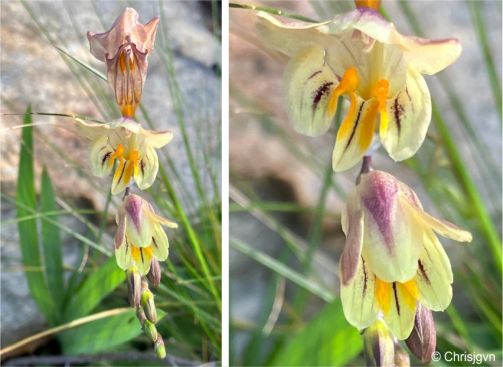
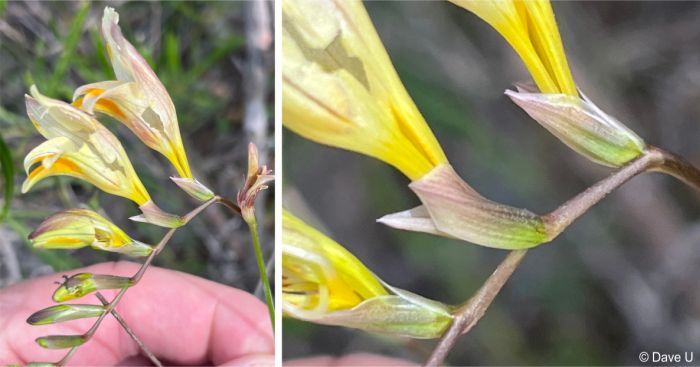
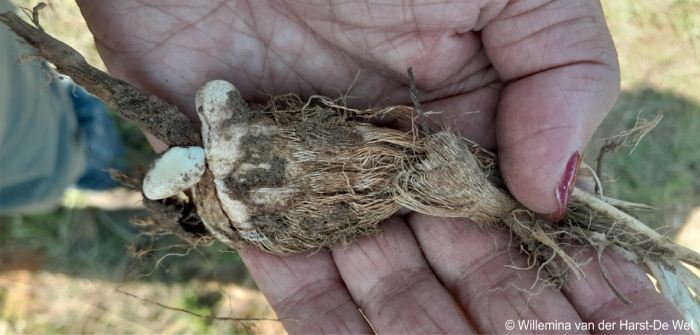
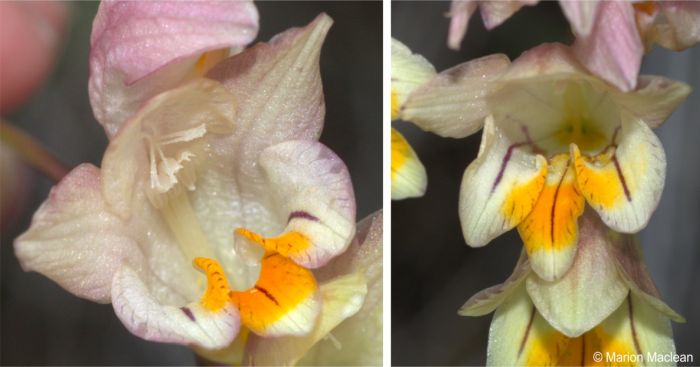
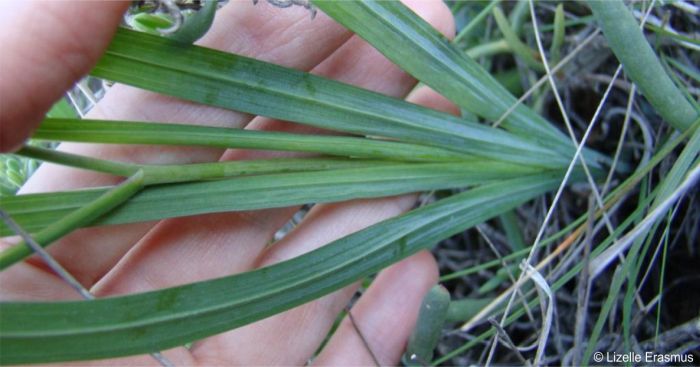
The plants vary in size between 80 and 600 mm in height. The corm is cone-shaped, about 12 to 30 mm wide and covered with light brown fibres. The stems are smooth and erect, and form up to four branches in a well-developed plant. Plants have 7 to 10 erect, narrow and pointy leaves (60-300 mm long and 2-10 mm wide) which are shorter or equal to the length of the stem. Five to 10 upright or curved flowers (25-35 mm long) are arranged in a spike and are surrounded by pale pinkish bracts with brown veins (4-8 mm long). Freesia refracta flowers may be unscented or have a strong rose, violet, or spicy smell. The tepals are pale greenish yellow or dull white within, with a dark brown line in the middle. Additionally, the three lower tepals have a bright orange tint on the inside and are curved downwards. All the tepals have a purple tint on the outer surface. The dorsal lateral tepals are narrow and the central dorsal tepal is broad and heart shaped. The seeds are rounded or oval-shaped, lightly wrinkled, glossy and reddish brown. Flowering time is from midwinter to spring, between mid-July and early September.
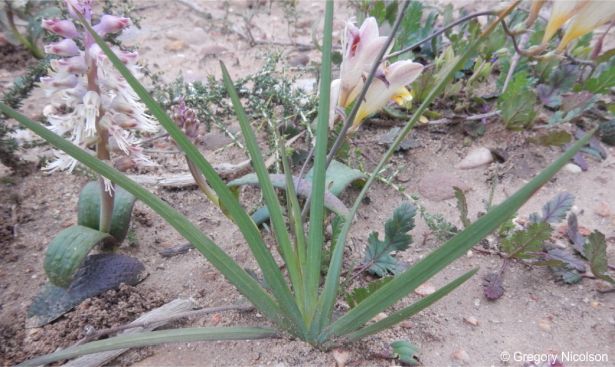
Freesia refracta is distinguished from F. corymbosa and F. occidentalis by its leaves that are as long as the stem, uniformly pale bracts without brown tips and dull yellowish or greenish flowers. Freesia corymbosa has bracts with dark brown tips, while F. occidentalis has leaves mostly shorter and blunter, flowers that are white to pale creamy yellow with obtuse tepals, and tips of the bracts that are lightly but quite obviously tipped with brown.
Conservation Status
Status
Freesia refracta is listed as Least Concern (LC) in the Red List of South African Plants because it is widespread and common and not threatened with extinction.
Distribution and habitat
Distribution description
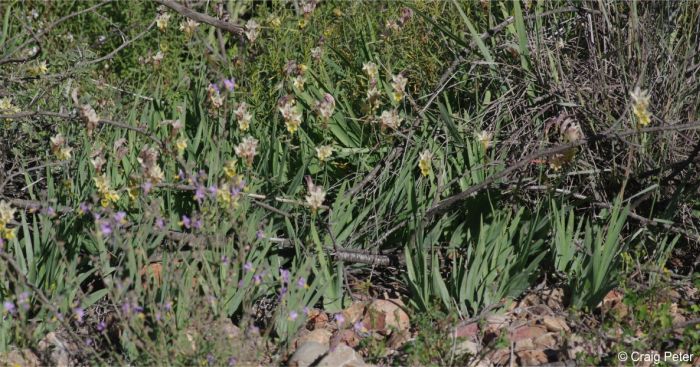
The species occurs in the southeastern Western Cape from the Hex River Valley, along the Breede River Valley and through the Little Karoo to Oudtshoorn. Plants inhabit valleys with dry and rocky soil derived from sandstone, limestone or shale, in fynbos, succulent karoo shrubland and coastal thicket.
Derivation of name and historical aspects
History
The genus Freesia has 16 species and is part of the Iris family (Iridaceae) which has about 2 000 species from ± 65 genera. Freesia is named after the German doctor, Friedrich Heinrich Theodor Freese, who was also a botanist. The species epithet refracta is a Latin word meaning ‘bent’, which refers to the bent flower stalk of the species. The name Freesia refracta effectively translates to ‘Freese’s bent plant’. The genus Freesia was first mentioned in literature in 1827 by Christian Friedrich Ecklon, as Freesea Eckl., in honour of his college friend Dr Friedrich Freese. However, Ecklon did not provide a morphological description and the name is therefore illegitimate according to the International Code of Nomenclature for algae, fungi, and plants (ICN). Klatt validly published the name as Freesia in 1866.
Freesia refracta has a complex taxonomic history. Klatt, in 1866, recognised four species and two varieties namely, F. odorata, F. leichtlinii, F. xanthospila, F. refracta var. refracta, and F. refracta var. alba, of which the latter was later changed to F. alba. In 1935, Brown explained that plants of several taxa in the genus looked very similar especially when dried, which led to confusion and mistakes in identifying them.
Furthermore, Klatt mistakenly referenced various distinct species such as F. muirii Eckl., a synonym of F. corymbosa, as F. refracta. Bolus in 1933 erroneously described F. refracta as a new species, referring to it as F. hurlingii because she mistakenly applied the name F. refracta to a taxon whose correct name is F. leichtlinii subsp. alba.
Brown, in 1935, provided clarifications by creating an identification key with six diagnostic characters to help distinguish between species. However, even with Brown’s publication the confusion still persists, especially in horticulture. Nonetheless, F. refracta native to the Western Cape of South Africa, remains a species that carries a historical significance in the development of cultivated freesias.
Ecology
Ecology
Little is known about pollination in Freesia, however, based on their floral structure it is possible to deduce probable pollinators. Freesia refracta is likely pollinated by long-tongued, nectar-collecting bees such as Amegilla (Apidae: Anthophorinae) and Andrena (Andrenidae) species.
Uses
Use
Freesia refracta was first cultivated in the late 19th century in Vienna. The origin of cultivated Freesias came from various crossings of the three white and pale-flowered species F. leichtlinii subsp. alba (= F. alba), F. corymbosa and F. leichtlinii. The ornamental appeal of freesias, their graceful floral form, and strong fragrance influenced modern cut flower breeding, and the many hybrids and cultivars produced are commonly used as decorative plants and cut flowers worldwide. Its scent is also widely recognized in the fragrance industry, is synthetically reproduced and used in cosmetics.
Growing Freesia refracta
Grow
Freesia refracta is best in a winter-rainfall or Mediterranean-type climate with full sun to very light semi-shade and well-drained soil. Most Western Cape bulbous plants need to be kept dry in summer otherwise they rot. They require water in autumn, winter and spring, and a dry summer. The species is suitable for rockeries or mixed beds in water-wise fynbos and succulent karoo gardens, or should be grown in pots with adequate drainage and stored in a cool, dry, well-ventilated place during summer. It is ideal for sensory gardens due to its fragrance and soft floral hues.
Freesias can be propagated reliably from cormels or seed. Propagation from cormels is the most preferred and efficient method. Plants grown from cormels flower in their second year while those propagated from seed take 15-18 months to flower. Sow or plant in late summer to early autumn to mimic natural dormancy cycles. A well-draining soil mixture of sandy loam, coarse river sand and bark is recommended. Compost improves soil structure and mulching retains moisture. Fertilizers like phosphorus and potassium support development stage of leaves and buds. You do not need rooting hormones, however fungicide dusting helps prevent damping off. Misting or bottom heating is not essential. Prick out seedlings when they develop the second true leaf and pot up once the cormels form. After their first dormancy, place corm-grown plants into garden beds, so you can harden them off.
Although it is generally pest-free it can be affected by thrips and aphids, some fungal pathogens during seedling stage, and corm rot due to overwatering. To prevent corm rot, provide moderate watering during active growth and cease watering during dormancy.
References
- Brown, N.E. 1935. Freesia, Klatt, and its history. Journal of South African Botany 1(2):1-19.
- Chrisjgvn. 2024. Observation of Freesia refracta, Cape Winelands. iNaturalist. Online. https://www.inaturalist.org/observations/270380223.
- Dave U. 2024 Observation of Freesia refracta, Oudtshoorn. iNaturalist. Online. https://www.inaturalist.org/observations/226223472.
- Erasmus, L. 2016. Observation of Freesia refracta, McGregor. iNaturalist. Online. https://www.inaturalist.org/observations/11259771.
- Goldblatt, P. 2008. The iris family: natural history & classification. Timber Press, Portland.
- Kalaf, Y.F., Mohammad, S. & Adul Kareem, A.J. 2020. Response of freesia (Freesia hybrida) to growth medium and foliar spray with marine algae extract. Plant Archives 20(Supplement 2):65–70.
- Kim, E., et al. 2024. Analysis of active components and transcriptome of Freesia refracta callus extract and its effects against oxidative stress and wrinkles in skin. International Journal of Molecular Sciences 25(15):8150.
- Maclean, M. 2016. Observation of Freesia refracta, Montagu. iNaturalist. Online. https://www.inaturalist.org/observations/26930993.
- Manning, J.C. & Goldblatt, P. 2010. Botany and horticulture of the genus Freesia (Iridaceae). Strelitzia 27. South African National Biodiversity Institute, Pretoria.
- Nicolson, G. 2018. Observation of Freesia refracta, west of Worcester. iNaturalist. Online. https://www.inaturalist.org/observations/16352680.
- Peter, C. 2024. Observation of Freesia refracta, De Rust. iNaturalist. Online. https://www.inaturalist.org/observations/240384055.
- Suedan, E.A., et al, R.G. 2023. Evaluation of the effect of chemical fertilization and some natural extracts on the production of freesia (Freesia refracta L.) plants: a sustainable approach. Rendiconti Lincei. Scienze Fisiche e Naturali 34(4):1161–1167.
- Van der Harst-De Wet, W. 2023. Observation of Freesia refracta, Overberg. iNaturalist. Online. https://www.inaturalist.org/observations/182796614
- Von Staden, L. & Patel, T. 2021. Freesia refracta (Jacq.) Klatt. National Assessment: Red List of South African Plants version. https://redlist.sanbi.org/species.php?species=1543-20.
Credits
Lebogang Mokwatsi and Natasha Lombard
National Herbarium, Pretoria
April 2026
Acknowledgements: images by Craig Peter, Willemina van der Harst-De Wet, Gregory Nicolson, Lizelle Erasmus, Chrisjgvn, Dave U and Marion Maclean.
Plant Attributes:
Plant Type: Bulb
SA Distribution: Western Cape
Soil type: Sandy, Loam
Flowering season: Spring, Winter
PH: Acid, Neutral
Flower colour: Purple, Cream, Yellow, Orange
Aspect: Full Sun
Gardening skill: Average
Special Features:
 Fragrant
 Good potplant
Horticultural zones



Rate this article
Article well written and informative
Rate this plant
Is this an interesting plant?
Login to add your Comment
Back to topNot registered yet? Click here to register.