


Gladiolus sekukuniensis
Introduction
Gladiolus sekukuniensis is a member of the Iridaceae family and a rare endemic species of Sekukuniland in Limpopo Province; it has grass-like leaves and white, cream or pale salmon-pink flowers in late summer, and is found in grassland or savanna margins growing among grass.
Description
Description
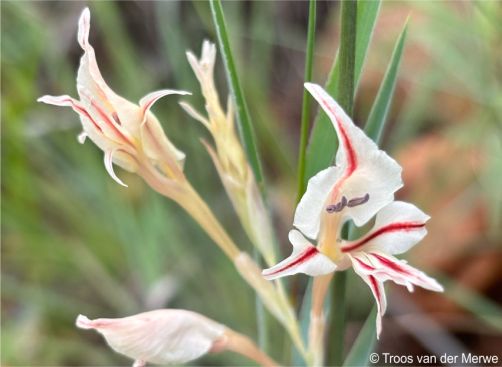
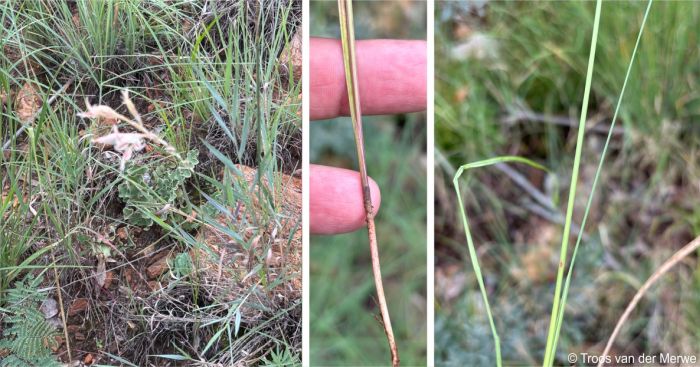
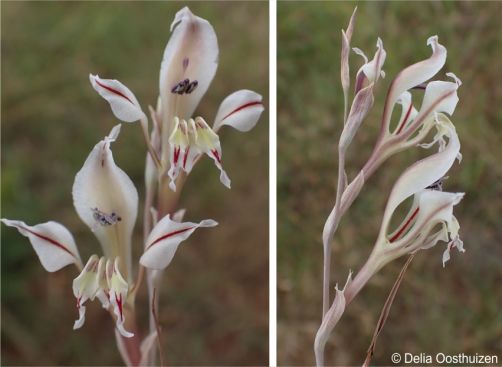
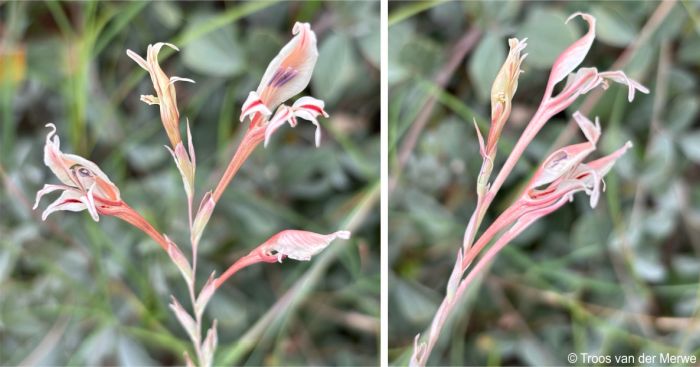
Gladiolus sekukuniensis is a deciduous perennial with a rootstock that is a corm. The plant is actively growing in summer and flowers in late summer to early autumn (March to April), then goes dormant after flowering is complete. The plant is approximately 0.6–1.1 m tall with long, narrow, grass-like leaves that have a noticeable midrib. The plant produces an erect flower stalk that bears about 8-17 flowers towards the tip. Each flower is white, cream, or pale salmon-pink, often decorated with a thin dark red streak down the center of each petal. Sometimes, the lower petals show a yellow midline, making the flowers look strikingly patterned. The flowers are unscented and have gaps, termed windows, between the upper petals, and narrow, tail-like petal tips that curl or twist. Each flower has a long, narrow tube at its base (perianth tube), 25-35 mm long. If pollinated, the plant produces a dry capsule that contains flat, winged seeds that are easily dispersed by wind.
It closely resembles G. permeabilis subsp edulis in vegetative features and in flower form but differs from it in flower colour and in having a more elongated perianth tube.
Conservation Status
Status
This species is assessed as Vulnerable (VU) by the Red List of South African plants, occurring in 3-5 locations in Limpopo province, where it is threatened by grazing and mining activities.
Distribution and habitat
Distribution description
Gladiolus sekukuniensis is a very rare, locally endemic species known to occur in three or five populations located in Sekukuniland, in Limpopo Province, between Leolo Mountains and Strydpoort Mountains, west of the Transvaal Drakensberg Mountains, in South Africa. It thrives in open woodland areas on rocky alkaline or dolomitic soils, often among Senegalia afra (= Acacia afra) and Combretum molle. The species is associated with savanna or grassland margins.
Derivation of name and historical aspects
History
The name Gladiolus is derived from the Latin word gladius, meaning sword which refers to the shape of the plant’s long, narrow, sword-like leaves. The species name sekukuniensis refers to Sekukuniland, the region in South Africa where this plant naturally occurs. The suffix -ensis is Latin, meaning from or belonging to a place.
Gladiolus is a large genus of about 260 species, primarily found in sub-Saharan Africa, especially the Cape Floristic Region and other parts of southern Africa. A smaller number of species are native to the Mediterranean, parts of Europe and western Asia. Gladiolus belongs to the family Iridaceae, commonly known as the iris family. This is a moderately large family of flowering plants with about 66 genera and over 2 000 species worldwide. The family is known for its showy flowers, often with sword-shaped leaves and corms or rhizomes as underground storage organs.
Ecology
Ecology
Gladiolus sekukuniensis has a specialized pollination system, as it is adapted for pollination by long-proboscid flies, flying insects with extremely long mouthparts that can reach into the deep floral tube of the flower. The flowers have a long perianth tube of about 25-35 mm in length, which allows only insects with long feeding tubes to access the nectar. This limits the pollination of the species as it depends on the presence of specific insect pollinators.
Uses
Use
There is no evidence of any traditional or horticultural uses for Gladiolus sekukuniensis, due to its rarity and restricted habitat. However other related species in the genus Gladiolus have been used in the cut flower industry, and grown in gardens for display, and species like G. permeabilis subsp. edulis and G. dalenii have a history of use in traditional medicine in South Africa.
Growing Gladiolus sekukuniensis
Grow
Gladiolus sekukuniensis can be easily propagated from corms, by lifting mature corms and removing the cormels that form around the mother plant. In the southern hemisphere, plant the cormels in early summer (October to late November), with the pointed end up using well-drained, fertile, sandy-loam soil with added organic matter. The medium should be slightly acidic (pH 6-7). The cormels will take 2-3 years to flower. The plant performs best in full sun (6-8 hours of direct sunlight daily) with consistent moisture (not waterlogged) during growth and flowering stages. Overwatering may result in corm rot. Cease watering when foliage dies and keep the plants cool and dry during winter, and resume watering in spring.
References
- Agriculture Institute. Gladiolus Flower Cultivation: Species, Growing Conditions, and Care. https://agriculture.institute/floriculture-and-landscaping/gladiolus-flower-cultivation-guide/. Accessed 06/10/2025.
- Goldblatt, P. & Manning, J. 1998. Gladiolus in southern Africa. Fernwood Press, Cape Town.
- Goldblatt, P. & Manning, J.C. 1999. Two new species of Gladiolus (Iridaceae: Ixioideae) from South Africa and notes on long-proboscid fly pollination in the genus. Bothalia 29(2):219–223.
- Goldblatt, P. 1990. Systematics of the Iridaceae of Sub-Saharan Africa. Memoirs of the New York Botanical Garden.
- Manning, J.C. & Goldblatt, P. 1997. The Moegistorhynchus longirostris pollination guild: long-tubed flowers and a specialized pollinator in southern Africa. Plant Systematics and Evolution 206:51–69.
- Goldblatt, P. & Manning, J.C. 1999. Two new species of Gladiolus (Iridaceae: Ixioideae) from South Africa and notes on long-proboscid fly pollination in the genus. Bothalia 29(2):219–223.
- Oosthuizen, D. 2024-Feb. Observation of Gladiolus sekukuniensis, Sekhukhuneland, Limpopo. iNaturalist. Online. https://www.inaturalist.org/observations/199888676.
- Pacific Bulb Society. Gladiolus sekukuniensis. https://www.pacificbulbsociety.org/pbswiki/index.php/Gladiolus_sekukuniensis. Accessed 01/09/2025.
- Plants of the World Online (POWO), Royal Botanic Gardens, Kew. Gladiolus L. https://powo.science.kew.org/taxon/urn:lsid:ipni.org:names:331644-2. Accessed 01/09/2025.
- Van der Merwe, T. 2025-Apr. Observations of Gladiolus sekukuniensis. iNaturalist. Online. https://www.inaturalist.org/observations/271367213 & https://www.inaturalist.org/observations/271370951.
- Winter, P.J.D. & Victor, J.E. 2009. Gladiolus sekukuniensis P.J.D.Winter. National Assessment: Red List of South African Plants version 2024.1. https://redlist.sanbi.org/species.php?species=1549-609.
Credits
Sharlotte Kwenaite
Free State National Botanical Garden
November 2025
Acknowledgements: the author thanks Troos Van der Merwe and Delia Oosthuizen for making their images available on iNaturalist and granting permission to utilise them.
Plant Attributes:
Plant Type: Bulb
SA Distribution: Limpopo
Soil type: Sandy, Loam
Flowering season: Late Summer, Autumn
PH: Acid, Alkaline, Neutral
Flower colour: Red, White, Pink, Cream
Aspect: Full Sun
Gardening skill: Average
Special Features:
 Good potplant
Horticultural zones


Rate this article
Article well written and informative
Rate this plant
Is this an interesting plant?
Login to add your Comment
Back to topNot registered yet? Click here to register.