


Glottiphyllum depressum
Introduction
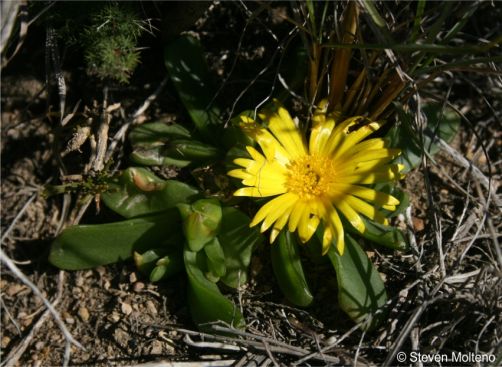
A compact, low-growing succulent with glossy green tongue-like leaves, displaying beautiful bright yellow daisy-like flowers in autumn, winter and spring.
Description
Description
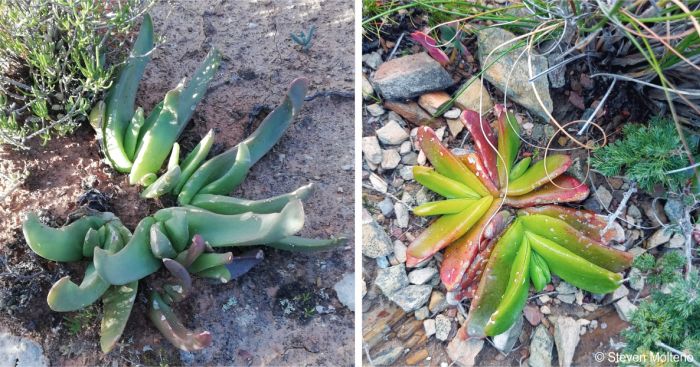
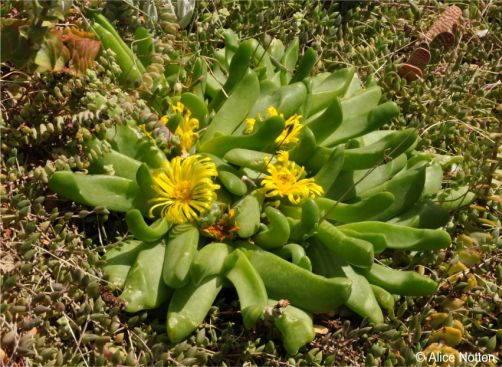
Glottiphyllum depressum is an evergreen, low growing, compact succulent shrublet, that reaches a mature height of about 100 mm. They can form clusters that can reach a diameter of 300 to 450 mm. The root system is fibrous which is fundamental for plant growth. Glottiphyllum depressum has shallow roots that can penetrate the soil as deep as 150 to 300 mm. The shallow roots allow the plant to take up water effectively. The tongue-leaved mesemb is stemless or nearly stemless, and has a flat growth form often lying flat on the ground. The plant has very short internodes and a relatively slow growth rate. Its lifespan can be 5 to 10 years, depending if the growth conditions are favourable and a plant can reach adult stage in approximately 2 to 3 years.
The fleshy green tongue-like leaves are smooth, soft and can easily break when touched. Leaf edges are rounded and smooth. Leaves grow downwards from the middle of the branches and end with hooked leaf-tips, curving towards the ground. Three or four pairs of leaves are attached to a branch and are unequal in shape and size, and grow on opposite sides of the stem. The hooked leaf tips are a result of the leaf tip pressing into the young leaves when they emerge, resulting in the plant having hooked leaf tips.
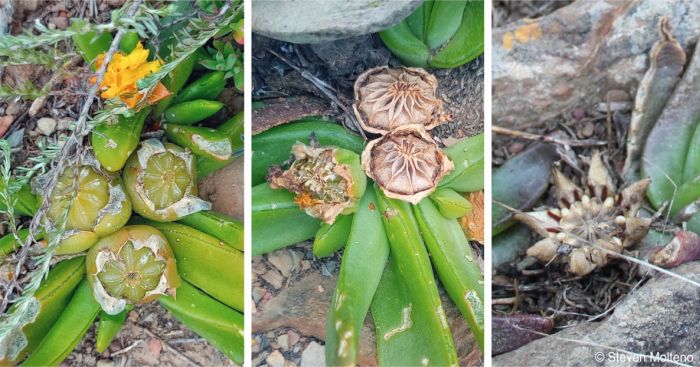
Large, bright yellow, daisy-like flowers, 50 mm across, with four sepals, are displayed from autumn to spring. Glottiphyllum depressum flowers are sessile (lack a flower stalk) which keeps the flowers and fruit closely attached to the plant. A full bloom of bright yellow flowers can be seen in September. The seed capsules are rounded, with a soft texture and have a soft base. The capsules fall off the mother plant very quickly by themselves. The fallen capsule rolls when it falls causing the seed to be dispersed, resulting in the name tumble fruit.
Glottiphyllum depressum is sometimes mistaken for Glottiphyllum longum. The difference between the two species, is that the fruit of Glottiphyllum longum is carried on stalks and stays on the plant for an extended period, while the fruit of Glottiphyllum depressum has a very short stalk, with the fruit deeply pushed into the leaves.
Conservation Status
Status
Glottiphyllum depressum is widespread and not faced with any threats or destruction. It is assessed as Least Concern (LC) in the Red List of South African Plants.
Distribution and habitat
Distribution description
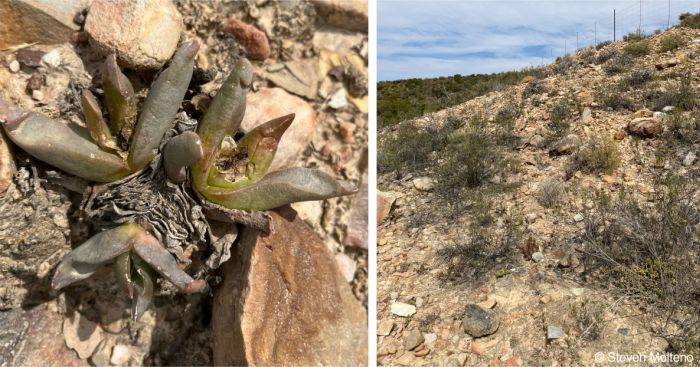
The tongue-leaved mesemb is a common species, indigenous to South Africa in the Western Cape and Eastern Cape provinces. Distribution spreads from Ceres through the Western Karoo and the Little Karoo to Uniondale. It can be found growing between rocks, underneath plants and in different soil types, especially loamy soil, sandstone, shale and quartz. Glottiphyllum depressum does not handle cold temperature too well. Water requirements are also low. Temperature of 5°C and below, will cause frost damage and eventually death, therefore, in cold climates it is advisable to move the plant indoors when it is growing outside to prevent damage.
Derivation of name and historical aspects
History
The genus name Glottiphyllum comes from the Ancient Greek words glotta meaning ‘tongue’ and phyllon meaning ‘leaf’, referring to its tongue-like leaf. The specific epithet depressum comes from Latin and refers to the plant’s flat and pressed down growth habit. Glottiphyllum depressum was first discovered in 1803 by the botanist Adrian Hardy Haworth who named it Mesembryanthemum depressum. In 1921 it was moved to Glottiphyllum by Nicholas Edward Brown and is now called Glottiphyllum depressum.
The genus Glottiphyllum consisted of 59 species, but was revised in 1993 by Hartmann and Gölling and reduced to 16 species. Ten of the 16 species can be located in the Klein Karoo. This species is native to South Africa and belongs to the family Aizoaceae which is South Africa’s largest succulent family. Plants in the Aizoaceae are also named vygies and 1 800 species can be found in South Africa. Mesembryanthemum is one of the popular genera of the Aizoaceae and some are even used for traditional medicine.
Ecology
Ecology
The flowers of Glottiphyllum depressum and many species belonging to the Aizoaceae, are completely opened at 11:00 am. From this time of the day, the plant and flowers receive enough sunlight and warmth to attract pollinators. Pollinators include butterflies, flies and other insects, but bees are the primary daytime pollinating agents of this species. Some vygies open at night and are pollinated by moths. The flowers of Glottiphyllum depressum draw the pollinating agents to the plant, which then serve as food for birds and other animals. The leaves of this plant are also eaten by various insects, and tortoises, hence its Afrikaans name skilpadkos (tortoise-food).
The seeds of the tongue-leaf plant are dispersed through wind and rain. Glottiphyllum depressum has hygrochastic seed capsules that only open when they come in contact with moisture or raindrops. The moisture causes the capsule to expand and it opens, exposing the seeds inside which get splashed out by the rain drops, resulting in seed falling into cracks and openings around the mother plant. When a seed capsule breaks off and detaches from the mother plant, it is blown away by the wind. Wherever it lands, with the next rainfall, seeds will be dispersed at this new location where it will establish itself.
The tongue-leaf plant is well adapted to semi-arid and arid environments. The annual rainfall in the area where Glottiphyllum depressum grows is less than 400 mm. Glottiphyllum depressum can survive in harsh, drought conditions and high temperatures. The thick succulent leaves are a water reservoir allowing the plant to store water which is one mechanism for survival. The root system of Glottiphyllum depressum is not anchored deep into the ground, but is close to the surface, which allows the roots to absorb water from light rainfall or heavy dew events, giving them enough water from the soil to survive very dry environmental conditions. This species is spread over a large geographical area so it shows quite a lot of variation, with different variants especially in shrubby vegetation.
Uses
Use
Glottiphyllum depressum is cultivated mainly for its ornamental properties in nurseries, private gardens, public gardens and container plantings. It provides colour and textural interest to a landscape design. The tongue-leaf is low-maintenance and can be used in different garden designs such as a waterwise garden, container gardening, and rock gardens. Glottiphyllum depressum can also be grown indoors in planters and pots.
Growing Glottiphyllum depressum
Grow
The tongue-leaf plant is one of the easiest slow-growing succulent plants to cultivate and grow. Propagation can take place by means of seed and cuttings. It grows best in full sun, semi-shade or light shade and in temperatures ranging from 15°C to 35°C. A loam based, well-drained, composted soil mix is a good soil medium and will provide optimal results. Moderate water is needed from the middle of summer until end of winter. Plants need minimal water during spring and summer but water can be given when leaves start to shrivel.
The best method to produce Glottiphyllum depressum plants is from stem cuttings and seed sowing.
Seeds germinate very easily and can be sown in spring or early summer, from September to November or throughout the year in warm climates. Avoid seed sowing when the weather is extremely hot. Seed can be sown in a soil medium consisting of a sandy loam and placed where the temperature ranges between 20-25°C. Sow seed in a flat seed tray with adequate drainage holes at the bottom. Keep the sowing medium slightly damp, to prevent rot from overwatering. During periods of hot temperatures, inspect your seed once in the morning when temperatures are still cool and do not water when the soil is still damp. Do not sow the seed too deep under the soil medium as it will create difficulty for the seed too germinate. The ideal sowing depth is 2 mm.
Germination can take place with or without bottom heat. The use of bottom heat will allow seed to easily germinate as it provides an ideal humid environment. Seed germination can take place from 1 to 8 weeks. Seedlings can be pricked out when they are 3-5 cm high and planted in a succulent or cacti mix with good drainage. Seedlings need to be gradually hardened off before placing them in their permanent location. Place them under full sun or light shade and water moderately.
Glottiphyllum depressum can also be propagated by means of stem cuttings taken at the end of summer. Take cuttings from the stem of the plant and allow it to dry and form a callus before striking it in a well-drained soil mixture or coarse river sand. Root development takes place very easily and therefore no rooting hormone is needed. Place the cuttings in an area with a temperature ranging from 15-20°C. Water the soil every third day to prevent the soil from becoming waterlogged. Cuttings will develop roots within two to three weeks. Once transplanted, place it in a hardening off area with a temperature range of 15-21°C. For optimal growth, place young plants in full sun or light shade. Water moderately during the growing season.
The tongue-leaf can go for long periods without water, even when it is exposed to very dry temperatures. No fertilizer is needed when growing Glottiphyllum depressum, as the plant is adapted to grow in dry hot weather and still grow to its full potential. Glottiphyllum depressum forms a mat in the growth location and can therefore be planted in an area to stabilize the soil and prevent soil erosion.
References
- Brown, J.R., White, A., Boyd, L.S. & Reynolds, G.W. 1939. Succulents for the amateur. Abbey Garden Press, Pasadena.
- Burgoyne, P.M. & Bredenkamp, C.L. 2019. Aizoaceae: Glottiphyllum N.E.Br. In: CL Bredenkamp (ed.), A Flora of the Eastern Cape Province. Strelitzia 41(1): 229-230. South African National Biodiversity Institute, Pretoria.
- Court, D. 2010. Succulent flora of southern Africa: Revised Edition. Random House Struik, Cape Town.
- Jackson, W.P.U. 1990. Origins and meanings of names of South African plant genera. University of Cape Town Printing Department, Cape Town.
- Kumbula Indigenous Garden. A database of Indigenous South African Flora. Glottiphyllum depressum. https://kumbulanursery.co.za/plants/glottiphylum-depressum. Accessed 13/07/2026.
- LLifle.The Encyclopedia of Succulents. Glottiphyllum depressum. https://www.llifle.com/Encyclopedia/SUCCULENTS/Family/Aizoaceae/22725/Glottiphyllum_depressum. Accessed 10/06/2026.
- Molteno, S. 2026. Observatins of Glottiphyllum depressum. iNaturalist. Online. https://www.inaturalist.org/observations?taxon_id=524318&user_id=steven_molteno
- Oliver, I. 2010. Glottiphyllum regium N.E.Br. (Aizoaceae). PlantZAfrica. Online. https://pza.sanbi.org/glottiphyllum-regium.
- Raimondo, D., Von Staden, L., Foden, W., Victor, J.E., Helme, N.A., Turner, R.C., Kamundi, D.A. & Manyama, P.A. (eds) 2009. Red list of South African plants. Strelitzia 25. South African National Biodiversity Institute, Pretoria.
- Smith, G.F., Crouch, N.R. & Figueiredo, E. 2017. Field guide to succulents in southern Africa. Struik Nature, Cape Town.
- The Plant Library. Glottiphyllum depressum. https://www.theplantlibrary.co.za/plants/glottiphyllum-depressum. Accessed 13/06/2026.
- Van Jaarsveld, E., Van Wyk, B-E. & Smith, G. 2005. Succulents of South Africa: a guide to the regional diversity. Tafelberg Publishers, Cape Town.
- Vlok, J. & Schutte-Vlok, A-L. 2015. Plants of the Klein Karoo. Umdaus Press, Hatfield.
Credits
Maria Van Der Westhuizen
Karoo Desert National Botanical Garden
August 2026
Acknowledgements: the author thanks Steven Molteno for allowing the use of his images of Glottiphyllum depressum in habitat to illustrate this article.
Plant Attributes:
Plant Type: Succulent
SA Distribution: Eastern Cape, Western Cape
Soil type: Sandy, Loam
Flowering season: Spring, Autumn, Winter
PH: Acid, Neutral
Flower colour: Yellow
Aspect: Full Sun, Morning Sun (Semi Shade), Afternoon Sun (Semi Shade)
Gardening skill: Easy
Special Features:
 Attracts butterflies
 Drought resistant
 Good potplant
 Indoor plant
 Feeds honeybees
Horticultural zones



Rate this article
Article well written and informative
Rate this plant
Is this an interesting plant?
Login to add your Comment
Back to topNot registered yet? Click here to register.