


Gnidia oppositifolia
Introduction
A willowy fynbos shrub with pale yellow tubular flowers almost all year round. It is known to be one of the plants that recovers fast or resprouts after disturbances such as fire.
Description
Description
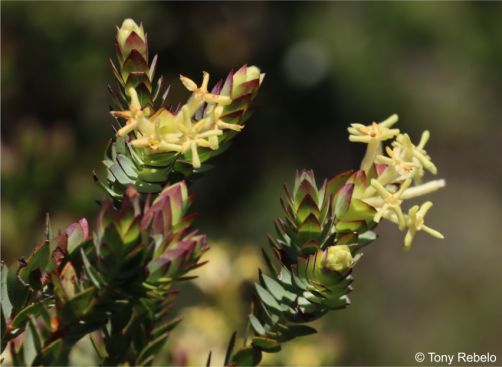
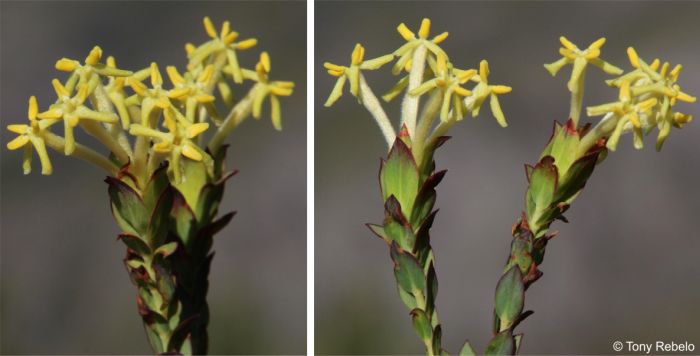
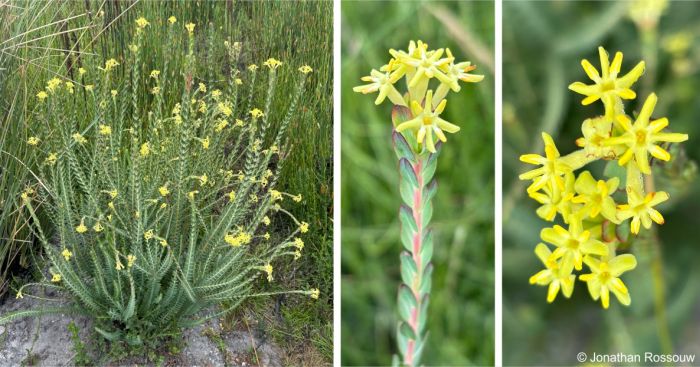
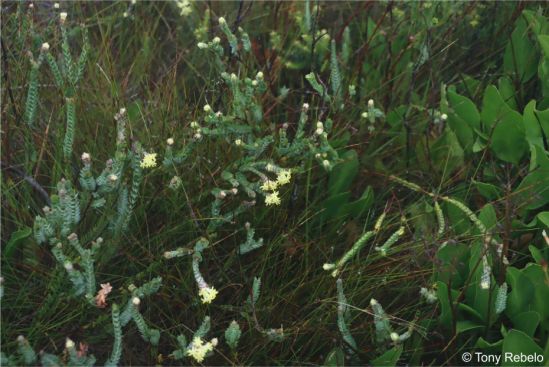
This is an evergreen shrub with many slender branches, that grows up to 3 m in height but may reach the size of a small tree in some environmental conditions. It is fast-growing, long-lived and has the ability to sprout again after damage caused by fire or harsh conditions. The stem of this plant is woody and greyish-brown. The leaves are elliptic to lance-shaped with a pointed tip, and are arranged along the stems, overlapping each other, in opposite pairs. They are bright green, sometimes with reddish purple edges. The inflorescence is a cluster of 4 to 6 bright yellow to pale yellow tubular flowers at the tips of the branches, produced for most of the year, especially from autumn to late winter. The flowers are made up of a long, narrow, silky hairy, ribbed tube with 4 lobes and 4 fleshy petaloid scales, that make a star-like structure at the mouth of the tube.
Conservation Status
Status
According to the Red List of South African Plants, Gnidia oppositifolia is assessed as Least Concern (LC) which means it is widespread and no major threats have been identified.
Distribution and habitat
Distribution description
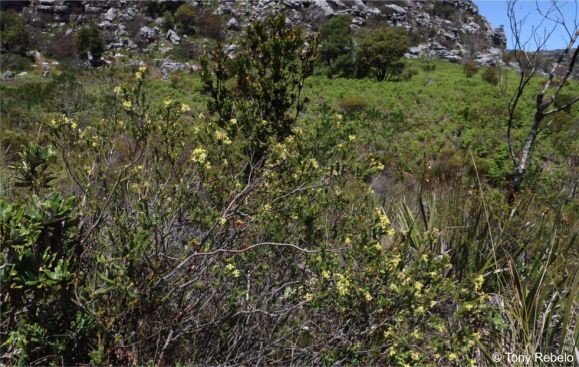
Gnidia oppositifolia is one of the endemic plants of South Africa and occurs from Clanwilliam in the Western Cape to the southern parts of the Eastern Cape. It grows in fynbos, renosterveld and adjacent thicket vegetation, usually on sandstone or granite mountain slopes and along streams or in wet places, from near sea level going up to approximately 1 800 m.
Derivation of name and historical aspects
History
The specific epithet oppositifolia is derived from the Latin oppositus which means ‘opposite’ and folium meaning ‘leaves’ and refers to the arrangement of the leaves, which is opposite.
The taxonomic history of Gnidia oppositifolia is complex, reflecting the historical development of taxonomy of plants in southern Africa. In 1753, the species was described for the first time by Carl Linnaeus, who placed it into the genus Gnidia based on its morphology: opposite leaves and tubular flowers, which served as key taxonomic features. From the middle of the eighteenth untill the beginning of the nineteenth century, Gnidia oppositifolia continued to belong to the genus Gnidia, although during that period, several synonyms were described based on morphological variation observed among different populations of this species. In the twentieth century, after advancements in comparative morphology, discussions regarding the circumscription of Gnidia became more common, with some botanists arguing that several Gnidia species, should be classified as Lasiosiphon due to their close relationship. Finally, in the late twentieth and early twenty-first centuries, when phylogenetic analyses based on molecular data proved Gnidia to be polyphyletic (containing unconnected lineages), those discussions gained even more momentum. The last revision by Olaniyan et al. in 2024, based on molecular and morphological data yielded compelling arguments for moving tropical African Gnidia taxa into Lasiosiphon, which marks an important step in the taxonomy of these genera. The new classification marks the end of more than two centuries of research in botany and reflects the transition from traditional morphology-based classification to modern genetics-based classification.
Ecology
Ecology
The pollination biology for Gnidia oppositifolia has not been studied, but pollination is most likely effected by night-flying insects such as moths that are attracted by the pale yellow night-scented tubular flowers. The plants provide habitat and forage for a variety of small wildlife, improving biodiversity. G. oppositifolia is adapted to survive fire by resprouting, which is one of the strategies employed by fynbos plants.
Uses
Use
Gnidia oppositifolia, and other similar species are known as basbos or gonnabas in Afrikaans, an old name referring to the use of their bark (bas in Afrikaans) to make twine and rope. The bark is stripped off and twisted or plaited together to make serviceable twine. The flowers are also used to make a yellow dye. Although G. oppositifolia is not known to have any medicinal uses, some species of Gnidia and Lasiosiphon are utilised in traditional medicine, although most of them contain toxic compounds and must be used carefully.
Growing Gnidia oppositifolia
Grow
Gnidia oppositifolia is a fast-growing shrub that is naturally found in the Fynbos Biome of South Africa, with a climate characterised by hot dry summers and cool wet winters where frost is absent or rare. This species is best suited to this region, but, if such an environment can be artificially created the plant will grow with ease. It is adapted to a temperate to subtropical climate and sunny, windy and often dry weather conditions and cannot tolerate shaded areas and frost. It prefers to grow in a well-drained, sandy or loamy, acidic to neutral soil and is best left undisturbed when planted. It is best suited for low-maintenance fynbos gardens and natural landscapes. It requires moderate watering, particularly during autumn, winter and spring, whereby watering should be done when the soil is dry. The plant naturally grows in a region that experiences summer drought and therefore can withstand periods of drought and is thus perfect for water-wise gardens in winter-rainfall climates.
Two methods are used in propagation of the plant, namely through seeds and semi-hardwood cuttings. Seeds can be sown in autumn, to co-incide with the winter rains. Cuttings are taken in spring, treated with rooting hormone and placed in a propagation unit with bottom heating and intermittent mist to enhance root formation. Light pruning of young plants can be done to increase branching. Older plants that become lanky can be cut back and the plant should resprout with fresh growth. Feed with well-rotted compost or moderate to small doses of organic fertilizer but avoid excessive use of fertilizers and manure as this can lead to the death of the plant.
References
- Beaumont, A.J. 2010. Systematic studies in Gnidia L. (Thymelaeaceae). PhD thesis, University of KwaZulu Natal, Pietermaritzburg.
- Fernkloof Nature Reserve. Gnidia oppositifolia. https://www.fernkloof.org.za/index.php/all-plants/plant-families/item/gnidia-oppositifolia. Accessed 16 April 2026.
- Goldblatt, P. & Manning, J. 2000. Cape Plants. A conspectus of the Cape flora of South Africa. Strelitzia 9. National Botanical Institute, Pretoria & Missouri Botanical Garden, Missouri.
- Jonathan Rossouw 2026-Feb. Observation of Gnidia oppositifolia , Silvermine Nature. iNaturalist. Online. https://www.inaturalist.org/observations/337434890. Reserve
- Manning, J. & Goldblatt, P. 2012. Plants of the Greater Cape Floristic Region 1: the Core Cape Flora. Strelitzia 29. South African National Biodiversity Institute, Pretoria.
- Olaniyan, O.D. et al. 2024. Molecular and morphological support for transferring the tropical African species of Gnidia to Lasiosiphon (Thymelaeaceae: Thymelaeoideae) and a worldwide synopsis of the species. Plant Systematics and Evolution 310(5).
- Peterson, B. 1978. Thymelaeaceae, in Polhill, R.M. (ed.) Flora of Tropical East Africa. A.A. Balkema, Rotterdam.
- Plants of the World Online. Gnidia oppositifolia L. https://powo.science.kew.org/taxon/urn:lsid:ipni.org:names:831836-1. Accessed 28 April 2026.
- Raimondo, D., Von Staden, L., Foden, W., Victor, J.E., Helme, N.A., Turner, R.C., Kamundi, D.A. & Manyama, P.A. (eds) 2009. Red list of South African plants. Strelitzia 25. South African National Biodiversity Institute, Pretoria.
- Rebelo, T. 2017-Mar. Observation of Gnidia oppositifolia, Boosmansbos Wilderness Area, WC. iNaturalist. Online. https://www.inaturalist.org/observations/11307165.
- Rebelo, T. 2024-Nov. Observation of Gnidia oppositifolia, Table Mountain, WC. iNaturalist. Online. https://www.inaturalist.org/observations/289905022.
- Rebelo, T. 2026-Feb. Observation of Gnidia oppositifolia, Silvermine Nature Reserve, WC. iNaturalist. Online. https://www.inaturalist.org/observations/337358511.
- Smith, C.A. 1966. Common names of South African plants. Memoirs of the Botanical Survey of South Africa No. 35. Government Printer, Pretoria.
- Van Wyk, B.-E., Van Oudtshoorn, B. & Gericke, N. 2009. Medicinal plants of South Africa, edn 2. Briza Publications, Pretoria.
- Wall-Smith, D. 2026-Jan. Observation of Gnidia oppositifolia, Silvermine Nature Reserve, WC. iNaturalist. Online. https://www.inaturalist.org/observations/336078374.
Credits
Nandim Ncuka-Ncuka
Kirstenbosch National Botanical Garden
June 2026
Acknowledgements: images by Debbie Wall-Smith, Jonathan Rossouw and Tony Rebelo.
Plant Attributes:
Plant Type: Shrub
SA Distribution: Western Cape
Soil type: Sandy, Loam
Flowering season: Autumn, Winter, Sporadic/All year
PH: Acid
Flower colour: Yellow
Aspect: Full Sun
Gardening skill: Average
Special Features:
 Fragrant
 Useful plant
Horticultural zones



Rate this article
Article well written and informative
Rate this plant
Is this an interesting plant?
Login to add your Comment
Back to topNot registered yet? Click here to register.