


Helichrysum kraussii
Introduction
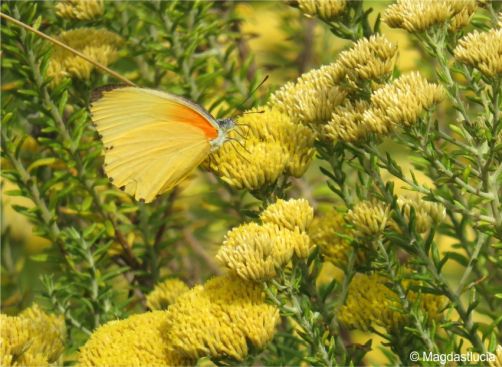
Helichrysum kraussi is a bushy, aromatic shrublet with a clustered inflorescence of lemon lime flowers that are borne from autumn through winter to spring.
Description
Description
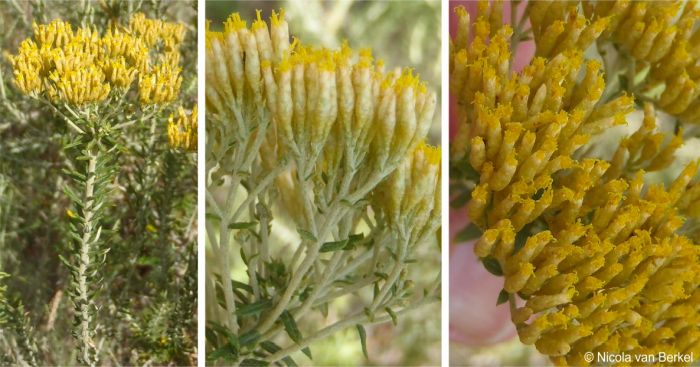
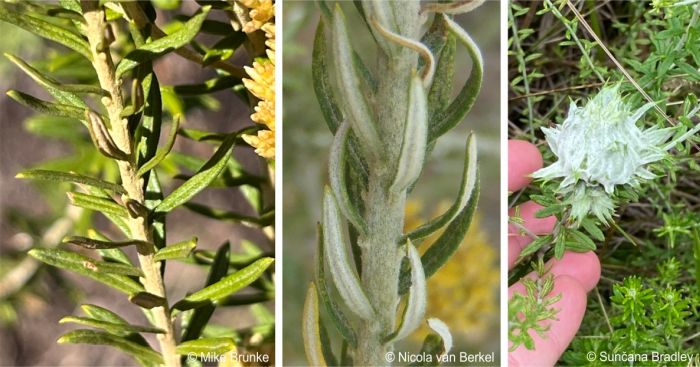
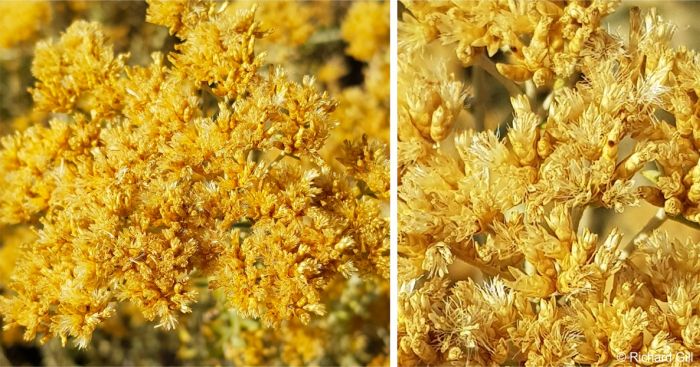
Helichrysum kraussii is an evergreen, fast growing shrublet of about 1 m tall. The stem is covered with greyish glandular hairs which disappear with age. Branches are stiff and closely leafy. The leaves are linear with a pointed tip, sessile, the upper surface cobwebby and hairless with age, the lower surface covered with white-felted hairs, margins usually curl downwards (revolute). The inflorescence is a dense cluster of numerous branched cymes, carrying the small lemon-yellow or straw-coloured flowerheads (capitula), from autumn through to spring.
Helichrysum kraussii is often confused with H. cymosum, but the two can be distinguished by their very different leaves and H. kraussi often has fluffy white galls at the tip of a branch.
Conservation Status
Status
Helichrysum kraussii is assessed as Least Concern (LC) according to the Red List of South African Plants, the population of this plant is considered stable in the wild and there are no known risks that are identified as threats.
Distribution and habitat
Distribution description
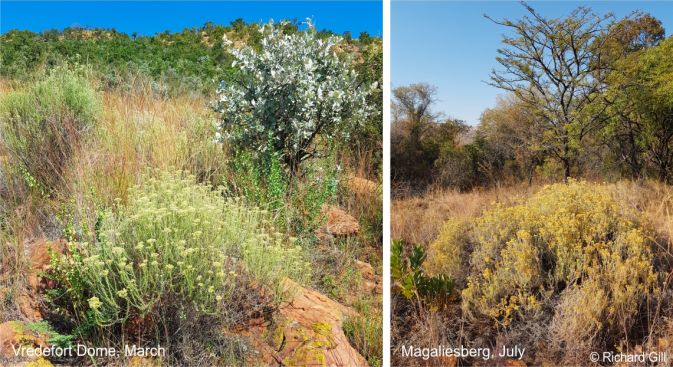
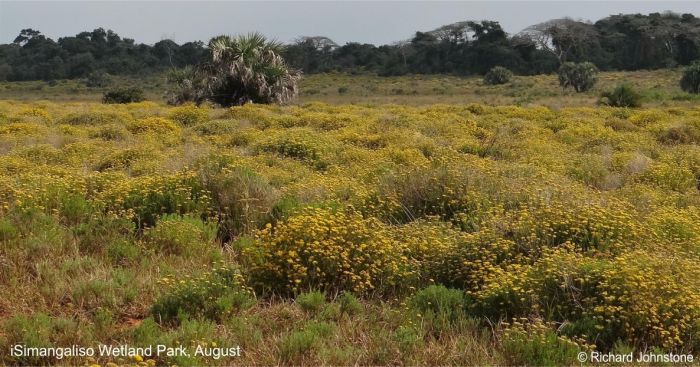
Helichrysum kraussii has a wide distribution in southern Africa, occurring in southern Angola, Zambia, Zimbabwe, Mozambique, South Africa and Eswatini. Within South Africa, it grows naturally in Limpopo, Mpumalanga, Free State, Gauteng, North West and KwaZulu-Natal provinces. Helichrysum kraussii predominantly grows in grassland, open woodland and bushveld, withstands harsh hot and dry environments, and periods of drought, and occurs in rocky mountainous areas, with little soil.
Derivation of name and historical aspects
History
The genus name Helichrysum, is derived from the Greek words helios, meaning ‘sun’ and chrysos, meaning ‘gold’, referring to the usually bright yellow flowers of plants in this genus. This species is named after Christian Krauss (1812-1890), the German scientist, who was known for travelling and collecting in South Africa.
The genus Helichrysum belongs in one of the largest and best known families, Asteraceae, the daisy family, that contains about 1 530 genera worldwide and 22 800 species. About 240 species of Helichrysum are indigenous to South Africa. The most similar species to Helichrysum kraussii is H. cymosum, the two species can be distinguished by their leaves. Most species of Helichrysum are used as traditional medicine in South Africa.
Ecology
Ecology
The narrow leaf shape and recurved margin of Helichrysum kraussii is an adaptation to prevent water loss, allowing the plants to thrive in conditions with little water. The flowers attract bees and other insects, which assist in pollinating them. The seeds are light in weight, with a pappus of many bristles, and are easily dispersed by wind. This species acts as a good binder of the soil on both gentle and steep slopes and prevents erosion.
Uses
Use
Almost all parts of Helichrysum kraussii are used as traditional medicines in the southern African region. A review found that the leaves, flowers, roots, branches, seeds and the whole plant, are used both during ritual practices and in traditional medicine to treat many different human ailments, including nasal congestion, chest pain, cough, fever, headache, respiratory infections and skin infections. Phytochemical compounds isolated from this species show antioxidant, antibacterial, antifungal, antiviral, cytotoxic and anti-inflammatory activities.
Growing Helichrysum kraussii
Grow
Helichrysum kraussii can be propagated from stem cuttings or seeds. During the active growing season, cuttings can be harvested from the mother plant, and planted in a fast draining medium of 1 part compost or sand and 1 part perlite. A rooting hormone suitable for semi-hardwood cuttings can be used to enhance root development. Addition of fertilisers can be used to enhance growth. Monitor the cuttings on a regular basis to ensure enough water is received, avoid over watering as the cuttings can be affected by fungus, keep the environment warm and do not expose cuttings to direct sun.
The author has not sown the seeds before, however related species are sown in autumn or spring in well-drained sandy or loamy soil with acid to neutral pH balance and transplanting must be done when seedlings are big enough to withstand handling, and transplanting to a different environment.
References
- Arnold, T.H. & de Wet, B.C. 1993. Plants of southern Africa: names and distribution. Memoirs of the Botanical Survey of South Africa No. 62.
- Bradley, S. 2025-Apr. Observation of Helichrysum kraussii, Amatikulu Nature Reserve, KZN. iNaturalist. Online. https://www.inaturalist.org/observations/276476568.
- Brunke, M. 2024-Jul. Observation of Helichrysum kraussii, Blyde River Canyon NR, MP. iNaturalist. Online. https://www.inaturalist.org/observations/232491139.
- Eliovson, S. 1984. Wild flowers of southern Africa: how to grow and identify them. 7th Edition. Macmillan.
- Gill, R. 2019-Jul. Observation of Helichrysum kraussii, Magaliesberg, NW. iNaturalist. Online. https://www.inaturalist.org/observations/32200182.
- Gill, R. 2021-Mar. Observation of Helichrysum kraussii, Vredefort Dome, NW. iNaturalist. Online. https://www.inaturalist.org/observations/71375227.
- Hayloft. 2023. How to grow Helichrysum. https://hayloft.co.uk/ how-to-grow-helichrysum. Accessed 24 March 2023.
- Herman, P.P.J., Retief, E. & Meyer, N.L. 2017. Asteraceae. In: E Retief & NL Meyer (eds), Plants of the Free State: inventory and identification guide, Strelitzia 38: 249-413. South African National Biodiversity Institute, Pretoria.
- Hilliard, O.M. 1983. Gnaphaliinae (first part): Facelis - Edmondia, Flora of Southern Africa 33(7),2: 1-317. Botanical Research Institute, Department Agriculture, Pretoria.
- Johnstone, R. 2018-Aug. Observation of Helichrysum kraussii, Isimangaliso Wetland Park, KZN. iNaturalist. Online. https://www.inaturalist.org/observations/175265531.
- Lourens, A.C.U., Viljoen, A.M. & van Heerden F.R. 2003. South African Helichrysum species: A review of the traditional uses, biological activity and phytochemistry. Journal of Ethnopharmacology 119: 630–652.
- magdastlucia, 2019-Jul. Observation of Helichrysum kraussii, iSimangaliso Wetland Park, KZN. iNaturalist. Online. https://www.inaturalist.org/observations/32706074.
- Maroyi, A. 2023. Helichrysum kraussii Sch.Bip.: Review on its medicinal uses, phytochemistry and pharmacological properties. Plant Science Today. https://doi.org/10.14719/pst.2402.
- Pooley, E. 1998. A field guide to wild flowers of Kwazulu-Natal and the eastern region. Natal Flora Publications Trust, Durban.
- Raimondo, D., Von Staden, L., Foden, W., Victor, J.E., Helme, N.A., Turner, R.C., Kamundi, D.A. & Manyama, P.A. (eds) 2009. Red list of South African plants. Strelitzia 25. South African National Biodiversity Institute, Pretoria.
- Van Berkel, N. 2015-Apr. Observation of Helichrysum kraussii, Magaliesberg Biosphere Reserve, NW. iNaturalist. Online. https://www.inaturalist.org/observations/11102582.
- Watt, J.M. & Breyer-Brandwijk, M.G. 1962. The medicinal and poisonous plants of southern and eastern Africa , edn 2. Livingstone, Edinburgh & London.
Credits
Mashudu Tshitereke
Walter Sisulu National Botanical Garden
September 2026
Acknowledgements: images by magdastlucia, Nicola van Berkel, Mike Brunke, Sunčana Bradley, Richard Johnstone and Richard Gill from their observations uploaded on iNaturalist.
Plant Attributes:
Plant Type: Shrub
SA Distribution: Free State, Gauteng, KwaZulu-Natal, Limpopo, Mpumalanga, North West
Soil type: Sandy, Loam
Flowering season: Spring, Early Summer, Autumn, Winter
PH: Acid, Neutral
Flower colour: Yellow
Aspect: Full Sun
Gardening skill: Easy
Special Features:
 Attracts butterflies
 Drought resistant
 Fragrant
 Medical plant
 Feeds honeybees
 Pioneer plant
Horticultural zones




Rate this article
Article well written and informative
Rate this plant
Is this an interesting plant?
Login to add your Comment
Back to topNot registered yet? Click here to register.