


Ledebouria altopaludosa
Introduction
Compact dwarf bulbous plant with broad rounded leaves and pale lilac flowers, found in high altitude wetlands on the edges of peat mires. Easy to grow from seeds, best in cool climates.
Description
Description
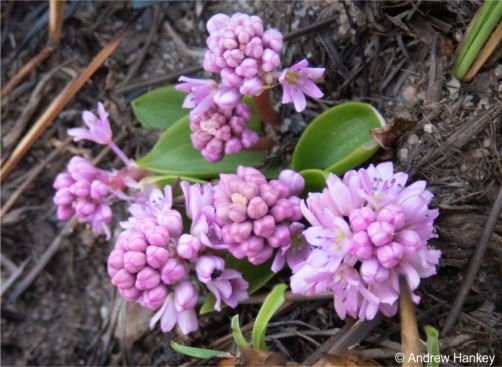
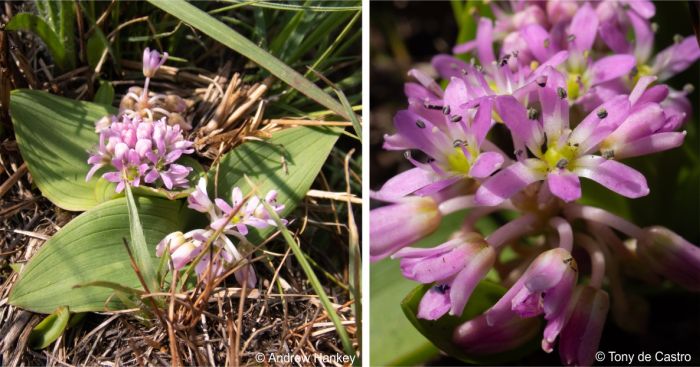
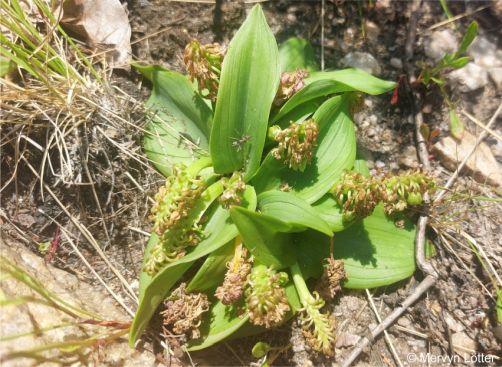
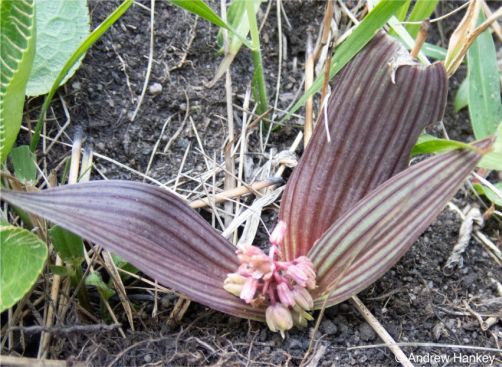
Dwarf bulbous plant, mostly solitary plants occurring in large numbers. Each bulb produces 1-5 broad rounded leaves which are loosely appressed to the soil surface. Leaves have obscure linear grooves on the upper surface, which are sometimes red or occasionally the entire leaf is suffused with red, creating a red-green appearance. The flowers are small, lilac scented, with yellow to whitish centres and are produced in compact inflorescences that are usually shorter than the leaves and held amongst the leaves like a small pompon. The inflorescences are produced in early spring and summer.The flowers once pollinated give way to small green seed capsules which develop quickly, the green capsules shrivel to reveal the brownish shiny and wrinkled seeds, which drop to the ground around the mother plant.
Conservation Status
Status
Ledebouria altopaludosa has not been formerly assessed for the Red List of South African Plants, however Hankey & De Castro (2024) proposed that it may qualify as Rare in accordance with the South African conservation status categories used by Raimondo et al. (2009).
Distribution and habitat
Distribution description
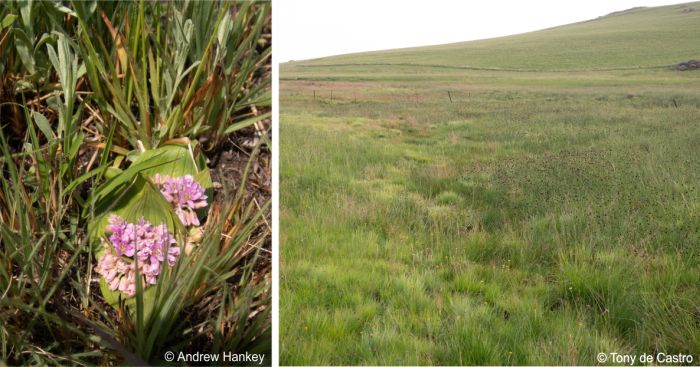
This species is recorded from numerous sites across the Steenkampsberg in the Mpumalanga province of South Africa, where it is regarded as a narrow endemic. Ledebouria altopaludosa is only found in valley bottom wetlands and seepage settings in montane grassland where it is restricted to the edges of peat mires and peaty soils that are saturated even during the dry winter season. Despite the perennial soil wetness the plants are completely deciduous in winter when the temperatures can reach freezing or slightly below and frost may be frequent. These grasslands are also prone to regular veld fires.
Derivation of name and historical aspects
History
The species was named by the author in 2024, although it has been known for many years but was never allocated a name. The species name altopaludosa is derived from the Latin alto, meaning high, and paludosa, meaning swampy or marshy, in reference to the high altitude wetlands that this species is restricted to. The genus Ledebouria is named after a German-Estonian botanist, Professor Carl Friedrich von Ledebour (1785–1851).
The centre of diversity for the genus is over the eastern parts of South Africa, most notably in the Mpumalanga province. However the genus occurs from the Cape of South Africa across southern Africa stretching mostly up the eastern side of the continent into India, with one species each on the islands of Socotra and Madagascar.
Ecology
Ecology
Hankey & De Castro (2024) suggested that current knowledge of this species indicates that it is restricted in its range by altitude and specific habitat type. The species appears to be restricted to wetlands at altitudes between 2 020 m.a.s.l. to 2 258 m.a.s.l., which is close to the highest altitude in the province.
The species is open pollinated, meaning it is pollinated by many visiting insects. The tiny dark brown and wrinkled seeds are produced quickly after the flowers and are released around the base of the mother plant. Venter (1993) conducted research on other Ledebouria species suggesting that the seeds are spread by water wash.
Uses
Use
There are no known or recorded uses of this species.
Growing Ledebouria altopaludosa
Grow
This species is easily maintained in cultivation, it prefers a cool climate and can be planted in a loamy soil mixture with the addition of sifted well-rotted leaf litter or compost and kept in full sun. Watering should be done in summer and can be generous as they thrive in wet soils. In winter watering can be reduced until the soil remains just damp. Plants respond well to feeding with organic and inorganic fertilizers.
Propagation is best achieved through seed. Sow the seed as soon as it is produced and still fresh, in a sifted mixture of loam or peat based seedling mix with fine sand and finely sifted compost mixed in equal parts. The addition of organic fertilizer can be beneficial, or it can be added after germination once the seedlings have established their first leaf. A general fungicide should be applied to prevent damping off. The seedlings can be transplanted once they are large enough to handle or left until the second growth season.
Plants are susceptible to slugs and snails in cultivation, counter measures can be applied if these pests are noticed to be causing damage to the plants. Mealy bug can be a problem in the crown of, or under the leaves, or on the roots, especially if air circulation is poor or plants are kept in confined spaced such as greenhouses or indoors.
References
- Dictionary of botanical epithets. http://www.winternet.com/~chuckg/dictionary.html
- Hankey, A.J. & De Castro, A. 2024. Four new species of Ledebouria Roth. (Hyacinthaceae) from the high altitude grasslands of the Steenkampsberg, South Africa. Haseltonia 31(1):103–126.
- Jessop, J.P. 1970. Studies in the bulbous Liliaceae in South Africa: 1. Scilla, Schizocarpus and Ledebouria. Journal of South African Botany 36(4): 233–266.
- Raimondo, D., Von Staden, L., Foden, W., Victor, J.E., Helme, N.A., Turner, R.C., Kamundi, D.A. & Manyama, P.A. (eds) 2009. Red list of South African plants. Strelitzia 25. South African National Biodiversity Institute, Pretoria.
- Venter, S. 1993. A revision of the genus Ledebouria Roth (Hyacinthaceae) in South Africa. Unpublished M.Sc. thesis, University of Natal, Pietermaritzburg.
- Venter, S. 2008. Synopsis of the genus Ledebouria Roth (Hyacinthaceae) in South Africa. Herbertia 62
Credits
Andrew Hankey
Walter Sisulu National Botanical Garden
January 2026
Acknowledgements: the author thanks Dr Mervyn Lӧtter and Tony de Castro for providing images.
Plant Attributes:
Plant Type: Bulb
SA Distribution: Mpumalanga
Soil type: Loam
Flowering season: Spring
PH: Acid
Flower colour: Mauve/Lilac
Aspect: Full Sun
Gardening skill: Easy
Special Features:
 Good potplant
Horticultural zones




Rate this article
Article well written and informative
Rate this plant
Is this an interesting plant?
Login to add your Comment
Back to topNot registered yet? Click here to register.