


Dombeya autumnalis
Introduction
This small tree is notable for its masses of white blossoms appearing in the autumn months, which in the southern Hemisphere is March to June. It is not very well known, since it originates from a very small area of northern South Africa.
Description
Description
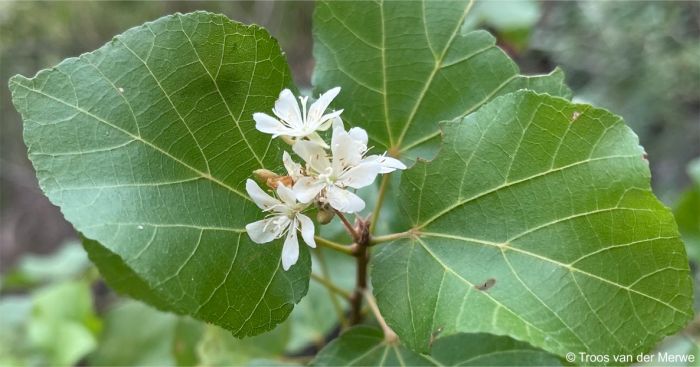
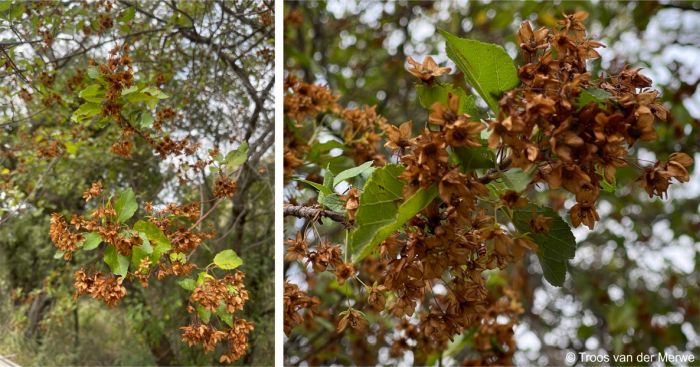
A small, shrubby tree growing up to 5 m tall, with roundish leaves which have 3 to 5 main veins leading from the base. The blades have scalloped edges, and tend not to taper where they join the leaf stem. The delicate, creamy white heads of sweet-scented little flowers appear in a burst of blossom in late summer to autumn (March to June). Like other dombeyas, the blooms retain their shape, but change colour to reddish brown and remain on the plant, while the seed capsules form in the centre. The dry petals help to disperse the seed later on when they act as wings to float the seed capsules away. It has a greyish bark with lenticels (small dark bumps which allow gases and moisture to leave the plant). These can be a useful feature for telling it apart from Dombeya rotundifolia, whose bark tends to be rough, dark and fissured and flowers in early spring.
Conservation Status
Status
Dombeya autumnalis is assessed as Least Concern (LC) according to the Red List of South African plants. It is possible that, due to its very restricted distribution area, over-collection for use as firewood could pose a threat in some areas. Additionally, it has disappeared from areas where the habitat has been transformed for cultivation or become extremely degraded. The Red List does indicate that the Potlake Nature Reserve near Tsibeng in Limpopo, is an area of conservation for the rock dombeya.
Distribution and habitat
Distribution description
The rock dombeya grows within the Savanna Biome and can be found in the river gorges of the Blyde and Olifants Rivers, the Abel Erasmus Pass and Sekhukhuneland area of Mpumalanga and northwards into Limpopo. It is regarded as endemic (meaning that it does not occur naturally anywhere else). As inferred by the common name, this little tree’s preferred habitat is rocky hillsides.
Derivation of name and historical aspects
History
The genus Dombeya consists of 196 accepted species, and is found naturally in most of tropical and southern Africa, as well as the Arabian Peninsula and Indian Ocean Islands. Of the 196 species, South Africa has 7 species of Dombeya listed.
The family, Malvaceae, features some well-known garden plants, such as hibiscus (Hibiscus L.) and marshmallow (Althaea L.). The iconic baobab trees (Adansonia L.) are also members of the family.
The name of this genus honours Joseph Dombey (1742–1794 or 6), a French botanist who worked in Peru and Chile. Dombey was in fact a medical physician, but travelled as a botanist to South America. It appears that, while he was a prolific and able botanist, his efforts were undermined by misfortune. He lost specimens and illustrations several times, once due to capture of the ship transporting them, by the British. His pressed plants were sent to the British Museum, where they are still to be found. At other times he suffered confiscation of his material by local or Spanish authorities, seemingly on various pretexts. Some of his work was given to other botanists for publication. On his eventual return to Europe, he was reportedly imprisoned in Cadiz, for fear that he might reveal the ‘theft’ and publication of his work by other botanists. He escaped back to France, where he was provided with an indemnity and a pension. His misfortune continued however, as he was captured by privateers on his way to the United States where he had been sent. He was held in Montserrat, an island in the Caribbean, where he died in prison.
The species name, autumnalis, indicates the flowering time of this particular species.
Ecology
Ecology
The shallow, basin-like shape formed by the petals, and open arrangement of the anthers (the pollen-bearing organs) suggest that they are likely pollinated by generalist insects such as bees (as opposed to specialist insects which have unique features especially adapted to particular flower structures).
The larvae of a striking brown and white moth, called the bagnest moth (Anaphe reticulata) is reported to feed on southern African dombeya trees, as well as some other genera. The caterpillars become noticeable when they hatch, since they stay together in tight groups. The stinging hairs with which they defend themselves, also function as a way for them to keep in contact, so that they can keep huddled up together. If they move to another tree, they travel in a single line – like railway carriages. This gives them their other descriptive name, processionary caterpillars. These long lines of caterpillars are kept together by the secretion of a special scent (pheromone) from the abdomen. The name bagnest describes the unusual way the caterpillars pupate – a mass of up to 600 in a giant bag-like cocoon of silk. These can apparently reach the size of a football. It should be noted that this moth species is not to be confused with non-African species abroad, showing similar behaviour, but which can cause damage to oak and pine trees.
Growing Dombeya autumnalis
Grow
Dombeya autumnalis is not commonly available to gardeners but would make a pretty garden subject with its lovely smooth grey stems. One could plant the common wild pear, Dombeya rotundifolia, as a herald of spring, and the autumn wild pear to announce winter! Like other Dombeya species it can be propagated from seed, sown in spring in deep seed trays of good, fine seedling mix, lightly covered and kept moist. The seedlings should be transplanted into small nursery bags once the true leaves have formed, and should be given protection from heat and sun until they are hardened off.
References
- Plants of the World online. Malvaceae Juss. https://powo.science.kew.org/taxon/urn:lsid:ipni.org:names:30000208-2. Accessed 20/05/2025.
- Plants of the World online. Dombeya Cav. https://powo.science.kew.org/taxon/urn:lsid:ipni.org:names:331567-2. Accessed 20/05/2025.
- Schmidt, E., Lötter, M. & McCleland, W. 2002. Trees and shrubs of Mpumalanga and Kruger National Park. Jacana, Johannesburg.
- Scholtz, C., Scholtz, J. & De Klerk, H. 2021. Pollinators, predators and parasites – the ecological role of insects in southern Africa. Struik Nature, Cape Town, South Africa.
- Tracks 4 Africa. Potlake Nature Reserve. https://tracks4africa.co.za/listings/item/w195053/potlake-nature-reserve/. Accessed 20/05/2025.
- Tree SA. Dombeya autumnalis. https://treesa.org/dombeya-autumnalis/. Accessed 19/05/2025.
- Van der Merwe, T. 2023. Observations of Dombeya autumnalis, Ba-Phalaborwa rural, Limpopo. iNaturalist. Online. https://www.inaturalist.org/observations/161889272 & https://www.inaturalist.org/observations/161928348.
- Victor, J.E. 2021. Dombeya autumnalis I.Verd. National Assessment: Red List of South African Plants version 2024.1. Online. https://redlist.sanbi.org/species.php?species=1847-1.
- Wikipedia. Joseph Dombey. https://en.wikipedia.org/wiki/Joseph_Dombey. Accessed 20/05/2025.
Credits
Alice Aubrey
Walter Sisulu National Botanical Garden
March 2026
Acknowledgements: images by Troos van der Merwe.
Plant Attributes:
Plant Type: Tree
SA Distribution: Limpopo, Mpumalanga
Soil type: Loam, Metal-rich
Flowering season: Late Summer, Autumn
PH: Alkaline
Flower colour: White, Cream
Aspect: Full Sun
Gardening skill: Average
Special Features:
 Fragrant
Horticultural zones


Rate this article
Article well written and informative
Rate this plant
Is this an interesting plant?
Login to add your Comment
Back to topNot registered yet? Click here to register.