


Adromischus cristatus var. schonlandii
Introduction
Adromischus cristatus var. schonlandii is a dwarf cliff-hugging succulent from the south-eastern parts of South Africa. The plants form rounded clusters, with club-shaped, greyish-green to brownish-green, slightly sticky leaves and white tubular flowers in summer and autumn. Easily propagated from leaf cuttings, and best grown in containers.
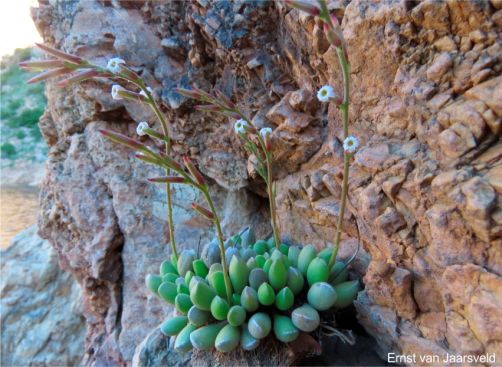
Fig. 1. Adromischus cristatus var. schonlandii in flower on the exposed north-facing cliff at the Kouga Dam, Eastern Cape.
Description
Description
The plants are small, much branched and compact, forming neat rounded cliff-hugging clusters 50-100 mm in diameter. The stems are covered in brownish coir-like aerial roots (not usually visible due to dense leaf arrangement). The stems are succulent, green, 5–10 mm in diameter. The petiole short, thin, terete and about 2-3 mm in diameter. The leaves are variable in size and shape, but always club-shaped (obtriangular to oblong oblanceolate) to rarely almost globose, 10–25 × 6–12 mm and somewhat terete. The leaf surface is greyish-green to brownish-green to purplish-green, covered in minute glandular hairs. The leaf tip is blunt and ending in a short horny margin to about 7 mm long blunt. The inflorescence is a spike-like, horizontally curved thyrse 100–150 mm high, bearing 6-8, 1-flowered cymes. The flowers with short pedicels 1 mm long. The buds are spreading, terete, tapering, purplish tipped. The calyx is 2–3 mm long. The individual flowers (corolla) 10–12 mm long with a purplish green tube, up to 2.5 mm in diameter when fully opened. The floral lobes are egg-shaped triangular (ovate-triangular), 3-4 mm long, white to pinkish, with minute club-shaped glandular hairs (trichomes) in its throat, ending in a sharp point (apices acute). The anthers included. The plants flower in summer and autumn (January–May).

Fig. 2. A cluster of Adromischus cristatus var. schonlandii showing the typical coir-like dense aerial roots on the stems of the plant, Kouga Dam, Eastern Cape.
Conservation Status
Status
Classified as Least Concern (LC) by the Red List of South African Plants, it is a rare habitat specialist but is not threatened because it is safeguarded by its difficult to reach habitat that falls within a greater conservation region.
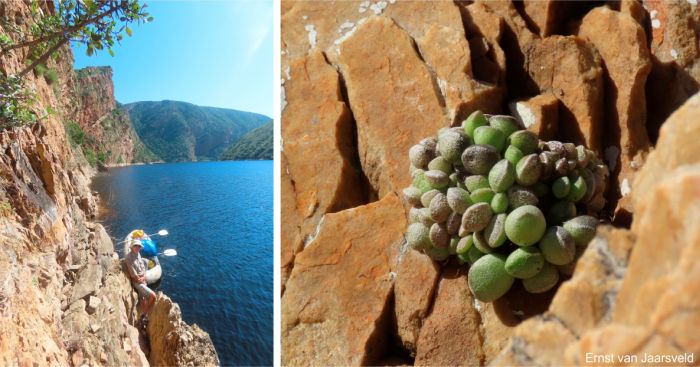
Fig. 3. Left The exposed, north-facing cliffs at the Kouga Dam, Eastern Cape, South Africa, habitat of Adromischus cristatus var. schonlandii,with Jan van der Poll waiting at the rubber canoe below. Right a close-up of a cluster growing in a sandstone crevice of a exposed north-facing ledge at Kouga Dam showing the tight, cliff-hugging habit, with the stems not exposed.
Distribution and habitat
Distribution description
Adromischus cristatus var. schonlandii is only known from sheer, mineral-poor, usually exposed, north-facing quarzitic sandstone cliffs of the Cape Supergroup, along the Baviaanskloof and Kouga River and eastwards to the Kouga Dam cliffs, tributaries of the Gamtoos River, in the Eastern Cape, South Africa. Plants have been recorded at altitudes up to 800 m above sea level. Although recorded from other aspects, most of the population has been observed on north-facing aspects. Temperatures vary and may reach 40°C in summer. The winters are cooler but frost is a rarity or absent. Average daily maximum temperature is 20–23°C and average daily minimum 10–14°C. Rainfall occurs mainly in summer, but in the southern parts in winter as well. The associated vegetation includes Groot Thicket.
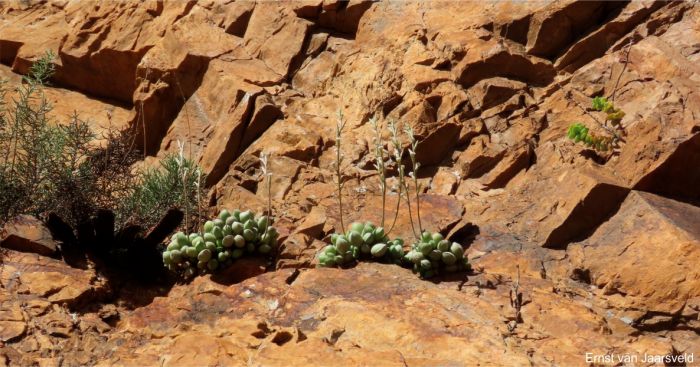
Fig. 4. A group of Adromischus cristatus var. schonlandii in flower on an exposed north-facing cliff ledge at Kouga Dam, sharing its habitat with Elytropappus rhinocerotis and Haworthiopsis viscosa.
At the Kouga Dam, plants are common on sheer north-facing cliffs in shallow crevices of the Table Mountain Group sandstone (Cape Supergroup) in association with Aloe pictifolia, Curio ficoides, Delosperma stenandrum, Cyrtanthus labiatus, Cotyledon tomentosa subsp. tomentosa, Adromischus sphenophyllus, Coleus subspicatus, Crassula perforata subsp. kougaensis, Crassula perfoliata var. minor, Ceropegia baylissii (= Tromotriche baylissii), Centella virgata and Haworthiopsis viscosa.
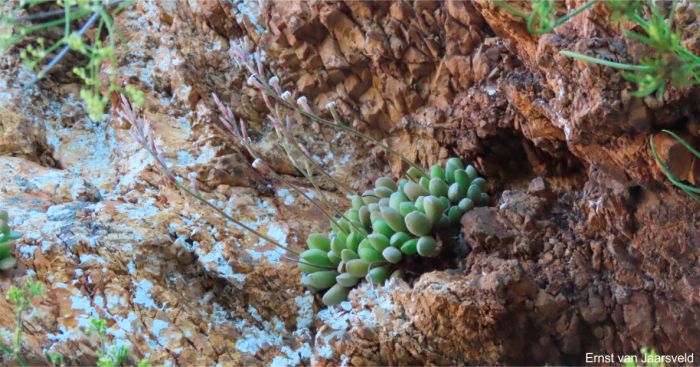
Fig. 5. Adromischus cristatus var. schonlandii in habitat on the sunny, exposed, mineral-poor quarzitic sandstone cliff, growing with lichens and the wortelgras (Centella virgata) sharing its cliff-face habitat.
Derivation of name and historical aspects
History
Adromischus cristatus var. schonlandii was named in 1929 by Edwin Phillips (1884-1967) in the Flowering Plants of Africa as Cotyledon schonlandii. At the time he was Curator of the National Herbarium in Pretoria and he worked from plants grown at Pretoria and of which the location was not known (ex hort). It was named after Selmar Schonland (1860-1940), a botanist from Germany who became the Curator of the Albany Museum in Grahamstown in 1889. Helmut Toelken, who revised the family Crassulaceae in southern Africa, transferred the species to the genus Adromischus, and was of the opinion that it would better fit within the Adromischus cristatus complex and reduced its species status to a variety. Adromischus cristatus var. schonlandii is at once distinguished from the other members by its club-shaped (almost terete and of which the widest point is not at the leaf tip), sticky leaves forming dense clusters, the stems covered in brownish coir-like aerial roots. Adromischus cristatus var. zeyheri also grows on cliffs in the same region at Kouga Dam, however it is always confined to shady cliffs and has broad flattened leaves without or sometimes with a few aerial roots. It can be confused with Adromischus cristatus var. clavifolius, however the leaf of the latter, has a broad flattened tip, the leaves are not sticky, and it is only known from between Alexandria and Grahamstown, growing on rocky outcrops. Adromischus cristatus var. mzimvubuensis is only known from the Mzimvubu River and the leaves have a leaf margin extending right around the leaf and to the stem.
Adromischus cristatus var. schonlandii is one of 5 Adromischus species that belong to section Longipedunculati. The latter was established by Carl von Poellnitz in 1940 to accommodate those species characterised by funnel-shaped, glaucous-green, slightly grooved floral tubes and with spear-shaped to triangular lobes. Within the throat of the tube can be found minute club-shaped trichomes. The colour of the lobes is usually white with darker mauve and rarely red lines. Other members of this section include Adromischus leucophyllus, A. subviridus, A. cooperi and A. marianiae. Of these only A. cristatus var. zeyheri, A. cristatus var. schonlandii, A. cristatus var. mzimvubuensis and A. leucophyllus are associated with cliffs.
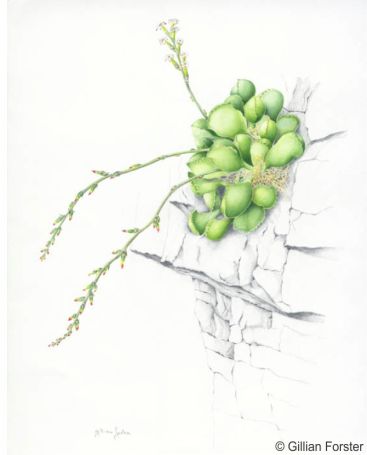
Fig. 6. An illustration of Adromischus cristatus var. schonlandii by the British botanical artist Gillian Forster.
Ecology
Ecology
Plants form tight rounded clusters, growing on sheer exposed north-facing cliffs in shallow ledges or sometimes hairline cracks. The soil is limited and therefore allowing very little competition from other non-succulent plants. The very succulent leaves (most succulent of all the varieties) and stems enables its long-term survival during periodic droughts. The dense coir-like aerial roots also aiding in the absorption of moisture from dew or rain.
The leaves are firm, becoming detached by disturbances, and will root and proliferate, forming new plants where they fall on suitable substrate. Detached leaves and pendent stems finding new crevices will root spontaneously, an efficient backup strategy for survival in this xeric cliff-face environment.
The leaves are firm and long-lived (more than a year) and with neither conspicuous armament nor camouflage properties, because they are adapted to the undisturbed cliff face which is largely free of herbivores.
Plants flower from summer to autumn (November–May) and are pollinated by insects. The fruiting capsules are dehiscent, with seeds spontaneously released and dispersed by updraft wind turbulence so commonly associated with cliffs. The seeds are minute and ideal for establishment in crevices.
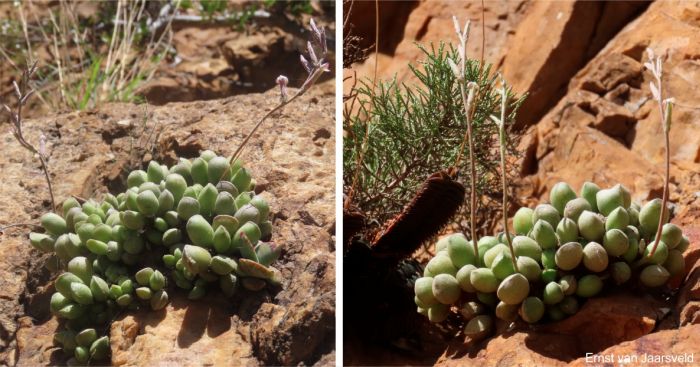
Fig. 7. Left A close-up of a cluster of Adromischus cristatus var. schonlandii growing on a sandstone ledge at the Kouga Dam, Eastern Cape, after rainfall, sharing its crevice with Crassula perfoliata var. minor, the mottled leaved plant in the right hand lower corner. Right A cluster of Adromischus cristatus var. schonlandii sharing its ledge with Haworthiopsis viscosa and the renosterbos (Elytropappus rhinocerotis).
Uses
Use
Except for its popularity among growers of succulent plants, no other uses have been recorded.
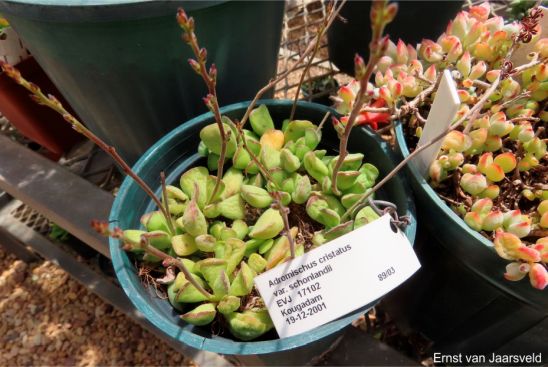
Fig. 8. Adromischus cristatus var. schonlandii in cultivation in the succulent collection at Kirstenbosch National Botanical Garden.
Growing Adromischus cristatus var. schonlandii
Grow
Adromischus cristatus var. schonlandii is grown for its ornamental value, and appealing compact shape of club-shaped leaves. Plants are easy to propagate and grow and have become popular pot plants in cultivation. It grows best in full sun in a well-drained sandy-loam to loam soil. Plants rapidly respond to watering, becoming turgid, eventually filling their containers. Plants can be fed with an organic fertiliser throughout the year. Its very easy growing nature maximises its survival rate. Plants adapt well to containers. When grown in shade the leaves elongate and lose their compact nature.
In regions outside of its habitat, ceramic containers are the solution. It also grows well with other succulents in miniature succulent gardens where conditions can be controlled.
Plants are easily propagated by leaf or stem cuttings taken during late summer, and are not too difficult to root. Avoid over watering as plants tend to rot. Water should be provided throughout the year, but sparingly.
Sow seed in winter or spring in a shallow tray in a sandy mixture and keep moist. Germination is within 3 weeks and once large enough to handle, transfer the seedlings to individual containers. Place container in a sunny or dappled shady position but with full light. The north, sunny, side (southern Hemisphere) of a building is ideal.
Plants are relatively disease free (except for stem and root rot with too much watering) but aphids, wine weevils, slugs and snails can sometimes be a problem.
References
- Helme, N.A. 2006. Adromischus cristatus (Haw.) Lem. var. schonlandii (E.Phillips) Toelken. National Assessment: Red List of South African Plants version 2024.1. https://redlist.sanbi.org/species.php?species=3831-9.
- Johnson, M.R., Anhaeusser, C.R. & Thomas, R.J. (eds). The geology of South Africa. Geological Society of South Africa, Johannesburg/Council for Geoscience, Pretoria.
- Mucina, L. & Rutherford, M.C. (eds) 2006. The vegetation of South Africa, Lesotho and Swaziland. Strelitzia 19. South African National Biodiversity Institute, Pretoria.
- Pilbeam, J., Rodgerson, C. & Tribble, D. 1998. Adromischus. The Cactus File Handbook 3. Cirio Publishing Services, Southampton.
- Toelken, H.R. 1985. Crassulaceae. Flora of Southern Africa 14: 1–244.
- Van Jaarsveld, E.J. 2003. New cliff-dwelling Crassulaceae from the Eastern Cape: a new Cotyledon and two new Adromischus taxa from the Mbashe and Mzimvubu Rivers, South Africa. Aloe 40: 2: 36–39.
- Von Poellnitz, K. 1940. Zur Kenntnis der Gattungen Cotyledon L. und Adromischus Lem. Feddes repertorium specierum novarum regni vegetabilis, Zeitschrift für systematische Botanik 48: 80–113.
Credits
Ernst van Jaarsveld
Kirstenbosch National Botanical Garden (Retired)
Babylonstoren Farm (Current)
Extraordinary senior lecturer and researcher,
Department of Biodiversity and Conservation, University of the Western Cape
November 2025
Acknowledgements: the author thanks his colleagues Cornell Beukes and Tiaan Kombrink for assisting him on various trips to see the plants in habitat.
Plant Attributes:
Plant Type: Succulent
SA Distribution: Eastern Cape
Soil type: Sandy
Flowering season: Late Summer, Autumn
PH: Acid
Flower colour: White
Aspect: Full Sun
Gardening skill: Average
Special Features:
 Drought resistant
 Good potplant
 Indoor plant
Horticultural zones


Rate this article
Article well written and informative
Rate this plant
Is this an interesting plant?
Login to add your Comment
Back to topNot registered yet? Click here to register.