


Adenandra villosa
Introduction
Adenandra villosa is a Western Cape endemic shrublet with aromatic leaves and bright white flowers in spring.
Description
Description
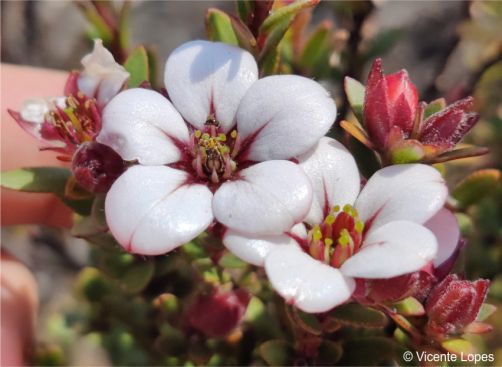
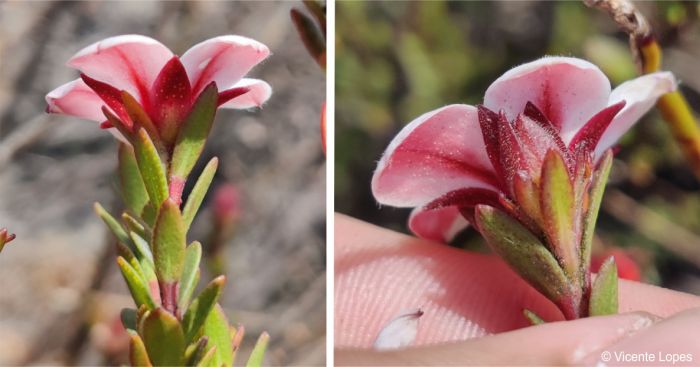
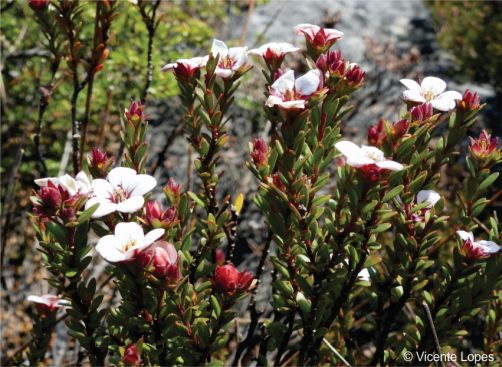
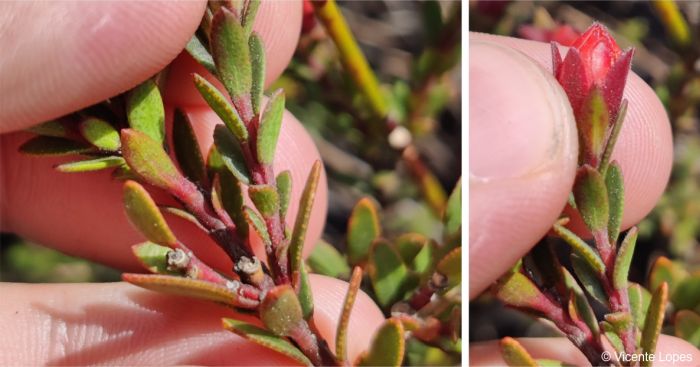
An ascending to erect shrublet. Leaves variable in shape, slightly hairy and sometimes glandular-punctate beneath. Flowers usually subsessile or with up to 7 mm long pedicels, solitary or 2–6 flowered. Calyx variable in shape, upper part usually red to purplish, calyx segments 4.0–9.5 mm long. Petals porcelain white on the inside and flushed red on the outside, petal limb 7–14 x 5.5–10 mm. Ovary glabrous with the upper part having small bumps. Capsule usually shorter than the calyx. Flowering time is mainly in late winter, spring and early summer, between August and November.
Conservation Status
Status
Nine subspecies of Adenandra villosa are recognized and most of them are of conservation concern, with only the subspecies villosa having a status of Least Concern (LC). The subspecies orbicularis and robusta are Near Threatened (NT), subspecies apiculata and imbricata are Vulnerable (VU), subspecies biseriata is Endangered (EN), and subspecies pedicellata, sonderi and umbellata are Rare but not threatened. The main threats to this species are habitat loss predominantly caused by urban expansion and wheat cultivation, and competition with alien invasive species. There are no threats to the subspecies of Least Concern and Rare status as they are either widespread and common, or their habitat is well protected.
Distribution and habitat
Distribution description
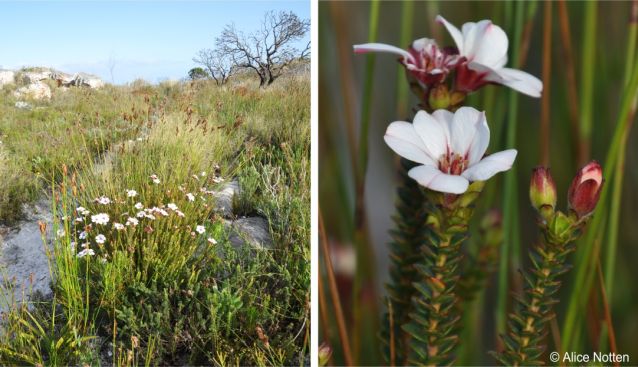
All nine subspecies of Adenandra villosa are endemic to the Western Cape. The subspecies apiculata occurs on dry sandstone slopes between rocks at 450–1 500 m altitude in the Riviersonderend and Langeberg Mountains; subspecies biseriata grows on sandy flats and plateaus on the Cape Flats between Darling, Muizenberg and Kuils River; subspecies imbricata grows predominantly on low to mid granite and clay slopes in the Hottentots Holland Mountains to the Kogelberg; subspecies pedicellata grows on rocks, cliffs and crevices on mountain slopes 1 000 m high in the Olifants River and Twenty-Four Rivers Mountains; subspecies robusta grows on lower sandstone slopes from Rooiels to Kleinmond; subspecies sonderi grows in sandy places among rocks on the lower mountain slopes of the southern Cape Peninsula; subspecies umbellata grows in gorges, on steep slopes and plateus in sandstone on the upper slopes and summit of Table Mountain in the northern Cape Peninsula; and subsp. villosa is the most widespread, occurring in sandstone and granite mountain fynbos in the northern part of the Cape Peninsula, the Hottentots Holland Mountains, and in the Caledon Swartberg and Kleinrivier Mountains to Witsenberg and Porterville in the Koue Bokkeveld.
Derivation of name and historical aspects
History
The name Adenandra is a Greek derived name, adena meaning ‘a gland’ and aner meaning ‘a man’, referring to the gland-bearing anthers present in the genus. The specific epithet villosa is a Latin derived word, villus meaning ‘shaggy’, this could be referring to the hairs on the leaves, petals or anthers. The subspecific epithet apiculata means ‘having an abrupt short point’, biseriata means ‘arranged in two rows, series or whorls’, imbricata means ‘overlapping like tiles or scales’, orbicularis means ‘circular’, pedicellata means ‘having a stalk’, robusta means ‘strong ’, sonderi is named after the botanist Otto Wilhelm Sonder and umbellata means ‘having umbels’.
Adenandra is part of the Rutaceae, the family most known for the genus Citrus which is of economic importance. This family has a worldwide distribution but is mainly found in the tropical and subtropical regions.
Ecology
Ecology
Adenandra villosa is part of Fynbos Biome which is fire-prone. As a member of the fynbos vegetation type, they have a life-span of between 10 and 15 years and become woody as they mature. Adenandra villosa is a resprouter and is able to resprout after a fire.
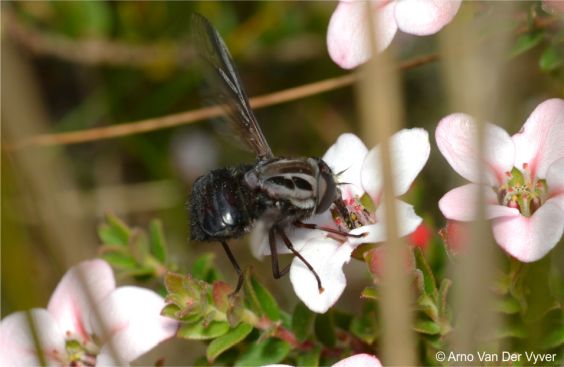
Adenandra villosa has been recorded to be pollinated by long-proboscid flies such as Prosoeca westermanni.
Uses
Use
Adenandra villosa is not often seen in cultivation but is a relatively easy plant to grow and would make an attractive addition to gardens. It is ideal for fynbos gardens, rock garden pockets or grown in a container.
Growing Adenandra villosa
Grow
Grow Adenandra villosa in a sunny, well-ventilated position, in well-drained acidic soil suitable for fynbos. Feed with well-rotted compost added as a layer of mulch.
Similar to other species in the Rutaceae family, they can be either propagated by seed or by cuttings. To propagate by seed, prepare a well-drained medium using equal parts sand, loam and compost, and mix lightly. Place the medium in 100 mm deep trays with sufficient drainage holes. Flatten the surface lightly and water. The seeds should be spread evenly over the medium and covered with 3 mm of the medium. Trays should then be placed in a covered area that has good light and free air circulation. Make sure that the trays are kept damp. Seeds should germinate in one to two months.
To propagate by cuttings, take cuttings 50–70 mm long from the current year’s growth. The most successful cuttings are taken six to nine weeks after flowering. The cuttings should have a clean cut below the node, remove up to a third of the lower leaves. The cut end should be dipped in a rooting hormone and the cuttings should then be placed in trays filled with a medium of equal parts milled bark and polystyrene. Ideally the trays should be placed in a well-aerated propagation unit that has timed misting andbottom heating of 24°C, but if this is not possible, the trays could be placed within a plastic container where the leaves and the medium do not touch the plastic covering. Rooting usually occurs in nine to eleven weeks.
Adenandra villosa could be affected by pests and diseases that other species in the Rutaceae family experience. It could be affected by the citrus caterpillar but this can be controlled with a contact stomach insecticide. Phytophthora cinnamomi is a common pathogen that affects many fynbos species and could also affect A. villosa. It thrives in soil with high temperatures and attacks the root system which prevents the plant from absorbing water causing the plant to eventually wilt and die. To prevent this, before planting young plants, treat them with acylalanine and try not to cause any root damage, add mulch to reduce the soil temperature and try not to disturb the soil.
References
- Appelhans, M.S., Bayly, M.J., Heslewood, M.M., Groppo, M., Verboom, G.A., Forster, P.I., Kallunki, J.A. & Duretto, M.F. 2021. A new subfamily classification of the Citrus family (Rutaceae) based on six nuclear and plastid markers. Taxon 70: 1035–1061.
- Fernkloof Nature Reserve. Adenandra villosa. https://www.fernkloof.org.za/index.php/all-plants/plant-families/item/adenandra-villosa. Accessed 29/12/2025.
- Geoffrey’s plant names explained. Adenandra. https://www.plantnames.co.za/index.php. Accessed 18/05/2022.
- Lopes, V. 2024. Observation of Adenandra villosa, Table Mountain National Park, Cape Town. iNaturalist. Online. https://www.inaturalist.org/observations/329841041.
- Pauw, A. 2022. Pollination syndrome accurately predicts pollination by tangle‐veined flies (Nemestrinidae: Prosoeca s.s.) across multiple plant families. Plant Biology 24: 1010–1021.
- Strid, A. 1972. Revision of the genus Adenandra (Rutaceae). Opera Botanica 32:1-112.
- Van Der Vyver, A. 2024. Observation of Prosoeca westermanni pollinating Adenandra marginata, Cape Winelands Biosphere Reserve. iNaturalist. Online. https://www.inaturalist.org/observations/248789813.
- Von Staden, L. 2017. Adenandra villosa (P.J.Bergius) Licht. ex Roem. & Schult. subsp. orbicularis Strid. National Assessment: Red List of South African Plants version 2024.1. Accessed on 2025/12/29
- Von Staden, L. 2019. Adenandra villosa (P.J.Bergius) Licht. ex Roem. & Schult. subsp. apiculata Strid. National Assessment: Red List of South African Plants version 2024.1. Accessed on 2025/12/29.
- Von Staden, L. 2019. Adenandra villosa (P.J.Bergius) Licht. ex Roem. & Schult. subsp. biseriata (E.Mey. ex Bartl. & H.L.Wendl.) Strid. National Assessment: Red List of South African Plants version 2024.1. Accessed on 2025/12/29
- Von Staden, L. 2019. Adenandra villosa (P.J.Bergius) Licht. ex Roem. & Schult. subsp. imbricata Strid. National Assessment: Red List of South African Plants version 2024.1. Accessed on 2025/12/29
- Von Staden, L. 2019. Adenandra villosa (P.J.Bergius) Licht. ex Roem. & Schult. subsp. pedicellata Strid. National Assessment: Red List of South African Plants version 2024.1. Accessed on 2025/12/29
- Von Staden, L. 2019. Adenandra villosa (P.J.Bergius) Licht. ex Roem. & Schult. subsp. robusta Strid. National Assessment: Red List of South African Plants version 2024.1. Accessed on 2025/12/29
- Von Staden, L. 2019. Adenandra villosa (P.J.Bergius) Licht. ex Roem. & Schult. subsp. sonderi (Dummer) Strid. National Assessment: Red List of South African Plants version 2024.1. Accessed on 2025/12/29
- Von Staden, L. 2019. Adenandra villosa (P.J.Bergius) Licht. ex Roem. & Schult. subsp. umbellata (J.C.Wendl.) Strid. National Assessment: Red List of South African Plants version 2024.1. Accessed on 2025/12/29
- Von Staden, L. 2019. Adenandra villosa (P.J.Bergius) Licht. ex Roem. & Schult. subsp. villosa. National Assessment: Red List of South African Plants version 2024.1. Accessed on 2025/12/29.
Credits
Aarifah Jakoet
Compton Herbarium
January 2026
Acknowledgements: the author thanks Vicente Lopes and Arno Van Der Vyver for allowing the use of their images.
Plant Attributes:
Plant Type: Shrub
SA Distribution: Western Cape
Soil type: Sandy, Loam
Flowering season: Spring, Early Summer, Winter
PH: Acid
Flower colour: Red, White
Aspect: Full Sun
Gardening skill: Average
Special Features:
 Drought resistant
 Fragrant
Horticultural zones



Rate this article
Article well written and informative
Rate this plant
Is this an interesting plant?
Login to add your Comment
Back to topNot registered yet? Click here to register.