


Crassula montana subsp. quadrangularis
Introduction
Crassula montana subsp. quadrangularis is a densely dividing cliff-hugging plant with leaves in tight square rosettes and white to pinkish flowers in flat-topped heads in winter and early spring. Widespread in the Great Karoo between Beaufort West and Kariega, mainly in Nama Karoo and Thicket vegetation. Grows well in containers in dappled shade.
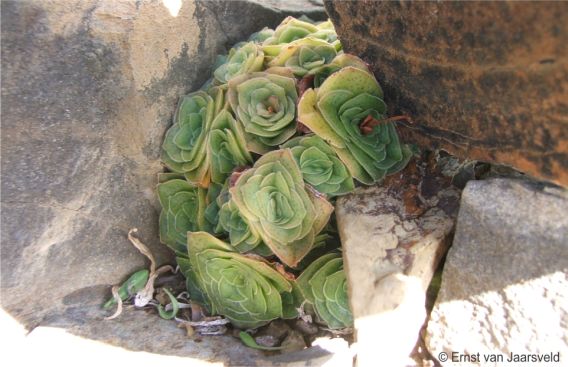
Fig. 1. A young plant of Crassula montana subsp. quadrangularis growing on a shale cliff north of Laingsburg, Western Cape, in summer (December).
Description
Description
The plants proliferating from base to form small, dense mats up to 30 mm high. Roots fibrous. The leaves grows in a basal rosette, 4-ranked, obovate, 7–20 × 4–15 mm, abruptly tapering towards apex, forming a flat square rosette, light to dark green, with dark green dots, the surface hairless accept for short marginal hairs (cilia). The leaf tips pointed to blunt (obtuse). The inflorescence elongate but flat-topped, 50–70 mm high, the bracts leaf-like, obovate to lanceolate, 5–14 × 6–8 mm, the margin with stiff hairs (ciliate). The calyx lobes 4–5 mm long, triangular-lanceolate, ciliate. The corolla tubular, 6 mm long; lobes oblong, 5 mm long, fused shortly at base, apices spreading, white. Flowering occurs in spring (August–October).
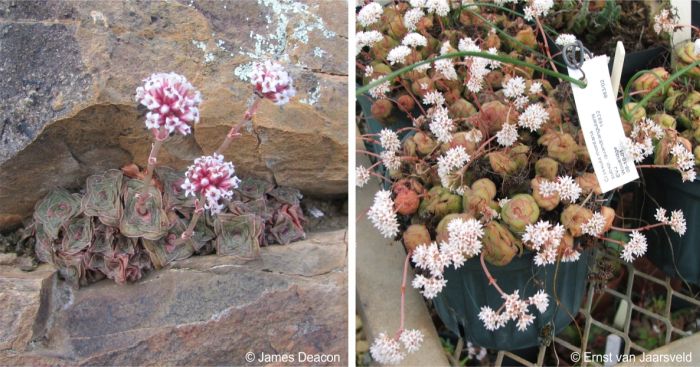
Fig. 2. Crassula montana subsp. quadrangularis in flower in habitat LEFT and RIGHT in cultivation in the succulent collection nursery at Kirstenbosch National Botanical Garden.
Conservation Status
Status
Assessed as Least Concern (LC) by the Red List of South African Plants, Crassula montana subsp. quadrangularis is well protected by the often inaccessible cliff habitat.
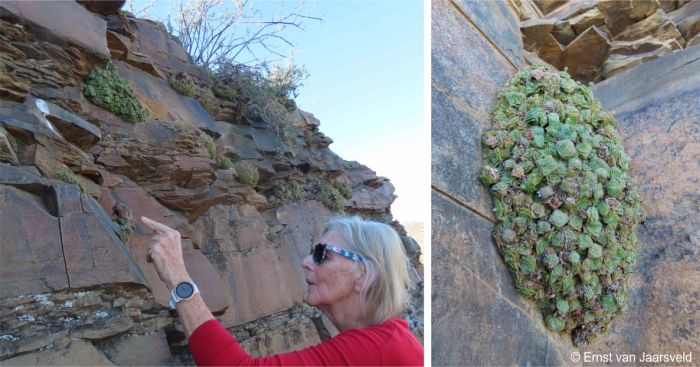
Fig. 3. Renee Rust pointing out a young plant of Crassula montana subsp. quadrangularis growing on a shale cliff near Laingsburg, Western Cape and a plant in its south-facing Beaufort Shale cliff-face habitat near Laingsburg in midwinter.
Distribution and habitat
Distribution description
Crassula montana subsp. quadrangularis is confined to the eastern Great Karoo and southwards to the lower slopes of the Cape Fold Belt mountains bordering the southern Great Karoo, from Beaufort West and Laingsburg in the west to Kariega in the east at 1 000–1 400 m in altitude. The habitat consists of sheltered shale cliffs (Beaufort Shale), mainly on southern aspects. Plants grow in shallow soil in crevices, sometimes on broader ledges, among leaf litter on shady rocky ledges, dividing to form dense, cliff-hugging clusters. Temperatures are high in summer and mild in winter. The average daily maximum temperature is 25–27°C and average daily minimum 10–12°C. Rainfall occurs in winter (cyclonic winter rain) and summer (thunder showers) and ranges from 200–300 mm per annum. The associated vegetation consists of Koedoesberge-Moordenaars Karoo (Succulent Karoo Biome) as well as Steytlerville Karoo (Rainshadow Valley Karoo Bioregion) of the Succulent Karoo Biome. Near Koup Station plants were found growing on south-facing Beaufort Shale cliffs. The plants are solitary, growing among a few Holothrix orchids and Crassula arborescens was found growing close by.
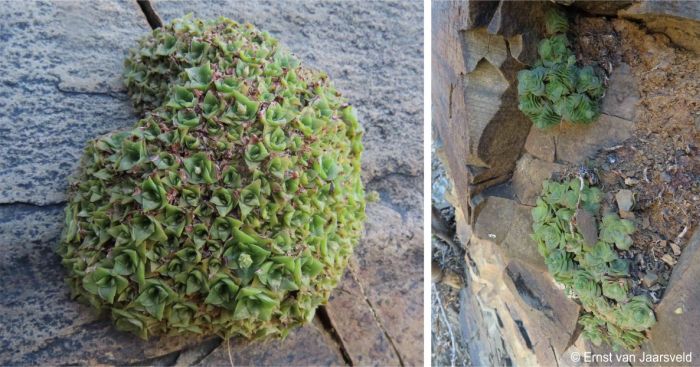
Fig. 4. A rounded cluster of Crassula montana subsp. quadrangularis growing in a vertical crevice of a shale cliff face and two younger plants growing on the base of the shale cliff, north of Laingsburg, in winter, note that the plants are coming into flower.
Derivation of name and historical aspects
History
Crassula montana subsp. quadrangularis was first named and described in 1844 by the German horticulturist and explorer Johann Frantz Drège (1794-1881) from plants he collected at Swanepoelspoort in the Eastern Cape in 1832. He published this species in 1844 in his Zwei Pflanzengeographische Documente under the name Crassula hemisphaerica sensu Drege, but the name had already been applied by Thunberg in 1778 to a different species, Crassula hemisphaerica Thunb. In 1903, Selmar Schonland published this species as Crassula quadrangularis, from plants collected by Marloth near Laingsburg, in the Records of the Albany Museum, and because this is the earliest validly published name, it therefore became the valid name. When Toelken revised Crassula, he thought it better to make it a subspecies of Crassula montana, and published his results in 1975 in the Journal of South African Botany. The species name quadrangularis given by Schonland means ‘with four angles’ and pertains to the almost square leaf rosettes.
Crassula montana subsp. quadrangularis belongs to section Rosulares, and is distinguished by its tight rounded cushions, consisting of small almost square rosettes, green leaves and white flowers. The leaves are obovate in shape, much smaller and usually not spotted, in 4-ranks, forming square rosettes. Crassula montana subsp. quadrangularis may be confused with Crassula cremnophila but they can easily be distinguished because Crassula cremnophila has spherical grey leaves and pinkish flowers.
Three subspecies of Crassula montana are recognised, subsp. montana, subsp. quadrangularis and subsp. borealis. The subsp. montana has fewer rosettes that are much larger in size, and the leaves are usually mottled. The subspecies borealis occurs in northern Namaqualand and the Richtersveld, and has deep cup-shaped rosettes of broadly ovate leaves which are pitted, and flowers in midsummer (December and January).
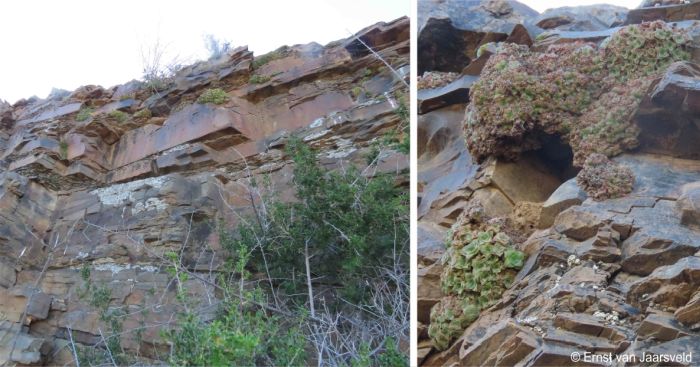
Fig. 5. The upper south-facing shale cliffs near Laingsburg in the Western Cape, in midwinter, plastered with Crassula montana subsp. quadrangularis.
Ecology
Ecology
The plants are long-lived perennials growing in dense, compact, rounded clusters on cliffs and rock overhangs. The succulent nature of the plant enables it to cope during periods of drought. The cliff habitat ensures a safe haven free of disturbances by larger herbivores. The leaf skin (epidermis) is green, becoming reddish during the dry season. The reddish colour is caused by the production of anthocyanins and appears under dry conditions, protecting the leaf by reducing penetration of excessive light, an adaptation resulting from the xeric conditions of the cliff habitat.
Flowering occurs in spring and the flowers are pollinated by insects. The fruits (follicles) are dehiscent and the very small seeds are spontaneously released, becoming airborne with wind thermals. The seeds are released in summer at the onset of rainy conditions, maximising establishment. Any of the rosettes becoming detached, would also root when landing on a crevice.
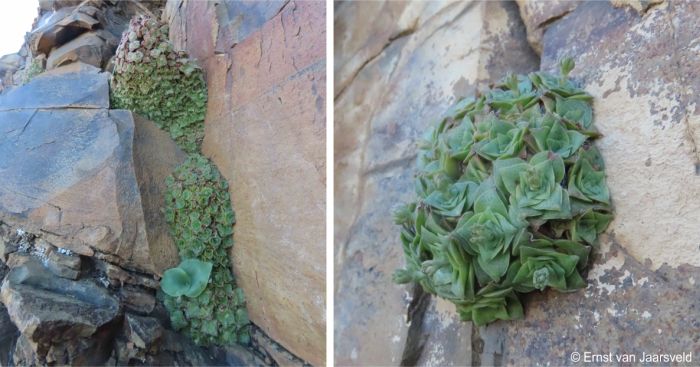
Fig. 6. Crassula montana subsp. quadrangularis occupying a crevice on a shale cliff north of Laingsburg in midwinter and a young plant growing in a crevice on the cliff face, the plants coming into flower.
Uses
Use
It is not known whether the plants are used medicinally.
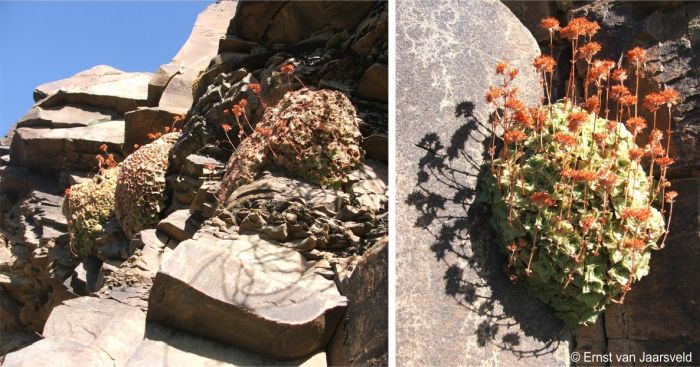
Fig. 7. The south-facing shale cliffs near Laingsburg in the Western Cape, in midsummer, with rounded clusters of Crassula montana subsp. quadrangularis growing on the cliff with the persistent remains of old inflorescences.
Growing Crassula montana subsp. quadrangularis
Grow
Crassula montana subsp. quadrangularis is easily cultivated, its vigour viewed as maximising survival. Outside its habitat, it is best grown under controlled conditions in a greenhouse. It is best grown in small containers, miniature succulent gardens and on windowsills where there is no competition from larger non-succulent plants. The substrate should be sandy and well drained. The plant does best in dappled shade. Avoid full sun. Water moderately in autumn, winter and spring, and keep dry during summer. It can be grown with other dwarf succulent plants. Apply an organic liquid fertiliser when necessary.
Propagate by division or seed. Sow seed in a sandy gravely mixture in autumn and keep in a shady position. Germination is rapid and once the seedlings are large enough to handle, prick out into larger containers. Mealy bug can be a problem and occasionally white scale.
References
- Deacon, J. 2024. Observation of Crassula montana subsp. quadrangularis. iNaturalist. Online. https://www.inaturalist.org/observations/248881254.
- Eggli, U. (ed.) 2003. Illustrated handbook of succulent plants: Crassulaceae. Springer, Berlin.
- Glen, H.F. & Germishuizen, G. (compilers). 2010. Botanical exploration of southern Africa, edition 2. Strelitzia 26. South African National Biodiversity Institute, Pretoria.
- Mucina, L. & Rutherford, M.C. (eds) 2006. The vegetation of South Africa, Lesotho and Swaziland. Strelitzia 19. South African National Biodiversity Institute, Pretoria.
- Raimondo, D., Von Staden, L., Foden, W., Victor, J.E., Helme, N.A., Turner, R.C., Kamundi, D.A. & Manyama, P.A. (eds) 2009. Red list of South African plants. Strelitzia 25. South African National Biodiversity Institute, Pretoria.
- Rowley, G. 2003. Crassula: a growers guide. Cactus & Co. Vista, California.
- Schönland, S. 1903. Crassula quadrangularis Schönl. n. sp. Records of the Albany Museum 1: 57.
- Thunberg, C.P. 1778 Crassula montana. Nova acta physico-medica Academiae Caesareae Leopoldino-Carolinae Naturae Curiosum 6: 329, 332.
- Toelken, H.R. 1985. Crassulaceae. Flora of Southern Africa 14: 1–244.
- Van Jaarsveld, E.J. 2015. Crassula montana subsp. borealis, a new cliff-dwelling species from Namaqualand, Northern Cape, Republic of South Africa. Haseltonia 21:97-101.
Credits
Ernst van Jaarsveld
Kirstenbosch National Botanical Garden (Retired)
Babylonstoren Farm (Current)
Extraordinary senior lecturer and researcher,
Department of Biodiversity and Conservation, University of the Western Cape
February 2026
Acknowledgements: the author thanks James Deacon for the image of Crassula montana subsp. quadrangularis in flower in habitat.
Plant Attributes:
Plant Type: Succulent
SA Distribution: Eastern Cape, Western Cape
Soil type: Sandy, Loam
Flowering season: Spring
PH: Acid, Neutral
Flower colour: White
Aspect: Shade, Morning Sun (Semi Shade)
Gardening skill: Average
Special Features:
 Drought resistant
 Good potplant
 Indoor plant
Horticultural zones



Rate this article
Article well written and informative
Rate this plant
Is this an interesting plant?
Login to add your Comment
Back to topNot registered yet? Click here to register.