


Argyrella canescens
Introduction
This pretty shrub looks remarkably like a dwarf version of the related South American tibouchina trees (Tibouchina and Pleroma spp.) which are grown in the more tropical parts of the country. This is where the similarity ends!
Description
Description
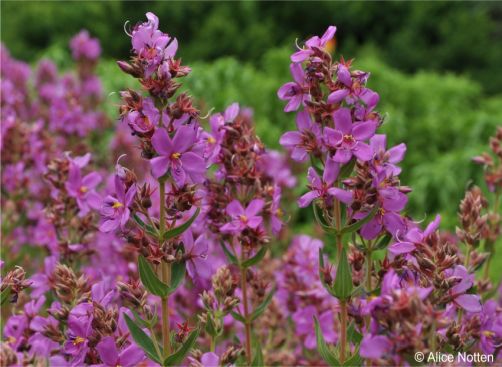
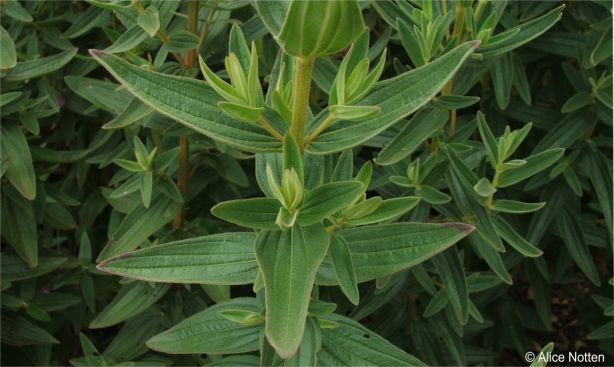
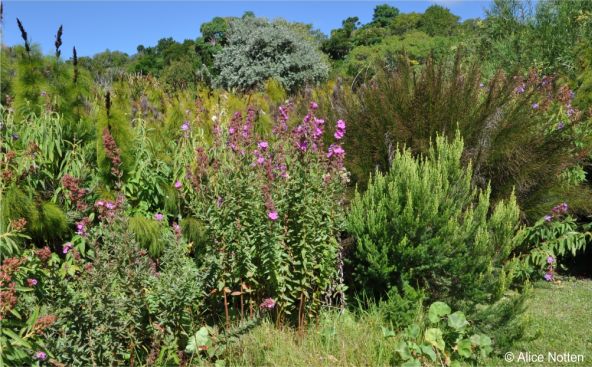
Argyrella canescens is a soft wooded shrub up to 1.5 m in height and 1 m in spread, with an underground rootstock. It is deciduous in winter and may be grown in a warm position on the highveld where it is dormant for the coldest months. The stems are 4-angled, reddish-brown. The leaves are velvety, whitish underneath, with 3-5 veins from the base.
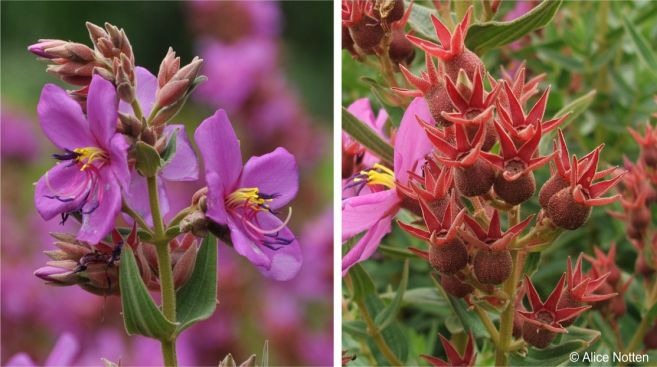
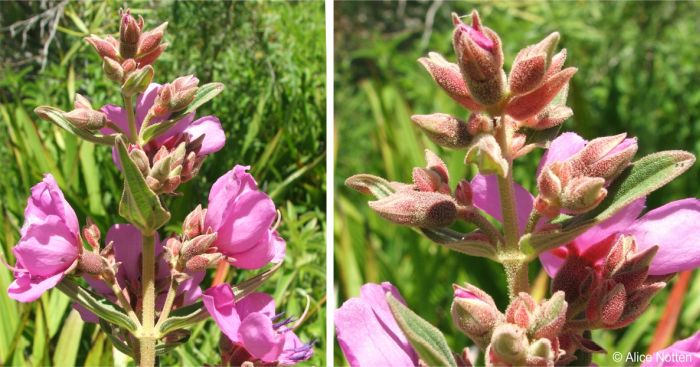
The large brilliant magenta flowers appear in branched clusters at the tips of the stems, from midsummer to autumn (December to April) and make a spectacular display. They contrast well with the dark green to purplish leaves and reddish stems of the plant. The flowers are quite unusual in that they have two sets of stamens (pollen producing parts) which differ from each other; they consist of five long curved pink connectives attached to yellow filaments and tipped with purple anthers in the lower half of the flower and the other five are shorter and on bright yellow filaments in the middle of the flower. The calyx is velvety red-brown and the pinkish-red triangular lobes persist after the petals drop, appearing star-like.
Conservation Status
Status
Argyrella canescens is not threatened, it is assessed as Least Concern (LC) on the Red List of South African Plants.
Distribution and habitat
Distribution description
Argyrella canescens can be found growing in marshy areas in the eastern provinces of South Africa, from the Eastern Cape through KwaZulu-Natal, Mpumalanga and Limpopo, and in Eswatini, Mozambique, Zimbabwe and into tropical Africa.
Derivation of name and historical aspects
History
Argyrella canescens was previously placed in the genus Dissotis, that genus name referring to the stamens which are of two different types, derived from the Greek dissos meaning ‘two-fold’. The meaning for the genus name Argyrella is not given; the Greek meaning of argyros is silver and the suffix ella indicates the diminutive, thus ‘little silver’, possibly referring to the small white hairs that typically cover these plants. The species name canescens refers to the greyish-white hairs on the plant.
The genus Argyrella was first described in 1850, but all the species in it were placed within the genus Dissotis in 1871. Argyrella was recognised as a section of Dissotis in 1872 and as a subgenus of Dissotis in 1970. Argyrella was reinstated as a genus in 2017 and its description updated, following phylogenetic studies on the African Melastomataceae that found that these species formed a well-supported clade, also supported by their morphology. The genus Argyrella consists of 7 accepted species that occur in tropical and southern Africa with only one species in South Africa. Species are characterised as white-pubescent subshrubs, with stems, leaves and hypanthium densely covered with stellate and/or glandular hairs appearing dusty, and the sepals are persistent.
Ecology
Ecology
The anthers release the pollen through a tiny apical pore, the pollen is forced out when the anthers are vibrated at a particular frequency by a bee, termed buzz pollination. At Kirstenbosch, carpenter bees (Xylocopa spp.) have been observed visiting the flowers.
Uses
Use
Argyrella canescens has been traditionally eaten in times of famine, leaves are used to treat dysentery and diarrhoea, and roots, stems and leaves to treat hangovers.
Growing Argyrella canescens
Grow
Argyrella canescensis a rewarding garden plant provided it is given enough water in summer. It makes a good shrub border specimen. A prime position would be near a pond where it can obtain plenty of moisture. It prefers full sun, and thrives in good soil with lots of compost.
It may be grown from seed sown in spring, and from cuttings taken in spring and summer. It is also possible to propagate it from rooted runners which may be lifted.
References
- Dictionary of botanical epithets. http://www.winternet.com/~chuckg/dictionary.html
- Fox, F.W. & Norwood Young, E. 1982. Food from the veld: edible wild plants of southern Africa. Delta Books, Cape Town.
- Hutchings, A., Scott, A.H., Lewis, G. & Cunningham, A.B. 1996. Zulu medicinal plants: an inventory. University of Natal Press, Pietermaritzburg.
- Plants of the World Online. Argyrella canescens (Graham) Harv. https://powo.science.kew.org/taxon/urn:lsid:ipni.org:names:566295-1. Accessed 4 Feb 2026.
- Pooley, E. 1998. A field guide to wild flowers of Kwazulu-Natal and the eastern region. Natal Flora Publications Trust, Durban.
- Raimondo, D., Von Staden, L., Foden, W., Victor, J.E., Helme, N.A., Turner, R.C., Kamundi, D.A. & Manyama, P.A. (eds) 2009. Red list of South African plants. Strelitzia 25. South African National Biodiversity Institute, Pretoria.
- Van Wyk, A.E. 2000. A photographic guide to wild flowers of South Africa. Struik, Cape Town.
- Veranso-Libalah, M.C., Stone, R.D., Fongod, A.G.N., Couvreur, T.L.P. & Kadereit. G. 2017. Phylogeny and systematics of African Melastomateae (Melastomataceae). Taxon 66: 584–614.
Credits
Alice Aubrey, Walter Sisulu National Botanical Garden, March 2001
updated by Alice Notten, Kirstenbosch National Botanical Garden, February 2026
Plant Attributes:
Plant Type: Perennial, Shrub
SA Distribution: Eastern Cape, KwaZulu-Natal, Limpopo, Mpumalanga
Soil type: Loam
Flowering season: Late Summer, Autumn
PH: Acid, Neutral
Flower colour: Pink
Aspect: Full Sun
Gardening skill: Average
Special Features:
 Edible plant
 Medical plant
 Useful plant
 Wet sites
Horticultural zones


Rate this article
Article well written and informative
Rate this plant
Is this an interesting plant?
Login to add your Comment
Back to topNot registered yet? Click here to register.