


Diascia namaquensis
Introduction
South Africa is home to more than 70 species of Diascia, and, although not widely cultivated, one of the most rewarding to grow in a garden is the annual Diascia namaquensis. With its large, showy flowers in shades ranging from salmon and pale orange to wine red, purple or maroon, this species can be a striking addition to any a fine garden.
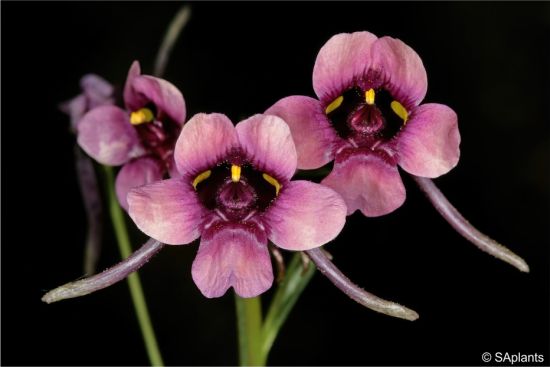
Fig. 1. Frontal view of flowers of Diascia namaquensis. Note the characteristic long spurs that are carried horizontally behind the face of the flower.
Description
Description
Diascia namaquensis is a soft herbaceous annual that grows up to about 400 mm tall. The stems may branch from the base or remain unbranched. The leaves are mostly arranged in a basal rosette and become smaller towards the tips of the stems. They are obovate to elliptic in shape, up to 50 × 12 mm in size, and are irregularly lobed or divided. The flowers are distinctive and showy and bilaterally symmetrical. The calyx lobes are long-pointed and vary from tail-like to curved and sickle-shaped. The corolla is usually salmon, pale orange, purple-red or maroon, and rarely white. The flower limb is 10–20 mm long, the side and upper lobes slightly smaller. Below the upper and side lobes of the corolla tube there is a yellow, elliptical translucent patch, often called a “window”, sometimes accompanied by one or two much smaller patches. Most flowers have two long and widely spreading spurs, pointing sideways when the flower is viewed from a frontal position, measuring 5–20 mm in length. Although forms with short, blunt spurs may also be present in the same population. The stamens project forward and are somewhat straight. The rear filaments are thickened or slightly bent backwards near the middle and are mostly hairless, except for a small tuft of purple hairs at the bend.
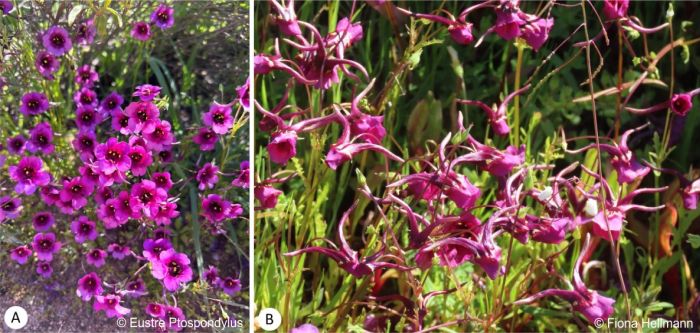
Fig. 2. Plants of Diascia namaquensis are usually floriferous when grown in full sun and with ample watering. Here shown in frontal view (A) and from behind showing the characteristic horizontal held spurs (B).
The fruit is an ovoid capsule, 5–7 mm long, which is equal to or longer than the calyx. The seeds are very small, black, and shiny, with a rough, wrinkled surface. Flowering takes place mainly in spring, from August to October, depending on the timing and amount of rainfall.
Diascia namaquensis can be recognised by its combination of large, colourful flowers, the presence of the usually two long spurs, and the yellow translucent “windows” in the corolla tube. The only other species with which it can be confused in its native range are two, formally undescribed, species that differ in the orientation, length and thickness of their spurs. Most annual Diascia species are found in the winter-rainfall regions of western South Africa, while perennial species mainly occur in the eastern, summer-rainfall parts of the country. This geographic separation further helps to distinguish D. namaquensis from related species.
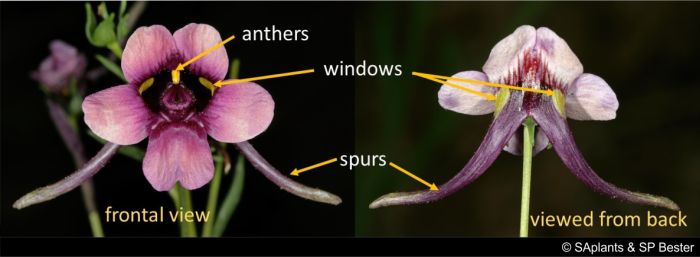
Fig. 3. Frontal view of a flower (left) and flower viewed from behind (right) showing morphological structures of the flower (spurs, windows, anthers).
Conservation Status
Status
Diascia namaquensis was not selected during four different screening processes aimed at identifying species of conservation concern. As a result, it was automatically assessed as Least Concern (LC) by the Red List of South African Plants. Current information suggests that populations are stable. However, many habitats within its main distribution range are heavily affected by mining activities. In addition, future changes linked to global warming could alter this assessment. As an annual plant, populations of Diascia namaquensis naturally fluctuate from year to year depending on rainfall timing and amount.
Distribution and habitat
Distribution description
This species is restricted (endemic) to the greater Namaqualand region, from around Calvinia to the Richtersveld, in the Western and Northern Cape provinces of South Africa. It grows on flats and slopes in sandy loam soils and has been recorded at altitudes between 240 and 1 280 m above sea level. Plants grow in full sun, partial shade or even deep shade, but flowering is usually most abundant in full sun or light, dappled shade provided by surrounding nurturing vegetation. As with many Namaqualand annuals, the appearance and abundance of this species depends strongly on the timing and amount of winter rainfall.
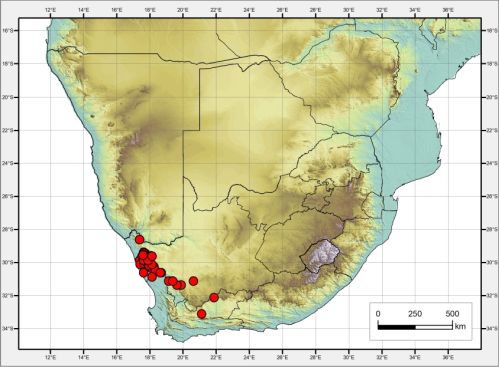
Fig. 4. Known distribution for Diascia namaquensis based on herbarium specimens from the SANBI Herbaria (NBG, NH and PRE).
Derivation of name and historical aspects
History
The family Scrophulariaceae, commonly known as the snapdragon family, is a large plant family with about 1 830 species worldwide. In South Africa, it is represented by 62 genera with ±825 taxa. Diascia is one of the larger genera of the family. The first species of Diascia, D. barberae, was described by Hooker in 1820. Since then, the genus has expanded to more than 70 described species.
The name Diascia comes from the Greek words di, meaning ‘two’ and askion, meaning ‘a wine skin or bladder’. This name allegedly refers not to the spurs themselves, but to the pair of yellow, translucent sacs or “windows” found in the corolla tube of the flowers. The prominent double spur found in many species is, however, a useful diagnostic feature and explains the common name twinspur, despite several species only have vestigial sacs and not necessarily distinct spurs. The specific epithet namaquensis obviously refers to Namaqualand, the main geographical area where this species occurs.
There are about 70 species of Diascia endemic to South Africa. The genus can be roughly divided into annual species, which mainly occur in the winter-rainfall regions of the west, and perennial species, which are found mostly in the summer-rainfall regions of the east.
Interest in Diascia increased through the collection of garden-worthy plants and previously unknown species from the wild. Many of these were introduced into cultivation through the Royal Botanic Garden Edinburgh by Olive Hilliard and Bill Burtt. They noted the lack of natural hybrids in the wild, which is thought to be linked to the close co-evolution of Diascia species with their specialised pollinators in the genus Rediviva (family Melittidae).
For Diascia namaquensis and the related D. longicornis, visits by the oil-collecting bees Rediviva emdeorum and Rediviva longimanus and an opportunistic bee, Patellapis montagui have been observed during pollination studies.
In 1978, Hector Harrison obtained three Diascia species and began cross-pollinating them by hand, creating various hybrids. What began as a hobby developed into a breeding programme, and some of the earliest Diascia cultivars were introduced by him. His generosity in sharing plants widely, including with nurseries, meant that he was unable to register them for Plant Breeders’ Rights but through his efforts this genus was introduced to gardeners globally.
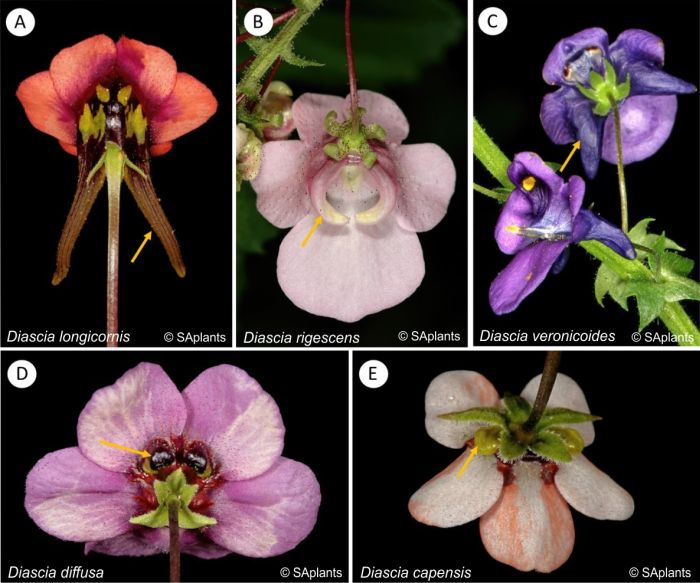
Fig. 5. Examples of different spur types in the genus Diascia. A, B & C, long tubular spurs; D & E, short saccate spurs. Spurs indicated by yellow arrow.
Ecology
Ecology
Unlike most members of Diascia that are hardy and fairly drought tolerant, D. namaquensis is a quite fragile plant and needs much water that can extend its growing season. They grow best in sunny or lightly shaded conditions. In the wild they often occur near streams, or in the moist shade of rocks or grass tussocks. Despite their delicate appearance, they can be surprisingly tough.
The flowers of the Namaqualand twinspur are self-incompatible, meaning they cannot fertilise themselves and in the absence of pollinators when grown outside their natural range may not produce viable seed to collect for the next season. The species has a fascinating, highly specialised pollination system involving oil-collecting bees in the genus Rediviva. These solitary bees, like Diascia, are endemic to South Africa. In some species, the female bees have evolved unusually long forelegs, which they use to collect oil rather than nectar from flowers in the Iridaceae, Orchidaceae and Scrophulariaceae families. Oil-secreting hairs (elaiophores) occur near the tips of the spurs, and oil-secreting trichomes are present inside the spurs.
In Diascia namaquensis, the stamens are positioned between the two spurs, forcing the bee to straddle the anthers when inserting its forelegs into the spurs. Using specialised pads of hairs on their front legs, the bees absorb oil secreted by the glands inside the spurs. As the bee presses against the flower, pollen is transferred to its thorax and later deposited on the stigma of the next flower it visits. The two yellow translucent “windows” on the flower help guide the bee into the correct position.
This system represents an evolutionary shift from nectar-based to oil-based rewards, driven by strong selection pressure. The collected oil is mixed with pollen and used as food for the developing larvae of Rediviva bees.
Although not selective, the Namaqualand speckled padloper (Homopus signatus signatus), the smallest tortoise in the world, may include Diascia namaquensis in its diet where the two occur together. This still needs confirmation through studies such as pollen analysis of faecal material.
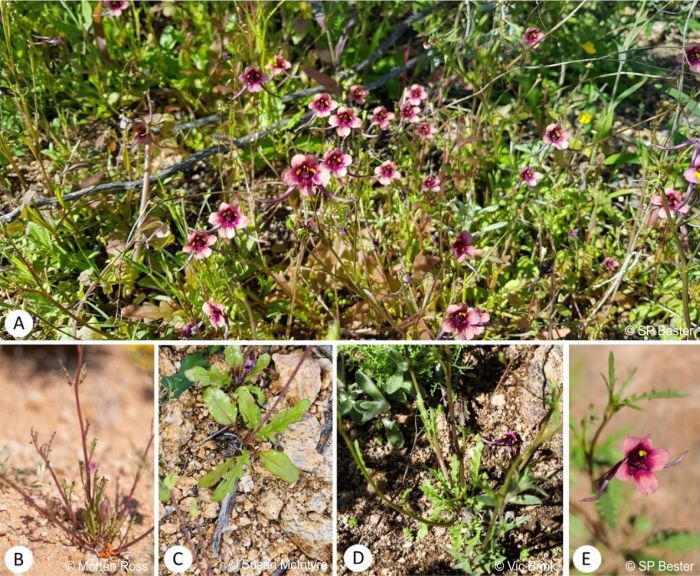
Fig. 6. Diascia namaquensis prefers sunny positions in sandy soils and grows well when mixed with other herbaceous species. Note especially the basal rosette of leaves (B−D) that become smaller up the stems.
Uses
Use
There are no recorded traditional medicinal, edible, craft or ritual uses for Diascia namaquensis. Its main value lies in horticulture. Many Diascia species and their cultivars are popular ornamental plants, widely used in hanging baskets, containers, rockeries and flowerbeds. Diascia namaquensis is well suited to open sandy gardens, borders, ground cover plantings and container cultivation. Although seed is not commonly available through the horticultural trade, plants grown from wild-collected seed have shown the ability to grow under a wide range of climatic conditions.
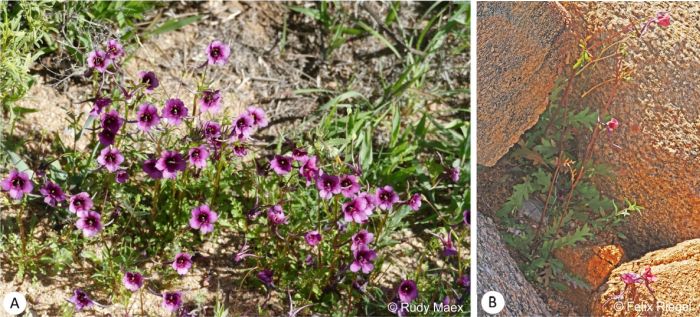
Fig. 7. Diascia namaquensis is well-suited as a ground cover (A), and in hanging baskets and containers. Despite being very delicate plants, they can grow, flower and disperse their seeds in inhospitable habitats, such as from the tiniest cracks in this granite boulder (B).
Growing Diascia namaquensis
Grow
Plants are grown from seed. Seeds should be sown in autumn, preferably on a fine seedling mix, and covered lightly to prevent drying out. Because the seedlings are delicate and fragile, it is best to raise them in seed trays until they are large enough to transplant into the garden.
Plant in well-drained soil in full sun or semi-shade. Water regularly to extend the flowering period. A fertiliser high in potassium can be used, but excessive fertilisation should be avoided, as this encourages leafy growth at the expense of flowers.
Most Diascia species tolerate moderate frost, are easy to grow, and are usually resistant to disease. Because plants are self-incompatible, they do not readily set seed in garden conditions.
References
- Benham, S. 1987. Diascia - a survey of the species in cultivation. Plantsman 9(1):1−17.
- Brink, V. 2024. Observation of Diascia namaquensis, Namaqualand. iNaturalist. Online. https://www.inaturalist.org/observations/238463172.
- Dlamini, M.D. & Aubrey, A. 2002. Diascia rigescens Benth. (Scrophulariaceae).PlantZAfrica. Online. https://pza.sanbi.org/diascia-rigescens.
- Garbutt, S. 1994. Up-and-coming Diascia. The Garden 119(1):18−21. Royal Horticultural Society, London.
- Kampny, C.M. 1995. Pollination and flower diversity in Scrophulariaceae. Botanical Review 61(4): 350−366.
- Koekemoer, M., Steyn, H.M. & Bester, S.P. 2023. Flowering plant families of southern Africa. Strelitzia 46. South African National Biodiversity Institute, Pretoria.
- Le Roux, A. 2005. Namaqualand. South African Wild Flower Guide 1. Botanical Society of South Africa, Cape Town.
- Loehr, V.J.T. 2002. Diet of the Namaqualand speckled padloper, Homopus signatus signatus, in early spring. African Journal of Herpetology 51(1): 47−55.
- Maex, R. 2022. Observation of Diascia namaquensis. Kamiesberg. iNaturalist. Online. https://www.inaturalist.org/observations/139895935.
- Marinus, E. 2012. Diascia lewisiae K.E.Steiner (Scrophulariaceae). PlantZAfrica. Online. https://pza.sanbi.org/diascia-lewisiae.
- McIntyre, S. 2023. Observation of Diascia namaquensis, Goegap Nature Reserve. iNaturalist. Online. https://www.inaturalist.org/observations/180472229
- McQuillan, M. 2009. Diascia vigilis Hilliard & B.L.Burtt. (Scrophulariaceae). PlantZAfrica. Online. http://pza.sanbi.org/diascia-vigilis.
- Powrie, F. (ed) 1998. Grow South African Plants. A gardener's companion to indigenous plants. National Botanical Institute, Cape Town.
- Ptospondylus, E. 2023. Observation of Diascia namaquensis, Namaqua NP. iNaturalist. Online. https://www.inaturalist.org/observations/183356196
- Raimondo, D., Von Staden, L., Foden, W., Victor, J.E., Helme, N.A., Turner, R.C., Kamundi, D.A. & Manyama, P.A. (eds) 2009. Red list of South African plants. Strelitzia 25. South African National Biodiversity Institute, Pretoria.
- Riegel, F. 2025. Observation of Diascia namaquensis, Goegap NR. iNaturalist. Online. https://www.inaturalist.org/observations/332763980.
- Ross, M. 2024. Observation of Diascia namaquensis, Namaqua NP. iNaturalist. Online. https://www.inaturalist.org/observations/243947685.
- SAplants, Wikimedia Commons, CC-BY-SA 4.0. https://commons.wikimedia.org/wiki/Category:Photographs_by_SAplants.
- Scholtz, C., Scholtz, J. & De Klerk, H. 2021. Pollinators, predators and parasites – the ecological role of insects in southern Africa. Struik Nature, Cape Town, South Africa.
- Seipold, T., Gerlach, G. & Vogel, S. 2008. Floral oils of Diascia species (Scrophulariaceae): chemistry and biological function. Phytochemistry 69(1):137–145.
- Steiner K.E. 1990. The Diascia (Scrophulariaceae) window: an orientation cue for oil-collecting bees. Botanical Journal of the Linnean Society 102:175−195.
- Steiner, K.E. & V.B. Whitehead, V.B. 1990. Pollinator adaption to oil-secreting flowers −Rediviva and Diascia. Evolution 44 (6):1701−1707.
- Steiner, K.E. 2013. Scrophulariaceae: Diascia. In: DA Snijman (ed.), Plants of the Greater Cape Floristic Region 2: The Extra Cape flora. Strelitzia 30: 457−460. South African National Biodiversity Institute, Pretoria.
- Van der Walt, L. 2001. Diascia integerrima Benth. (Scrophulariaceae). PlantZAfrica. Online. https://pza.sanbi.org/diascia-integerrima.
- Van Jaarsveld, E. 2000. Wonderful waterwise gardening: a regional guide to indigenous gardening in South Africa. Tafelberg Publishers, Cape Town.
- Van Rooyen, M.W., et al. 2018. Long term vegetation change (>20 years) in the plains habitat on Goegap Nature Reserve, Succulent Karoo, South Africa. African Journal of Range & Forage Science 35 (3&4): 289−302.
- Viljoen, C. 2021. Diascia mollis Hilliard & B.L.Burtt (Scrophulariaceae). PlantZAfrica. Online. https://pza.sanbi.org/diascia-mollis.
- Vogel, S. 1984. Diascia flower and its bee—an oil-based symbiosis in southern Africa. Acta Botanica Neerlandica 33: 509–518.
- Whitehead, V.B., Schelpe, E.A.C.L.E. & Anthony, N.C. 1984. The bee, Rediviva longimanum Michener (Apoidea: Melittidae), collecting pollen and oil from Diascia longicornis (Thunb.) Druce (Scrophulariaceae). South African Journal of Science 80:286.
- World Flora Online. Diascia namaquensis Hiern. https://www.worldfloraonline.org/taxon/wfo-0000644731. Accessed on 5 February 2026.
Credits
S.P. Bester
Foundational Biosystematics Division
National Herbarium
March 2026
Acknowledgements: the author warmly thanks the photographers who generously shared their images on Wikimedia Commons and iNaturalist, making them available for use in this contribution. Their photographs have added great value to this work. The photographers are: Eustre Ptospondylus, Felix Riegel, Fiona Hellmann, Morten Ross, Rudy Maex, SAPlants, Susan McIntyre, and Vic Brink.
Plant Attributes:
Plant Type: Bi/Annual
SA Distribution: Northern Cape, Western Cape
Soil type: Sandy, Loam
Flowering season: Spring, Winter
PH: Acid, Neutral
Flower colour: Purple, White, Pink, Orange
Aspect: Full Sun, Morning Sun (Semi Shade), Afternoon Sun (Semi Shade)
Gardening skill: Easy
Special Features:
 Good potplant
Horticultural zones





Rate this article
Article well written and informative
Rate this plant
Is this an interesting plant?
Login to add your Comment
Back to topNot registered yet? Click here to register.