


Carpobrotus acinaciformis
Introduction
Carpobrotus acinaciformis is a perennial succulent that forms dense mats, found growing in coastal dunes in the Western Cape, it bears attractive large purple-pink flowers in spring and early summer. It is a useful, drought tolerant groundcover.
Description
Description
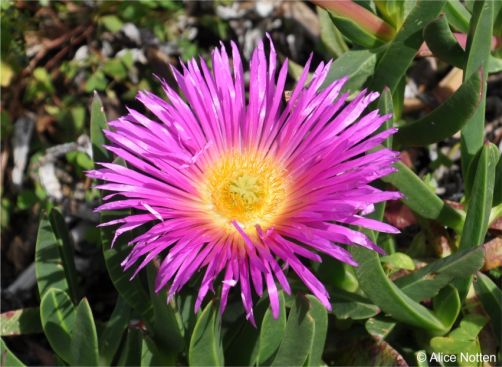
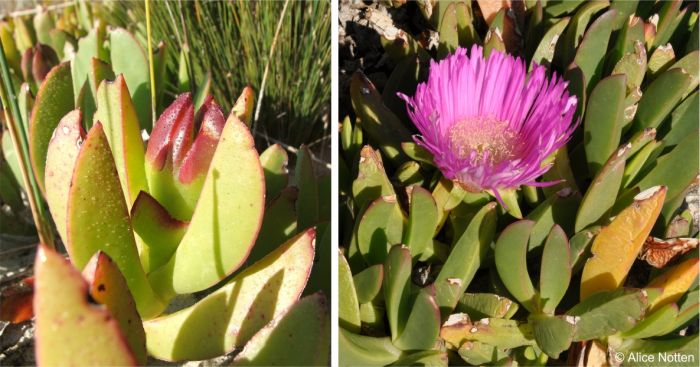
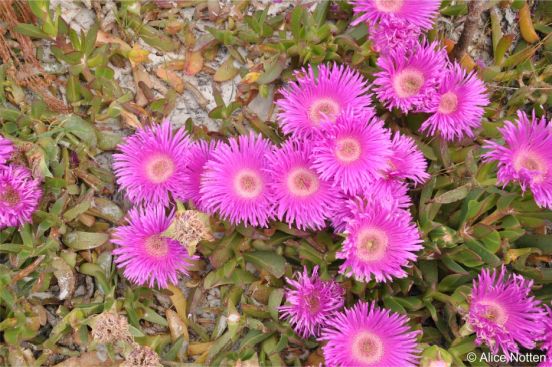
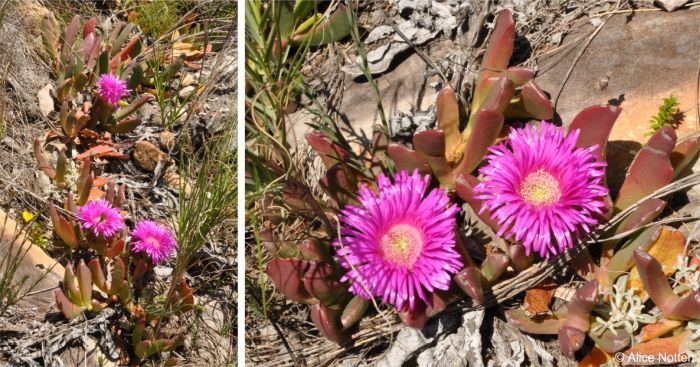
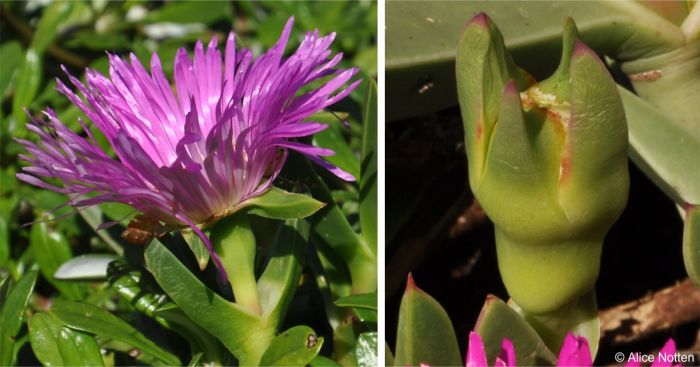
A robust, low-growing perennial with trailing stems up to 2 m long, forming dense mats, rooting at nodes. The leaves are fleshy, sabre-shaped, 15-20 mm in diameter, yellowish to grass-green, often red-tinged at the edges. In spring and early summer, from August to December, it bears large bright pinkish-purple flowers 70-100 mm in diameter. They are solitary and they open up in the morning when they receive direct sunlight. The receptacle is oblong and curves abruptly into the pedicel. Seeds are numerous, small, flat, obovate, dark brown or reddish-brown , measuring approximately 1.5 mm. The fruits are semi-globose when ripe turning reddish-brown or purple-pink and have a pleasant aromatic smell when ripe. The seeds are embedded in a sticky, sweet-sour, jelly-like pulp inside the fleshy fruit.
Conservation Status
Status
Carpobrotus acinaciformis is not anywhere even near threatened, even though it is deeply rooted in traditional medicine and has been widely used for centuries for its healing properties and is a popular fruit for jams and curry dishes. The Red List of South African Plants still considers it to be a Least Concern (LC) plant with stable populations.
Distribution and habitat
Distribution description
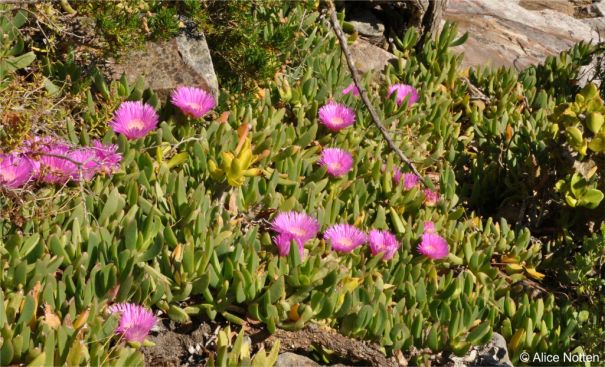
Carpobrotus acinaciformis is endemic to the Western Cape of South Africa, ranging from Saldanha to Mossel Bay, growing on coastal dunes and in Cape flats sand fynbos. It is widely grown as an ornamental plant and has been introduced in other countries, and in the Mediterranean climates of coastal Europe, California and Australia it has naturalised and become an invasive species. It thrives in sunny, sandy coastal areas, forming dense, fast-growing mats with long stems and spreading branches rooting at nodes functioning as an excellent sand binder, normally found growing on dunes, sandy cliffs and beaches.
Derivation of name and historical aspects
History
The name Carpobrotus is derived from the Greek word karpos, meaning ‘fruit’ and brotos, meaning ‘edible’. The Latin word acinaciformis means ‘having the form of a scimitar’, referring to the shape of the leaves. The name Hottentot fig (Hottentotsvy) was first used a long time ago in 1685, it is derived from the Colonists’s observations of the KhoiKhoi or Khoekhoe (Hottentot) people harvesting and using parts of the plants such as leaves and fruits, and the fruits resembling figs.
This species is closely related to C. edulis, but can be distinguished by its flowers that are vibrant purplish-pink where C. edulis flowers are yellow. Both plants have been traditionally used for centuries for their medicinal and edible properties by KhoiKhoi and San (Bushman) people, often referred to as the Khoi-San people.
Carpobrotus acinaciformis belongs to Aizoaceae family, a large group of succulent plants with about 1 500 species found in South Africa.
Ecology
Ecology
Carpobrotus acinaciformis is a mat-forming succulent that has long stems and spreading branches that root freely making it an exceptional sand binder for coastal dunes, sandy cliffs and beaches. C. acinaciformis is fire-resistant due to its leaves having a high water content, making it an excellent plant to use as fire break especially in fire-prone areas, it can be used for fire-scaping a garden.
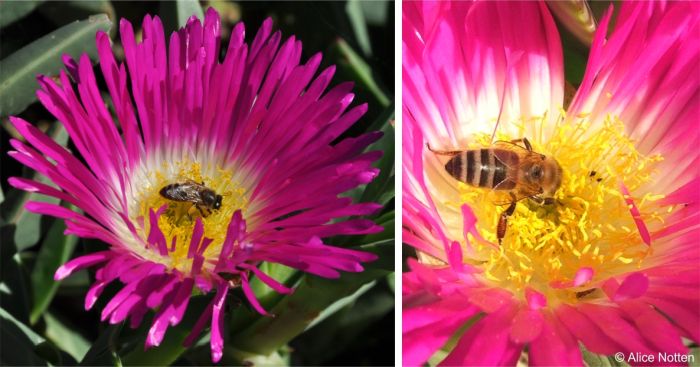
The vibrant purple-pink flowers attract pollinators, such as honey-bees and other insects. The pulpy, berry-like fruits are eaten by humans and animals, which disperse the seeds and expand the the plant’s range.
Uses
Use
Carpobrotus acinaciformis has been used traditionally for centuries, mainly its leaves and fruit. The leaves are highly astringent, mildly antiseptic, diuretic and styptic. The juice from the leaves can be used as mouth wash, gargled to treat mouth ulcers and throat infections, it can also be used in cosmetics as a skin treatment for eczema, wounds, burns and bluebottle stings. The leaves can be chewed to ease ear ache or tooth ache as well as to treat tonsillitis, and can be rubbed against babies gums to soothe them them when teething.
The fruits are edible, the base of the fruit is bitten off and the sweet-sour pulp is sucked out. The ripe fruits are cooked and cooled off, the syrup is then used to make the famous sour fig jam. The fruits can also be used in curry dishes to add an aromatic sweet-sour, tangy favour.
Growing Carpobrotus acinaciformis
Grow
Carpobrotus acinaciformis is an easy and fast species to grow. It requires well-drained soil and full sun. In a garden it can be planted on sandy slopes or in areas where there is soil erosion and it will act a soil binder. It is drought-resistant and can be planted in a water-wise zoned garden. It can be used to screen a retaining wall where it will trail over and hang down the wall, and it can be used in large hanging baskets.
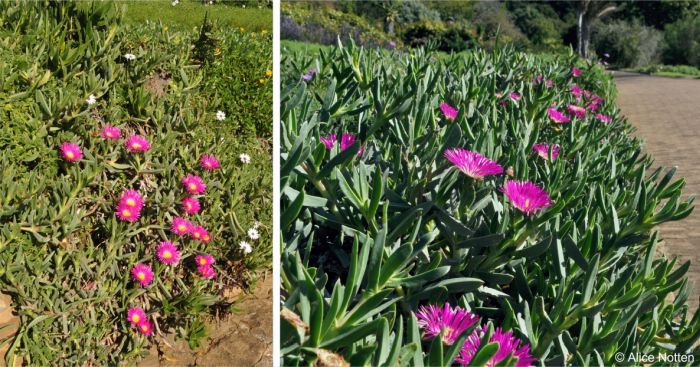
Make cuttings during the active growing season, allow the base of the cuttings to dry out before it inserting into a well-drained soil, this will ensure that the cuttings don’t rot. They are easy to root and don’t require any special treatment. Seeds should be sown when night temperatures are moderate, they usually germinate in 7-10 days. When they are large enough they can be transferred into pots or bags or planted out directly into flowerbeds where they will still survive if well taken care of until established.
Avoid overwatering because it will stress the plant and cause bacterial rot of the leaves. Another health threat to the plant is spittlebugs, and spraying horticultural soap will help get rid of the bugs.
References
- Burman, l. & Bean, A. 1985. Hottentots Hollands to Hermanus. South African Wild Flower Guide 5. Botanical Society of South Africa, Cape Town.
- Fernkloof Nature Reserve. Carpobrotus acinaciformis. https://www.fernkloof.org.za/index.php/all-plants/plant-families/item/carpobrotus-acinaciformis. Accessed on 2026/02/24.
- Helme, N. & Manning, J. 2024. Ericas of the Fynbos. Published by Struik Nature.
- iNaturalist. Carpobrotus acinaciformis. https://www.inaturalist.org/taxa/129759-Carpobrotus-acinaciformis. Accessed on 2026/02/24.
- Jackson, W.P.U. 1990. Origins and meanings of names of South African plant genera. University of Cape Town Printing Department, Cape Town.
- Manning, J. & Goldblatt, P. 2012. Plants of the Greater Cape Floristic Region 1: the Core Cape Flora. Strelitzia 29. South African National Biodiversity Institute, Pretoria.
- Manning, J. 2007. Field guide to Fynbos. Struik Publishers, Cape Town.
- Raimondo, D., Von Staden, L., Foden, W., Victor, J.E., Helme, N.A., Turner, R.C., Kamundi, D.A. & Manyama, P.A. (eds) 2009. Red list of South African plants. Strelitzia 25. South African National Biodiversity Institute, Pretoria.
- Useful Tropical Plants. Carpobrotus acinaciformis. https://tropical.theferns.info/viewtropical.php?id=Carpobrotus+acinaciformis. Accessed on 2026/02/24.
- Van Wyk, B.-E. 2008. A review of Khoi-San and Cape Dutch medical ethnobotany. Journal of Ethnopharmacology 119: 331–341.
Credits
Caroline Marima
Harold Porter National Botanical Garden
March 2026
Acknowledgements: images by Alice Notten
Plant Attributes:
Plant Type: Ground Cover, Succulent
SA Distribution: Western Cape
Soil type: Sandy, Loam
Flowering season: Spring, Early Summer
PH: Acid, Neutral
Flower colour: Purple, Pink
Aspect: Full Sun
Gardening skill: Easy
Special Features:
 Drought resistant
 Edible plant
 Medical plant
 Useful plant
 Feeds honeybees
 Pioneer plant
Horticultural zones


Rate this article
Article well written and informative
Rate this plant
Is this an interesting plant?
Login to add your Comment
Back to topNot registered yet? Click here to register.