


Drimiopsis dolomitica
Introduction
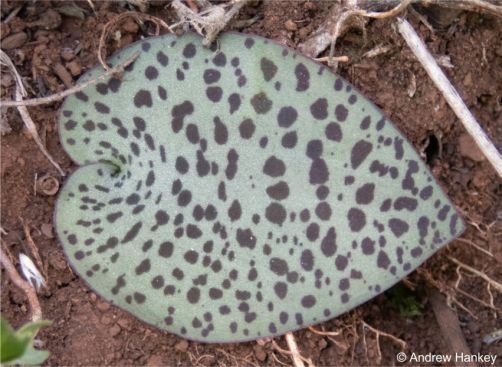
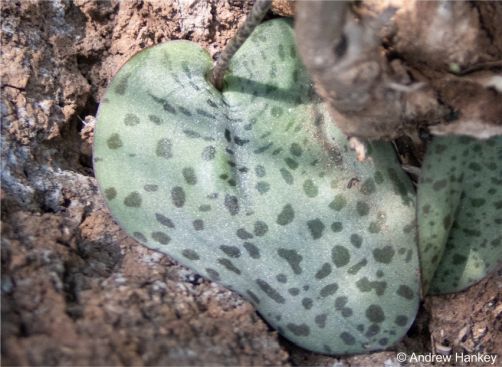
Unusual dwarf bulbous plant producing a solitary appressed silvery leaf with dark brown spots, usually associated with rocky outcrops.
Description
Description
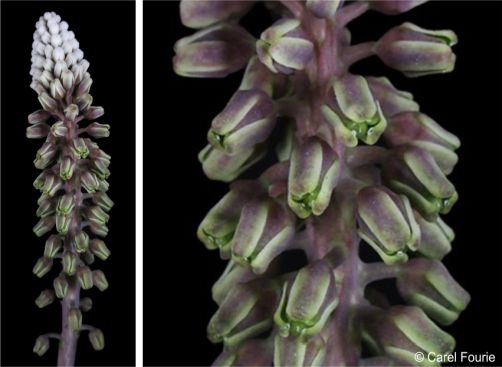
This unique bulbous plant produces a solitary, appressed, silvery, heart-shaped leaf with brown spots, which is usually flat on the ground. The leaves are usually solitary although occasionally plants with two leaves can be found. The flower stalk is produced early in the season and is topped with small bluish-green flowers that don’t really open fully like most flowers. The flowers are replaced by small greenish seed capsules which develop quickly. The outer skin of the capsule shrivels to release the small black seeds which usually fall near the base of the mother plant.
Conservation Status
Status
This species has not yet been assessed by the Red List of South African Plants, however the author suggests that according to ICUN Red List thresholds this species would probably be listed as Critically Rare.
Distribution and habitat
Distribution description
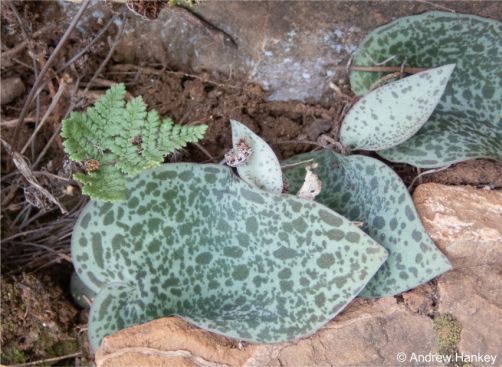
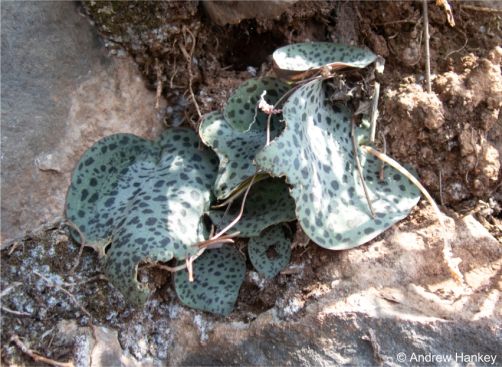
This species is restricted to a small location in the Limpopo province where it occurs amongst dolomite rock outcrops in savannah vegetation. The species prefers to remain in the protection of the rocks where it can presumably get protection from herbivores by hiding its bulbs between, and deep in, rock crevices. The species is seldom seen in the surrounding open woodland vegetation. The area receives summer rainfall with hot summers and mild dry winters with most of the annual rainfall falling in the summer months. Like most bulbous plants, the species is deciduous and goes completely dormant during the unfavourable winter months.
Derivation of name and historical aspects
History
The name Drimiopsis comes from the Latin drimi- in reference to another genus of bulbous plants Drimia, and the Latin suffix -opsis meaning ‘looks similar to’. In summary ‘the plant that looks similar to a Drimia’. The species name dolomitica is in reference to the specific type of rock (dolomite) on which the species is known to occur. The species was first collected by South African botanists Dr Codd and Dr De Winter in 1947, although it was not at that time recognized as a new species. Only after it was re-discovered from a collection in 2007 by Dr M. Lӧtter did it again become noticed, and was studied to determine that it was indeed a new species to science.
The genus Drimiopsis is a small genus of fewer than 20 species, mostly occurring in South Africa with a few species in west and east Africa. Drimiopsis was combined under a broader concept of Ledebouria in 2004 however a 2022 study shows that Drimiopsis may belong in a distinct clade. Pending further clarifying studies, Hankey and De Castro choose to retain it as a separate genus. The plants mostly have spotted leaves and are often found hiding under the shade of other vegetation, which often causes them to go un-noticed. Few of the species are cultivated, although there is one species, Drimiopsis maculata, which has been extensively spread around the world by humans, as a popular horticultural subject.
Ecology
Ecology
Little is known about the pollinators of this species, however closely related species have been observed to be pollinated by solitary bees, small flies and even wasps. The flowers are sweetly scented, mostly during the day time. Since the flowers don’t open fully the visiting insects have to physically open the petals with their forelegs in order to gain access to the nectar and internal structures in the flower. Seed capsules are produced quickly after the flowers have been pollinated, small black seeds drop to the ground around the mother plant where they germinate to create small clusters of plants in rock crevices.
Uses
Use
There are no known uses for the species although the group of plants that this species belongs to is regarded as being poisonous. Some species are used as traditional medicine by local people.
Growing Drimiopsis dolomitica
Grow
Dolomite African hyacinth is a novelty that would only really appeal to bulb collectors, it is more suited pot culture and would have little role in a gardening situation. The species is easy to maintain, although the plants tend to become more robust under cultivation than in the wild, often producing larger and more than one leaf, and leaves also become spreading as opposed to being pressed to the soil. This aspect makes the species less appealing and it should be kept in full sun or brightly-shaded light to avoid this happening. The broad ovate leaf with its silvery sheen is an attractive feature that makes this plant an ideal subject for collectors. The species is easily grown from fresh seed and can be raised to adult size in two to three years in cultivation. This species is suited to a warm climate with mild winters. Ideally the plants should be lifted from their pots in winter or alternatively the containers can be kept dry and cool as watering may stimulate early sprouting. Watering can be resumed in spring, around September, and can be applied as necessary during the summer months, although it should be borne in mind that the species will endure protracted hot and dry periods during the summer months.
The species may be able to be propagated from leaf cuttings done early in the season, although this has not been tested on this species. Seed should sown fresh ideally in spring in a well-drained potting soil with some sharp sand added. Rich soils should be avoided as this encourages the plants to become to robust and lose their wild characteristics. Seed germinates quickly and seedlings can be seen emerging within three to six weeks. The seedlings can be left in their natal seed tray or pricked out into individual containers using the same soil mixture. Seedlings and adult plants can be prone to mealy bug especially when air movement is inadequate. Fertilising should be avoided as this too results in the plants becoming robust and detracts from their wild character.
References
- Hankey, A.J. & De Castro, A. 2025. New species and new combinations in the genus Drimiopsis Lindl. and Paxton (Asparagaceae, Scilloideae) from Mpumalanga and Limpopo, South Africa. Haseltonia 32:1–22.
- IPNI, International Plant Names Index. Drimiopsis dolomitica Hankey. The Royal Botanic Gardens, Kew, Harvard University Herbaria & Libraries and Australian National Herbarium. Online. https://beta.ipni.org/n/77370248-1. Accessed 26 March 2026.
Credits
Andrew Hankey
Walter Sisulu National Botanical Garden
April 2026
Acknowledgements: the author thanks Carel Fourie for the image of the inflorescence.
Plant Attributes:
Plant Type: Bulb
SA Distribution: Limpopo
Soil type: Loam
Flowering season: Spring
PH: Neutral
Flower colour: Green
Aspect: Shade, Morning Sun (Semi Shade)
Gardening skill: Easy
Special Features:
 Fragrant
 Good potplant
Horticultural zones




Rate this article
Article well written and informative
Rate this plant
Is this an interesting plant?
Login to add your Comment
Back to topNot registered yet? Click here to register.