


Drosanthemum anemophilum
Introduction
Drosanthemum anemophilum is an erect spindly cliff-squatting shrub to 1.5 m tall. The leaves are succulent, linear and light pink to white flowers appear in spring, at the ends of the branches. The fruiting capsules are bony and remain open once opened. Confined to the mountains just south of Laingsburg in the Western Cape. Grows well in small containers.
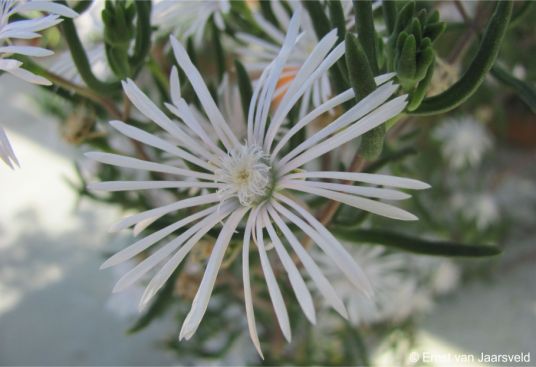
Fig. 1. A close-up of a flower of Drosanthemum anemophilum in cultivation at Kirstenbosch, Cape Town. Note the staminodes towards centre of the flower.
Description
Description
The plants are summer-deciduous spindly shrubs to 1.5 m tall, with erect growth from a solitary lower main branch, with leaves and fertile parts carried at the branch ends. Main branch woody, up to 18 mm thick, terete, sometimes slightly angular, with smooth purplish brown bark; young branches warty (papillate) which subsides with age. The older branches are smooth (glabrescent). The leaves opposite, equal, warty (papillate), compressed, 3-angled, 10–16 × 2–2.5 × 2 mm, dark dull green, ascending-spreading; apices slightly incurved, obtuse. Older leaves becoming purplish at their tips and ultimately yellow when they drop at the end of the spring. The flowers diurnal, appearing in late spring and early summer (October to early November), solitary and at the ends of the branches. The pedicels 2–8(–15) mm long. The sepals 5, triangular, 3 × 3 mm, margins thin, aging to a dull to dark purple. The floral petals linear, 10–14 × 0.5 mm, blunt, spreading, in 2 series: a longer outer one and a shorter inner erect one, mauve pink to white, shiny. The staminodes in a central cone and the filaments about 2 mm long, white, the anthers 0.3 mm long, white, not overtopping the stigmas. The ovary is conical, 5-angled, raised to about 2.5 mm, reddish when fresh. The stigmas (female part) 5, ascending-spreading, lanceolate, 1.5–2 mm long. The fruiting capsule is rounded (globose) to top-shaped, with 5 cavities (5-locular), 9–11 × 7–9 mm when fresh, reduced to about 7–8 × 5–8 mm when dried, the seed cavities (loculi) deep and slightly narrowing to the 4 mm wide at the, hard and bone-like, ivory-coloured when dried, and difficult to break open with the fingers, hygroscopic. The valves triangular, 2 × 2 mm, without wings, remaining erect once opened. The expanding keels contiguous, parallel, loculi deep (4–5 mm), without covering membranes, central axis and loculi roofs raised to almost as high as open erect valves. The seed 1.3 × 0.75 × 0.40 mm, minutely tuberculate, slightly flattened, brownish. Flowering mainly in spring and early summer.
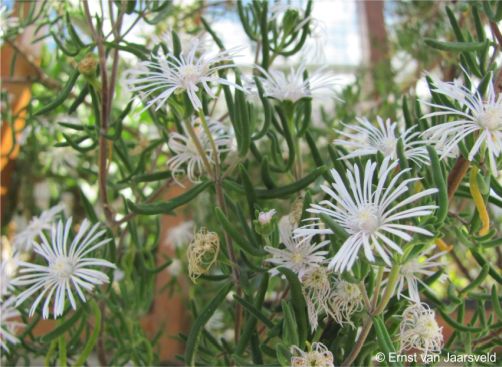
Fig. 2. Drosanthemum anemophilum in flower in a corner unit in the Botanical Society Conservatory at Kirstenbosch, Cape Town.
Conservation Status
Status
Only known from one spot and not assessed by the Red List of South African Plants, but due to its localised specialist habitat it should be classified as Rare.
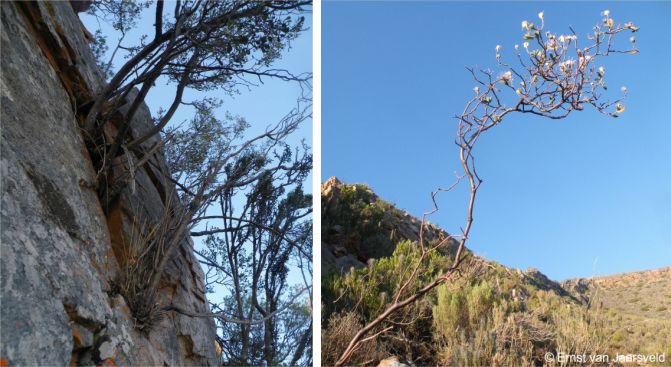
Fig. 3. LEFT In habitat, Drosanthemum anemophilum grows firmly anchored in crevices and ledges at the base of the cliff face. RIGHT Plants grow tall, erect and spindly from a solitary main branch, with leaves, flowers and fruits carried at the branch ends.
Distribution and habitat
Distribution description
Drosanthemum anemophilum is a quarzitic sandstone endemic, confined mainly to the south-facing cliffs on the Rooinek Pass, south of Laingsburg in the Western Cape. The habitat consists of steep, south-facing aspects, on and below sandstone cliffs, up to altitudes 800–1 000 m. The geology consists of quarzitic sandstone of the Table Mountain Group (Cape Supergroup).Plants are rooted in crevices and on ledges. Temperature high in summer, warm with cold nights in winter. Average daily maximum temperature about 29°C and average daily minimum about 14°C. Rainfall in winter and summer, 200–300 mm per annum.
The associated vegetation is the Western Little Karoo of the Succulent Karoo Biome and plants that share its habitat at Rooinek Pass include Crassula atropurpurea var. purcellii, Crassula brachystachya, Othonna osteospermoides and Baculellum articulatum (= Senecio articulatus).
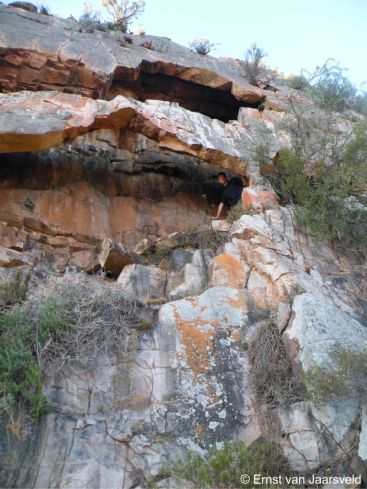
Fig. 4. The mineral poor, quarzitic sandstone cliff face on the Rooinek Pass, south of Laingsburg, Western Cape, habitat of Drosanthemum anemophilum, with Gunter Vandeval among the sandstone rocks.
Derivation of name and historical aspects
History
Drosanthemum anemophilum was named by Steven Hammer, American mesemb specialist, and the author in the Cactus and Succulent Journal (Los Angeles) in 2004, from plants collected by the author on the Rooinek Pass. The author joined a friend, Jan Theart, who wanted to show him Haworthia wittebergensis growing in the sandstone rock crevices on the Rooinek Pass. Having seen and documented the species of Haworthia, the author explored the adjacent cliffs where he came across this peculiar ascending mesemb with long spindly branches, light pink flowers and hard, firm, bone-like capsules which remain open. Material was collected, which revealed it to be a species unknown to science. Steven Hammer, due to his interest in Mesembs, was invited to become part of the article. The epithet anemophilum, meaning ‘wind-loving’, pertains to the wind-dispersed seed. Due to the very different capsule and peculiar mode of growth we were unsure where to place this plant, however the leaves and flowers are typical of Drosanthemum. The habitat was visited again in October 2010 with visiting Belgian student Gunther Vandeval and local ecologist, Greg Nicolson, when the plants were in full flower.
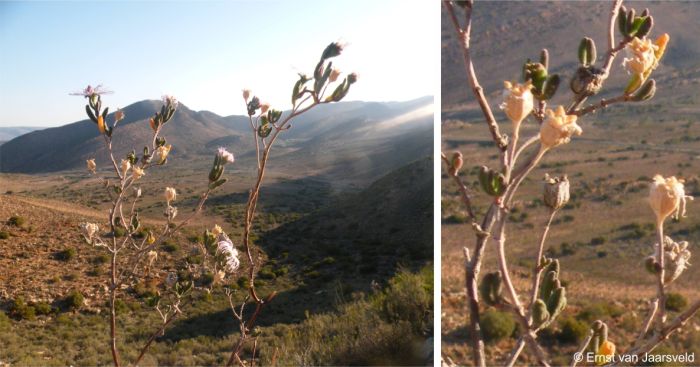
Fig. 5. Drosanthemum anemophilum in flower in its native habitat on the Rooinek Pass, south of Laingsburg, Western Cape. Note the persistent capsules from the previous year’s growth.
Drosanthemum is a large genus created in 1927 by Gustav Schwantes (1881–1960), a German archaeologist, botanist and mesemb specialist. The genus presently consists of about 130 species, all succulents, and mainly confined to the semi-arid winter-rainfall region in southern Africa, and many are highly ornamental and often grown in gardens local and abroad. The appropriate genus name Drosanthemum, meaning ‘dew flower’ is derived from Greek, drosos meaning ‘dew’, and anthemum ‘flower’, and pertains to the shiny leaf papillae. In 2007, Heidi Hartmann, German mesemb specialist, subdivided the genus into 8 new subgenera. In 2014, together with Sigrid Liede-Schumann they added another two, subgenera Quadrata and Decidua. Subgenus Decidua was created accommodating the plants that possess cork in the lower portion of the flower and fruit stalk, and white paper-like sheaths left behind after the leaves are dropped in the dry summer months, which includes our species D. anemophilum. The subgenus Decidua includes 5 species: D. anemophilum (Laingsburg, Western Cape), D. inornatum (Richtersveld and Hunsberg, Northern Cape and Namibia), D. longipes (Clanwilliam, Western Cape), D. deciduum (Loeriesfontein, Northern Cape) and D. pauper (Luderitz & Hardap, Namibia).
Drosanthemum anemophilum is not closely related to other members of Decidua and is immediately distinguished by being a tall, erect, spindly shrub to 1.5 m as well as its very distinctive bony capsule which remains open, and flattish, wind-dispersed seeds. In fact it is the tallest species in the genus Drosanthemum, and like other members of Decidua, it loses its leaves during the dry summers.
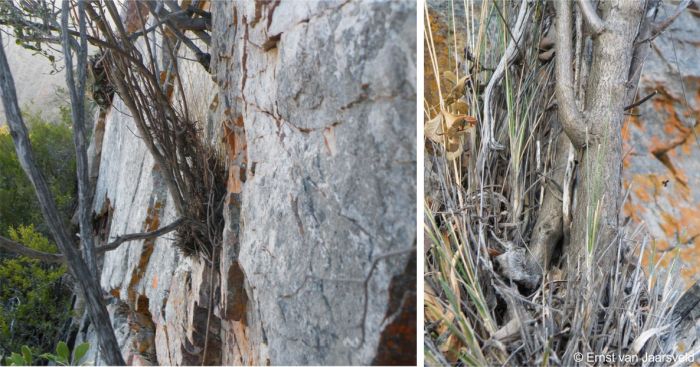
Fig. 6. The basal stem of a Drosanthemum anemophilum plant among a tuft of grass and firmly anchored on the cliff face, in its native habitat on the Rooinek Pass. It represents not only the tallest but also largest stem diameter in the genus Drosanthemum.
Ecology
Ecology
Plants have an unusual shape when related to other obligatory cliff dwelling plants, being erect, very sparsely branched, of a virgate growth habit and growing up to 1.5 m high. It has a central taproot, firmly anchored on cliff face with fibrous roots. The stems are initially succulent, erect and soon becoming woody. The succulent ascending spreading pale green leaves aid the plant during the dry periods.
The tall growth sways with the prevailing south-easterly winds that are strong at times, and the seeds are shaken out of the capsules and dispersed. The fruiting capsule remains open, the slightly flattened seeds are dispersed by wind and jactitation. The seed is 1.3 × 0.75 × 0.40 mm, brownish, minutely tuberculate. It ripens throughout the summer and autumn, in time for winter rains. Germination after 14–21 days.
The flowers are solitary at branch ends, conspicuous, maximising visibility for successful pollination in the cliff environment. Flowering time is in spring (October–November). A solitary bee was observed visiting the flowers in habitat.
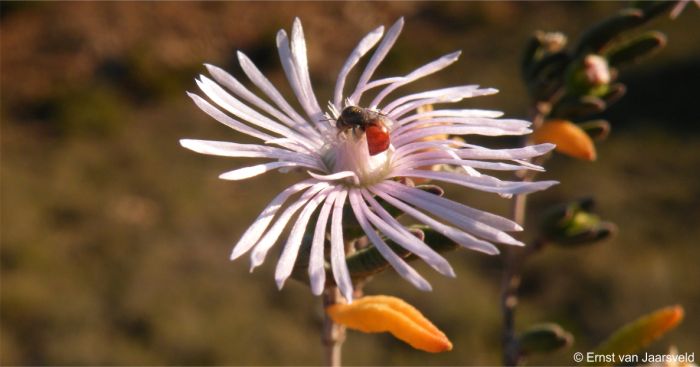
Fig. 7. Drosanthemum anemophilum with its solitary bee pollinator in habitat on the Rooinek Pass, South of Laingsburg, Western Cape.
Uses
Use
It is not known whether the plants are used.
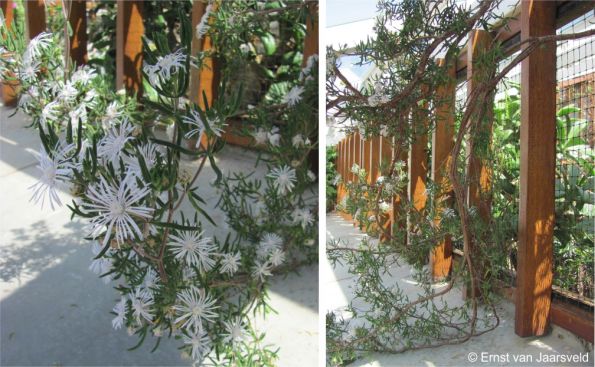
Fig. 8. Drosanthemum anemophilum in flower in a corner unit of the Botanical Society Conservatory at Kirstenbosch, Cape Town, Western Cape. The flower colour varies from light pink to white. The plant became scandent.
Growing Drosanthemum anemophilum
Grow
Drosanthemum anemophilum is an ascending leaf-succulent shrub which is best grown in succulent karoo gardens on steep embankments and slopes. Outside the habitat, it is best grown under controlled conditions in a greenhouse. Plants grown from seed in the Botanical Society Conservatory, Klein Karoo Section and the Leslie Hill Stone Plant Corner Unit grew fast and flowered and fruited well. With its tall growth it became scandent. In cultivation it would suit a wall but a support should be provided. Propagation is by seed sown in the cooler months. Gemination is within 3 weeks and the young seedlings can be pricked out as soon as they are large enough to handle. Plant in a well-drained, mineral poor sandy soil mixture. Grow in full sun or dappled shade. Water sparingly throughout the year. Plants should flower in about 3 years.
References
- Christenhusz, M.J.M., Fay, M.F. & Chase, M.W. 2017. Plants of the World, an illustrated Encyclopedia of vascular plants. Kew Publishing, Royal Botanic Gardens, Kew.
- Clarke, H. & Charters, M. 2016. The illustrated dictionary of southern African plant names. Flora & Fauna Publications Trust, Jacana, Johannesburg.
- Hartmann, H.E.K. 2007. Studies in Aizoaceae: eight new subgenera in Drosanthemum Schwantes. Bradleya 25: 145–176.
- Hartmann, H.E.K. & Liede-Schumann, S. 2014. Two new subgenera and one new species in the genus Drosanthemum. Bradleya 32: 50-63.
- Jackson, W.P.U. 1990. Origins and meanings of names of South African plant genera. University of Cape Town Printing Department, Cape Town.
- Mucina, L. & Rutherford, M.C. (eds) 2006. The vegetation of South Africa, Lesotho and Swaziland. Strelitzia 19. South African National Biodiversity Institute, Pretoria.
- Van Jaarsveld, E.J. & Hammer, S. 2004. An unusual new species of Drosanthemum from Rooinek Pass in South Africa’s Western Cape. Cactus & Succulent Journal 76(3): 202–204.
Credits
Ernst van Jaarsveld
Kirstenbosch National Botanical Garden (Retired)
Babylonstoren Farm (Current)
Extraordinary senior lecturer and researcher,
Department of Biodiversity and Conservation, University of the Western Cape
May 2026
Plant Attributes:
Plant Type: Shrub, Succulent
SA Distribution: Western Cape
Soil type: Sandy
Flowering season: Spring, Early Summer
PH: Acid
Flower colour: White, Pink
Aspect: Full Sun, Morning Sun (Semi Shade), Afternoon Sun (Semi Shade)
Gardening skill: Challenging
Special Features:
 Drought resistant
Horticultural zones


Rate this article
Article well written and informative
Rate this plant
Is this an interesting plant?
Login to add your Comment
Back to topNot registered yet? Click here to register.