


Delosperma purpureum
Introduction
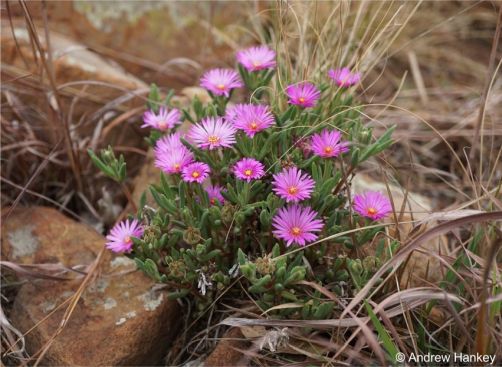
Delosperma purpureum is a striking, low-growing succulent that creates a vibrant display of rich purple hues. Its fleshy foliage supports a profusion of dazzling, star-shaped flowers that form a dense, jewel-toned carpet across the ground. Exceptionally hardy and drought-tolerant, it thrives in harsh conditions, bringing both resilience and brilliance to the landscape. This species effortlessly transforms garden spaces into vivid, colourful displays while requiring minimal maintenance.
Description
Description
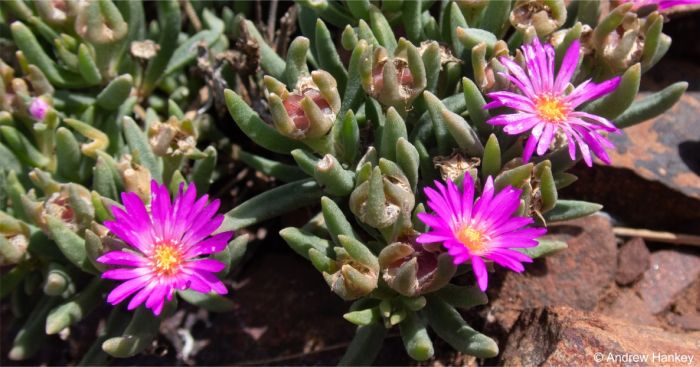
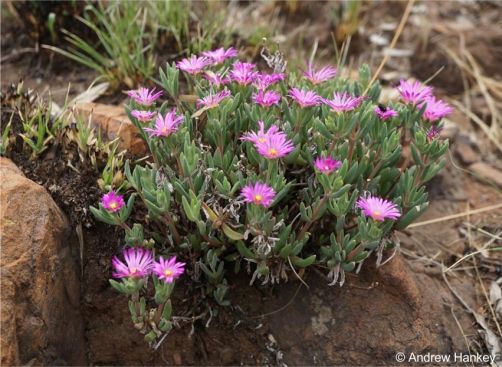
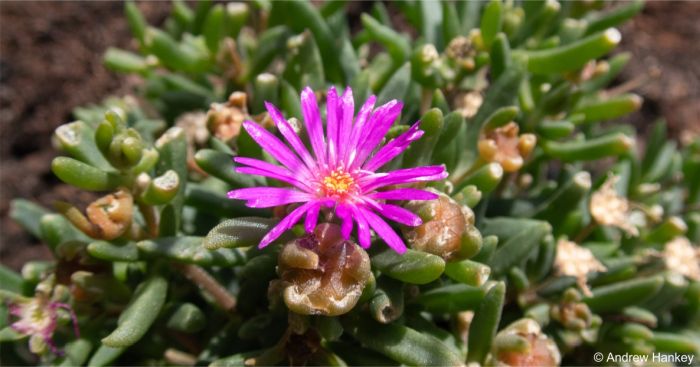
Delosperma purpureum is a captivating succulent perennial characterised by a somewhat woody taproot reaching up to 120 mm in length and approximately 15 mm in diameter. From the root apex arises a cluster of stems (hypocotyl), producing erect, fasciculate branches with basal vegetative growth. The stems attain heights of up to 90 mm and bear linear leaves measuring 10–40 mm in length, approximately 2.4 mm in width, and 2–4 mm in thickness. Leaf apices are straight and acute, while the upper surface is slightly channeled under natural conditions. Bladder cells are semi-globose, either smooth or with a small central dome.
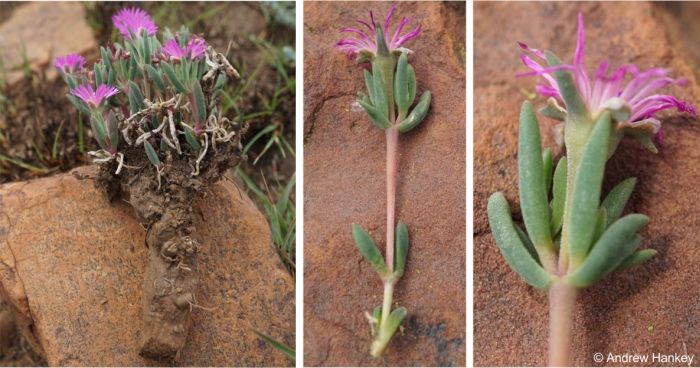
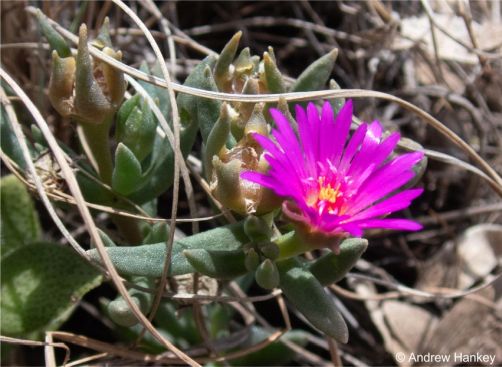
Inflorescences are arranged in cymes and are borne above the foliage, often persisting in the following season as dried skeletal remains. Pedicels range from 8–20 mm in length. The flowers, measuring 10–23 mm in diameter, display deep purple petals arranged in one to two series, non-overlapping laterally, and lacking an inner series of shorter petals. Individual petals are 7–8 mm long and approximately 1.2 mm wide. The calyx lobes are unequal, measuring approximately 4.5 mm and 3 mm respectively. The flowers contain 16–22 filamentous staminodes and approximately 45 stamens. The fruit is a capsule, 4–5.5 mm in diameter, which senesces after one season. It detaches cleanly from its base before dispersal. The capsule apex is initially flat but later becomes centrally sunken, completing the reproductive cycle. Flowering occurs during the spring and summer months in South Africa.
Conservation Status
Status
Delosperma purpureum is currently classified as Endangered (EN) on the Red List of South African Plants due to ongoing habitat loss and degradation caused by urban expansion and invasive alien plants.
Distribution and habitat
Distribution description
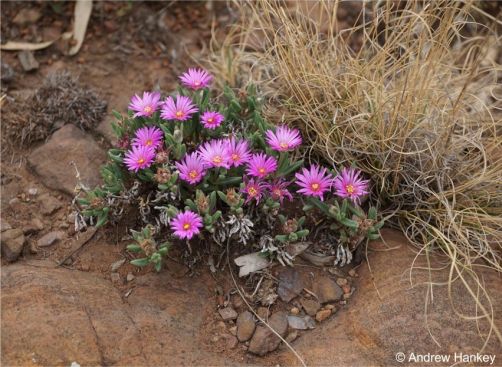
This species is endemic to the Witwatersrand in the province of Gauteng in South Africa. It occurs in Gold Reef Mountain Bushveld and Andesite Mountain Bushveld vegetation types, typically growing in shallow soils among crystalline or conglomerate quarzitic rocks on south-facing slopes.
Derivation of name and historical aspects
History
The genus name Delosperma is derived from the Greek delos, meaning visible or evident and sperma, meaning seeds, referring to the exposed seeds visible within the fruiting capsule. The genus was described in 1925 by Nicholas Edward Brown, a British botanist who made significant contributions to the taxonomy of southern African succulents. The species epithet purpureum is derived from Latin, meaning purple, in reference to the vivid flower colour.
Delosperma purpureum belongs to the Aizoaceae, commonly known as the ice plant family. This family comprises approximately 1 800 species across more than 135 genera, largely distributed in arid and semi-arid regions, particularly in southern Africa. Members are well adapted to water-limited environments through various succulent strategies.
Ecology
Ecology
Delosperma purpureum is well adapted to fire-prone grassland systems. It employs several survival strategies, including the formation of regenerative buds on the hypocotyl, the development of adventitious storage roots for moisture retention, and the ability to resprout from basal nodes of old inflorescences. These adaptations enable rapid post-disturbance recovery.
The species typically occurs in rocky grassland habitats, where it grows in humus-rich pockets associated with rock outcrops. These microhabitats enhance moisture retention and provide protection from environmental extremes.
The brightly coloured flowers attract a range of pollinators, including bees and butterflies, contributing to pollination processes. The plant also provides habitat and resources for various invertebrates, playing a functional role in local ecosystems.
Uses
Use
Delosperma purpureum can be utilised in landscaping for its striking floral display and drought tolerance. It is particularly suitable for rock gardens, borders, and as a ground cover in well-drained, sunny areas. Its spreading growth habit and root system contribute to soil stabilisation, making it effective for erosion control on slopes.
The species is also well suited to xeriscaping, where water conservation is a priority. In its natural range, it is appreciated for its resilience and aesthetic value, symbolising endurance and adaptability.
Growing Delosperma purpureum
Grow
Delosperma purpureum is relatively easy to cultivate and can be propagated through seed, cuttings, or division. It performs best in well-drained soils and full sun, and is tolerant of nutrient-poor substrates, although it does not thrive in heavy clay soils.
Seeds should be sown in well-drained media and lightly covered, with germination typically occurring within 2–3 weeks under suitable moisture conditions. Seedlings can be transplanted once established.
Vegetative propagation via stem cuttings is the most reliable method. Cuttings should be taken in spring or summer, allowed to callus for 1–2 days, and then planted in a well-drained medium. Watering should be minimal until roots have developed.
References
- Buys, M.H., Janse van Rensburg, L.L., Mienie, C.M.S., Barker, N. & Hartmann, H.E.K. 2008. Applying AFLPs in Aizoaceae: The Delosperma herbeum complex as a case study. Biochemical Systematics and Ecology 36: 92-100.
- Hankey, A. 2026. Observations of Delosperma purpureum. iNaturalist. Online. https://www.inaturalist.org/observations?taxon_id=583556&user_id=andrew_hankey.
- Hartmann, H. 2001. Illustrated handbook of succulent plants. Aizoaceae, A-E. Springer, Berlin.
- Hankey, A. 2026. Observations of Delosperma purpureum. iNaturalist. Online. https://www.inaturalist.org/observations?taxon_id=583556&user_id=andrew_hankey.
- Valente, L.M., Britton, A., Powell, M.P., Papadopulos, A., Burgoyne, P. & Savolainen, V. 2014. Correlates of hyperdiversity in southern African ice plants (Aizoaceae). Botanical Journal of the Linnean Society 174(1):110-129.
- Victor, J.E. & Pfab, M.F. 2005. Delosperma purpureum H.E.K. Hartmann. National Assessment: Red List of South African Plants version 2024.1. Accessed on 2026/05/05
Credits
Rofhiwa Ingrid Mudau
Pretoria National Botanical Garden
May 2026
Acknowledgments: Images by Andrew Hankey.
Plant Attributes:
Plant Type: Succulent
SA Distribution: Gauteng
Soil type: Sandy
Flowering season: Spring, Early Summer, Late Summer
PH: Acid, Neutral
Flower colour: Purple
Aspect: Full Sun
Gardening skill: Easy
Special Features:
 Attracts butterflies
 Drought resistant
 Good potplant
 Feeds honeybees
Horticultural zones





Rate this article
Article well written and informative
Rate this plant
Is this an interesting plant?
Login to add your Comment
Back to topNot registered yet? Click here to register.