


Syncolostemon albiflorus
Introduction
Indigenous to the mountainous region of northeastern southern Africa, white sagebush is a specialist of harsh, exposed environments and thrives in cracks of rocky quartzite, transforming bare stones into a home. This adaptatable and resilient plant also has stunning white and purple flower heads during summer, and makes an ecologically beneficial and an aesthetically pleasing addition to any landscape.
Description
Description
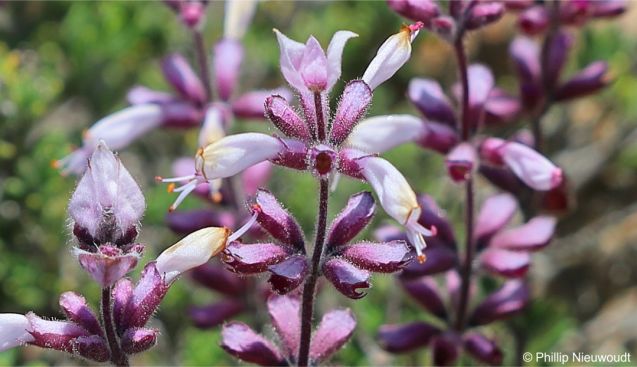
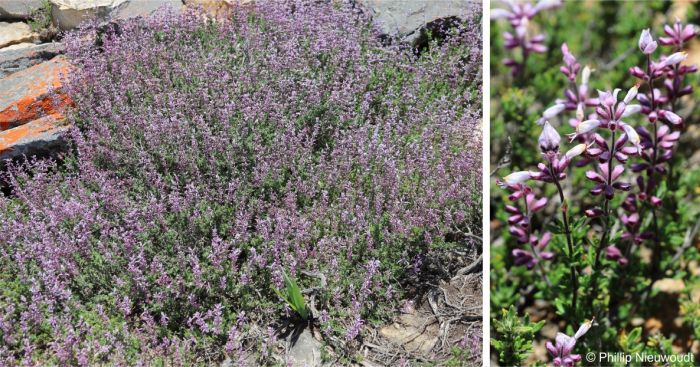
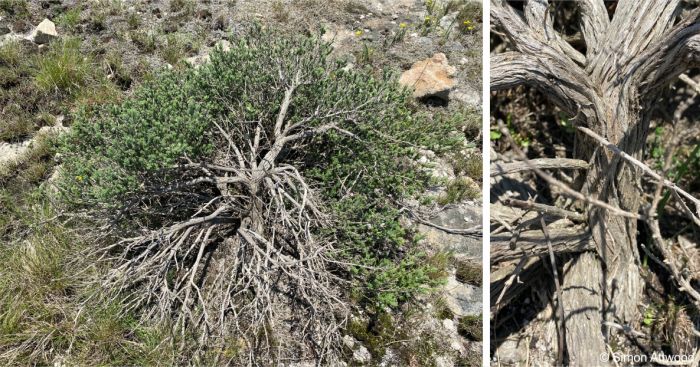
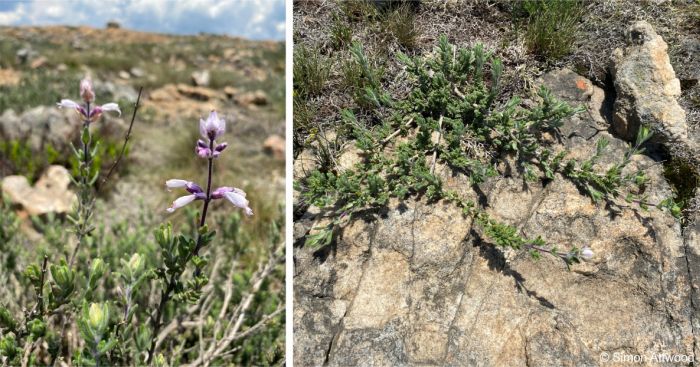
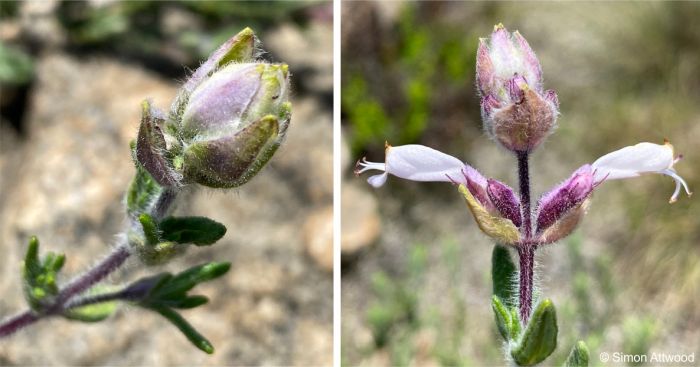
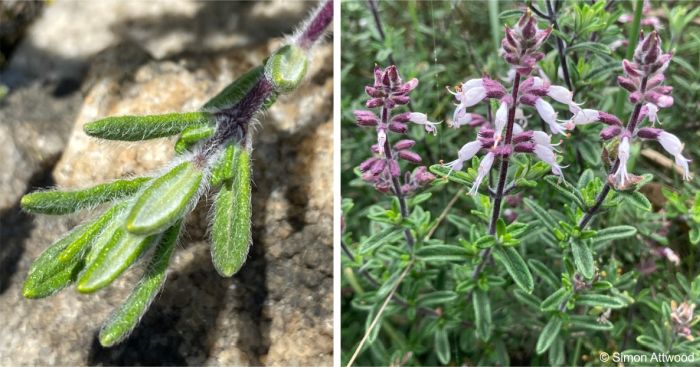
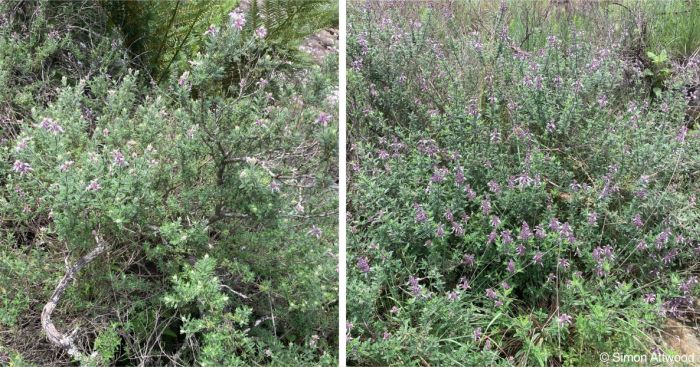
White sagebush is a woody shrublet that normally grows to a height of between 0.3 and 1.5 m. It has an erect to decumbent habit, is well-branched and may have a twisted and bent shape. The stems are woody at the base, which provides stability in windy weather. New stems are soft and vibrant purple. The leaves are sessile, slender and narrow, leathery, dark green on top, the margins are rolled under (ericoid), and they are covered in soft white hairs which reduces moisture loss and gives the leaves a greyish-green colour, that makes them ideal for hot and dry environments. One of the most appealing aspects of this plant is its flowers, which appear in spike-like flower heads, 50-100 mm long. The spikes are made up of whorls of 4-6 flowers. Each flower is 12-15 mm long, white, and they emerge from distinctive purple calyxes, 6-8 mm long. Flowers resemble miniature tubes with stamens peeking out. After the flowers drop, the purple calyxes remain on the plant and the seeds develop inside them. It flowers in spring and summer and can continue to early autumn.
Conservation Status
Status
Syncolostemon albiflorus is currently considered not threatened and is assessed as Least Concern (LC) by the Red List of South African Plants. However, habitat destruction and climate change may pose future threats and to ensure that this plant can survive in the wild, conservation efforts must prioritize habitat protection.
Distribution and habitat
Distribution description
White sagebush is native to southern Africa, located in the mountans of northeastern South Africa and northern Eswatini, between Mariepskop in Limpopo and Barberton in Mpumalamga. This resilient plant thrives in a warm climate, with rainfall in summer and a mild dry winter. It is well adapted to drought and can endure periods of low or no rainfall. White sagebush prefers well-drained soils, which are commonly found in sandy or rocky habitats. Its ability to thrive in severe environments reveals exceptional adaptation strategies.
Derivation of name and historical aspects
History
The genus name Syncolostemon is derived from the Greek syn-, which means joined, kolos, which means stunted, and stemon, which means pillar or stamen, and most likely refers to the merged anterior filaments. And the species name albiflorus is Latin, albi meaning white and florus meaning flowers, thus white flowered.
Syncolostemon albiflorus belongs to the mint family (Lamiaceae). It was was first described by N.E. Brown in 1910 as Orthosiphon albiflorus, moved into the genus Hemizygia by M. Ashby in 1935 and then into Syncolostemon in 2006 by D.F. Otieno. Recent molecular research revealed that Hemizygia and Syncolostemon belong to the same monophyletic group and Syncolostemon is now the combined name. The 2022 worldwide revision recognizes 51 species in Syncolostemon, with three divided into varieties. Forty-nine species occur on mainland Africa, one on Madagascar and one in India. A new species Syncolostemon attwoodii was decribed by Balkwill in 2025, discovered by Simon Attwood in the Limpopo Province.
Ecology
Ecology
White sagebush is a crucial component in the ecology of its habitat. Its nectar-rich flowers attract a variety of pollinators, including bees and butterflies, adding to local biodiversity. In addition, the plant acts as ground cover, preventing soil erosion in its habitat. Its leaves and branches also serve as food and shelter for a variety of species, demonstrating its crucial function in maintaining a healthy ecology. The plant reproduces by dispersing seeds that are shaken off the mother plant by the wind or carried away in the fur of passing animals.
Uses
Use
There are no recorded traditional or medicinal uses for Syncolostemon albiflorus. The plant would be an asset in landscaping due to its attractive flowers and leaves, especially in water-wise gardens that are intended to use less water while still being aesthetically pleasing. It is a great option for gardeners seeking low-maintenance plants because of its resistance to drought. Its flowers are known to draw pollinating insects, fostering a thriving ecology.
Growing Syncolostemon albiflorus
Grow
Syncolostemon albiflorus is not well-known in horticulture but it has been propagated and cultivated by Ziphezinhle Madonsela, a horticulturist at the Lowveld NBG. It requires a sunny or semi-shaded location in nutrient-rich, well-drained, compost-rich soil. It is ideal for a rockery. It can be grown alone or in groups, and it works well when planted around 60 cm apart. It is hardy to Highveld conditions with a winter minimum of -5°C, although young plants should be protected from frost. It is a long-lived herbaceous perennial that may survive for a very long time if not disturbed once it is established. Syncolostemom albiflorus should be severely pruned in the middle of winter for optimal results. This will boost flowering, revitalize the plants, and produce a rush of robust new growth in the spring. Annual composting and mulching in winter will benefit the plant greatly.
When growing this plant from cuttings, the best time to achieve the highest success rate is to harvest the cuttings when the plant is actively growing, which is usually in late spring or early summer. This is when the plant has the most energy to devote to producing new roots. Take cuttings from healthy, non-flowering stems, or wait until after it has completed its main flush of blossoms. The stem should be about 10-15 cm long. Take off the lower third of the cutting's leaves. To promote root formation, dip the cut end into rooting hormone. Place the cuttings in a potting mix designed specifically for cuttings and seedlings that drains well. Syncolostemon albiflorus grows best in soil that drains well and resembles its native sandy environment. To improve drainage, use a sandy loam or supplement your potting mix with perlite and coarse sand. Make sure the leaf-removed bottom node is submerged in the mixture. The cuttings should be kept out of direct sunlight. Use a propagation dome or cover the pot with a clear plastic bag to keep the environment moist. Maintain a steady moisture level in the potting mix without making it soggy. When new growth appears, usually in 3 weeks, it's a sign that roots have grown. Due to high ultra violet in the Lowveld, the cuttings did not do well despite the care and precautions taken . It does not thrive in humid areas. Be sure to allow good aeration.
To propagate from seeds, to get the best results, sow seeds in a shallow standard seed tray with a normal well-drained seedling mix in either spring or summer. Bury the seeds about 0.5 cm deep. Cover with a thin layer of sand (1-2 mm) and keep the medium moist but not waterlogged. Seeds should germinate in three to four weeks. As soon as the seedlings reach a suitable size, they can be transplanted into individual bags.
References
- Attwood, S. 2023. Observation of Syncolostemon albiflorus, De Berg Nature Reserve, Mpumalanga. iNaturalist. Online. https://www.inaturalist.org/observations/191746392.
- Balkwill, K. 2025. Syncolostemon attwoodii, a new species from Limpopo, South Africa. South African Journal of Botany 184:895–898.
- Codd, L.E. 1985. Lamiaceae. Flora of southern Africa 28(4). Botanical Research Institute, Department of Agriculture and Water Supply, Pretoria.
- Hyde, M.A., Wursten, B.T., Ballings, P. & Coates Palgrave, M. 2026. Syncolostemon. Flora of Mozambique. Online. https://www.mozambiqueflora.com/speciesdata/genus.php?genus_id=1237.
- Manning, J. 2019. Field guide to wild flowers of South Africa. Struik Nature, Cape Town.
- Nieuwoudt, P. 2024. Observation of Syncolostemon albiflorus, Verloren Vallei Nature Reserve, Mpumalanga. iNaturalist. Online. https://www.inaturalist.org/observations/197477001.
- Otieno, D.F., Balkwill, K. & Paton, A.J. 2022. A worldwide revision of Syncolostemon (Ocimeae: Lamiaceae). Kew Bulletin 77:583-646.
- Plants of the World Online. Syncolostemon albiflorus (N.E.Br.) D.F.Otieno. https://powo.science.kew.org/taxon/urn:lsid:ipni.org:names:77075133-1. Accessed 23 Apr 2026.
- Raimondo, D., Von Staden, L., Foden, W., Victor, J.E., Helme, N.A., Turner, R.C., Kamundi, D.A. & Manyama, P.A. (eds) 2009. Red list of South African plants. Strelitzia 25. South African National Biodiversity Institute, Pretoria.
- Van Jaarsveld, E. 2001. Syncolostemon transvaalensis (Schltr.) D.F.Otieno (Lamiaceae). PlantZAfrica. Online. https://pza.sanbi.org/syncolostemon-transvaalensis.
- WFO The World Flora Online. Syncolostemon albiflorus (N.E.Br.) D.F.Otieno. https://www.worldfloraonline.org/taxon/wfo-0000810326. Accessed 23 Apr 2026.
Credits
Adelaide Lekota
Lowveld National Botanical Garden
May 2026
Acknowledgements: Thanks to Simon Attwood and Phillip Nieuwoudt (Ecowild) for providing pictures. Appreciation to Ms Ziphezinhle Madonsela for providing information on the species and guidance.
Plant Attributes:
Plant Type: Shrub
SA Distribution: Limpopo, Mpumalanga
Soil type: Sandy, Loam
Flowering season: Spring, Early Summer, Late Summer
PH: Acid, Neutral
Flower colour: Purple, White
Aspect: Full Sun
Gardening skill: Average
Special Features:
 Attracts butterflies
 Drought resistant
 Fragrant
 Feeds honeybees
Horticultural zones


Rate this article
Article well written and informative
Rate this plant
Is this an interesting plant?
Login to add your Comment
Back to topNot registered yet? Click here to register.