


Portulaca oleracea
Introduction
Portulaca oleracea, commonly known as purslane, is a cosmopolitan succulent weed often seen growing between pavement cracks and along roads. Despite its humble appearance, this resilient plant is celebrated as a superfood as it is not only edible but packed with omega-3 and -6 fatty acids – essential nutrients more commonly associated with fish in our diets. Because P. oleracea shows a high degree of variation, many varieties, subspecies, and even microspecies have been described. As a result, it is regarded as a species aggregate or polymorphic species.
Description
Description
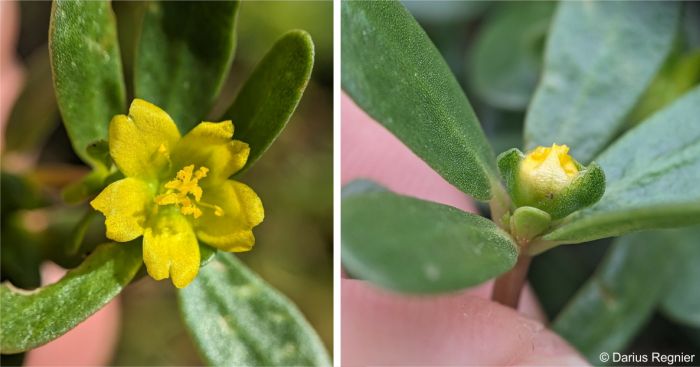
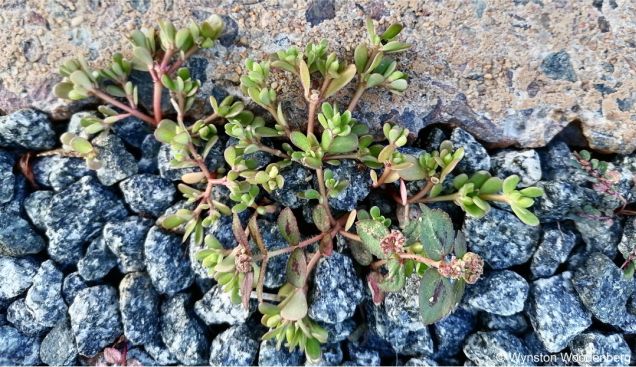
Purslane is a low-growing, fleshy herb that can be either an annual or a short-lived perennial. The plant forms a flat, mat-like shape, usually between 150 and 300 mm wide, with many branches spreading out from a single base that lies close to the ground. The stems are smooth, hairless, and typically reddish green. The leaves are small, thick, and smooth, without stalks or teeth. They are shaped like a spatula, rounded at the tips, and usually grow in opposite pairs along the stem. The leaves may reach up to 60 mm long and 25 mm wide, though they are often smaller. Inconspicuous flowers appear at the tips of branches, clustered among the leaves. Each flower is small (about 3 to 10 mm long) with up to six bright yellow petals. Flowering occurs throughout the year in warm climates. After flowering, the plant produces fruit consisting of a capsule that opens across the middle when it is mature to release many tiny black seeds, each about 0.6 to 1 mm wide.
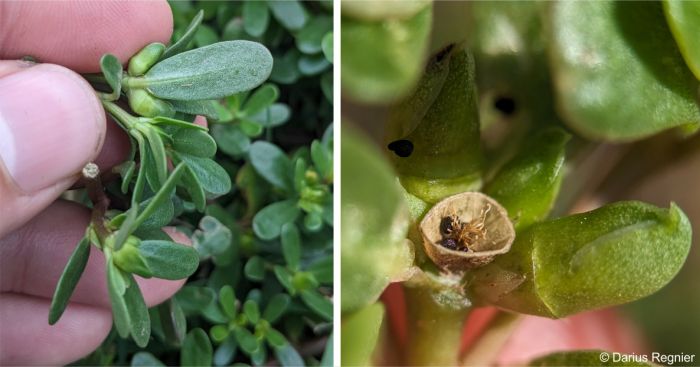
Purslane can be distinguished from other similar Portulaca species by its mat-forming growth habit, broadly spatulate leaves, and inconspicuous yellow flowers.
Conservation Status
Status
This widespread species is not assessed or evaluated by the Red List of South African Plants because it is regarded as a naturalized exotic in South Africa, but globally it is assessed as Least Concern (LC) by the IUCN Red List.
Distribution and habitat
Distribution description
Globally, purslane has a cosmopolitan distribution, occurring throughout the tropical and temperate regions of the world, including Europe, the Americas, Canada, India, Australia, and New Zealand. Its spread has been greatly assisted by human activity, water movement, and possibly birds that carry its small seeds. Historical evidence from India shows purslane pollen and seeds preserved in ancient lake sediments dating back to around 1350–1539 A.D., suggesting that it has long been associated with human settlement and may have been transported by early travelers and settlers for its edible and medicinal value. In South Africa, where purslane is regarded as an exotic naturalized species, it grows abundantly across most regions at altitudes ranging from 50 to 1850 m. It thrives in fertile soil and is commonly found in gardens, cultivated fields, and disturbed sites such as roadsides, pavements, and stream banks. The species prefers warm, sunny conditions and can tolerate drought and poor soil.
Derivation of name and historical aspects
History
Portulaca oleracea is believed to have originated in the Old World, possibly in India, North Africa, or the Mediterranean region, though its exact origin remains uncertain. It is now a cosmopolitan species, occurring in almost every warm region of the world and commonly found as a weed in gardens, cultivated fields, and disturbed ground. It was likely introduced to South Africa from Europe, where it had long been used as both a vegetable and a medicinal herb.
The genus name Portulaca is derived from the Latin words porto, meaning ‘to carry’ and lac, meaning ‘milk’, referring to the milky sap that exudes from the stems and leaves when broken. The species name oleracea comes from the Latin oleraceus, meaning ‘related to vegetables’ or ‘edible’, reflecting the plant’s long history as a food crop. The common name, purslane, is thought to come from the Old French porcelaine or pourpier, both derived from the Latin portulaca, again referring to the same plant.
Ecology
Ecology
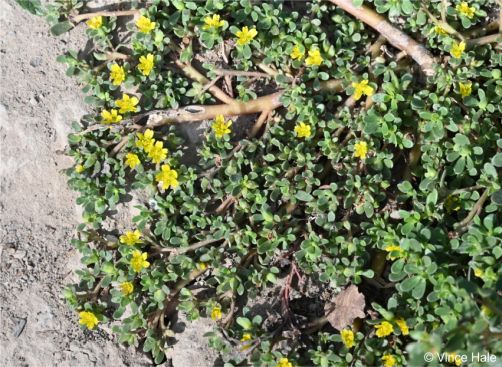
It is a highly adaptive species allowing it to tolerate a wide range of soils and occupy disturbed habitats, which is also why it is such a widespread species. It has a waxy cover that protects it from insects and pathogens. The flowers of purslane open only in full sunlight, usually during the late morning on sunny days. They are mostly self-pollinated but may also be pollinated by small bees and flies. The species exhibits rapid reproduction where flowering may occur within a month of germination, and a single plant can produce over 100 000 seeds in a season and the seeds can be viable for up to 40 years.
Uses
Use
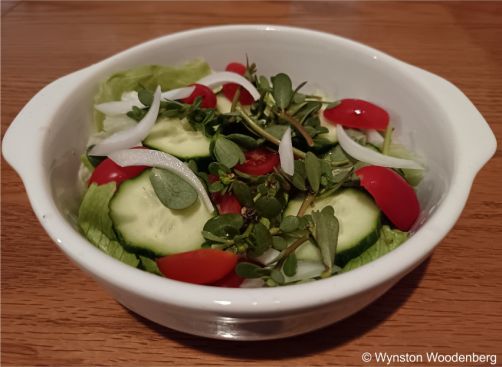
Portulaca oleracea is valued worldwide as both a food and medicinal plant. In the Mediterranean region and many tropical countries, it is eaten as a leafy vegetable, cooked like spinach or mixed into salads and soups. Its crisp texture and slightly tangy flavour make it a popular ingredient in various dishes; however, over consumption may be detrimental to health due to the high levels of oxalic acid in the plants. Traditionally, purslane has been used in herbal medicine for a wide range of ailments. The leaves and stem juice are applied to inflammation, sores, and burns, or taken to relieve fevers, headaches, ulcers, and respiratory problems. In regions such as Jamaica, Indo-China, and Nigeria, it has also been used to treat kidney and liver inflammation, intestinal parasites, and high blood pressure. Scientific studies confirm that purslane is highly nutritious, containing vitamins, minerals, antioxidants, and omega-3 and -6 fatty acids. These compounds contribute to its anti-inflammatory, antimicrobial, and antioxidant effects, and research suggests it may help protect against cell and nerve damage. In horticulture, purslane is sometimes left to grow as a groundcover or edible ornamental because it is drought-tolerant and thrives in poor soil. Its resilience and nutritional value have also made it a promising crop for sustainable food production in hot, dry regions.
Growing Portulaca oleracea
Grow
Although often regarded as a weed, purslane can be easily propagated or cultivated from seed or stem cuttings when desired. For best results, sow seed in spring when soil and air temperatures are above 20–25°C, placing them on a surface of moist soil as they require light for germination. For cuttings, P. oleracea propagates easily from 100–200 mm stem sections taken from mature plants, which root readily from their nodes in warm, moist conditions and produce vigorous new growth within a few weeks. While it may not be the most visually appealing plant, purslane’s exceptional nutritional value makes it a worthy addition to any food garden.
References
- Bromilow, C. 1995. Problem plants of South Africa. Briza, Arcadia.
- Clarke, G. 2025. Purslane (Portulaca oleracea) Australian growing guide. Aussie Green Thumb. Online. https://aussiegreenthumb.com/purslane-portulaca-oleracea/.
- Diop, F.N. & Naas, M. 2020. Portulaca oleracea L. IUCN Red List of Threatened Species. https://www.iucnredlist.org/species/164001/65924501.
- Germishuizen, G. & Meyer, N.L. (eds) 2003. Plants of southern Africa: an annotated checklist. Strelitzia 14. National Botanical Institute, Pretoria.
- Hale, V. 2024. Observation of Portulaca oleracea, Garland, Texas, USA. iNaturalist. Online. https://www.inaturalist.org/observations/236343995.
- Henderson, M. & Anderson, J.G. 1966. Common weeds in South Africa. Department of Agricultural Technical Services, Pretoria.
- iNaturalist. Common purslane (Portulaca oleracea). https://www.inaturalist.org/taxa/58991-Portulaca-oleracea. Accessed 30/06/2023.
- Masoodi, H.M., Ahmad, B., Mir, S.R., Zargar, B.A. & Tabasum, N. 2011. Portulaca oleracea L.: A review. Journal of Pharmacy Research 4: 3044–3048.
- Matthews, F.J., Donna, W.K. & Zane, S.F. 1993. The biology and taxonomy of the Portulaca oleracea L. (Portulacaceae) complex in North America. Rhodora 95: 166–183.
- Regnier, D. 2023. Observations of Portulaca oleracea, Omaha, USA. iNaturalist Online. https://www.inaturalist.org/observations/197004591 & https://www.inaturalist.org/observations/189563002.
- SANBI. 2020. Portulaca oleracea L. National Assessment: Red List of South African Plants version 2020.1. Accessed 13/06/2023.
- Smith, G.F., Van Jaarsveld, E.J., Arnold, T.H., Steffens, F.E., Dixon, D. & Retief, J.A. (eds) 1997. List of southern African succulent plants: 1–175. Umdaus, Hatfield, Pretoria.
- Thinner, F.R. 1915. Flowering plants of Africa: an analytical key to the genera. Soho Square, London.
- Van Wyk, B. & Malan, S. 1998. Field guide to the wild flowers of the Highveld. Struik, Cape Town.
- Wadley, L., Willemse, L., Baytopp, K., Swart, J., Heymans, J. Tarboton, W. & Tarboton, M. 2021. Wild Flowers of the Waterberg. Mapula Trust.
- Woodenberg, W.R. & Ramdhani, S. 2025. Revision of Portulaca L. (Portulacaceae) in southern Africa. South African Journal of Botany 187: 393–409.
- Zhou Y-X., Xin, H-L., Rahman, K., Wang S-J., Peng, C., & Zhang, H. 2015. Portulaca oleracea L.: a review of phytochemistry and pharmacological effects. BioMed Research International Article ID 925631.
Credits
K. Molehane and W.R. Woodenberg
KwaZulu-Natal Herbarium
Foundational Biodiversity Sciences Division
June 2026
Acknowledgements: the authors thank Vince Hale and Darius Regnier for making their images available via iNaturalist.
Plant Attributes:
Plant Type: Ground Cover, Succulent
SA Distribution: Eastern Cape, Free State, Gauteng, KwaZulu-Natal, Limpopo, Mpumalanga, North West, Northern Cape, Western Cape
Soil type: Sandy, Loam
Flowering season: Sporadic/All year
PH: Acid, Alkaline, Neutral
Flower colour: Yellow
Aspect: Full Sun
Gardening skill: Easy
Special Features:
 Drought resistant
 Edible plant
 Medical plant
 Feeds honeybees
 Pioneer plant
Horticultural zones





Rate this article
Article well written and informative
Rate this plant
Is this an interesting plant?
Login to add your Comment
Back to topNot registered yet? Click here to register.