


Gladiolus undulatus
Introduction
This seldom seen vleipypie adds a pleasant surprise to a garden with its tall spikes of large pale flowers with long wavy tepals during the late spring and early summer months in the Western Cape of South Africa.
Description
Description
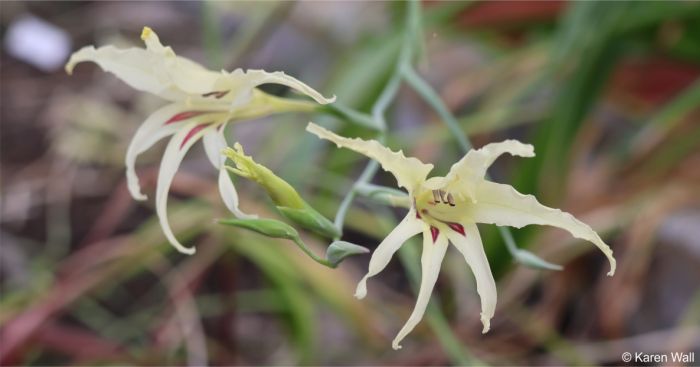
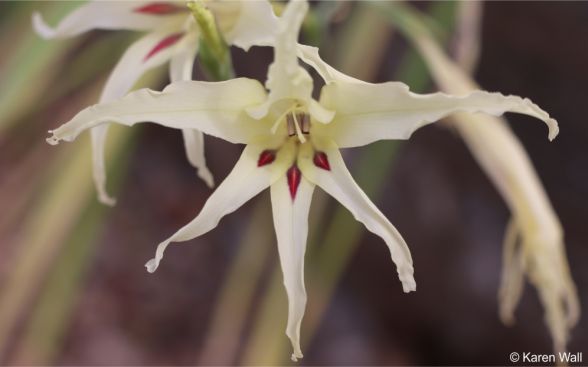
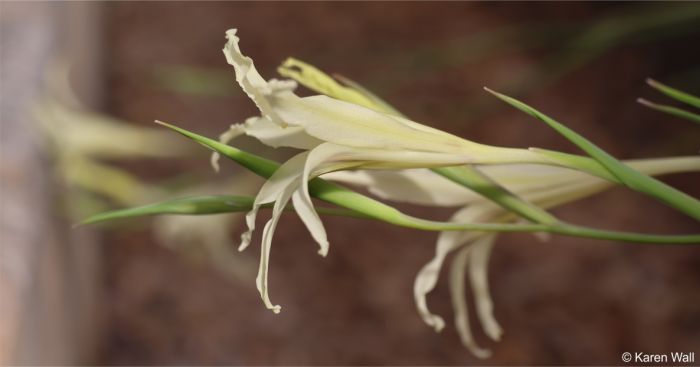
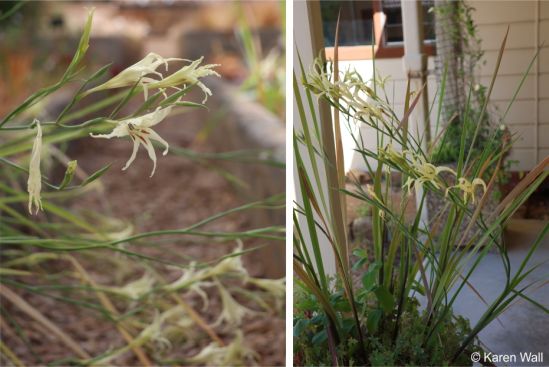
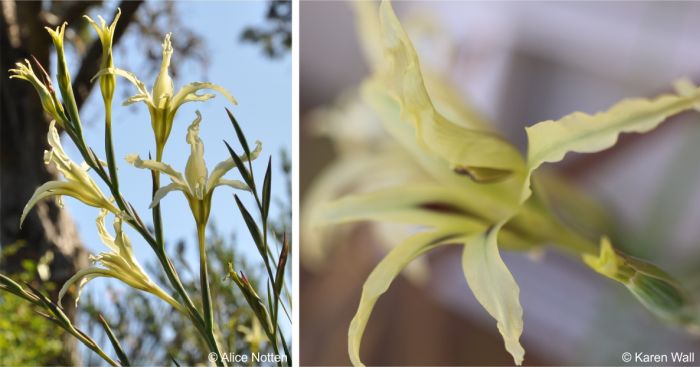
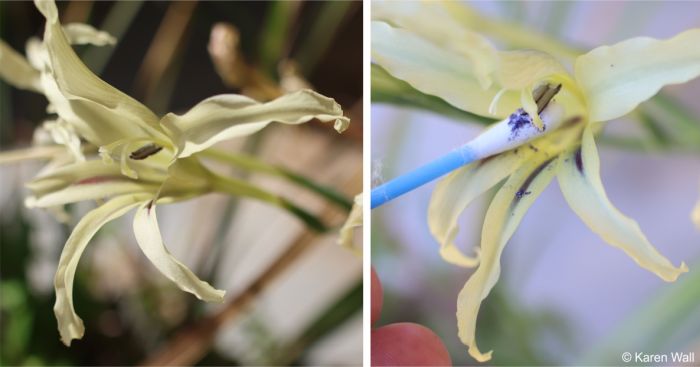
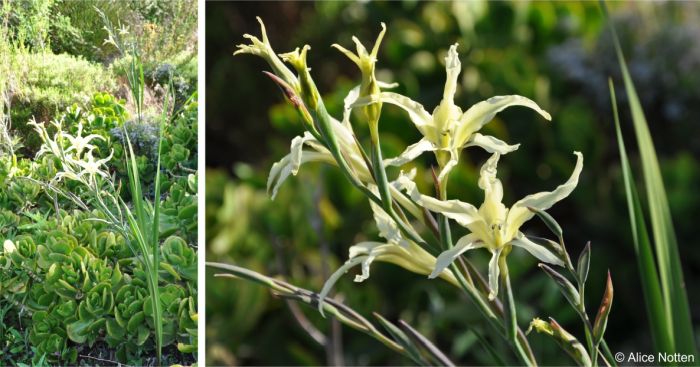
Gladiolus undulatus is a geophytic plant growing upright, reaching a height of 250 to 800 mm and occasionally up to 1.5 m. The rootstock is an ovoid corm with a diameter of up to 30 mm, that is covered by a thin brown tunic which soon becomes fibrous. Often, one can find tiny reddish-brown cormlets developing around the base of the corm. At the base of the stem, are two short basal leaves which are 5-12 mm wide and reach to the middle of the spike. The leaves (around 5) are variable in size and shape, where some are sword-shaped while others are narrow and ribbon-like. The leaves are closely veined and occasionally the veins are minutely pubescent below. The spike is sometimes branched and produces between 3-12 flowers, which are laxly arranged in two rows on opposite sides of the stem (distichous). The flowers are up to 100 mm long with a long tube and a funnel-shaped limb with lobes that are long and tapered, and margins that are wavy or curled. The flowers can be greenish white, white, cream or pink, with dark pink or red markings on the lower lobes. The anthers are 7-8 mm long, cream above and purple below, with purple pollen. The style arches over the anthers and reaches just beyond them.
Flowering takes place in late spring and summer (October-December) and after flowers have withered, the leaves turn brown and die back. New leaves develop in the following spring. Seeds produced are a light translucent brown, ovate and 8 x 5 mm in size and broadly and evenly winged.
Conservation Status
Status
Gladiolus undulatus is not threatened and is assessed as Least Concern (LC) in the Red list of South African Plants.
The vleipypie has naturalized overseas in New Zealand, tropical Asia, the Caribbean and in southern Australia. In southern Australia it has become a weed of gardens, roadsides, disturbed sites, wetlands, river banks, swamps, estuarine mudflats, coastal environs (and other moist habitats); grasslands and shrubby woodlands in the temperate regions. In areas like Victoria, South Australia and Western Australia, it was originally grown as a garden plant but is now considered a significant environmental weed as it spreads rapidly and displaces native species. It has invaded several conservation areas in South Australia and, along with other weedy species, is seen as a major threat to the survival of the only remaining wild population of the endangered Lasiopetalum pterocarpum. Gladiolus undulatus has not been declared and is not considered a noxious weed in Australia but was listed as a moderately high priority species in the Environmental Weed Strategy of Western Australia.
In the USA, the results of a weed risk assessment of G. undulatus show that the species is a high risk, as it shares many traits and impacts as other low scoring major invaders and moderate scoring minor invaders and because it invaded natural ecosystems in Australia, even though it requires specialized pollinators to set seed in its native habitat. It has been in the USA since 1930 and possibly since 1795 and is cultivated in a number of states. However, Michael Mace, a member of the Pacific Bulb Society, has stated that it is grown by several members of the bulb society and that there have been no reports of invasive tendencies.
In South Africa, this plant is not considered a weed and does not behave like a weed as it does in Australia. This could be due to the presence of natural biological controls within its natural environment or it could be that a particularly strong growing form of G. undulatus has been introduced into Australia.
Distribution and habitat
Distribution description
Gladiolus undulatus is found growing naturally in the Cape Floral Kingdom, occurring from the Cape Peninsula, Stellenbosch and the Kogelberg to the Kamiesberg and Bokkeveld Mountains near Nieuwoudtville. It grows in marshes, marshy sandstone slopes or permanent stream valleys in stony, coarse sandstone soils which are permanently moist. In the Kamiesberg, it grows in a granite substrate but the habitat is the same.
Plants growing in the Western Cape experience a Mediterranean climate, with cool wet winters and hot dry summers. Temperatures experienced can range from 0ᵒC in winter to over 40ᵒC in summer. Snow is experienced on the higher mountain peaks and some areas are prone to frost during the winter months.
Derivation of name and historical aspects
History
Gladiolus undulatus belongs to the Iris family (Iridaceae). The family takes its name from Iris, the Greek Goddess of the rainbow. It refers to the many rainbow coloured flowers within the family. This family is spread throughout the world but mostly in South Africa and America. The genus name Gladiolus is Latin and means a small sword and refers to the sword-like shape of the leaves. There are roughly 260 species of Gladiolus in Africa, Madagascar and Eurasia while 170 species occur in South Africa. The species name undulatus is Latin and means undulate or wavy and refers to the remarkably wavy edges of the tepals.
This species was described and named by Carl Linnaeus and first published in the first volume of Mantissa plantarum in 1767. Linnaeus had described it from plant specimens sent to him from Holland by the botanists J. and N.L. Burman. The original source of these plant specimens was not known by Linnaeus.
In the 1780s the botanist Nicholas Jacquin also obtained plant material of Gladiolus undulatus but thought it was a new species and named it Gladiolus cuspidatus. It is thought that specimens of Gladiolus undulatus were sent to Jacquin from the Cape by Jan Andries Auge. He was the superintendent of the Company’s Garden in Cape Town and had been on many expeditions in search of indigenous plant material. The material was sent to the botanical garden at Schönbrunn, in Vienna, Austria, which was being developed under the supervision of Jacquin at the time.
In 1790, Jacquin published a figure of a species that he mistakenly took to be what Linnaeus had named as Gladiolus undulatus but was in fact Gladiolus floribundus. He therefore misapplied Linnaeus’s name. This mistake was picked up by John Ker Gawler but Ker Gawler continued to use Gladiolus undulatus in Jacquin’s sense because it was known to botanists by that name. This usage of the name continued throughout the nineteenth century and can be seen in the old literature. During this time, the real Gladiolus undulatus was known as Gladiolus cuspidatus.
In 1792, a botanist named George Voorhelm Schneevoogt published a plate of the pink variety of Gladiolus floribundus under the name Gladiolus undulatus in the second volume of his Icones plantarum rariorum in Haarlem.
Thus the real Gladiolus undulatus was mistakenly renamed and erroneously known for years as Gladiolus cuspidatus, while the real Gladiolus floribundus was misidentified and known wrongly as Gladiolus undulatus¸ and a pink form of it also illegitimately named as Gladiolus undulatus.
Thanks to the work the botanist Gwendoline Joyce Lewis in 1972, the history of the naming was unraveled and corrected and the vleipypie once again became known as Gladiolus undulatus as named by Linnaeus.
Ecology
Ecology
The vleipypie has a perianth tube that is 50-70 mm long. Its flowers are pollinated by very long-tongued flies of the families Nemestrinidae and Tabanidae. The primary pollinator appears to be the tabanid fly, Philoliche rostrata but visits from Moegistorhynchus braunsi have been recorded at Stellenbosch. The flowers are unscented and produce a moderate amount of nectar with a low sugar concentration and close at night.
Gladiolus undulatus grows in the Cape Floral Kingdom which consists mostly of Fynbos vegetation. Fynbos is highly prone to fires but Gladiolus undulatus grows in marshy, damp areas which assist in reducing heat damage caused by fires. The plant also produces small cormlets which break off easily when the corm is dug up. These cormlets are left behind and will continue to grow.
Uses
Use
There are no known medicinal uses of Gladiolus undulatus. Horticulturally, it would make a good garden or pot plant.
Growing Gladiolus undulatus
Grow
The vleipypie is recommended as a winter-growing species for the garden. The growth cycle of Gladiolus undulatus involves the initiation of new roots and leaves in the autumn months. This is due to the lower night temperatures, shorter days, cooler soil temperatures at night and increased precipitation after the hot, dry summer months. During winter, the plant grows vegetatively and it flowers in spring to early summer. By mid-summer, seed is produced and dispersed and with the increased summer temperatures, the plant enters into dormancy.
Gladiolus undulatus is propagated by sowing seeds in the cooler autumn months or by separating corm offsets and cormlets in the summer months, while the corms are dormant. Corms need to be stored and kept dry until planting.
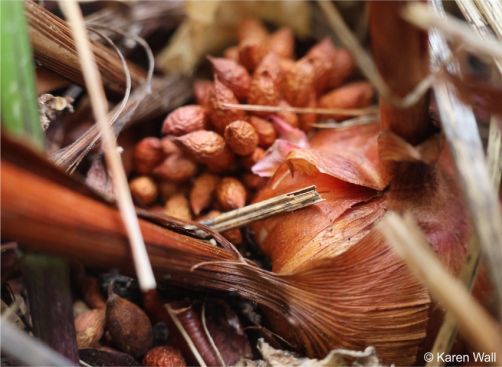
Sow the seeds in an area that receives morning sun, and where germinating seedlings can be under protection from heavy rain. Use a well-drained, sandy, slightly acidic growing medium, such as 3 parts medium-grained river sand and 1 part fine, acidic compost, or finely milled, acidic bark. Wet the surface of the medium before sowing the seed, using a watering can or soft spray. Make shallow rows in the medium at a depth of 5 mm and sow the seeds thinly in the rows, covering them up at a depth of 5 mm with the same medium after sowing. Water well after sowing and keep the medium moist by watering every second or third day. When the leaves start to turn yellow by mid-summer, stop watering and allow the seedlings to be completely dry over the dormant period.
Plant corms in the autumn months, using a slightly acid, sandy but well-drained, growing medium, with a layer of well-decomposed compost at the base of the container. Plant the corms at a depth of 20-50 mm, depending on their size. Once planted, water the corms very well. After the initial watering, wait for the leaf shoots to appear and then water well once or twice a week. Once the leaves begin to turn yellow in the summer, stop watering.
Gladiolus corms are susceptible to mealy bug infestations and fungal rot caused mainly by Botrytis and Fusarium. The developing flower buds are attacked by aphids or even thrips, causing deformed blooms. When planting into a pot or into the garden, plant the corms in a sunny area that receives good air circulation. This will aid in keeping pests at bay. Do not plant them where they will dry out on hot days or where they are exposed to harsh winds.
References
- Bean, A. & Johns, A. 2005. Stellenbosch to Hermanus. South African Wild Flower Guide 5. Botanical Society of South Africa, Cape Town.
- Brand, J.G. 2016. A short history of the Company’s Garden, Cape Town. The Heritage Portal. Online. https://www.theheritageportal.co.za/article/short-history-companys-garden-cape-town.
- Burman, l. & Bean, A. 1985. Hottentots Hollands to Hermanus. South African Wild Flower Guide 5. Botanical Society of South Africa, Cape Town.
- Clarke, H. & Charters, M. 2016. The illustrated dictionary of southern African plant names. Flora & Fauna Publications Trust, Jacana, Johannesburg.
- Douglas, B. & Kruger, M. 2023. Plants of the Baviaanskloof. Struik Nature. South Africa.
- Duncan, G.D. 2000. Grow bulbs. Kirstenbosch Gardening Series. National Botanical Institute, Cape Town.
- Duncan, G. 2010. Grow bulbs. A guide to the cultivation of bulbs of South Africa and neighboring countries. Kirstenbosch Gardening Series. South African National Biodiversity Institute, Cape Town.
- Duncan, G. 2019. Gladiolus aureus. Baker. (Iridaceae). PlantZAfrica. Online. http://pza.sanbi.org/gladiolus-aureus
- Goldblatt, P. & Manning, J. 1998. Gladiolus in southern Africa. Fernwood Press, Cape Town.
- Daydon Jackson, B. 1979. A glossary of botanic terms. Duckworth, London.
- Manning, J. & Goldblatt, P. 2012. Plants of the Greater Cape Floristic Region 1: the Core Cape Flora. Strelitzia 29. South African National Biodiversity Institute, Pretoria.
- Raimondo, D., Von Staden, L., Foden, W., Victor, J.E., Helme, N.A., Turner, R.C., Kamundi, D.A. & Manyama, P.A. (eds) 2009. Red list of South African plants. Strelitzia 25. South African National Biodiversity Institute, Pretoria.
- Saunders, R. & Saunders, R. 2021. Saunders’ field guide to gladioli of South Africa. Penguin Random House, South Africa.
- The Garden History Blog. The Company’s Garden. https://thegardenhistory.blog/2022/09/17/the-companys-gardens/. Accessed 16/02/2016.
- Trinder-Smith, T.H. 2003. The Levyns Guide to the plant genera of the south western Cape. Bolus Herbarium, UCT, Red Roof Design CC, Cape Town
- United States Department of Agriculture. Animal and Plant Health Inspection Service. May 14, 2012. Weed Risk Assessment for Gladiolus undulatus L. (Iridaceae) – Wavy gladiolus. https://www.aphis.usda.gov/media/document/85763/file.
- Weeds of Australia. Gladiolus undulatus L. https://keyserver.lucidcentral.org/weeds/data/media/Html/gladiolus_undulatus.htm. Accessed: 03/02/2026
- Wikipedia. Palmenhaus Schönbrunn. https://en.wikipedia.org/wiki/Palmenhaus_Sch%C3%B6nbrunn. Accessed 16/02/2026.
Credits
Karen Wall
Kirstenbosch National Botanical Garden
June 2026
Acknowledgements: the author thanks John Manning for providing insight and information on the naming and history of Gladiolus undulatus and Alice Notten for assistance.
Plant Attributes:
Plant Type: Bulb
SA Distribution: Northern Cape, Western Cape
Soil type: Sandy, Loam
Flowering season: Spring, Early Summer
PH: Acid
Flower colour: Red, White, Cream
Aspect: Full Sun, Morning Sun (Semi Shade), Afternoon Sun (Semi Shade)
Gardening skill: Average
Special Features:
 Good potplant
 Pioneer plant
Horticultural zones



Rate this article
Article well written and informative
Rate this plant
Is this an interesting plant?
Login to add your Comment
Back to topNot registered yet? Click here to register.