


Protea denticulata
Introduction
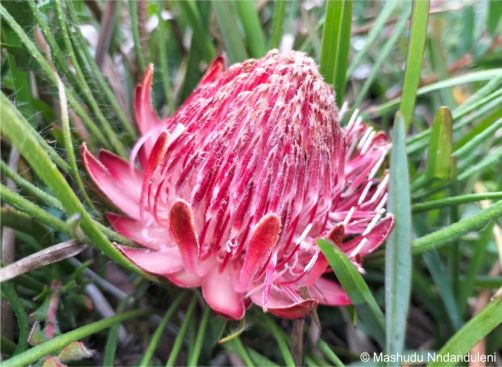
A remarkable rocky outcrop species that belongs to the dwarf-tufted sugarbush group of proteas, which is a particularly special plant for fynbos enthusiasts. The flowers are not easily visible from a distance, however, upon closer inspection, their beauty becomes apparent. The dull reddish flower heads are captivating and add to the unique charm of this species. Its understated elegance makes it a treasured plant among those who appreciate the diversity and beauty of the fynbos biome.
Description
Description
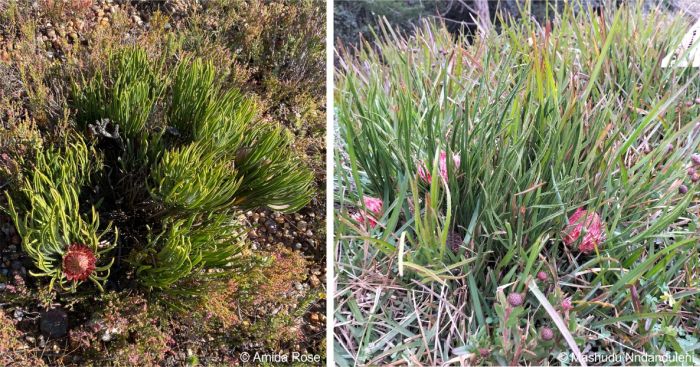
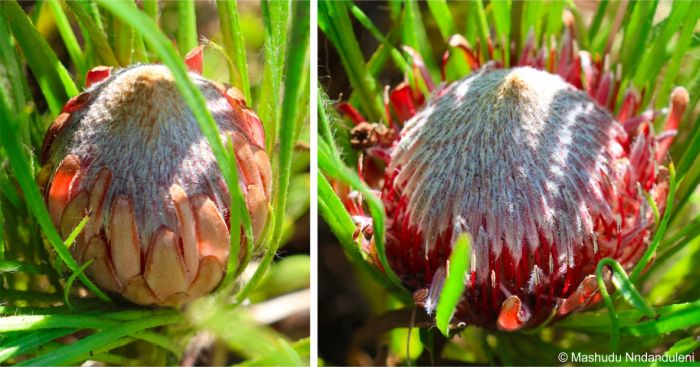
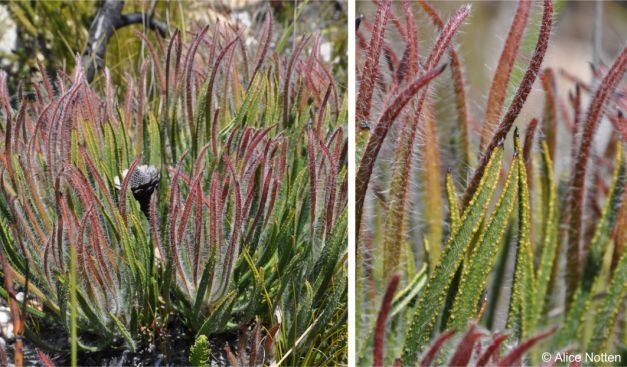
Protea denticulata is an evergreen, dense, branched shrub that grows up to 1 m tall and spreads up to 2 m wide. It produces a very short erect stem that develops from a subterranean rootstock and is covered with leaf scars. The leaves are hard, curved upwards, with pointed tips, and are slightly twisted with horny denticles (tiny tooth-like projections). The linear, canaliculate leaves are 150–250 mm long and 5–8 mm wide, hairy when young and becoming almost hairless at maturity. This species produces an ovoid inflorescence measuring 40–50 mm long and 35–40 mm in diameter. The involucral bracts are dull reddish-carmine, densely covered with velvety hairs along the margins, and have rounded tips. The outer series of bracts measures 13–15 mm long, while the inner series is 30–40 mm long. The styles are dull red, curved inward, and 25–35 mm long, merging indistinctly with the pollen presenter, which is approximately 6 mm long. Protea denticulata flowers from late winter to spring (mid-August to October).
Although Protea denticulata is often considered similar to Protea scabra, there are several distinguishing characteristics that can be observed. P. denticulata has a shrubby growth habit, with erect and robust stems reaching up to 1 m in height. Its involucral bracts are dull reddish, softly velvety on the outer surface, and possess distinctive brown margins, setting it apart from P. scabra with its underground stems, mat-forming habit and cream and brown flower heads.
Conservation Status
Status
Protea denticulata has been assessed as Vulnerable on the Red List of South African Plants. Despite its conservation status, the current population appears relatively stable, as most remaining plants occur in areas that are unsuitable for ploughing and within protected areas of De Hoop Nature Reserve.
Prior to 1990, a small portion of the population was lost when land was cleared for crop production. However, these areas have not been cultivated since then, allowing the species to persist. One of the main threats to the species is invasion by alien plants, particularly wattles. Although alien-clearing programmes have been implemented, complete eradication remains challenging because wattles produce a persistent soil seed bank that readily regenerates after fire.
Distribution and habitat
Distribution description
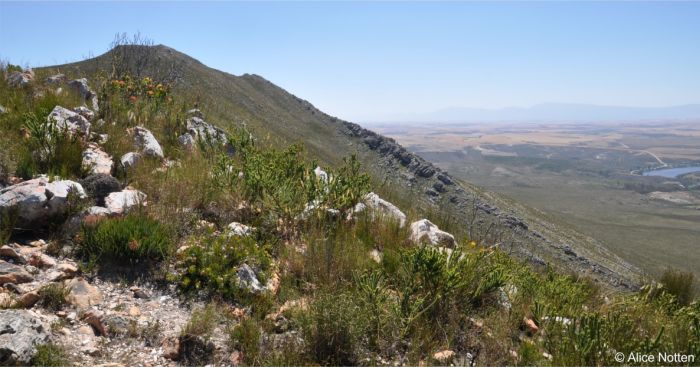
Protea denticulata is a rare endemic species restricted to the Potberg Mountains on the eastern boundary of De Hoop Nature Reserve in the Western Cape, South Africa. The species occurs in two subpopulations, including one near Infanta that consists of several hundred individuals. It grows on the lower slopes in sandstone fynbos and ferricrete fynbos habitats, from sea level up to approximately 600 m above sea level. The population occurring on the southern slopes experiences moister conditions, resulting in denser vegetation. This site also appears to burn more frequently than those on the northern slopes. As a result of the frequent fires, plants in the southern population tend to be shorter, typically reaching only 300–400 cm in height.
Derivation of name and historical aspects
History
The genus Protea was named by Carl Linnaeus, the father of modern taxonomy, after Proteus the Greek mythological god who could foresee the future and always spoke the truth. According to mythology, Proteus could change into numerous animate and inanimate forms to avoid revealing his prophecies, reflecting the remarkable diversity of forms found within the genus.
Protea denticulata was discovered by Margaret Levyns in 1947, although the species was only formally described in 1974. Its late discovery is believed to be linked to the remoteness of the Potberg area and the fact that it was not a commonly travelled route at the time.
The species epithet denticulata means ‘finely toothed’ or ‘bearing minute teeth,’ referring to the small horny denticles that cover the leaf margins. These denticles are so rough that the interlocking branches of mature plants have been likened to barbed-wire entanglements.
Ecology
Ecology
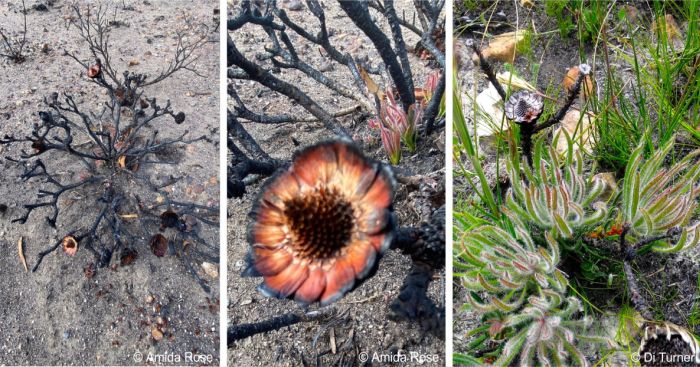
Protea denticulata is probably pollinated by birds, but the flower heads being low to the ground and somewhat hidden among the leaves may also be visited by rodents. The species regenerates through both seed production and resprouting from an underground rootstock. It is a remarkably resilient and long-lived plant that survives fire by means of its subterranean rootstock.
Seeds are stored within the persistent flower heads and are released several years after maturity or following a fire event. When a fire passes through the vegetation, the seeds remain protected within the woody fruits. A few days after the fire, the fruits begin to dry and open, releasing the seeds, which are dispersed by wind. Germination typically occurs during the winter rainy season when moisture conditions are favourable. Following fire, numerous new shoots emerge from the underground rootstock. These develop into multiple branches, resulting in the dense, shrubby growth form characteristic of the species.
Uses
Use
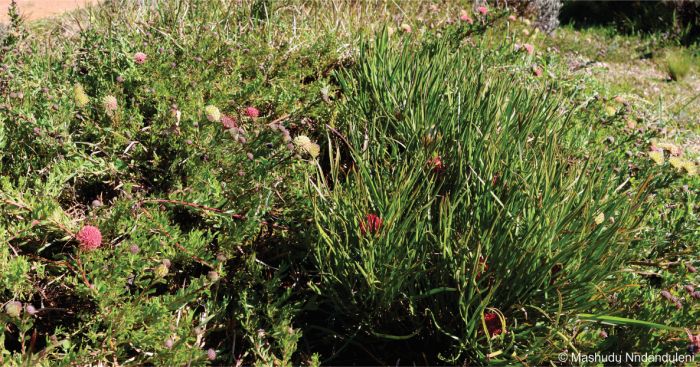
Protea denticulata is a good species for rocky gardens and hillside plantings where drainage is good. Its compact, dense growth habit makes it particularly suitable for naturalistic fynbos gardens and areas with shallow, well-drained acidic soils. For best effect, it can be planted alongside other fynbos species, especially small to medium-sized companions such as: Leucospermum heterophyllum, Lachnospermum imbricatum and Phaenocoma prolifera.
Growing Protea denticulata
Grow
Protea denticulata is readily propagated from seed. Seeds should be collected and sown in autumn (March–May) in a well-drained, acidic growing medium suitable for fynbos species. Only fertile seeds that are free from insect or worm damage should be selected and sown. Prior to sowing, seeds should be treated with a systemic fungicide to prevent fungal infections and exposed to smoke treatment to enhance germination.
Optimal germination occurs when night temperatures range between 5–10°C and daytime temperatures between 15–20°C. Seeds are generally sown in a well-aerated medium and treated with smoke derived from dry and green fynbos material. Under suitable conditions, germination usually occurs within 25 days. Because seedlings are susceptible to fungal diseases, fungicide applications should continue on a regular basis after sowing. Seedlings are ready for potting up once they have produced their first true leaves. Potting at this stage reduces transplant shock, minimizes wilting, and improves survival rates.
Both seedlings and rooted cuttings should be maintained under shade netting that reduces direct sunlight, and helps retain moisture in the growing medium. Once the plants have developed a strong root system, they can be gradually acclimatized to full sun. Young plants are usually ready for planting in the garden after two to three years. When planting in the garden, a layer of organic mulch should be applied around the base of the plant to help retain soil moisture, regulate soil temperature, and suppress weed growth. Plants typically begin flowering in their fourth year when grown from seed.
Protea denticulata has been cultivated successfully at Kirstenbosch since 1972. However, the emergence of root rot diseases caused by Phytophthora species has made it increasingly difficult to maintain healthy specimens in display gardens. During the 1980s, plants generally performed well and exhibited good survival rates in Kirstenbosch garden. In contrast, plants maintained in mother stock collections, where soil disturbance is minimal and growing conditions are more stable, continue to show vigorous growth and exceptional health.
References
- Duncan, G., Brown, N. & Nurrish, L. 2013. Grow proteas. Kirstenbosch Gardening Series. South African National Biodiversity Institute, Cape Town.
- Nndanduleni, M. 2023. Protea comptonii Beard. (Proteaceae). PlantZAfrica. Online. https://pza.sanbi.org/protea-comptonii.
- Protea Atlas Project. Protea denticulata Rourke. https://www.proteaatlas.org.za/sugar13.htm. Accessed 04/06/2026.
- Rebelo, A.G., Mtshali, H. & von Staden, L. 2019. Protea denticulata Rourke. National Assessment: Red List of South African Plants version 2024.1. Accessed on 2026/05/11.
- Rebelo, T. 1995. SASOL Proteas, a field guide to the proteas of southern Africa, Edn 2. Fernwood Press, Vlaeberg, Cape Town.
- Rose, A. 2024. Observation of Protea denticulata, De Hoop Nature Reserve, Western Cape. iNaturalist. Online. https://www.inaturalist.org/observations/240697260.
- Rose, A. 2026. Observation of Protea denticulata, De Hoop Nature Reserve, Western Cape. iNaturalist. Online. https://www.inaturalist.org/observations/336654087.
- Rourke, J.P. 1980. The proteas of southern Africa. Purnell, Cape Town.
- Turner, D. 2016. Observation of Protea denticulata, De Hoop Nature Reserve, Western Cape. iNaturalist. Online. https://www.inaturalist.org/observations/11213384.
- Vogts, M. 1989. South Africa’s Proteaceae. Know them and grow them. Struik Publishers, Cape Town.
Credits
Mashudu Nndanduleni
Thohoyandou National Botanical Garden
June 2026
Acknowledgements: the author thanks Amida Rose, Di Turner and Alice Notten for kindly providing the photographs of plants in habitat used in this publication.
Plant Attributes:
Plant Type: Shrub
SA Distribution: Western Cape
Soil type: Sandy, Loam
Flowering season: Spring, Winter
PH: Acid
Flower colour: Red
Aspect: Full Sun
Gardening skill: Average
Special Features:
 Attracts birds
 Drought resistant
Horticultural zones


Rate this article
Article well written and informative
Rate this plant
Is this an interesting plant?
Login to add your Comment
Back to topNot registered yet? Click here to register.