


Ficus burkei
Introduction
The fascinating Ficus burkei has an extraordinarily hidden life cycle. Its flowers are enclosed within the fig itself and instead of relying on wind or common pollinators like bees, it depends on a tiny, highly specialised wasp that enters the fig to pollinate the internal flowers. Its sweet fruits attract monkeys, baboons and a wide variety of birds, turning the tree into a lively hub of wildlife activity.
Description
Description
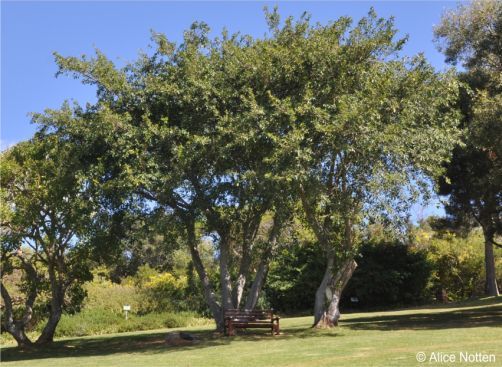
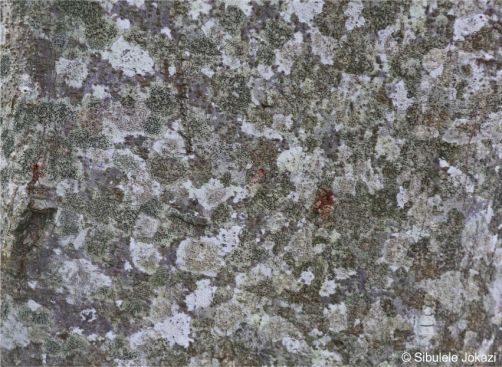
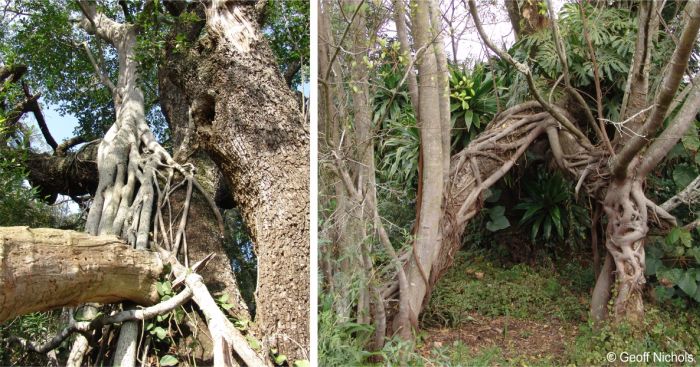
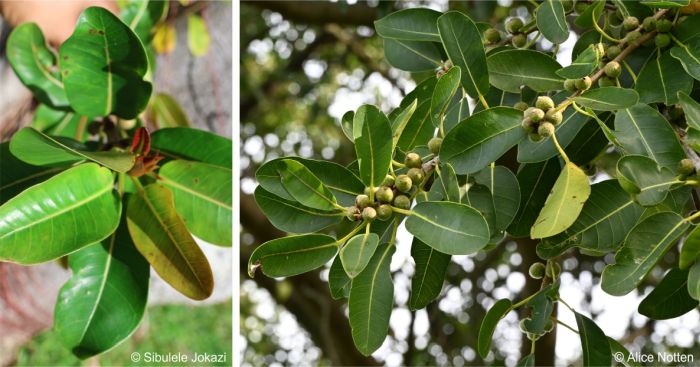
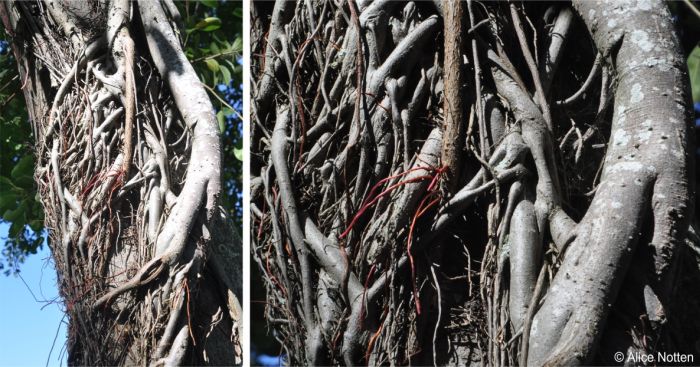
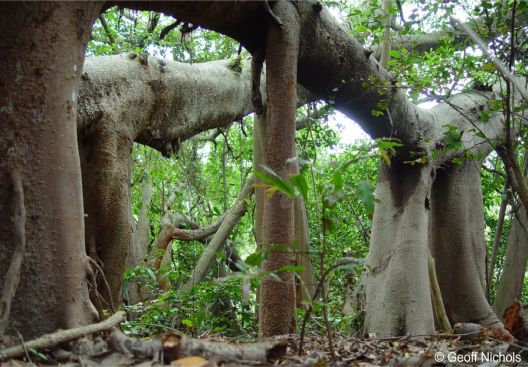
Ficus burkei is a medium sized, spreading tree, 15-18 m high, and it can be twice as wide, often with at least some to many aerial roots. Bark is light or dark grey or almost khaki.
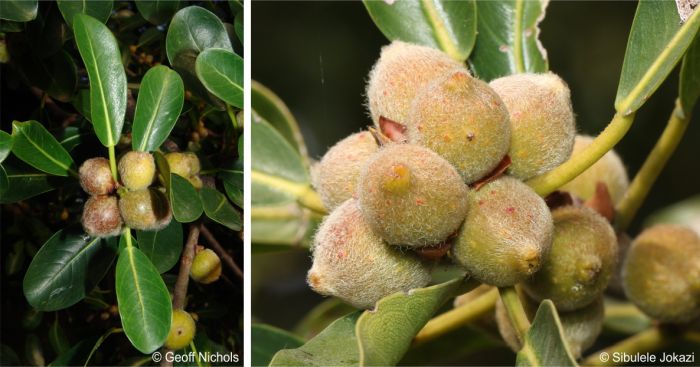
Leaves are elliptic with more or less parallel sides, 30-120 x 15-60 mm, smooth or velvety, with a single midrib going right to the apex and without a distinct pair of lateral veins at the base, the lateral veins joining up and forming a submarginal vein, net veining distinct, apex tapering to abruptly tapering, base rounded to square or narrowly lobed, margin entire, petiole 7–40 mm long, variable in length on the same twig, stipules often present. Figs without stalks, in pairs in the leaf axils, small, up to 10 mm in diameter, green with white spots, densely hairy to almost hairless, dull red when mature.
Conservation Status
Status
According to SANBI’s Red List of South African Plants, Ficus burkei is classified as Least Concern (LC), meaning the species is considered stable throughout its natural range in southern Africa.
Distribution and habitat
Distribution description
Ficus burkei is widely distributed across eastern and southern Africa, occurring from Kenya and Uganda through Tanzania, Malawi, Mozambique, Zambia, Zimbabwe, Eswatini and South Africa, where it is mainly found in the warmer northern and eastern regions. It typically grows in woodland and wooded grassland, savanna woodland, bushveld, dry and riverine forests, rocky hillsides, hill slopes, the edge of slightly damper areas and mixed woodland environments, often favouring well drained soils and nutrient rich sites such as termite mounds.
The species occurs from lowland areas up to mid-altitude regions of about 1 800 m above sea level and is well adapted to warm subtropical to warm temperate climates. It thrives in areas with seasonal rainfall, particularly regions with warm, wet summers and dry winters, rather than consistently wet conditions. Once established, it is relatively drought tolerant due to its deep and extensive root system, which allows it to access moisture from deeper soil layers.
Ficus burkei is also moderately frost tolerant. Mature trees can withstand light, occasional frost but young plants are more sensitive and may be damaged by severe cold. The species grows best in full sun to partial shade and prefers well drained sandy to rocky soils. Overall, its ecological flexibility allows it to thrive in a wide range of African woodland and savanna habitats and makes it suitable for cultivation in similar warm, seasonal climates.
Derivation of name and historical aspects
History
The genus name Ficus is derived from the Latin word for fig, referring to the characteristic fruit produced by all members of the genus. The species epithet burkei honours Joseph Burke (1812–1873), an Irish botanist and animal collector who travelled in southern Africa during the 19th century and made significant botanical collections, including the type specimen of Ficus burkei from the Magaliesberg in the Gauteng region.
Ficus burkei was first described in 1867 by Friedrich Anton Wilhelm Miquel based on African herbarium material. Over time, its taxonomic placement has been revised as botanists re-examined variation within African fig species. It has often been associated with the broader Ficus thonningii complex, first described in 1838, due to overlapping morphological characteristics.
In a major taxonomic review, Berg highlighted the high variability within this group and treated several previously named taxa, including Ficus burkei, as part of a difficult to separate species complex. Later, studies by Burrows & Burrows re-evaluated this interpretation and recognised Ficus burkei and related taxa as distinct species in southern Africa, although they noted that hybridisation and morphological overlap continue to complicate clear delimitation.
The genus Ficus includes a diverse group of trees, shrubs, stranglers and climbers with more than 24 species occurring in southern Africa. All species belong to the family Moraceae, which contains around 40 genera and over 1 000 species worldwide. Members of this family are characterised by the production of latex and specialised fruit structures, including the unique enclosed flower struture.
Ecology
Ecology
Ficus burkei plays a vital role in its ecosystems through multiple ecological interactions. Like all figs, it has a specialised mutualistic relationship with fig wasps, of the Family Agaonidae, which are the sole pollinators of its figs. Female wasps enter the enclosed fig to lay eggs, pollinating the flowers inside in the process, while their offspring develop within the fig. This ensures successful reproduction for both plant and insect. The figs are also a critical food source for birds, monkeys, bats and small mammals, which eat the ripe fruit and disperse the seeds through their droppings. This contributes to the species’ wide distribution and allows it to colonise open or disturbed areas.
Ficus burkei shows several adaptations to its climate and habitat. It can grow as a strangler, starting on other trees to reach light in shaded areas or directly from the ground in open spaces. Its leathery, tough leaves reduce water loss during dry periods, while its deep roots and aerial roots help it access soil moisture and stabilise rocky soils. The tree tolerates occasional frost and seasonal dry spells, making it resilient in sub-tropical to warm-temperate climates. Its rapid growth and prolific fruiting allow it to recover quickly after disturbances such as fire and it can provide shelter and microhabitats for other plants, insects and small animals under its canopy. In addition to its mutualistic pollination system and seed dispersal relationships, Ficus burkei often hosts insects, birds and small mammals that use it for nesting, feeding or refuge, making it a keystone species in southern African woodlands and bushveld. Its presence supports biodiversity and contributes to ecosystem stability, illustrating why figs are sometimes called keystone species of the tropics and subtropics.
Uses
Use
Ficus burkei has several traditional and practical uses that highlight its importance to people. In traditional medicine, various parts of the tree such as the bark, leaves and latex have been used to treat ailments including skin conditions, digestive issues and inflammation, although scientific validation of these uses is limited. The figs themselves are edible and provide a source of food for local communities and wildlife alike.
Beyond medicinal and food uses, the wood of Ficus burkei is occasionally used in craftwork and for making tools, although it is not highly valued commercially for timber due to its moderate size and softness. In some cultural contexts, figs hold symbolic or spiritual significance and Ficus burkei, like other fig species, may be involved in traditional ceremonies or regarded as sacred.
In horticulture, Ficus burkei is appreciated for its aesthetic appeal, dense foliage and ecological benefits. It is grown in gardens and landscapes for shade, as a street tree or as a specimen tree in parks and botanical gardens. Its ability to tolerate dry periods, occasional frost and varied soils makes it suitable for cultivation in urban and suburban environments. While not widely exported as a cut flower, its figs and foliage contribute to ornamental value and it may occasionally be sold in nurseries as a decorative tree. Additionally, its role as a keystone species, supporting wildlife in gardens, makes it a valuable choice for ecological landscaping and conservation-oriented planting.
Growing Ficus burkei
Grow
Ficus burkei can be propagated from seed or semi hardwood cuttings, though seeds are generally more reliable for large scale planting. Collect ripe figs in late summer to autumn and extract the seeds by gently mashing the fruit and rinsing away the pulp. Sow seeds immediately, as viability drops quickly. Use a well-drained propagation medium, such as equal parts river sand, compost and peat or coir. Seeds should be sown on the surface and lightly covered to keep the medium moist but not waterlogged. Germination typically occurs in 2 to 4 weeks in warm conditions, ideally 20 to 25°C and seedlings should be pricked out when they develop two to three true leaves.
Semi-hardwood cuttings can be taken in spring, 15 to 20 cm long, treated with a rooting hormone and planted in a sandy-loam medium under mist or high humidity conditions. Cuttings may root in 6–10 weeks. After seedlings or cuttings are established, harden them off for 2–3 weeks before planting in the garden.
Ficus burkei grows best in full sun to light shade, with a preference for well-drained, fertile loam soils, though it tolerates sandy or rocky soils. Moderate watering is required, especially during establishment, with less frequent irrigation once the tree is mature. A dry period in winter helps maintain compact growth and fruit production. Apply balanced organic compost or slow release fertiliser in spring, avoiding excessive nitrogen, which can reduce fig production. Mulch around the base to conserve moisture and suppress weeds. The species is tolerant of occasional frost and harsh conditions and it grows fast, potentially reaching 6–12 m in height in favorable conditions. Prune lightly after fruiting to maintain shape, remove dead branches and encourage a dense canopy. Avoid planting near foundations or paved areas, as aerial and lateral roots can be aggressive and figs can stain paving with fallen fruit.
Ficus burkei makes an excellent feature or focal point tree, especially in naturalistic or wildlife friendly gardens. Its dense canopy provides shade, making it suitable near seating areas or as a street or avenue tree. In botanical gardens, it can be planted near paths to highlight wildlife interactions with its figs, and its tolerance of dry periods makes it suitable for water wise gardening.
Ficus burkei is a strong, easy to grow tree that usually does not have many pest problems but young seedlings can occasionally be affected by fungal damping off, which can be prevented by using well drained soil and fungicide treatments if necessary. Aphids or scale insects may occasionally colonise young shoots which can be controlled by using general horticultural oil or insecticidal soap.
References
- Berg, C.C. & Wiebes, J.T. 1992. African fig trees and fig wasps. Koninklijke Nederlandse Akademie van Wetenschappen, Amsterdam.
- Berg, C.C. 1990. Annotated check-list of the Ficus species of the African floristic region, with special reference and a key to the taxa of southern Africa. Kirkia 13:253–291.
- Burrows, J. & Burrows, S. 2003. Figs of southern and south-central Africa. Umdaus Press, Hatfield.
- Burrows, J.E. & Victor, J.E. 2005. Ficus burkei (Miq.) Miq. National Assessment: Red List of South African Plants version 2024.1. Online. https://redlist.sanbi.org/species.php?species=1906-6.
- Coates Palgrave, K. 2015. Palgrave’s Trees of southern Africa. Struik, Cape Town.
- Van Wyk, B. & Van Wyk, P. 2013. Field guide to trees of southern Africa. Struik Publishers, Cape Town, Johannesburg.
Credits
Sibulele Jokazi
Kirstenbosch National Botanical Garden
June 2026
Acknowledgements: the author thanks Alice Notten and Geoff Nichols for images.
Plant Attributes:
Plant Type: Tree
SA Distribution: Eastern Cape, Gauteng, KwaZulu-Natal, Limpopo, Mpumalanga, North West
Soil type: Sandy, Loam
Flowering season: Late Summer
PH: Acid, Neutral
Flower colour:
Aspect: Full Sun, Morning Sun (Semi Shade), Afternoon Sun (Semi Shade)
Gardening skill: Easy
Special Features:
 Attracts birds
 Feature plant
 Edible plant
 Medical plant
 Useful plant
Horticultural zones




Rate this article
Article well written and informative
Rate this plant
Is this an interesting plant?
Login to add your Comment
Back to topNot registered yet? Click here to register.