


Peperomia leptostachya
Introduction
Peperomia leptostachya is a low growing fleshy plant that stores water in its leaves and stems and is characterized by slender stems almost hidden under the flat clusters of leaves. It belongs to the Piperaceae, also known as the Pepper family, a large family of flowering plants. This species was previously included in Peperomia blanda but this taxon has been split into a neotropical (American) species (P. blanda) and a paleotropical (African and Asian) species (P. leptostachya).
Description
Description
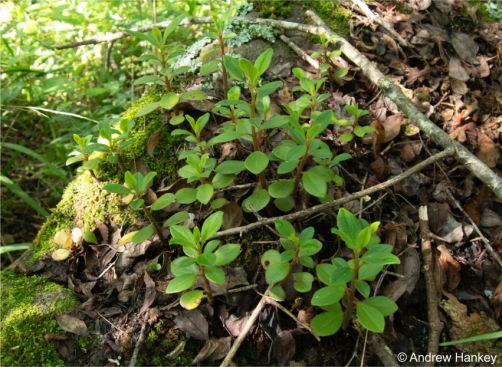
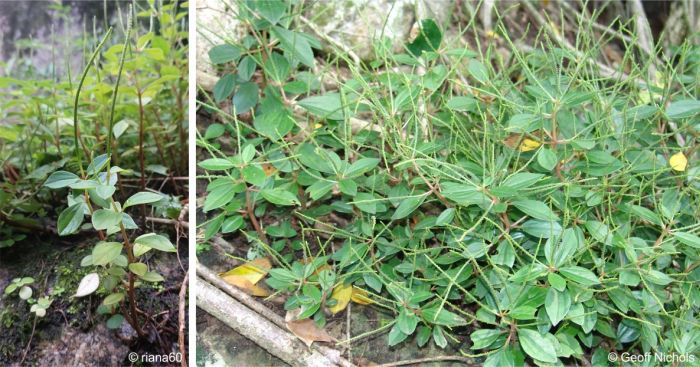
Peperomia leptostachya is an evergreen, herbaceous perennial which spreads from the base to form a small, compact shrublet between 300 and 600 mm tall. It has opposite leaves, sometimes 3 or 4 in a whorl, sometimes isolated, oval or obtuse. It often grows an epiphytic plant, growing on trees and rocks with weak stems that are green or pink. Both its leaves and the stems are succulent and somewhat hairy. The flowers are tiny, greenish yellow, on long, thin, yellowish spikes and are present from midsummer to autumn (January to March).
Conservation Status
Status
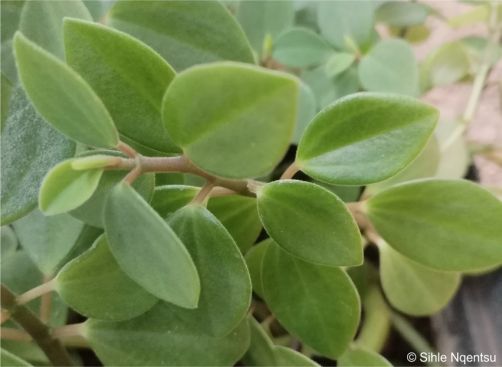
According to the Red List of South African Plants, Peperomia leptostachya is considered not threatened and is assessed as Least Concern (LC).
Distribution and habitat
Distribution description
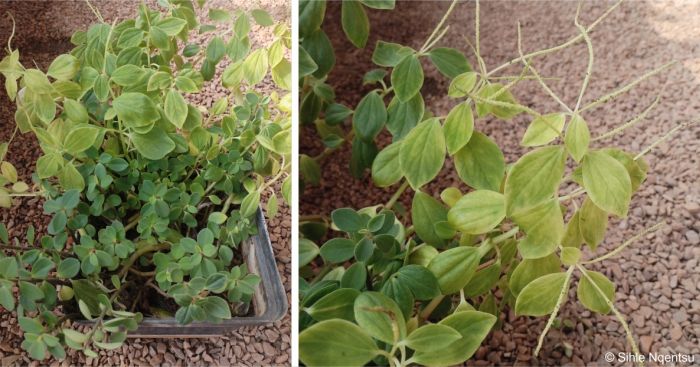
Peperomia leptostachya can be found along riverbanks growing on trees or rocks, in rock cracks, in moist or wet forest, along the coast from KuGompo City (previously East London) in the Eastern Cape, KwaZulu-Natal, Mpumalanga and Limpopo, and throughout tropical and subtropical regions of Africa, and Madagascar, Yemen, India and tropical Asia. In its natural habitat in South Africa it is found enduring a certain amount of drought, growing between stones or on rocky ledges, mostly in shade.
Derivation of name and historical aspects
History
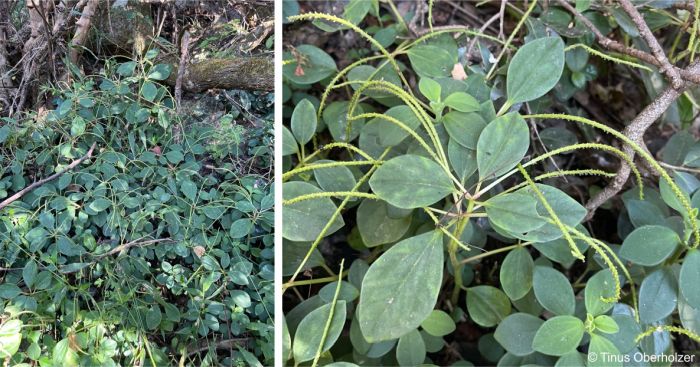
The species Peperomia blanda has for many years regarded as a very widespread and variable species. Many similar looking species in the Americas, Africa and Asia were sunk within it. However, recent studies that took a closer look at the original type material have showed it to be distinctly different from the African and Asian plants. They proposed a narrower concept of Peperomia blanda, now regarded as indigenous only in northern Venezuela, and they have reinstated several species that previously were synonymous with P. blanda. In South Africa, this means that the plant we knew as Peperomia blanda is now Peperomia leptostachya.
The genus name Peperomia is derived from the Greek word peperi meaning pepper and homoios meaning alike, referring to the similarity of some species to certain Piper species. The species name leptostachya means with slender spikes, referring to the inflorescence. The former species name blanda means pleasant or agreeable.
The genus Peperomia occurs throughout the tropical and subtropical regions of both the eastern and western hemispheres with over 1 000 species mostly native to South America, and a few in Africa and Asia. It belongs in the Piperaceae, also known as the pepper family, a large family of flowering plants which contains around 3 600 species in 5 genera of which most of those species can be found within the two main genera, Piper and Peperomia. Species in Piperaceae may be small trees, shrubs, or herbs and the distribution of this group is best described as pantropical.
Ecology
Ecology
Peperomia leptostachya inhabits shady places, often growing in moss on rocks, in shallow soil or in the cracks between rocks. Its succulent stems and leaves store water and allow it to survive dry periods.
The pollination biology of this species has not been studied, however a study of eight Brazilian species showed that some peperomias are wind-pollinated, others are pollinated by hoverflies and some are self-pollinated.
Uses
Use
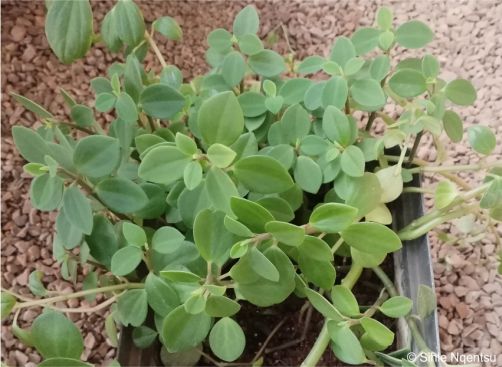
Although the flowers of this species are not very noticeable, it is attractive in growth habit, leaf colour and shape. It is a popular container plant and house plant and is well-suited to shady rock gardens.
Growing Peperomia leptostachya
Grow
Peperomia leptostachya is an easy to grow and care for plant which does well in light shade, dappled shade, semi-shade and shade with moderate watering needed. It grows best in a well-draining potting soil that is rich in organic matter but it must be kept moist.
The species can be successfully grown from seeds which should not be stored for a period of more than 3 months as they will lose their viability.
The species can also be propagated through stem cuttings which should be 8–10 cm long. Remove the lower leaves, flower spikes and trim the upper leaves in half when making cuttings. Use a low-concentration rooting hormone as the cuttings root very easily on their own, making use of a rooting hormone optional, though it enhances propagation success and uniformity.
For your cuttings, use a mix of 1 part perlite to 1 part peat moss and position them in a cool, shady location and keep them moist. Peat moss helps in retaining the needed moisture and nutrients the cuttings need to survive, while perlite promotes aeration to prevent root rot, ensuring optimal growth.
Peperomia leptostachya can be grown in the garden in warm, moderately well-watered climates, and it makes a green and unusual ground-cover in any shady area. Soil must be well-drained to avoid root rot. Add some compost to the soil when planting and water well enough until the plant has become fully established. To encourage bushing, cut off the growing points in winter or early spring and after flowering, cut the flowering stems down to the base so fresh stems may grow.
References
- De Figueiredo, R.A. & Sazima, M. 2007. Phenology and pollination biology of eight Peperomia species (Piperaceae) in semideciduous forests in southeastern Brazil. Plant Biology (Stuttg). 9(1):136-141.
- Fawcett, W. & Rendle, A.B. 1914. Piperaceae. Flora of Jamaica Vol. 3. https://www.biodiversitylibrary.org/item/61188.
- Forster, P.I. 1993. A taxonomic revision of the genus Peperomia Ruiz & Pav. (Piperaceae) in mainland Australia. Austrobaileya A Journal of Plant Systematics 4(1):93-104.
- Hankey, A. 2023. Observation of Peperomia leptostachya, Thaba Chweu, MP. iNaturalist. Online. MP https://www.inaturalist.org/observations/193792092.
- Immelman, K.L. 2000. FSA contributions 15: Piperaceae. Bothalia 30(1):25-30. https://www.biodiversitylibrary.org/item/348328.
- iNaturalist. Pepper Plant Family (Piperaceae). https://www.inaturalist.org/taxa/71604-Piperaceae. Accessed on 2026/06/10.
- Kumbula Indigenous Garden. Peperomia blanda. https://kumbulanursery.co.za/plants/peperomia-blanda. Accessed on 2026/06/10.
- Mathieu, G. 2020. Peperomia leptostachya (Piperaceae) revived. Candollea 75:45-49.
- Oberholzer, T. 2022. Observation of Peperomia leptostachya, Kokodilspoort Nature Reserve, MP. iNaturalist. Online. https://www.inaturalist.org/observations/121440805.
- Plants of the World Online. Peperomia leptostachya Hook. & Arn. https://powo.science.kew.org/taxon/urn:lsid:ipni.org:names:678970-1. Accessed 22/06/2026.
- Pooley, E. 1998. A field guide to wild flowers of Kwazulu-Natal and the eastern region. Natal Flora Publications Trust, Durban.
- Raimondo, D., Von Staden, L., Foden, W., Victor, J.E., Helme, N.A., Turner, R.C., Kamundi, D.A. & Manyama, P.A. (eds) 2009. Red list of South African plants. Strelitzia 25. South African National Biodiversity Institute, Pretoria.
- riana60. 2024. Observation of Peperomia leptostachya, Manzini, Eswatini. iNaturalist. Online. https://www.inaturalist.org/observations/199030347.
Credits
Sihle Nqentsu
Pretoria National Botanical Garden
July 2026
Acknowledgements: Taxonomic information by Alice Notten. Additional images by Andrew Hankey, Geoff Nichols, riana60 and Tinus Oberholzer.
Plant Attributes:
Plant Type: Bi/Annual, Epiphyte, Ground Cover, Perennial
SA Distribution: Eastern Cape, KwaZulu-Natal, Limpopo, Mpumalanga
Soil type: Sandy, Loam
Flowering season: Late Summer
PH: Acid, Neutral
Flower colour: Green, Yellow
Aspect: Shade, Morning Sun (Semi Shade), Afternoon Sun (Semi Shade)
Gardening skill: Easy
Special Features:
 Good potplant
 Indoor plant
Horticultural zones


Rate this article
Article well written and informative
Rate this plant
Is this an interesting plant?
Login to add your Comment
Back to topNot registered yet? Click here to register.