


Drimiopsis attwoodii
Introduction
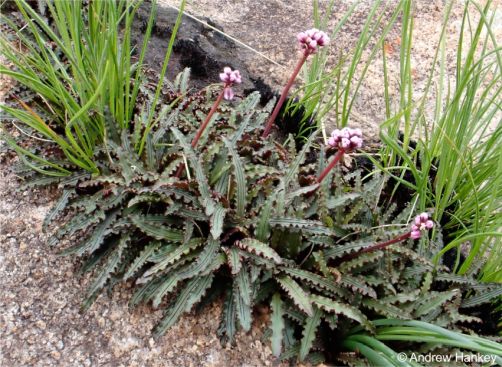
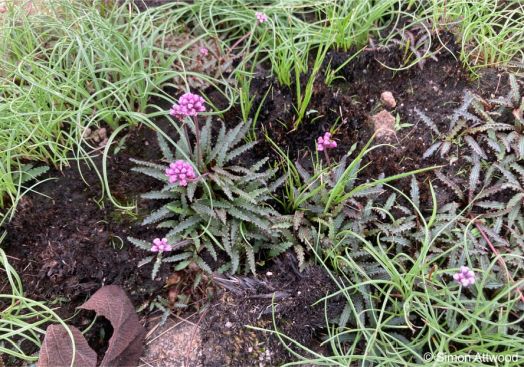
An attractive miniature bulbous plant with ornamental dark green leaves which are striped with red ridges, forming dense mats on rock sheets. This species was misidentified for many years as Drimiopsis burkei until it was recently recognized as a separate species.
Description
Description
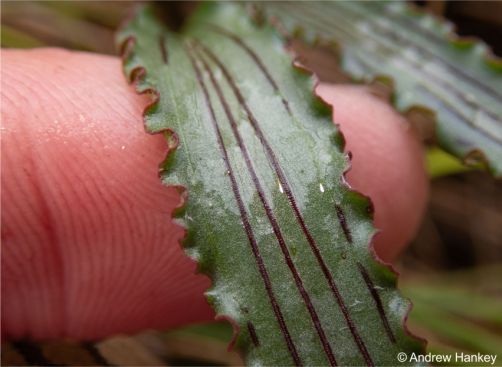
Miniature bulbous plant growing in dense colonies of several hundred individuals forming dense mats in rock sheet habitat, often in seasonal seepage. Despite the miniature leaves the species has relatively large bulbs, this presumably allows the species to survive extended drought and dry winters in their natural habitat. Leaves approximately 2–9, small, reddish-green, narrowly lanceolate, about 25 mm wide and usually about 35 mm long, marked with longitudinal, raised, red ridges and with deeply crenulate red margins; the undersides of the leaves are deep burgundy in colour. Many Drimiopsis species produce a short stalk-like leaf base which is referred to as a pseudopetiole, in this species the pseudopetiole is usually less than a third the total length of the leaf.
The small, bright pink flowers are produced in late winter and early spring (July to August), held well above the leaves by a bright pink flower stalk. Tiny dark brown to almost blackish seeds are produced soon after flowering and fall around the base of the adult plants.
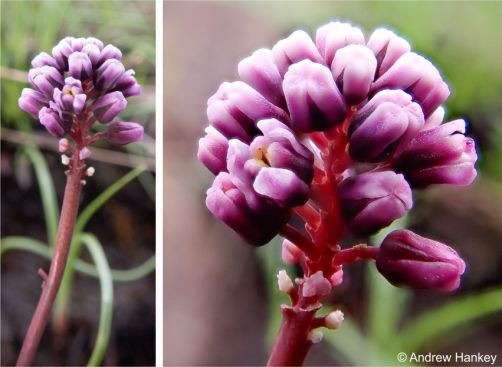
This species is most easily confused with Drimiopsis davidsoniae from which it can easily be distinguished by the fewer raised longitudinal stripes on the leaves, shorter pseudopetiole and bright pink flowers. Whereas in D. davisoniae the longitudinal stripes are more numerous and not raised, that species also produces a much longer pseudopetiole, usually longer than the actual leaf (lamina) portion and has pale pink to whitish flowers.
Conservation Status
Status
This species was only named in 2025 and as such has not yet been officially assessed for the IUCN or South African Red List. However, the authors of the species proposed a threat status of Critically Endangered (CR) based on the fact that the species occurs on only two rocky outcrops and is surrounded by plantations, making the species vulnerable to habitat loss.
Distribution and habitat
Distribution description
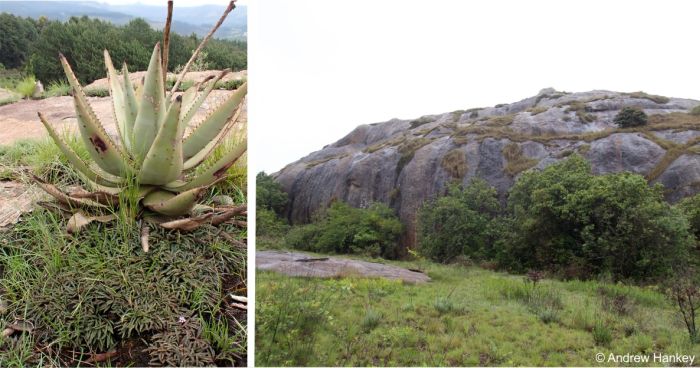
This species occurs in the Mpumalanga province near the town of White River where it is restricted to two granite outcrops. Although the species is very abundant on these two outcrops, it is susceptible to being shaded by invasive species and at risk of habitat loss due to impacts the surrounding plantations. The climate of the area is seasonally dry subtropical bushveld (savannah). It receives rain mostly during the summer months and can experience significant drying out during the winter months.
Derivation of name and historical aspects
History
The name Drimiopsis was first applied to a species of the related genus Ledebouria, which was described to look like a Drimia, hence the Latin name Drimi– and –opsis meaning ‘looking like a Drimia’. The specific name of this species honours the person who independently discovered the plant in 2021, Simon Seretse Attwood (1997– ), while conducting surveys in the area, and subsequently mapped the entire population of the species.
The genus Drimiopsis was combined under a broader concept of Ledebouria in 2004 however, many authors disagreed and a 2022 study shows that Drimiopsis may belong in a clade distinct from Ledebouria. Pending further clarifying studies, Hankey and De Castro recognize it as a separate genus. Drimiopsis is a complex group of bulbous plants currently comprised of 22 species occurring across sub-Saharan Africa of which 15 occur in southern Africa viz. Botswana (1 sp.), Zimbabwe (1 sp.), Mozambique (2 spp.), eSwatini (4 spp.) and South Africa (15 spp.); of which the northern and eastern provinces represent the centre of diversity for the genus (Mpumalanga (8 spp), Limpopo (4 spp.), Northwest (1 sp.), Gauteng (1 sp), Free state (1 sp.), Kwa Zulu-Natal (4 spp), Eastern Cape (1 sp.)). The taxonomy of the genus is not yet fully understood, and current research is underway to try to gain a deeper understanding of the genus.
Ecology
Ecology
The species is highly adapted to the specific granite rock sheet habitat in which it grows where it often forms dense mats of hundreds of individuals usually wherever rain water accumulates or seepage flows during the summer rainy season. Drimiopsis has uniquely connate (closed) flowers which unlike normal flowers only open slightly, this forces the pollinators to push their faces into the flower to access the nectar. The pollinators are attracted to the strongly scented flowers, and are usually solitary bees, flies, honey bees and wasps.
The seeds are dispersed by falling around the base of the adult plants and maybe be dispersed by water wash during heavy rain events in early summer.
Bulbs are heavily disturbed in their natural habitat by Cape bush pig (Potamochoerus larvatus) who flip over the dense root mats to gain access and eat the nutlet-like rhizomes of a common sedge which is abundant and shares the same habitat. Since the Drimiopsis are bulbous they simply resprout after such disturbances.
Uses
Use
There is no recorded uses of this species in the literature, although the related genus Ledebouria has been recoded as being used by indigenous southern African people for various medicinal purposes. The species is uncommon in horticulture; due to its diminutive size it would likely only appeal to the specialist collector of unusual bulbous plants.
Growing Drimiopsis attwoodii
Grow
This species can be propagated by seed or division of adult bulb clusters. Seed should be sown fresh in a finely sifted, sterile, peat-rich seedling medium with some fine sand added to facilitate drainage. The seed can be very lightly sown on the pressed firm mixture and very lightly covered with the same mixture or a light sand layer. The seed trays can be watered with a systemic fungicide and placed in a brightly lit position (out of direct sunlight) and kept moist until germination begins. Seed germinates rapidly under ideal conditions which may be from two to four weeks. Seedlings can be pricked out as soon as they are large enough to handle or may be left in their natal container for the first season. After which they can be planted into small pots or shallow trays of an open peaty potting mixture with some compost added. Plants can also be propagated by division by dividing the clumps of adult bulbs and planting them separately using the potting mixture mentioned above.
Plants make an interesting and attractive miniature novelty, however they are usually only grown by specialist bulb collectors. They could be used in terrariums, or planted around the base of bonsai due to their miniature stature.
Adult plants prefer full sun to bring out the best colours in the leaves, however they will grow well under light shade (±40%). They should ideally be planted into shallow containers using a peat rich soilless potting medium with some sharp sand and compost added. Plants can be watered generously in the summer months, the pots or trays can even stand in shallow trays of water for periods providing they have high quality water available. In autumn watering should be gradually reduced until a low moisture level is achieved for the duration of the dormant winter period. Plants respond quickly to the onset of watering in late winter to early spring, which is also when they flower. Plants don’t usually require much fertilizer, the addition of compost to the potting mix is usually sufficient, providing they are repotted every couple of years.
Pests and disease commonly found in cultivation include slugs, snails, red-spider mite and mealy bug, these maladies should be treated with available off the shelf products as per manufacturers recommendations.
References
- Attwood, S. 2022. Observation of Drimiopsis attwoodii. iNaturalist. Online. https://www.inaturalist.org/observations/141458288.
- Hankey, A.J. & De Castro, A. 2025. New species and new combinations in the genus Drimiopsis Lindl. and Paxton (Asparagaceae, Scilloideae) from Mpumalanga and Limpopo, South Africa. Haseltonia 32:1–22.
- Hankey, A.J. 2019. Proposed English common names for African hyacinths (genus Ledebouria). Plantlife SA Vol 47:7. https://plantlifesouthafrica.blogspot.com/
- Plants of the World Online. Drimiopsis Lindl. & Paxton. https://powo.science.kew.org/taxon/urn:lsid:ipni.org:names:24213-1. Accessed 02 June 2026.
- Simon Seretse Attwood. https://www.simonattwood.com/ Accessed 02 June 2026.
Credits
Andrew Hankey
Walter Sisulu National Botanical Garden
July 2026
Acknowledgements: Simon Attwood is thanked for the use of one photograph, all other photos by the author.
Plant Attributes:
Plant Type: Bulb
SA Distribution: Mpumalanga
Soil type: Sandy
Flowering season: Spring, Winter
PH: Acid
Flower colour: Pink
Aspect: Full Sun
Gardening skill: Average
Special Features:
 Fragrant
 Good potplant
Horticultural zones




Rate this article
Article well written and informative
Rate this plant
Is this an interesting plant?
Login to add your Comment
Back to topNot registered yet? Click here to register.